

 Bestill trykk Kjøp digitalt bilde
 Send
Send
 Del med andre
 Details
 Legg til i favoritter

 Last ned bildet
 Liknende objekter
 X-Ray
X-Ray
 Lysbildefremvisning
Peru 73


Håndlaget oljereproduksjon
Håndmalt olje på lerret i din valgte størrelse og ramme, laget på bestilling av våre kunstnere.




P118B $10

P118H $10

P118W $10

P438Z $10

P508JH $12

P508YH $12

P805H $10

P805Z $10

P919BZ $10

P919G $10

P919XJ $10

P959ZH $10

P968JZ $12

W106C $8

W218G $10

W218JH $8

W218Y $10

W307PJ $10

W316G $10

W316PJ $8

W316Y $10

W398PJ $8

W4111J $10

W500HY $15

W500JH $15

W692G $12

W849H $8

W940BG $15

W953PJ $8




 Les mer om dette
Velg mellom våre forhåndsdefinerte størrelser som bevarer kunstverkets opprinnelige proporsjoner.

Du kan angi egne mål for å tilpasse en spesifikk ramme eller plass. Dersom den valgte størrelsen ikke samsvarer med originalbildets proporsjoner, vil vi enten beskjære kunstverket eller utvide maleriet med ytterligere håndmalte elementer. En digital mockup vil bli sendt til din godkjenning før produksjonen starter.
Vennligst merk at forhåndsvisningen på skjermen ikke gjenspeiler den faktiske beskjæringen eller utvidelsen. Kun mockuppen vil vise den endelige komposisjonen nøyaktig.
Selv om tilpassede størrelser er tilgjengelige, anbefaler vi å velge et mål fra den forhåndsdefinerte listen for å bevare de originale proporsjonene.
Etter bestilling vil ArtsDot.com-teamet sende e-post til kunden for instruksjoner og sende et utkast (mockup) som forhåndsvisning.
Verdensomspennende levering () på 3–4 uker i stedet for standard 5 uker. (1 July). Ingen kompromisser med kvaliteten.

Gratis ekspressfrakt over hele verden

Lerretsduk av høykvalitets lin

Full forsikring under transport

Garanti for refusjon av toll og importavgifter

Garantert korrekt fargegjengivelse

60 dagers returrett (kun ved feil)

100% pengene tilbake-garanti

Rabatt ved flere kjøp
 Glassalternativet er kun tilgjengelig i størrelser under 110 cm

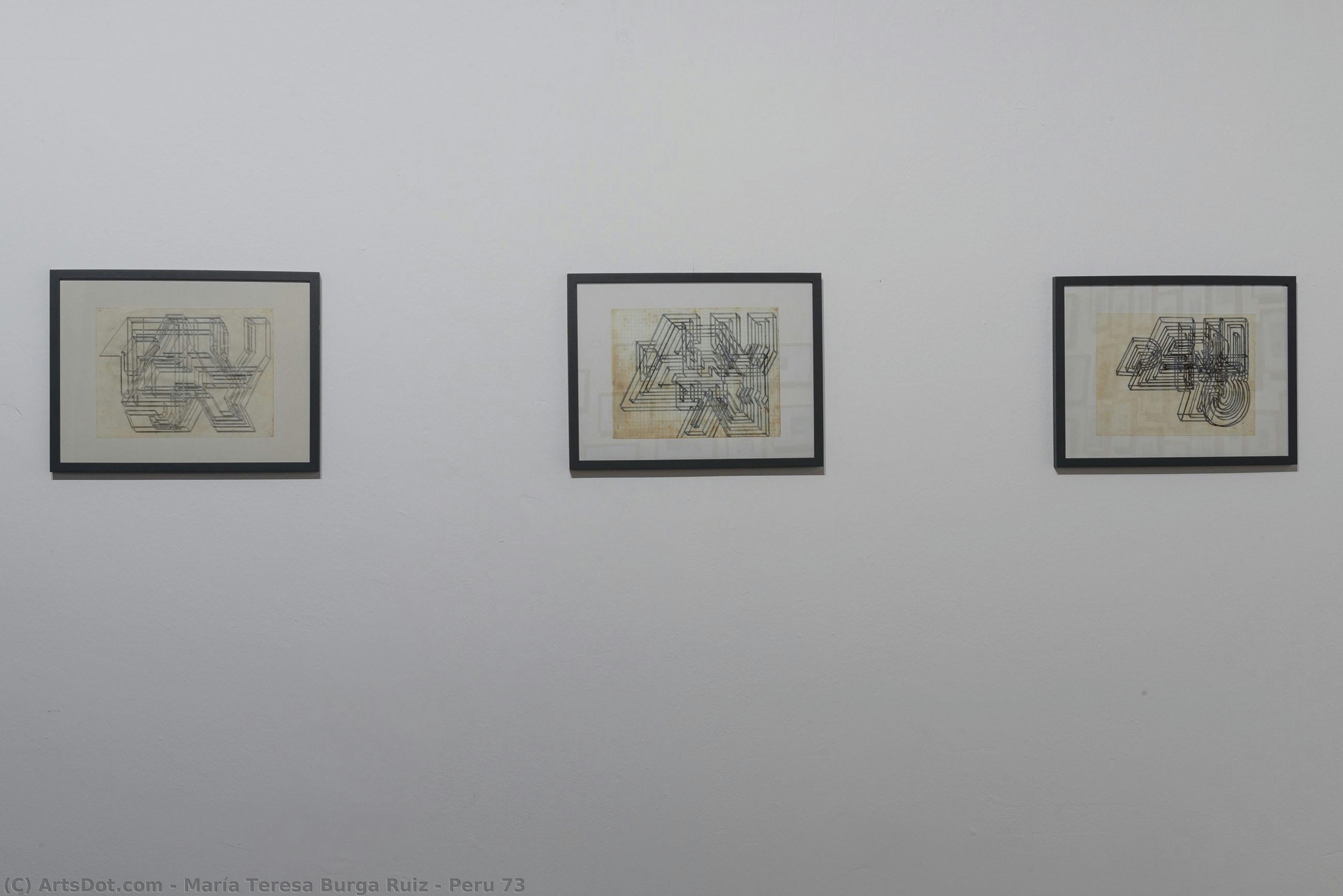
Peru 73
Teknikk for reproduksjon
Størrelse på reproduksjon
-


Endelig pris
-
Beskrivelse av kunstverket
María Teresa Burga Ruiz: A Visionary Pioneer of Peruvian Conceptual Art
María Teresa Burga Ruiz (1935-2021) stands as an undeniable cornerstone of Peruvian art history, recognized for her groundbreaking contributions to media art and conceptual explorations that fundamentally reshaped the artistic landscape of her time. Born in Iquitos, Peru—a city nestled within the heart of the Amazon rainforest—Burga’s formative years instilled a profound sensitivity to environmental concerns and social dynamics, themes that would permeate her oeuvre throughout her illustrious career. Her artistic journey began with an unwavering commitment to experimentation, pushing beyond conventional artistic boundaries to embrace technology and conceptual frameworks as integral components of her creative process. Early Influences and Artistic Exploration Burga’s initial investigations into art encompassed a diverse range of mediums—drawing, printmaking, sculpture—reflecting a restless spirit eager to engage with varied visual languages. However, it was during the late 1960s and early 1970s that she truly cemented her reputation as an innovator, establishing herself at the forefront of Peru’s burgeoning media art movement. This period witnessed Burga’s decisive shift away from traditional painting techniques toward a radical embrace of latex—a pliable material offering unparalleled possibilities for sculptural interventions and explorations of spatial dimensions. Conceptual Frameworks and Technological Innovation The core of Burga's artistic philosophy resided in her conviction that art should transcend mere aesthetic representation, delving into the realm of conceptual thought and challenging established notions of authorship. Influenced by European avant-garde movements—particularly Fluxus and Minimalism—she championed a collaborative approach to creation, delegating the actual painting process to assistants while meticulously documenting each step with detailed drawings—a practice that underscored her fascination with time and its impact on artistic production. These drawings weren’t simply records of execution; they functioned as visual meditations on duration itself, mirroring Burga's belief in art's capacity to provoke reflection and stimulate dialogue. The “Peru 73” Drawing: A Geometric Echo of Identity Her seminal work, "Peru 73," exemplifies Burga’s distinctive aesthetic vision—a striking ink drawing characterized by geometric forms arranged in layered structures. Executed in 1973, this piece represents a pivotal moment in her exploration of abstraction and its connection to Peruvian cultural heritage. The meticulous rendering of intersecting lines and planes conveys a sense of precision and deliberate composition, mirroring Burga’s unwavering dedication to craftmanship. Furthermore, the drawing's subdued tonal palette—primarily shades of gray—creates an atmosphere of contemplative stillness, inviting viewers to contemplate the interplay between form and space. Symbolic Resonance and Emotional Impact Beyond its formal qualities, “Peru 73” resonates with deeper symbolic significance. Burga’s choice of geometric abstraction speaks to a broader preoccupation with universal visual languages—a desire to communicate ideas beyond linguistic constraints. The drawing's repetitive patterns evoke echoes of Andean textiles and architectural designs—references to Burga’s homeland and its rich cultural traditions. Ultimately, “Peru 73” transcends mere visual representation, conveying an emotional depth that reflects Burga’s profound engagement with the human condition—a testament to her enduring legacy as a visionary pioneer of Peruvian conceptual art.- Artist: María Teresa Burga Ruiz
- Born Year: 1935
- Died Year: 2021
- Birth City: Iquitos
- Birth Country: Peru
Technique and Materials
Burga’s artistic process prioritized meticulous observation and documentation. She utilized latex as her primary medium, applying it with precision to create sculptural forms that responded dynamically to environmental conditions—a technique indicative of her commitment to exploring the relationship between art and nature. Her drawings were executed with graphite pencils, capturing intricate details and conveying a sense of contemplative stillness.Historical Context
Burga’s work emerged during Peru's vibrant media art movement—a period marked by experimentation and innovation in visual arts and challenging conventional artistic paradigms. Influenced by Fluxus and Minimalism, she championed collaborative practices and embraced technology as a tool for artistic expression—reflecting the broader cultural shifts occurring across Latin America during the 1960s and 1970s.Lignende kunstverk


Om kunstneren
María Teresa Burga Ruiz (1935-2021): A Pioneer of Peruvian Conceptual and Media Art
- Born: Iquitos, Peru, 1935
- Died: Lima, Peru, 2021
María Teresa Burga Ruiz, also known as Teresa Burga, was a groundbreaking Peruvian artist whose work spanned multimedia and conceptual art forms. Born in the Amazonian city of Iquitos, her artistic journey led her to become a pivotal figure in Peruvian art history, recognized for her pioneering contributions to media art, technology-based art, and installation art – fields that were nascent in Peru during her active years.
Early Life and Artistic Development
- Burga's early life in Iquitos likely influenced her later exploration of identity and social structures within Peruvian society.
- She began experimenting with various media, moving beyond traditional artistic boundaries to incorporate technology and conceptual frameworks into her practice.
- The late 1960s and 1970s marked a crucial period in Burga's development as an artist. It was during this time that she produced some of her most significant works, establishing her reputation as a visionary innovator.
Key Works and Artistic Style
- Untitled, 14, 15.04.1974: Perhaps Burga's most celebrated work, this series of monochrome drawings exemplifies her minimalist aesthetic and conceptual approach. The stark imagery invites contemplation on time, process, and the nature of representation. View Artwork
- Peru 73: This abstract ink drawing showcases Burga's exploration of geometric forms and layered structures, reflecting a broader engagement with the social and political landscape of Peru in 1973. View Artwork
- Untitled (contigo….): Demonstrates her versatility across different mediums. View Artwork
- Her artistic style is characterized by a reduction to essential forms, often employing monochrome palettes and repetitive patterns. This minimalist approach serves as a vehicle for exploring complex conceptual ideas.
Influences and Historical Significance
- Burga's work was influenced by the broader international trends in Conceptual Art and Minimalism that emerged in the 1960s and 70s.
- She is considered a precursor to media art and installation art in Peru, paving the way for subsequent generations of artists who embraced new technologies and expanded the boundaries of artistic expression.
- Her exploration of identity, feminism, and social structures within Peruvian society positions her as a significant contributor to Latin American feminist art.
- Burga's legacy lies in her ability to synthesize conceptual rigor with innovative use of media, creating works that are both aesthetically compelling and intellectually stimulating.
Legacy and Recognition
- María Teresa Burga’s work has gained increasing recognition posthumously, solidifying her place as a pivotal figure in Peruvian art history.
- She is now celebrated for her pioneering spirit and her contribution to the development of contemporary art practices in Peru.
- Her influence can be seen in the work of younger Peruvian artists who continue to explore themes of identity, technology, and social change.

María Teresa Burga Ruiz
1935 - 2021 , Peru
Kort om kunstneren
- Artistic Movement Or Style: Conceptual Art, Media Art
- Date Of Birth: 1935
- Date Of Death: 2021
- Full Name: María Teresa Burga Ruiz
- Nationality: Peruvian
- Notable Artworks:
- Untitled, 14, 15.04.1974
- Peru 73
- Untitled (contigo….)
- Place Of Birth (City And Country): Iquitos, Peru

