

- 110.0 x 78.0 cm


Bildet følger dine valg: , .
Beskrivelse av objektet
Explore 'The Juggler' by Marc Chagall – a surreal 1943 oil painting bursting with color & symbolic imagery. A captivating Expressionist/Surrealist masterpiece reflecting time, mortality & human experience.
 Vis hele teksten
Om kunstneren
Opplev Marc Chagall (1887-1985), en russisk-fransk kunstner kjent for sine drømmende malerier, jødiske temaer og fantastiske glasskunstverk. Utforsk hans arv!
Håndlaget oljereproduksjon
Håndmalt olje på lerret i din valgte størrelse og ramme, laget på bestilling av våre kunstnere. ( Bytt til trykk Bytt til digitalt bilde)
Dette kunstverket er beskyttet av opphavsrett
Kunstverket som vises på denne siden er beskyttet av opphavsretten, noe som betyr at vi ikke har juridisk tillatelse til å lage eller selge identiske reproduksjoner. Denne beskyttelsen håndheves i henhold til internasjonale avtaler som for eksempel Bernerkonvensjonen og av nasjonale lover, inkludert de som er fastsatt i Amerikansk lov om opphavsrett – Tittel 17.
Som et respektfullt og lovlig alternativ tilbyr vi skreddersydde, håndmalte kunstverk inspirert av originalen. Våre dyktige og profesjonelle kunstnere studerer nøye originalens stil, stemning og kunstneriske essens for å skape et nytt og unikt verk som vekker den samme følelsen – samtidig som det forblir en original skapelse i seg selv.
Denne metoden er i fullt samsvar med opphavsrettslige regler, da den ikke innebærer kopiering eller duplisering av det beskyttede kunstverket. I stedet er det snakk om en kreativ nytolkning – et nytt maleri som er inspirert av originalen, men ikke identisk med den.
Les mer om dette maleriet
 Forhåndsvisning
 Send
Send Del
Del
 Vis detaljer
 Utskriftsvennlig guide

 Last ned bilde
 Liknende objekter
 Røntgenundersøkelse
 Lysbildefremvisning
 Spørsmål og svar
 Statistikk
Bestill maleriet ditt i fire enkle trinn
Ta deg god tid. Du kan endre alle svar; prisen i handlekurven din oppdateres etter hvert valg.
1 Trinn én av fire
Hvilken størrelse ønsker du?
Disse størrelsene bevarer de originale proporsjonene til maleriet. Tegningen viser ditt valg på en vegg, over en to meter lang sofa.
Eller oppgi egne mål
Velg mellom våre forhåndsdefinerte størrelser som bevarer kunstverkets opprinnelige proporsjoner.

Skriv inn ønsket bredde og høyde for å tilpasse bildet til din ramme eller vegg. Siden dette er håndmalt, kan kunstneren male litt mer rundt motivet eller beskjære det noe dersom du velger et annet format — valget er ditt. Vi sender deg en digital mockup til godkjenning før maleriet påbegynnes. Bildet som vises på denne siden representerer ikke det faktiske resultatet — kun mockuppen viser det endelige uttrykket.
2 Trinn to av fire
Hvordan skal det klargjøres: rullet, strukket eller innrammet?
Prisene nedenfor gjelder for størrelsen du valgte i trinn én.
Velg kantutførelse på lerretet
Velg din ramme

Hvit kant Nkr1

Uskarp kantfinish Nkr1

Fortsatt motiv Nkr1

P118B Nkr10

P118H Nkr10

P118W Nkr10

P438Z Nkr10

P508JH Nkr12

P508YH Nkr12

P805H Nkr10

P805Z Nkr10

P919BZ Nkr10

P919G Nkr10

P919XJ Nkr10

P959ZH Nkr10

P968JZ Nkr12

W106C Nkr8

W218G Nkr10

W218JH Nkr8

W218Y Nkr10

W307PJ Nkr10

W316G Nkr10

W316PJ Nkr8

W316Y Nkr10

W398PJ Nkr8

W4111J Nkr10

W500HY Nkr15

W500JH Nkr15

W692G Nkr12

W849H Nkr8

W940BG Nkr15

W953PJ Nkr8

H24-GOLD Nkr30

H24-SILVER Nkr30

H36-GOLD Nkr45

H36-SILVER Nkr45
Innrammet
Profil: . Total størrelse med ramme: .
3 Trinn tre av fire
Ønsker du at noe skal endres i maleriet?
De fleste svarer nei. Siden hvert maleri er håndlaget, kan kunstneren vår også tilpasse det for deg.
Etter bestilling vil ArtsDot.com-teamet sende e-post til kunden for instruksjoner og sende et utkast som forhåndsvisning
4 Trinn fire av fire
Noen valgmuligheter for finish
Alle er valgfrie. Svarene som allerede er valgt, medfører ingen ekstra kostnad.
Hvem har malt det?
Verdensomspennende levering () på 3–4 uker i stedet for standard 5 uker. (8 November). Ingen kompromisser med kvaliteten.
En navneplate, som på et museum?
Detaljer om gravert bronseplate
This elegant plaque features the artist's name and the title of the artwork, finely engraved for a timeless presentation.
It is made from bronze with a refined, elegant finish. The text is precisely laser-engraved for a sharp and permanent result. Measuring 9x2 cm, the plaque is compact yet easy to read. It's built to be durable and scratch-resistant, offering a professional, museum-quality look. Mounting is simple thanks to the included adhesive backing.
Detaljer om gjennomsiktig akrylplate
The plaque includes essential engraved details such as the artist's name, the title of the artwork, the date it was created, the type of media used-like oil on canvas or watercolor-a brief description of the piece, and a QR code that links to the complete artwork information.
It is crafted from clear acrylic, offering a sleek, modern appearance. The text is UV-engraved in black to ensure strong visual contrast. With a size of 10x15 cm, it ensures optimal readability. It comes equipped with two metal hooks for secure wall mounting. The plaque is designed to be weather-resistant, making it suitable for various environments, and it includes interactive features that work seamlessly with smartphone scanning.
Detaljer om plakett i svart akryl
This elegant plaque includes engraved information such as the artist's name, the title of the artwork, the date it was created, the type of media used (like oil on canvas or watercolor), a short description of the artwork, and a QR code for quick access to more information.
The plaque itself is made from refined black acrylic with a premium finish. The text is laser-engraved in white for high contrast and readability. Its size is 10x15 cm, designed to be easy to read. It comes with two metal hooks for professional mounting. The design is sleek and fits any interior style. It is also weather-resistant and durable, with built-in digital integration for mobile compatibility.
En beskyttende lakk?
Når trenger du det?
✓ Kontroller og bestill
Ditt maleri, slik du bestilte det

The Juggler
Trykkmetode
Størrelse på reproduksjon
-

Utvalgte mesterkunstnere
Mer detaljrikdom, finesse og ekstra produksjonstid
-

Innramming av reproduksjon
-
-
For kunstverk eller reproduksjoner som er større enn 105 cm (ca. 41 tommer) på noen side, vil rammen bli sendt som et sett som må monteres. Denne metoden sikrer trygg levering og forhindrer skader under transport.
Krever profesjonell montering – dette er ikke et DIY-produkt.
Settet må monteres og lerretet strammes av en erfaren profesjonell rammelegger, ved bruk av trelim (følger ikke med), en lerretstang og klemmer for å holde rammelisten vinkelrett mens limet tørker. Feilaktig montering eller ujevn stramming av lerretet kan påføre kunstverket permanente skader og er
 For kunstverk eller reproduksjoner som er større enn 105 cm (ca. 41 tommer) på noen side, vil rammen bli sendt som et sett som må monteres. Denne metoden sikrer trygg levering og forhindrer skader under transport.
Alle massive trelister er inkludert, presist tilpasset i størrelse.
Monteres med de medfølgende skruene, samt trelim til hjørnene, som ikke er inkludert og må anskaffes av din rammehandler.
Profesjonelt verktøy er nødvendig og er ikke inkludert: en lerretstang (strammer) og klemmer for å holde rammene vinkelrette mens limet tørker.
Viktig:
Hjørnene krever trelim, listene må holdes på plass med tvinger til limet er helt tørt, og stramming av lerretet på den ferdige rammen krever en lerretstang. Ingen av disse produktene er inkludert i settet. Vennligst sørg for tilgang til en erfaren profesjonell rammehandler før du bestiller denne størrelsen.

Navneskilt
-
-

Beskyttende ferniss
Blank lakk (forsterker farger, beskytter mot lys og fuktighet)
-

Tilpass mitt kunstverk
Eksempler på hva som kan endres: Erstatt ansikt med bilde av kunden; Legg til kjæledyr (f.eks. bytt ut katt med hund); Inkluder en skjult melding i bakgrunnen; Endre bakgrunnslandskap eller elementer.
-

Ekspresslevering
Verdensomspennende levering () på 3–4 uker i stedet for standard 5 uker. (8 November). Ingen kompromisser med kvaliteten.
-
Ekspresslevering
Verdensomspennende levering til innen 5 uker. (15 November).
Inkludert frakt
Totalpris for valgte alternativer
Nkr 2754
Glassalternativet er kun tilgjengelig i størrelser under 110 cm
Inkludert med hver bestilling
- Gratis ekspressfrakt over hele verden
- Lerretsduk av lin av høy kvalitet
- Full transportforsikring
- Garanti for refusjon av toll og importavgifter
- Garantert fargegjengivelse
- 100 dagers returrett ved fabrikasjonsfeil
- 100% pengene tilbake-garanti
- Rabatt ved flere kjøp


A Dreamscape of Modernity: Exploring Marc Chagall’s *The Juggler* (1943)
The Juggler*, created in 1943, is a captivating example of Marc Chagall's unique artistic vision – a blend of memory, folklore, and the anxieties of a world at war. Measuring 110 x 78 cm, this oil on canvas transports viewers to a surreal realm brimming with symbolic imagery and vibrant color.Subject & Composition
The painting centers around a striking figure: a bird-man, seemingly the titular juggler, poised amidst a swirling ground plane. He holds a clock, an immediately arresting detail. Surrounding him are numerous smaller figures engaged in various activities – a bustling scene that evokes both celebration and unease. The composition isn’t one of realistic space; rather, it's a flattened perspective where forms overlap and intertwine, creating a dynamic sense of movement. Chagall masterfully balances the central focus on the bird-man with the captivating details scattered throughout the canvas, inviting prolonged exploration.Style & Technique
Chagall’s style in *The Juggler* is firmly rooted in both Expressionism and Surrealism. The exaggerated forms, bold color palette, and distorted figures are hallmarks of Expressionist emotion. Simultaneously, the dreamlike quality, illogical juxtapositions, and symbolic content align with Surrealist principles. Executed in oil on canvas, the painting showcases visible brushstrokes and layering, adding texture and depth despite the flattened perspective. This technique allows for a rich interplay of light and shadow, emphasizing key elements and enhancing the overall dramatic effect.Historical Context & Influences
Created during World War II, *The Juggler* reflects the artist’s experience as a Jewish refugee fleeing Europe. Chagall found refuge in the United States from 1941-1948. While not explicitly depicting war scenes, the painting's sense of displacement and fragmented reality can be interpreted as a response to the trauma of the era. However, it is important to note that Chagall’s work consistently draws upon his childhood memories of Vitebsk, Belarus – a city steeped in Jewish tradition and folklore. This personal history infuses his art with a unique lyrical quality, even amidst darker themes.Symbolism & Interpretation
The symbolism within *The Juggler* is rich and open to interpretation. The clock held by the bird-man is particularly potent, potentially representing time’s relentless march, mortality, or a distorted perception of reality – all themes resonant during wartime. The surrounding figures could symbolize various aspects of human experience, societal roles, or even fragmented memories. The bird-man himself can be seen as an alter ego for Chagall, navigating a chaotic world while attempting to maintain balance and control (the act of juggling).Emotional Impact & Aesthetic Appeal
*The Juggler* evokes a complex range of emotions – wonder, anxiety, nostalgia, and perhaps even a touch of melancholy. The vibrant colors and dynamic composition are visually stimulating, while the underlying sense of unease adds depth and intrigue. This painting is not merely a decorative piece; it’s an invitation to contemplate the human condition, the passage of time, and the power of memory. Its unique aesthetic makes it suitable for both modern and traditional interiors, adding a touch of sophisticated surrealism and intellectual depth to any space. It's a work that continues to resonate with viewers decades after its creation, solidifying Chagall’s place as one of the most important artists of the 20th century.Spørsmål og svar
Hva anbefales brukt til "The Juggler" av Marc Chagall?
Anbefalt bruk for "The Juggler" av Marc Chagall er Conversation. Den kan også brukes til andre formål.
Hvor kan jeg finne kunstverk som ligner på "The Juggler" av Marc Chagall?
Siden Lignende verk for "The Juggler" av Marc Chagall viser relaterte kunstverk.
Hvem er opphavspersonen til "The Juggler", og hvilket år ble det laget?
Marc Chagall skapte "The Juggler" i 1943.
Lignende kunstverk


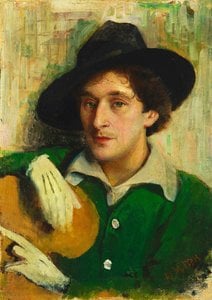
Marc Chagall
1887 - 1985, Belarus
Om kunstneren
A Life Painted in Dreams: The World of Marc Chagall
Marc Chagall, born Moishe Shagal in 1887 in the small Belarussian town of Liozna near Vitebsk, wasn’t merely a painter; he was a poet of color, a weaver of dreams, and a chronicler of memory. His life, spanning nearly a century, mirrored the tumultuous currents of the 20th century, yet his art remained steadfastly rooted in a deeply personal vision—one infused with the folklore of his Hasidic Jewish upbringing and an unwavering belief in the power of imagination. Vitebsk itself was more than just a birthplace; it became the emotional core of his artistic universe, a recurring motif populated by flying figures, whimsical animals, and the vibrant hues of remembered landscapes. The town’s unique blend of cultures—Russian Orthodox churches alongside bustling Jewish marketplaces—forged an aesthetic sensibility that would defy easy categorization throughout his long career. Though he sought formal training first with a local sign painter and later in St. Petersburg under Léon Bakst, and then in Paris at the Académie de la Grande Chaumière, Chagall never fully embraced any single artistic movement. He absorbed elements of Cubism, Symbolism, and Fauvism, but always filtered them through his own intensely personal lens, creating a style that was uniquely, unmistakably Chagall.Early Influences and Artistic Beginnings
Chagall’s formative years were marked by the traditions of Vitebsk’s Jewish community—a world steeped in ritual, storytelling, and vibrant visual culture. These influences would permeate his artistic vision throughout his life. His initial training was modest, focusing on practical skills as a sign painter, but he quickly developed an aptitude for drawing and painting, driven by an innate desire to capture the beauty of the natural world and the complexities of human emotion. St. Petersburg provided him with access to influential teachers like Léon Bakst, who encouraged him to experiment with theatrical design and introduced him to the principles of Cubism—a movement that would profoundly impact his artistic style. However, Chagall resisted rigid stylistic conventions, prioritizing instead a deeply expressive approach rooted in observation and imagination. His early canvases already hinted at the distinctive language he would develop – paintings like *I and the Village* (1911) are not simply depictions of place; they are explorations of identity, memory, and the relationship between the individual and community. The village isn’t rendered realistically but as a fragmented collection of recollections, imbued with symbolic meaning. This ability to transmute personal experience into universal themes became a hallmark of his art.The Symbolism of Flight and Memory
Chagall's artistic style quickly distinguished itself through its characteristic use of color and imagery—particularly the motif of flight. Figures soar across canvases in fantastical landscapes, defying gravity and logic, creating a dreamlike atmosphere that invites viewers into his inner world. This stylistic choice wasn’t accidental; it stemmed from a desire to move beyond mere imitation of reality and capture the essence of feeling, the weight of memory, and the power of folklore. Recurring symbols—such as apples, birds, and biblical figures—appear throughout his oeuvre, conveying profound emotional resonance and hinting at deeper spiritual concerns. His palette was bold and expressive, often employing vibrant, non-naturalistic colors to convey emotion rather than literal representation. This approach solidified his reputation as a visionary artist who dared to explore the subconscious mind and express ideas beyond conventional boundaries.From Vitebsk to Paris: Artistic Transformation
The Russian Revolution dramatically altered Chagall’s life trajectory, bringing him back to Vitebsk where he became involved in cultural initiatives, establishing an art school that briefly flourished before succumbing to the restrictions imposed by the new regime. This period was marked by both creative energy and political disillusionment, a tension that would continue to shape his artistic trajectory. He embraced Surrealism, influenced by André Breton and fellow artists, experimenting with dreamlike imagery and irrational juxtapositions—a stylistic shift that reflected the anxieties and uncertainties of the time. The outbreak of World War II forced him to flee occupied France for the United States, where he spent seven years in New York City. This period was marked by profound emotional upheaval and artistic experimentation. He found solace in his art, creating powerful works that reflected the traumas of war and displacement—particularly *White Crucifixion* (1938), a haunting depiction of suffering and persecution.Legacy and Recognition
After the war, Chagall returned to France, where he continued to paint and create until his death in 1985 at the age of 97. He received numerous prestigious commissions, including the ceiling of the Paris Opera (1964), a breathtaking explosion of color and form that celebrated musical masterpieces, and stunning stained glass windows for the Hadassah Hebrew University Medical Center synagogue in Jerusalem. These large-scale projects allowed him to translate his artistic vision into architectural spaces, creating immersive environments that continue to inspire awe and wonder. Chagall’s influence on subsequent generations of artists is undeniable. His lyrical quality, emotional depth, and imaginative power resonated with Surrealists and other movements that embraced fantasy and symbolism. He bridged the gap between European modernism and Jewish cultural identity, becoming known as “the quintessential Jewish artist of the twentieth century.” His ability to synthesize personal experience, folklore, and universal themes continues to resonate with audiences worldwide. Marc Chagall’s legacy extends beyond his paintings and stained glass; it resides in the enduring power of his vision—a vision that celebrates love, memory, and the boundless possibilities of the human imagination.


Relaterte artikler

Franz Marc: Expressionism, Spirituality & the Animal Symbolism of a Modern Master
Explore the profound world of Franz Marc's Expressionist paintings. Discover his spiritual connection to animals, innovative use of color, and lasting impact on modern art history. Learn more at ArtsDot.

Surrealismens 10 Mesterverk: Kunst som utfordrer virkeligheten – ArtsDot.no
Utforsk surrealismens 10 mest ikoniske malerier! Oppdag Salvador Dalí, René Magritte og andre mestere. Lær om drømmekunst, teknikker & historien bak disse tidløse verkene. Finn museumskvalitets kunsttrykk for ditt hjem på ArtsDot.com.

Tysk Ekspresjonisme: 10 Mesterverk som Definerte en Kunstbevegelse | ArtsDot.no
Utforsk 10 ikoniske mesterverk fra tysk ekspresjonisme! Oppdag Munch, Kirchner og Kandinsky – historiene bak fargene, teknikkene & følelsene. Finn museumskvalitets kunsttrykk for ditt hjem på ArtsDot.com.