

 Forhåndsvisning
 Send
Send Del
Del
 Vis detaljer
 Utskriftsvennlig guide

 Last ned bilde
 Liknende objekter
 Røntgenundersøkelse
 Lysbildefremvisning
 Spørsmål og svar
 Statistikk
Tchitchikov triumphant

- 27.0 x 21.0 cm


 Vis hele teksten
Få en utskriftsklar fil som går langt utover forhåndsvisningen på nett. Hvert digitale bilde vi selger er hentet fra en høyoppløselig master i vår database – vanligvis mellom 5 000 og 15 000 piksler bred – slik at du kan trykke stort, beskjære tett eller gjenskape fine detaljer med full trygghet.
Ingen filer forlater studioet vårt uten å bli bearbeidet. En digital ekspert kontrollerer fargene mot det originale maleriet og korrigerer dem ved behov, for deretter å forbedre klarhet og detaljrikdom med profesjonelle retusjeringsverktøy — alltid tro mot kunstnerens penselstrøk og stil. Resultatet er et bilde som fremstår som selve maleriet, ikke som en skann med filter.
Du godkjenner før ferdigstilling: vår ekspert sender bildet på e-post til din vurdering innen 72 timer. Ikke fornøyd? Be om forbedringer eller korrigeringer, eller be om refusjon dersom kvaliteten ikke svarer til forventningene.
Dette er kvaliteten forlag, designstudioer, gallerier og trykkerier stoler på.
Digitalt bilde
Last ned en høyoppløselig fil til personlig bruk, utskrift og kreative prosjekter. ( Bytt til trykk Kjøp håndmalt maleri)
Inkludert i alle bestillinger av digitale bilder
Ekspert på digital levering, garantert
Når du velger ArtsDot.com, får du ikke bare et bilde – du mottar et profesjonelt etterbehandlet digitalt kunstverk, skapt med presisjon og med en garantert tilfredshetsgaranti. Her er alt som automatisk følger med din bestilling:

Rask levering på e-post
Din høyoppløselige digitale bildefil sendes til din e-post innen 72 timer etter bestilling – klar til umiddelbar bruk.

KI-forbedret digital fil
Ditt kunstverk blir profesjonelt optimalisert ved hjelp av avanserte AI-verktøy og manuell redigering, noe som sikrer maksimal detaljrikdom, klarhet og fargegjengivelse.

Gratis livslang nyutlevering
Har du ved et uhell slettet eller mistet filen din? Ingen bekymring – vi sender den på nytt når som helst, helt gratis.

Ingen importavgifter – noen gang
Nyt ditt kunstverk umiddelbart uten toll, avgifter eller leveringskostnader – digitale nedlastinger er alltid avgiftsfrie.

Garantert fargenøyaktighet
Vi sikrer at det digitale bildet gjenspeiler de originale fargene så nøyaktig som mulig ved hjelp av profesjonelle verktøy og fargehåndtering.

100 dagers fornøydhetsgaranti
Hvis du ikke er fornøyd med ditt digitale bilde, vil vi revidere det eller refundere 100% innen 100 dager – uten spørsmål.

100% Penggaranti
Ikke fornøyd? Få full refusjon innen 100 dager etter at du har mottatt din digitale fil – uten spørsmål.

Rabatt ved storkjøp
Kjøp 3 bilder, spar 10% - Kjøp 5, spar 15% - Kjøp 10+, spar 20%. Ideelt for kreative prosjekter, gallerier og byråer.
Tchitchikov triumphant – A Celebration of Surrealist Vision
Marc Chagall’s “Tchitchikov triumphant,” created in 1923 during his Parisian period, stands as a testament to the artist's unwavering commitment to capturing dreams and folklore within the framework of Surrealism. This etching on zinc or copper exemplifies Chagall’s distinctive Naïve Art style—a deliberate rejection of academic conventions favoring expressive lines and simplified forms over meticulous realism. Measuring 27.6 x 21 cm, it resides in the Tretyakov Gallery in Moscow, Russia, serving as a captivating illustration from his “Dead Souls” series.Composition & Technique: Embracing Movement and Texture
The artwork’s asymmetrical composition immediately draws the eye to a central figure—a man elevated on one leg, arms outstretched in triumph—dominating the foreground. Surrounding him are sparse interior elements: a table bearing a vase of flowers and two additional figures, subtly contributing to the narrative's ambiguity. Chagall skillfully employs hatching and cross-hatching techniques to imbue the image with textural depth, simulating light and shadow without adhering to strict perspective rules. These lines aren’t merely descriptive; they convey emotion and dynamism—a characteristic trait of his artistic approach. The etching process itself – scratching lines into a metal plate followed by ink application – ensures remarkable detail and tonal variation.Symbolism & Narrative Resonance: Gogol's Influence
The figure’s posture powerfully echoes the spirit of Nikolai Gogol’s novel “Dead Souls,” referencing Tchitchikov’s ambition to acquire souls—a metaphor for achieving success through unconventional means. The inclusion of a vase symbolizes beauty and fragility amidst the chaotic backdrop, hinting at themes of aspiration and vulnerability. Chagall's deliberate use of flattened perspective and stylized figures invites contemplation on the nature of reality versus imagination – central concerns within Surrealist art.Historical Context: Parisian Surrealism & Artistic Rebellion
“Tchitchikov triumphant” emerged during a pivotal moment in artistic history—the burgeoning Surrealist movement spearheaded by André Breton. Chagall’s rejection of traditional representation aligns perfectly with Surrealists' desire to liberate the subconscious mind and explore dreamlike imagery as a conduit for expressing profound emotions. The etching reflects the broader cultural landscape of 1920s Paris, where artists challenged established norms and embraced experimentation—a spirit that continues to inspire contemporary art enthusiasts.Emotional Impact: A Visionary Expression
Ultimately, “Tchitchikov triumphant” transcends mere visual depiction; it communicates a palpable sense of exhilaration and triumph. Chagall’s masterful manipulation of tonal values and expressive lines captures the essence of aspiration and celebrates the transformative power of imagination—themes that resonate deeply with viewers across generations. It's a piece that invites us to step outside conventional thought and embrace the beauty of unconventional perspectives – a hallmark of Chagall’s enduring legacy as one of the most influential artists of the 20th century.Spørsmål og svar
Hva er den overordnede stemningen i "Tchitchikov triumphant" av Marc Chagall?
"Tchitchikov triumphant" av Marc Chagall beskrives med en Romantic stemning. Denne klassifiseringen kan bidra til å matche verket med et passende miljø.
Hvor lys eller mørk oppleves "Tchitchikov triumphant" av Marc Chagall som?
Den oppfattede lysstyrken til "Tchitchikov triumphant" av Marc Chagall er brilliant, og den kan tilpasses lysforholdene i det tiltenkte rommet.
Hvor kan jeg kjøpe en håndmalt reproduksjon av "Tchitchikov triumphant" av Marc Chagall?
"Tchitchikov triumphant" er tilgjengelig som en håndmalt oljereproduksjon på linlerret. Du kan bestille på siden Håndmalt oljereproduksjon, hvor du kan velge mellom ulike størrelser.
Lignende kunstverk


Om kunstneren
A Life Painted in Dreams: The World of Marc Chagall
Marc Chagall, born Moishe Shagal in 1887 in the small Belarussian town of Liozna near Vitebsk, wasn’t merely a painter; he was a poet of color, a weaver of dreams, and a chronicler of memory. His life, spanning nearly a century, mirrored the tumultuous currents of the 20th century, yet his art remained steadfastly rooted in a deeply personal vision—one infused with the folklore of his Hasidic Jewish upbringing and an unwavering belief in the power of imagination. Vitebsk itself was more than just a birthplace; it became the emotional core of his artistic universe, a recurring motif populated by flying figures, whimsical animals, and the vibrant hues of remembered landscapes. The town’s unique blend of cultures—Russian Orthodox churches alongside bustling Jewish marketplaces—forged an aesthetic sensibility that would defy easy categorization throughout his long career. Though he sought formal training first with a local sign painter and later in St. Petersburg under Léon Bakst, and then in Paris at the Académie de la Grande Chaumière, Chagall never fully embraced any single artistic movement. He absorbed elements of Cubism, Symbolism, and Fauvism, but always filtered them through his own intensely personal lens, creating a style that was uniquely, unmistakably Chagall.Early Influences and Artistic Beginnings
Chagall’s formative years were marked by the traditions of Vitebsk’s Jewish community—a world steeped in ritual, storytelling, and vibrant visual culture. These influences would permeate his artistic vision throughout his life. His initial training was modest, focusing on practical skills as a sign painter, but he quickly developed an aptitude for drawing and painting, driven by an innate desire to capture the beauty of the natural world and the complexities of human emotion. St. Petersburg provided him with access to influential teachers like Léon Bakst, who encouraged him to experiment with theatrical design and introduced him to the principles of Cubism—a movement that would profoundly impact his artistic style. However, Chagall resisted rigid stylistic conventions, prioritizing instead a deeply expressive approach rooted in observation and imagination. His early canvases already hinted at the distinctive language he would develop – paintings like *I and the Village* (1911) are not simply depictions of place; they are explorations of identity, memory, and the relationship between the individual and community. The village isn’t rendered realistically but as a fragmented collection of recollections, imbued with symbolic meaning. This ability to transmute personal experience into universal themes became a hallmark of his art.The Symbolism of Flight and Memory
Chagall's artistic style quickly distinguished itself through its characteristic use of color and imagery—particularly the motif of flight. Figures soar across canvases in fantastical landscapes, defying gravity and logic, creating a dreamlike atmosphere that invites viewers into his inner world. This stylistic choice wasn’t accidental; it stemmed from a desire to move beyond mere imitation of reality and capture the essence of feeling, the weight of memory, and the power of folklore. Recurring symbols—such as apples, birds, and biblical figures—appear throughout his oeuvre, conveying profound emotional resonance and hinting at deeper spiritual concerns. His palette was bold and expressive, often employing vibrant, non-naturalistic colors to convey emotion rather than literal representation. This approach solidified his reputation as a visionary artist who dared to explore the subconscious mind and express ideas beyond conventional boundaries.From Vitebsk to Paris: Artistic Transformation
The Russian Revolution dramatically altered Chagall’s life trajectory, bringing him back to Vitebsk where he became involved in cultural initiatives, establishing an art school that briefly flourished before succumbing to the restrictions imposed by the new regime. This period was marked by both creative energy and political disillusionment, a tension that would continue to shape his artistic trajectory. He embraced Surrealism, influenced by André Breton and fellow artists, experimenting with dreamlike imagery and irrational juxtapositions—a stylistic shift that reflected the anxieties and uncertainties of the time. The outbreak of World War II forced him to flee occupied France for the United States, where he spent seven years in New York City. This period was marked by profound emotional upheaval and artistic experimentation. He found solace in his art, creating powerful works that reflected the traumas of war and displacement—particularly *White Crucifixion* (1938), a haunting depiction of suffering and persecution.Legacy and Recognition
After the war, Chagall returned to France, where he continued to paint and create until his death in 1985 at the age of 97. He received numerous prestigious commissions, including the ceiling of the Paris Opera (1964), a breathtaking explosion of color and form that celebrated musical masterpieces, and stunning stained glass windows for the Hadassah Hebrew University Medical Center synagogue in Jerusalem. These large-scale projects allowed him to translate his artistic vision into architectural spaces, creating immersive environments that continue to inspire awe and wonder. Chagall’s influence on subsequent generations of artists is undeniable. His lyrical quality, emotional depth, and imaginative power resonated with Surrealists and other movements that embraced fantasy and symbolism. He bridged the gap between European modernism and Jewish cultural identity, becoming known as “the quintessential Jewish artist of the twentieth century.” His ability to synthesize personal experience, folklore, and universal themes continues to resonate with audiences worldwide. Marc Chagall’s legacy extends beyond his paintings and stained glass; it resides in the enduring power of his vision—a vision that celebrates love, memory, and the boundless possibilities of the human imagination.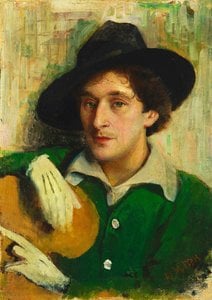
Marc Chagall
1887 - 1985 , Belarus
Kort om kunstneren
- Artistic Movement Or Style: Modernism, Kubism
- Artists Or Movements Influenced By This Artist:
- Surrealism
- Modern konst
- Artists Who Influenced This Artist:
- Bakst
- Delaunay
- Borovikovsky
- Date Of Birth: 7 juli 1887
- Date Of Death: 28 mars 1985
- Full Name: Marc Chagall
- Nationality: Russisk, senare fransk
- Notable Artworks:
- I och byen
- Vitbesk
- Vitkrifixion
- Place Of Birth: Liozna, Belarus