
Expressionism · 1915
Marching (Marc Chagall, 1915)
Marching is a work by Marc Chagall (1887–1985). It dates from 1915. It belongs to the Expressionism movement. It is made in Acrylic On Canvas.
- 1915
- Acrylic On Canvas

 Forhåndsvisning

 Trykk
 Send
 Del
 Utskriftsvennlig guide


 Last ned bilde
 Liknende objekter
 Røntgenundersøkelse
 Lysbildefremvisning
 Spørsmål og svar

 Statistikk
Marching in a nutshell
- Title
- Marching
- Artist
- Marc Chagall (1887–1985)
- Artist born in
- Liozna, Belarus
- Date
- 1915
- Medium
- Acrylic On Canvas
- Movement
- Expressionism
- Subject
- uniform, roof, sky, clock, figures, folklore
What's going on in Marching
A Symphony of Color and Memory: Exploring Marc Chagall's "I Am Alone"
Marc Chagall’s “I Am Alone,” painted in 1915, isn’t merely a depiction of solitude; it’s an embodiment of existential angst rendered in the breathtaking language of Expressionism. Created during the turbulent years preceding World War I—a period marked by anxieties about national identity and impending conflict—the painting transcends its immediate historical context to speak to universal themes of isolation and longing. It's housed in the Musée d'Orsay, Paris, a testament to Chagall’s enduring influence on modern art.- Subject Matter: The canvas portrays a man standing alone on a rooftop amidst a swirling panorama of fantastical figures—a woman with outstretched arms, a child perched precariously on the edge of the roof, and several other stylized individuals drifting upwards into the heavens.
- Style: Chagall’s style is unmistakably Expressionist. Rejecting representational accuracy in favor of emotional intensity, he employs bold colors—primarily yellows, blues, and reds—to convey mood and feeling rather than to faithfully reproduce reality. The figures themselves are distorted and stylized, imbued with a dreamlike quality that defies logical interpretation.
Technique: Bold Brushstrokes and Layered Color
Chagall’s technique is characterized by thick, impasto brushstrokes—meaning the paint is applied in layers so thickly that it stands up prominently from the surface of the canvas. This textural approach contributes significantly to the painting's dramatic impact, creating a palpable sense of movement and conveying the artist’s emotional state directly onto the artwork. The colors are blended strategically to create luminous washes and vibrant accents, enhancing the overall visual richness.- Color Palette: The dominant hues—golden yellows symbolizing warmth and optimism juxtaposed with deep blues representing melancholy and uncertainty—are deliberately chosen to evoke specific emotions. Chagall’s masterful use of color underscores the painting's psychological depth.
- Composition: The rooftop setting serves as a focal point, anchoring the swirling figures and emphasizing the man’s isolation. The upward trajectory of the figures symbolizes aspiration but also hints at vulnerability—a yearning for connection amidst overwhelming circumstances.
Symbolism: Folklore and Existential Concerns
“I Am Alone” is replete with symbolic references drawn from Jewish folklore and Kabbalah—the mystical tradition of Judaism. The woman with outstretched arms represents compassion and maternal care, while the child symbolizes innocence and vulnerability. The swirling figures embody the chaotic forces of fate and the anxieties surrounding impending war. More broadly, the painting explores profound existential questions about human existence—questions concerning identity, purpose, and the inevitability of suffering.Ultimately, Chagall’s “I Am Alone” transcends its historical origins to resonate with viewers across generations. It's a hauntingly beautiful meditation on solitude, loss, and the enduring quest for meaning—a masterpiece that continues to inspire awe and provoke contemplation decades after its creation.
Marching, up close

Things people wonder about Marching
Hvilken fase av Marc Chagall sin karriere tilhører "Marching", basert på datoen?
Dateringen fra 1915 plasserer "Marching" i Mature Period av Marc Chagall sin kunstneriske utvikling.
Er "Marching" av Marc Chagall i det frie domene?
"Marching" av Marc Chagall er fortsatt beskyttet av opphavsretten. Denne statusen avgjør hvordan bildet av verket kan reproduseres.
Hvor kjent er "Marching" av Marc Chagall?
"Marching" er klassifisert som Iconic.
Hvilken størrelse anbefales det å trykke "Marching" i?
"Marching" anbefales i en trykkstørrelse på Large. Andre størrelser er tilgjengelige med de samme proporsjonene.
Hvilken stemning formidler Expressionism-verket "Marching"?
Innenfor Expressionism-retningen er "Marching" preget av en Melancholic tone.
Hvilket rom komplementerer fargene i "Marching" av Marc Chagall?
De Earthy fargene i "Marching" av Marc Chagall harmonerer med det anbefalte rommet: et Living Room.
Hvilken følelse formidler "Marching" av Marc Chagall?
"Marching" av Marc Chagall formidler en Melancholic emosjonell tone.
Hvilken periode i Marc Chagall sin karriere tilhører "Marching"?
"Marching" representerer Marc Chagall sin Mature Period.
Hvilken lysstyrke har "Marching" av Marc Chagall?
Luminansen som er registrert for "Marching" av Marc Chagall, er Bright Balance.
Meet Marc Chagall
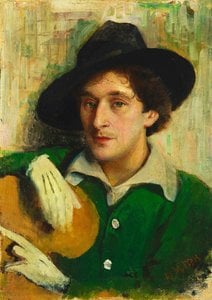
1887–1985, Belarus
Marc Chagall
Tidlig liv, familie og utdanning Marc Chagall trer inn i verden den 7. juli 1887 i Vitebsk i Det russiske imperiet, født som Moishe Segal. Han er det første av ni barn i en beskjeden jødisk familie, hvor livet er preget av arbeidets rytmer og småskala handel. Hans far, Khatskel Segal, arbeider som sildesalter ved et lager, mens hans mor, Feïga-Ita Tchernina, driver en liten dagligvarebutikk.
Get to know Marc Chagall The Marc Chagall works everyone loves
More by Marc Chagall you might love
 Jeg og landsbyen1911
 Den hvite korsfestelsen1938
 Fødselsdag1915
 Over Våren1918
More to read about Marching
 Topp 10 Kunstverk som Våkner Gleden: Malerier for Ditt HjemOpplev gleden gjennom kunsten! Utforsk topp 10 malerier av Van Gogh, Monet & Klimt som vekker positive følelser. Interiørdesign-tips og mus…
 Kubistisk Ekspresjonisme: Topp 10 Mesterverk som Formet Kunsten | ArtsDot.noUtforsk de 10 mest innflytelsesrike kubistiske og ekspresjonistiske mesterverkene fra Picasso, Braque & Gris. Lær historien bak ikoniske ma…
 Dreaming in Color: The 25 Most Iconic Masterpieces by Marc ChagallExplore 25 iconic Marc Chagall masterpieces through color and dream. Discover the full collection online at ArtsDot.com.