

 Forhåndsvisning
 Send
Send Del
Del
 Vis detaljer
 Utskriftsvennlig guide

 Last ned bilde
 Liknende objekter
 Røntgenundersøkelse
 Lysbildefremvisning
 Spørsmål og svar
 Statistikk
Bangudae Petroglyphs


 Vis hele teksten
Kunstverket som vises på denne siden er beskyttet av opphavsretten, noe som betyr at vi ikke har juridisk tillatelse til å lage eller selge identiske reproduksjoner. Denne beskyttelsen håndheves i henhold til internasjonale avtaler som for eksempel Bernerkonvensjonen og av nasjonale lover, inkludert de som er fastsatt i Amerikansk lov om opphavsrett – Tittel 17.
Denne metoden er i fullt samsvar med opphavsrettslige regler, da den ikke innebærer kopiering eller duplisering av det beskyttede kunstverket. I stedet er det snakk om en kreativ nytolkning – et nytt maleri som er inspirert av originalen, men ikke identisk med den.
Giclée / Kunsttrykk
Giclée- eller lerretsprint av museumskvalitet med rask produksjon og fleksible valgmuligheter for etterbehandling. ( Kjøp håndmalt maleri Bytt til digitalt bilde)




P118B Nkr10

P118H Nkr10

P118W Nkr10

P438Z Nkr10

P508JH Nkr12

P508YH Nkr12

P805H Nkr10

P805Z Nkr10

P919BZ Nkr10

P919G Nkr10

P919XJ Nkr10

P959ZH Nkr10

P968JZ Nkr12

W106C Nkr8

W218G Nkr10

W218JH Nkr8

W218Y Nkr10

W307PJ Nkr10

W316G Nkr10

W316PJ Nkr8

W316Y Nkr10

W398PJ Nkr8

W4111J Nkr10

W500HY Nkr15

W500JH Nkr15

W692G Nkr12

W849H Nkr8

W940BG Nkr15

W953PJ Nkr8




Velg mellom våre forhåndsdefinerte størrelser som bevarer kunstverkets opprinnelige proporsjoner.

Skriv inn ønsket bredde og høyde for å tilpasse trykket til din ramme eller vegg. Et trykk kan kun beskjæres, aldri skaleres opp utover motivets opprinnelige størrelse, noe som betyr at et format med andre proporsjoner vil føre til tap av deler av bildet. Vi sender deg en digital mockup for godkjenning før vi starter trykkeprosessen. Bildet som vises på denne siden viser ikke den faktiske beskjæringen — det er kun mockuppen som viser dette.
Verdensomspennende levering () på 2 uker i stedet for standard 4/5 uker. (5 November)

Gratis ekspressfrakt over hele verden

Lerretsduk av lin av høy kvalitet

Full transportforsikring

Garanti for refusjon av toll og importavgifter

Garantert fargegjengivelse

100 dagers returrett ved fabrikasjonsfeil

100% pengene tilbake-garanti

Rabatt ved flere kjøp
 Glassalternativet er kun tilgjengelig i størrelser under 110 cm

Bangudae Petroglyphs
Giclée / Kunsttrykk
Størrelse på reproduksjon
-


Totalpris for valgte alternativer
Nkr 603
Lignende kunstverk


Om kunstneren
A Life Rooted in Landscape, Blossoming into Abstraction
Ko Ilung, a South Korean artist born in the vibrant port city of Busan in 1937, embodies a fascinating journey from traditional landscape painting to the evocative realms of abstract art. His life story is interwoven with the cultural and religious fabric of Korea, deeply influenced by his membership within the Presbyterian Church in Korea (Hapdong). This spiritual grounding has consistently informed his artistic exploration, providing a contemplative lens through which he examines fundamental questions about existence and the origins of creative expression. Initially drawn to capturing the tangible beauty of the natural world, Ko Ilung’s path took an intriguing turn as he began to question the very nature of representation itself. He wasn't content merely depicting landscapes; he sought to distill their essence, to uncover the underlying forces that shaped them and, by extension, all of life. This quest led him toward abstraction, a realm where form could transcend literal depiction and speak directly to the soul.The Su-eom Technique: Water and Ink as Vessels of Thought
Central to Ko Ilung’s artistic identity is his mastery of *su-eom*, the traditional Korean technique of water and ink painting. However, he doesn't simply employ *su-eom* as a stylistic choice; he elevates it into a profound method for philosophical inquiry. For Ko Ilung, the fluidity of water and the subtle gradations of ink are not merely aesthetic qualities but rather metaphors for the ephemeral nature of reality itself. He manipulates these elements with deliberate control, allowing chance encounters and unexpected flows to guide his compositions. This process mirrors his belief that art should not be a product of rigid intention but an organic unfolding—a dialogue between the artist, the materials, and the unseen forces of creation. His work often evokes ancient landscapes, yet they are never direct copies. Instead, they are spectral impressions, imbued with a sense of timelessness and mystery. The technique allows him to explore his thoughts on the origins of art and the very essence of life, translating complex ideas into visually arresting forms.From Busan Art Festival to International Recognition
Ko Ilung’s dedication to artistic excellence has been consistently recognized throughout his career. His involvement as a board member and judge for both the Busan Art Festival and the Korean Art Festival demonstrates not only his standing within the South Korean art community but also his commitment to fostering emerging talent. These roles allowed him to shape the discourse surrounding contemporary Korean art, championing innovative approaches while remaining rooted in traditional values. Beyond national borders, Ko Ilung’s work has found an audience internationally, showcasing the power of Korean abstraction on a global stage. His exhibitions have served as cultural bridges, introducing viewers to the unique aesthetic sensibilities and philosophical depth of his paintings. This international exposure solidified his reputation as a significant voice in contemporary art, bridging Eastern traditions with universal themes of existence and spirituality.The Bangudae Petroglyphs: A Dialogue Across Time
Among Ko Ilung’s most notable achievements is his series inspired by the Bangudae Petroglyphs—ancient rock carvings discovered in Ulsan, South Korea. These petroglyphs, dating back to prehistoric times, depict scenes of hunting, fishing, and ritualistic practices, offering a glimpse into the lives and beliefs of early Koreans. Ko Ilung doesn’t simply reproduce these images; he engages with them on a deeper level, interpreting their symbolism through his abstract lens. His paintings become meditations on humanity's enduring connection to its past, exploring themes of ancestral memory, cultural identity, and the cyclical nature of time. The *Bangudae Petroglyphs* series is particularly compelling because it demonstrates Ko Ilung’s ability to synthesize historical significance with contemporary artistic expression. He transforms ancient symbols into powerful visual statements that resonate with modern audiences, prompting reflection on our shared human heritage.A Legacy of Essence and Inquiry
Ko Ilung's enduring legacy lies in his unwavering commitment to exploring the fundamental questions of art and existence through a unique blend of tradition and innovation. He is not merely an abstract painter; he is a philosophical explorer, using *su-eom* as a vessel for translating complex ideas into visually arresting forms. His work challenges viewers to move beyond superficial observation and engage with the deeper currents that shape our world. By drawing inspiration from ancient history, spiritual beliefs, and the natural world, Ko Ilung has created a body of work that is both deeply personal and universally resonant. He continues to live and create, inspiring generations of artists to embrace experimentation while remaining grounded in their cultural roots. His paintings are not simply objects of beauty; they are invitations to contemplate the origins of art, the essence of life, and the enduring power of human creativity.
Ko Ilung
1937 - , South Korea
Kort om kunstneren
- Full Name: Ko Ilung
- Nationality: South Korean
- Date Of Birth: 1937
- Place Of Birth: Busan, South Korea
- Notable Artworks: ['Bangudae Petroglyphs']
- Artistic Movement Or Style: Abstract Art, Su-eom
Relaterte artikler
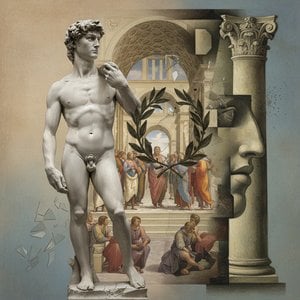
The Enduring Echo of Antiquity: Classical Ideals in Art from Renaissance to Modernism
Explore the lasting impact of classical ideals on art from the Renaissance to Modernism. Discover key movements, iconic artists & find museum-quality reproductions at ArtsDot.

Paul Cézannes 25 Mesterverk: En Kunstnerisk Reise for Ditt Hjem
Utforsk Paul Cézannes 25 mest ikoniske malerier! Oppdag historien bak impresjonismens mesterverk, fra stilleben til landskap. Finn kunsttrykk av høy kvalitet og interiørinspirasjon på ArtsDot.com.

Golden Hour on the Nile: Symbolism & Artistic Legacy of Egyptian Sunsets
Explore the rich symbolism of Egyptian sunset paintings & their artistic legacy. Discover how color, ritual, and landscape shaped ancient beliefs – a guide for discerning collectors.

Yi Eungro: Bridging East & West in the Landscape of Korean Modernism
Explore the captivating world of Yi Eungro (Lee Ungno), a pivotal figure in Korean modernism. Discover his unique fusion of Eastern and Western artistic traditions, abstract masterpieces, and lasting legacy. A must-read for discerning art collectors.

The Enduring Allure of Marble in Art History: From Classical Sculpture to Modern Abstraction
Explore the captivating history of marble sculpture from ancient Greece to modern art. Discover renowned artists like Canova & Michelangelo, carving techniques, and investment insights at ArtsDot.