

 Forhåndsvisning
 Send
Send Del
Del
 Vis detaljer
 Utskriftsvennlig guide

 Last ned bilde
 Liknende objekter
 Røntgenundersøkelse
 Lysbildefremvisning
 Spørsmål og svar
 Statistikk
Desnudo

- 30.0 x 25.0 cm


 Vis hele teksten
Kunstverket som vises på denne siden er beskyttet av opphavsretten, noe som betyr at vi ikke har juridisk tillatelse til å lage eller selge identiske reproduksjoner. Denne beskyttelsen håndheves i henhold til internasjonale avtaler som for eksempel Bernerkonvensjonen og av nasjonale lover, inkludert de som er fastsatt i Amerikansk lov om opphavsrett – Tittel 17.
Denne metoden er i fullt samsvar med opphavsrettslige regler, da den ikke innebærer kopiering eller duplisering av det beskyttede kunstverket. I stedet er det snakk om en kreativ nytolkning – et nytt maleri som er inspirert av originalen, men ikke identisk med den.
Giclée / Kunsttrykk
Giclée- eller lerretsprint av museumskvalitet med rask produksjon og fleksible valgmuligheter for etterbehandling. ( Kjøp håndmalt maleri Bytt til digitalt bilde)




P118B Nkr10

P118H Nkr10

P118W Nkr10

P438Z Nkr10

P508JH Nkr12

P508YH Nkr12

P805H Nkr10

P805Z Nkr10

P919BZ Nkr10

P919G Nkr10

P919XJ Nkr10

P959ZH Nkr10

P968JZ Nkr12

W106C Nkr8

W218G Nkr10

W218JH Nkr8

W218Y Nkr10

W307PJ Nkr10

W316G Nkr10

W316PJ Nkr8

W316Y Nkr10

W398PJ Nkr8

W4111J Nkr10

W500HY Nkr15

W500JH Nkr15

W692G Nkr12

W849H Nkr8

W940BG Nkr15

W953PJ Nkr8




Velg mellom våre forhåndsdefinerte størrelser som bevarer kunstverkets opprinnelige proporsjoner.

Skriv inn ønsket bredde og høyde for å tilpasse trykket til din ramme eller vegg. Et trykk kan kun beskjæres, aldri skaleres opp utover motivets opprinnelige størrelse, noe som betyr at et format med andre proporsjoner vil føre til tap av deler av bildet. Vi sender deg en digital mockup for godkjenning før vi starter trykkeprosessen. Bildet som vises på denne siden viser ikke den faktiske beskjæringen — det er kun mockuppen som viser dette.
Verdensomspennende levering () på 2 uker i stedet for standard 4/5 uker. (4 November)

Gratis ekspressfrakt over hele verden

Lerretsduk av lin av høy kvalitet

Full transportforsikring

Garanti for refusjon av toll og importavgifter

Garantert fargegjengivelse

100 dagers returrett ved fabrikasjonsfeil

100% pengene tilbake-garanti

Rabatt ved flere kjøp
 Glassalternativet er kun tilgjengelig i størrelser under 110 cm

Desnudo
Giclée / Kunsttrykk
Størrelse på reproduksjon
-


Totalpris for valgte alternativer
Nkr 602
Joy St Clair Hester’s “Desnudo”: A Study in Vulnerability and Expressionist Minimalism
“Desnudo,” created by Joy St Clair Hester in 1940, stands as a poignant testament to the burgeoning Expressionist movement within Australian Modernism. More than just a depiction of the human form—a recurring motif in Hester’s oeuvre—it embodies a profound exploration of emotion and psychological depth achieved through deceptively simple visual language. The artwork captures a nude female figure reclining diagonally across the canvas, bathed in diffused light that underscores its inherent softness and intimacy.Composition and Technique: Embracing Fluidity
Hester's masterful use of watercolor lends “Desnudo” an ethereal quality, prioritizing gesture and tonal variation over precise delineation. Lines are loose and expressive, guiding the viewer’s eye across the canvas without resorting to rigid geometric structures—a deliberate rejection of prevailing artistic conventions. The composition itself is deliberately asymmetrical, mirroring the vulnerability inherent in the subject matter. This imbalance contributes to a sense of dynamism and movement, suggesting an ongoing process of observation and interpretation rather than a static representation. Hester skillfully blends colors with delicate washes, creating subtle gradations that imbue the figure with warmth and luminosity.Color Palette and Symbolism: Earthy Undertones Reflect Inner Turmoil
The artwork’s color palette—primarily browns, tans, and creams—reflects an earthy sensibility characteristic of Expressionist aesthetics. However, a single touch of red on the woman's face introduces a jarring element of emotional intensity, hinting at underlying anxieties or unspoken desires. This deliberate chromatic contrast serves as a powerful symbol of inner turmoil juxtaposed with outward repose. The muted tones evoke a contemplative mood, inviting viewers to contemplate themes of solitude and introspection—central concerns within Hester’s broader artistic vision.Historical Context: Heide Circle and Artistic Rebellion
“Desnudo” emerged during the formative years of Hester's involvement in the Heide Circle, a group of Australian artists united by their commitment to exploring psychological landscapes through abstract forms. This movement challenged prevailing modernist ideals, prioritizing subjective experience over objective representation—a stance that aligns perfectly with Hester’s artistic philosophy. The Angry Penguins, spearheaded by Sidney Nolan and Albert Tucker, similarly championed bold experimentation and emotional honesty, establishing “Desnudo” as part of a larger cultural dialogue concerning the role of art in confronting existential anxieties.Emotional Impact: A Portrait of Quiet Strength
Ultimately, “Desnudo” transcends mere visual depiction; it communicates an arresting sense of vulnerability tempered by quiet resilience. Hester’s ability to distill complex emotions into simplified shapes and tonal harmonies speaks volumes about her artistic prowess—a testament to the enduring power of Expressionist minimalism to convey profound psychological truths. The artwork remains a compelling example of Australian Modernism's exploration of human experience, inviting contemplation on themes of intimacy, vulnerability, and the transformative potential of art itself.Spørsmål og svar
Hvordan harmonerer fargene i "Desnudo" med hverandre?
"Desnudo" av Joy St Clair Hester viser en Unified Palette fargeharmoni.
Hvilket rom passer best for "Desnudo", med tanke på fargepaletten?
Med sine Neutrals farger anbefales "Desnudo" for et Living Room.
Kan "Desnudo" forhåndsvises i utvidet virkelighet (AR)?
Siden for Se i AR av "Desnudo" av Joy St Clair Hester bruker utvidet virkelighet (AR) for å vise kunstverket i ditt eget rom på en kompatibel enhet.
Lignende kunstverk

![Legenden Om St. Francis - [23] - St. Francis Dødsbedrøvelse Av St. Clare — Giotto Di Bondone, Proto Renaissance](/media/artworks/images-thumb/17/1c/171c284c41dc3ef8bca83e51c1e1e531.jpg)


Om kunstneren
Joy St Clair Hester (1920-1960): Australian Modernist renowned for emotionally charged ink drawings exploring love, loss, & the human psyche. A key figure of the Angry Penguins/Heide Circle.
Joy St Clair Hester, a pivotal figure in Australian Modernism, lived a life marked by both artistic fervor and personal hardship. Born in Elwood, Australia, in 1920, her early years were shadowed by the loss of her father, an event that would subtly yet profoundly influence the emotional depth of her later work. From her formative studies at St Michael’s Grammar School and Brighton Technical School, Hester demonstrated a clear artistic inclination, culminating in recognition at the National Gallery School in Melbourne where she won the Drawing Head from Life prize in 1938. This early success signaled not just technical skill but an emerging ability to capture the essence of human form—a talent that would become her signature. It was also during this period that Hester began to break free from traditional artistic constraints, seeking a more expressive and personal visual language.Early Life and Artistic Training
Joy St Clair Hester’s childhood in Elwood instilled within her a sensitivity to observation and emotion – qualities that would permeate her entire artistic career. Following the untimely death of her father at the age of twelve, she embarked on her formal education journey, attending St Michael's Grammar School from 1933 to 1937 and subsequently pursuing Commercial Art for a year at Brighton Technical School. Her dedication to honing her craft culminated in acceptance into the National Gallery School in Melbourne in 1938 where she excelled in drawing from life, securing the prestigious Drawing Head Prize—a testament to her burgeoning talent and unwavering commitment to artistic excellence. This formative experience established a foundation for her distinctive style, characterized by meticulous detail combined with profound psychological insight.The Heide Circle and Angry Penguins: Embracing Radical Experimentation
Hester’s artistic trajectory took its most decisive turn in 1938 with her encounter with Albert Tucker—a relationship that blossomed into both romantic companionship and a collaborative partnership. This connection propelled her into the orbit of Sunday Reed, a champion of Australian art who fostered an environment ripe for artistic innovation. Together they formed the Heide Circle alongside Sidney Nolan, Arthur Boyd, and Charles Blackman – artists united by a shared desire to challenge established conventions and forge new paths in visual expression. The Heide Circle’s ethos encouraged experimentation and dialogue, fostering a spirit of intellectual curiosity that profoundly shaped Hester's artistic vision. Simultaneously, she became a founding member of the Contemporary Art Society (CAS) and bravely stood alone as the sole female participant in the groundbreaking Angry Penguins movement—a bold assertion against prevailing societal norms and an embodiment of modernist ideals. Her work within this group powerfully conveyed its rebellious spirit and unwavering commitment to pushing boundaries.A Distinctive Style: From Observation to Emotion
Hester’s artistic development was characterized by a remarkable shift away from conventional techniques toward bolder forms and more expressive lines. Initially influenced by traditional art training, she swiftly embraced a style rooted in observation and imbued with intense emotion. The 1940s witnessed her exploration of everyday life—street scenes and factory workers rendered with increasing sensitivity to human experience. However, it was her decisive decision to abandon oil painting in favor of watercolor and inks that truly cemented her artistic identity. This choice allowed for unparalleled fluidity and immediacy – perfectly suited to conveying the complexities of psychological states. Her lines became charged with emotion, often dark and sinuous—creating images that were both haunting and compelling. The shadow of World War II permeated this period, fueling her artistic impulse and prompting her to confront existential questions through visual representation. This era marked the genesis of Hester’s signature style – a raw, intensely personal expressionism conveyed through the evocative power of ink.Themes of Mortality, Love, and Loss: Exploring the Human Psyche
Joy St Clair Hester is perhaps best remembered for her series *Face,* *Sleep,* and *Love* (1948–49)—a profound meditation on human emotion and relationships. These works transcend mere portraiture; they delve into the depths of psychological experience with unflinching honesty—revealing a remarkable sensitivity to inner life. Recurring motifs – faces rendered with arresting detail, symbolic floral elements – reappear throughout her oeuvre, serving as visual anchors for her explorations of emotional landscapes. The awareness of mortality—deeply rooted in personal tragedy—became a central theme in her art—influenced by the early loss of her father and later confronted by Hodgkin’s disease—she channeled these experiences into powerful artistic statements. Her subsequent creations—including *The Lovers* (1956–58)—continued this trajectory—portraying love not as idealized romance but as a fragile and often painful reality. Hester's art stands as a testament to her ability to transform personal suffering into universal expressions of the human condition – securing her place among Australia’s most influential modernist artists. ## Legacy and Enduring Influence Despite facing obstacles in achieving widespread recognition during her lifetime, Joy St Clair Hester’s artistic legacy continues to inspire contemporary artists—particularly those drawn to expressionism and psychological exploration. Her bold use of line, masterful technique, and unwavering commitment to portraying the human psyche solidified her position as a pioneer of Australian Modern Art. Hester's enduring influence can be seen in the work of subsequent generations of artists who embrace vulnerability and strive to capture the essence of human experience—ensuring that her artistic vision remains relevant and resonant for years to come.
Joy St Clair Hester
1920 - 1960 , Australia
Kort om kunstneren
- Artistic Movement Or Style: Expressionism og Modernism
- Artists Or Movements Influenced By This Artist:
- Angry Penguins
- Heide Circle
- Artists Who Influenced This Artist:
- Ailsa O'Connor
- Danila Vassilieff
- Date Of Birth: August 21, 1920
- Date Of Death: December 4, 1960
- Full Name: Joy St Clair Hester
- Nationality: Australiansk
- Notable Artworks:
- Face serien
- Love serien
- The Lovers
- Place Of Birth: Elsternwick, Australia
Relaterte artikler

De 10 mest ikoniske akvarellmesterverkene som revolusjonerte kunsten | ArtsDot.no
Oppdag de 10 mest legendariske akvarellmesterverkene av kunstnere som Turner, Monet & Goya. Lær om historien bak ikoniske malerier og finn inspirasjon til interiørdesign. Museumskvalitet reproduksjoner på ArtsDot.no – utforsk samlingen online!

Ephemeral Visions: Exploring the Artistic Legacy & Contemporary Practice of Watercolor Painting
Explore the captivating world of watercolor painting! Discover its rich history, essential techniques, influential artists & collecting tips. A comprehensive guide for art enthusiasts from ArtsDot.
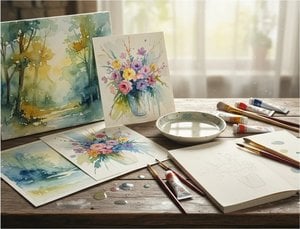
Ephemeral Visions: Exploring the Artistic Legacy & Nuances of Watercolor Painting
Explore the captivating world of watercolor painting! Discover its rich history, essential techniques, influential artists & collecting tips from art experts. A comprehensive guide for enthusiasts.

Akvarellens tidløse appell: Historie, teknikker og moderne praksis
Utforsk akvarellens fascinerende verden! Lær om historien, teknikker og moderne praksis. Få eksperttips for å mestre akvarellmaling – fra nybegynner til viderekommen.

Ephemeral Visions: Exploring the History & Emotional Resonance of Watercolor Painting
Explore the captivating history of watercolor painting, from ancient techniques to modern masters like Kandinsky & Blake. Discover essential artists, collecting tips & the emotional power of this luminous medium. Expert insights for art enthusiasts.