


 Se i rommet
 Del som digitalt kort
 Del
Del
 Detaljer
 Studentguide

 Last ned
 Liknende objekter
 Røntgen
 Lysbildefremvisning
 Besøksstatistikk
The Studio (VI)


 Les mer
Kunstverket som vises på denne siden er beskyttet av opphavsretten, noe som betyr at vi ikke har juridisk tillatelse til å lage eller selge identiske reproduksjoner. Denne beskyttelsen håndheves i henhold til internasjonale avtaler som for eksempel Bernerkonvensjonen og av nasjonale lover, inkludert de som er fastsatt i Amerikansk opphavsrettslov – Tittel 17.
Denne metoden er i fullt samsvar med opphavsrettslige regler, da den ikke innebærer kopiering eller duplisering av det beskyttede kunstverket. I stedet er det snakk om en kreativ nytolkning – et nytt maleri som er inspirert av originalen, men ikke identisk med den.
Giclée / Kunsttrykk
Giclée- eller lerretsprint av museumskvalitet med rask produksjon og fleksible valgmuligheter for etterbehandling. ( Bestill håndmalt reproduksjon Gå til digitalt bilde)




P118B Nkr10

P118H Nkr10

P118W Nkr10

P438Z Nkr10

P508JH Nkr12

P508YH Nkr12

P805H Nkr10

P805Z Nkr10

P919BZ Nkr10

P919G Nkr10

P919XJ Nkr10

P959ZH Nkr10

P968JZ Nkr12

W106C Nkr8

W218G Nkr10

W218JH Nkr8

W218Y Nkr10

W307PJ Nkr10

W316G Nkr10

W316PJ Nkr8

W316Y Nkr10

W398PJ Nkr8

W4111J Nkr10

W500HY Nkr15

W500JH Nkr15

W692G Nkr12

W849H Nkr8

W940BG Nkr15

W953PJ Nkr8




Velg mellom våre forhåndsdefinerte størrelser som bevarer kunstverkets opprinnelige proporsjoner.

Type the width and the height you need, to fit your frame or your wall. A print can only be cut, never made bigger than the picture, so a size with a different shape loses a part of the image. We send you a digital mockup to approve before we print anything. The picture shown on this page does not show the real cut — only the mockup does.
Verdensomspennende levering () på 2 uker i stedet for standard 4/5 uker. (14 October)

Gratis ekspressfrakt over hele verden

Lerretsduk av høykvalitets lin

Full transportforsikring

Garanti for refusjon av toll og importavgifter

Garantert fargeekthet

100 dagers returrett ved fabrikasjonsfeil

100% pengene tilbake-garanti

Mengderabatt
 Glassalternativet er kun tilgjengelig i størrelser under 110 cm

The Studio (VI)
Giclée / Kunsttrykk
Format på reproduksjon
-


Totalpris
Nkr 580
Georges Braque: The Architect of Cubism
Georges Braque (1882–1963) stands as a monumental figure in the history of modern art, inextricably linked to Pablo Picasso and the genesis of Cubism. More than just an artist, he was a meticulous craftsman who relentlessly interrogated artistic conventions—a quest that yielded groundbreaking results and cemented his legacy as one of the most influential painters of the 20th century.
- Early Life & Artistic Foundations: Born in Argenteuil, France, Braque’s upbringing instilled within him a profound appreciation for form and structure—a sensibility honed by his father's profession as a house painter. This practical grounding combined with formal training at the École des Beaux-Arts in Le Havre provided him with an unparalleled understanding of materials and techniques.
- The Fauvist Breakthrough: Braque’s artistic journey commenced with Impressionism, but he was profoundly moved by Henri Matisse's Fauvist paintings. Embracing bold colors—a deliberate rejection of academic tradition—he collaborated closely with artists like Raoul Dufy and Othon Friesz to explore expressive possibilities within this vibrant movement.
- The Birth of Cubism: The encounter between Braque and Picasso in 1907 marked a pivotal moment, propelling them into the forefront of Cubist experimentation. Influenced by Cézanne’s geometric simplification and inspired by African sculpture and Iberian art, they dismantled traditional perspective, presenting objects from multiple viewpoints simultaneously—a revolutionary approach that challenged viewers' perceptions.
- Analytical Cubism: Braque’s Analytical Cubism (1908–1912) is characterized by monochromatic color palettes and fractured forms meticulously rendered to convey spatial illusion. Paintings like “Houses at L’Estaque” exemplify this technique, demonstrating Braque's unwavering dedication to dissecting visual reality.
- Synthetic Cubism: Moving towards Synthetic Cubism (1912–1914), Braque incorporated collage elements—fragments of newspaper and fabric—into his canvases. This innovative method further expanded the boundaries of artistic expression, reflecting a broader cultural fascination with new materials and processes.
“The Studio” (VI): A Reflection of Artistic Process
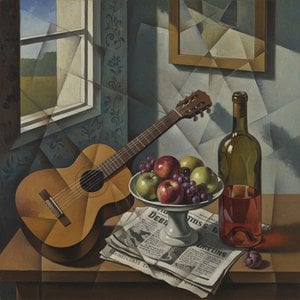
Georges Braque’s “The Studio” (VI), completed in 1951, embodies the culmination of his artistic evolution—a masterful distillation of Cubist principles tempered by a contemplative sensibility. This still life captures a moment of quiet observation within an artist's workspace, inviting viewers to contemplate the complexities of creative endeavor.
The painting’s monochrome palette—primarily ochre and brown—creates a subdued atmosphere that underscores Braque’s fascination with Cézanne’s exploration of form and structure. The fragmented depiction of objects—a chair, vases, bottles, and a cup—mirrors the Cubist technique of presenting multiple viewpoints simultaneously.
Notably, Braque incorporated handwritten script into the composition—a deliberate gesture that symbolizes the act of artistic creation itself. These lines disrupt the geometric precision of Cubism, adding textural richness and hinting at an underlying intellectual engagement with Cézanne’s legacy. The overall effect is one of serene contemplation—a testament to Braque's enduring belief in the transformative power of art.
Symbolic Significance & Emotional Impact
“The Studio” transcends mere visual representation; it speaks to the core values of Braque’s artistic philosophy. The inclusion of objects associated with an artist’s profession—the chair, the instruments—suggests a preoccupation with craftsmanship and intellectual rigor. Simultaneously, the muted color scheme evokes feelings of tranquility and introspection.
Braque's masterful handling of light and shadow contributes to the painting’s emotional resonance, capturing the subtle nuances of an artist’s environment. The composition encourages viewers to engage in a dialogue with the artwork—to contemplate its formal qualities alongside its symbolic implications.
Spørsmål og svar
Finnes det verk som ligner på "The Studio (VI)"?
Kunstverk som ligner på "The Studio (VI)" av Georges Braque er samlet på verkets Lignende verk-side.
Hva forestiller "The Studio (VI)" av Georges Braque?
Motivene i "The Studio (VI)" er still life, composition, geometric forms, monochrome palette, atelier, bird, texture.
Hva er den dominerende fargetonen i "The Studio (VI)" av Georges Braque?
En Ochre to Sepia nyanse preger "The Studio (VI)" av Georges Braque.
Relaterte kunstverk


Kunstnerbiografi
Early Life and Artistic Foundations
Georges Braque, født i Argenteuil ved Paris i 1882, begynte en reise dypt forankret i det stadig skiftende landskapet til moderne kunst. Hans barndom i en familie av husmalere og dekoratører la ikke bare grunnlag for en teknisk mesterskap over materialer, men også en tidlig forståelse for form og struktur. Selv om han først fulgte i farens fotspor i håndverkstiden, førte hans iboende kunstneriske impulser snart til formell utdannelse ved École des Beaux-Arts i Le Havre, og markerte starten på hans vei mot å bli en av de mest innflytelsesrike malerne på det 20. århundre. Denne bakgrunnen – en blanding av praktisk håndverkssjappe og akademisk studie – ville vise seg å være avgjørende da han senere dekonstruerte og reimplementerte tradisjonelle kunstneriske konvensjoner.
Da han flyttet til Paris i 1902, fortsatte Braque studiene ved Académie Humbert, og fordypet seg i den pulserende kunstneriske miljøet i byen. Det var her han møtte kunstnere som Marie Laurencin og Francis Picabia, og etablerte forbindelser som ville forme hans tidlige utvikling. Hans innledende verk reflekterte de dominerende influensene fra impresjonisme og postimpresjonisme, men en avgjørende møte med den dristige fargen og det uttrykksfulle friheten i fauvismen i 1905 tenner en ny retning i hans kunstneriske utforskning.
The Embrace of Fauvism and the Dawn of Cubism
Braques overtagelse av fauvistiske prinsipper – karakterisert ved intens, ikke-naturalistisk farge og emosjonell uttrykk – illustreres levende i malerier som The Patience. Denne perioden så ham arbeide sammen med kunstnere som Henri Matisse og André Derain, eksperimentere med livlige paletter og forenklede former. Imidlertid var Braques engasjement med fauvismen ikke bare etterlignende; han infuserte det med en unik sans forhetning, tempererte bevegelsens ukontrollerte utbrudd med en mer dempet og analytisk tilnærming.
Et vendepunkt kom i 1907 med hans eksponering mot retrospektivet av Paul Cézannes verk. Cézannes vektlegging av geometriske former og flere perspektiver hadde en dyptgripende innvirkning på Braque, og la grunnlaget for hans banebrytende samarbeid med Pablo Picasso. Fra 1908 begynte disse to kunstneriske titanene en intens intellektuell utveksling som ville føre til fødselen av kubisme – en revolusjonerende bevegelse som knuste tradisjonelle forestillinger om representasjon.
Sammen utviklet Braque og Picasso analytisk kubisme, dekonstruerte objekter i fragmenterte geometriske former og presenterte dem fra flere perspektiver samtidig. Verk som Houses at L'Estaque demonstrerer denne tidlige fasen, og viser en radikal avvik fra konvensjonelle perspektiver og et fokus på den underliggende strukturen til formene.
Innovation Through Fragmentation and Collage
Partnerskapet mellom Braque og Picasso fortsatte å presse grensene for kunstnerisk uttrykk, noe som førte til utviklingen av syntetisk kubisme rundt 1912. Denne fasen så introduksjonen av collage – integreringen av virkelige materialer som avisutklipp og tapetet i maleriene. Denne innovasjonen utfordret den tradisjonelle hierarkiet mellom kunst og skulptur, og uskarpet grensene mellom kunst og liv.
Braques banebrytende bruk av *papier collé* (pasted paper) markerte et betydelig vendepunkt i hans kunstneriske utvikling. Ved å integrere fragmenter av hverdagsgjenstander inn i komposisjonene sine, forstyrret han den illusjonistiske plassen til tradisjonelt maleri og introduserte et nytt nivå med materialitet og tekstur.
Krigen i 1914 brøt ut, og avbrøt denne intense samarbeidet, da Braque ble kalt inn for militærtjeneste. Hans krigserfaringer påvirket dypt hans kunstneriske visjon, noe som førte til at han utforsket mer personlige og lyriske temaer i sitt etterkrigsverk.
Later Years and Enduring Legacy
Etter krigen utviklet Braques stil seg utover de strenge grensene for tidlig kubisme, og integrerte elementer av klassisk komposisjon og en ny interesse for landskap. Mens han beholdt de geometriske innflytelser som hadde definert hans tidligere arbeid, utviklet han en mer nyansert og kontemplativ tilnærming til maleri.
I løpet av hele sin karriere fortsatte Braque å utforske de grunnleggende prinsippene for form, rom og representasjon. Han eksperimenterte med forskjellige materialer og teknikker, og presset grensene for kunstnerisk uttrykk frem til sin død i 1963. Hans innflytelse på etterfølgende generasjoner av kunstnere er ubestridelig, og har formet banen for moderne kunst og inspirert utallige malere, skulptører og collagister.
Influences and Notable Works
- Influenced By: Henri Matisse, André Derain, Paul Cézanne
- Key Works: Houses at L'Estaque, The Patience, Violin and Palette, Mandola
- Impact on Art History: Revolutionized 20th-century art through Cubism; challenged traditional notions of perspective and representation.

Georges Braque
1882 - 1963 , Frankrike
Kort om kunstneren
- Artistic Movement Or Style: Kubisme, Fauvisme
- Artists Or Movements Influenced By This Artist: ['Impressionisme']
- Artists Who Influenced This Artist:
- Henri Matisse
- Pablo Picasso
- Date Of Birth: 13 mai 1882
- Date Of Death: 31 aug 1963
- Full Name: Georges Braque
- Nationality: Fransk
- Notable Artworks:
- Huse ved L'Estaque
- Tålmodighet
- Fiolin og palett
- Place Of Birth: Argenteuil, Frankrike
Relaterte artikler
Deconstructing Reality: A Comprehensive Exploration of Cubist Still Life
Explore the revolutionary world of Cubist Still Life with ArtsDot. Discover Picasso & Braque's groundbreaking techniques, its philosophical roots, and lasting impact on modern art. Expert insights for collectors.

Georges Seurat: Topp 25 Maler – Impresjonisme og Punktillismens Mesterverk | ArtsDot.no
Utforsk Georges Seurats 25 mest ikoniske malerier! Oppdag historien bak punktillismen, impresjonismen og mesterverk som 'Et søndagsettermiddag på La Grande Jatte'. Finn kunsttrykk av høy kvalitet for ditt hjem på ArtsDot.com.

Georges Braque: Pioneering Cubism & the Evolution of Modern Form
Explore the revolutionary art of Georges Braque, a pioneer of Cubism alongside Picasso. Discover his artistic evolution, key works, and lasting impact on modern art. A guide for discerning collectors.

Georges Braques 25 Mesterverk: En Kunstnerisk Reise for Din Bolig
Utforsk Georges Braques 25 mest ikoniske verk! Fordyp deg i kubismens verden, fargepaletter og kunstnerisk nyskapning. Finn inspirasjon til din bolig med museumskvalitets reproduksjoner på ArtsDot.com.

Geometrisk Abstraksjon: Topp 10 Mesterverk for Kunstelskere – ArtsDot.com
Utforsk de 10 mest innflytelsesrike verkene innen geometrisk abstraksjon! Oppdag historiene bak Mondrian, Kandinsky og Malevich. Finn inspirasjon til interiøret med ArtsDot.coms eksklusive reproduksjoner – museumskvalitet for ditt hjem. Utforsk samlingen online!


