

- 280.0 x 450.0 cm


Bildet følger dine valg: , .
Beskrivelse av objektet
Featuring inverted figures and bold chromatic harmonies, Georg Baselitz's Supper in Dresden captures a powerful Neo-Expressionist moment that invites you to explore the depths of this monumental masterpiece.
 Vis hele teksten
Om kunstneren
Explore the powerful & provocative work of Georg Baselitz (b. 1938), a leading Neo-Expressionist known for his upside-down figures, challenging perspectives on German history, destruction, and the artifice of painting. Discover his sculptures & graph
Håndlaget oljereproduksjon
Håndmalt olje på lerret i din valgte størrelse og ramme, laget på bestilling av våre kunstnere. ( Bytt til trykk Bytt til digitalt bilde)
Dette kunstverket er beskyttet av opphavsrett
Kunstverket som vises på denne siden er beskyttet av opphavsretten, noe som betyr at vi ikke har juridisk tillatelse til å lage eller selge identiske reproduksjoner. Denne beskyttelsen håndheves i henhold til internasjonale avtaler som for eksempel Bernerkonvensjonen og av nasjonale lover, inkludert de som er fastsatt i Amerikansk lov om opphavsrett – Tittel 17.
Som et respektfullt og lovlig alternativ tilbyr vi skreddersydde, håndmalte kunstverk inspirert av originalen. Våre dyktige og profesjonelle kunstnere studerer nøye originalens stil, stemning og kunstneriske essens for å skape et nytt og unikt verk som vekker den samme følelsen – samtidig som det forblir en original skapelse i seg selv.
Denne metoden er i fullt samsvar med opphavsrettslige regler, da den ikke innebærer kopiering eller duplisering av det beskyttede kunstverket. I stedet er det snakk om en kreativ nytolkning – et nytt maleri som er inspirert av originalen, men ikke identisk med den.
Les mer om dette maleriet
 Forhåndsvisning
 Send
Send Del
Del
 Vis detaljer
 Utskriftsvennlig guide

 Last ned bilde
 Liknende objekter
 Røntgenundersøkelse
 Lysbildefremvisning
 Spørsmål og svar
 Statistikk
Bestill maleriet ditt i fire enkle trinn
Ta deg god tid. Du kan endre alle svar; prisen i handlekurven din oppdateres etter hvert valg.
1 Trinn én av fire
Hvilken størrelse ønsker du?
Disse størrelsene bevarer de originale proporsjonene til maleriet. Tegningen viser ditt valg på en vegg, over en to meter lang sofa.
Eller oppgi egne mål
Velg mellom våre forhåndsdefinerte størrelser som bevarer kunstverkets opprinnelige proporsjoner.

Skriv inn ønsket bredde og høyde for å tilpasse bildet til din ramme eller vegg. Siden dette er håndmalt, kan kunstneren male litt mer rundt motivet eller beskjære det noe dersom du velger et annet format — valget er ditt. Vi sender deg en digital mockup til godkjenning før maleriet påbegynnes. Bildet som vises på denne siden representerer ikke det faktiske resultatet — kun mockuppen viser det endelige uttrykket.
2 Trinn to av fire
Hvordan skal det klargjøres: rullet, strukket eller innrammet?
Prisene nedenfor gjelder for størrelsen du valgte i trinn én.
Velg kantutførelse på lerretet
Velg din ramme

Hvit kant Nkr1

Uskarp kantfinish Nkr1

Fortsatt motiv Nkr1

P118B Nkr10

P118H Nkr10

P118W Nkr10

P438Z Nkr10

P508JH Nkr12

P508YH Nkr12

P805H Nkr10

P805Z Nkr10

P919BZ Nkr10

P919G Nkr10

P919XJ Nkr10

P959ZH Nkr10

P968JZ Nkr12

W106C Nkr8

W218G Nkr10

W218JH Nkr8

W218Y Nkr10

W307PJ Nkr10

W316G Nkr10

W316PJ Nkr8

W316Y Nkr10

W398PJ Nkr8

W4111J Nkr10

W500HY Nkr15

W500JH Nkr15

W692G Nkr12

W849H Nkr8

W940BG Nkr15

W953PJ Nkr8

H24-GOLD Nkr30

H24-SILVER Nkr30

H36-GOLD Nkr45

H36-SILVER Nkr45
Innrammet
Profil: . Total størrelse med ramme: .
3 Trinn tre av fire
Ønsker du at noe skal endres i maleriet?
De fleste svarer nei. Siden hvert maleri er håndlaget, kan kunstneren vår også tilpasse det for deg.
Etter bestilling vil ArtsDot.com-teamet sende e-post til kunden for instruksjoner og sende et utkast som forhåndsvisning
4 Trinn fire av fire
Noen valgmuligheter for finish
Alle er valgfrie. Svarene som allerede er valgt, medfører ingen ekstra kostnad.
Hvem har malt det?
Verdensomspennende levering () på 3–4 uker i stedet for standard 5 uker. (8 November). Ingen kompromisser med kvaliteten.
En navneplate, som på et museum?
Detaljer om gravert bronseplate
This elegant plaque features the artist's name and the title of the artwork, finely engraved for a timeless presentation.
It is made from bronze with a refined, elegant finish. The text is precisely laser-engraved for a sharp and permanent result. Measuring 9x2 cm, the plaque is compact yet easy to read. It's built to be durable and scratch-resistant, offering a professional, museum-quality look. Mounting is simple thanks to the included adhesive backing.
Detaljer om gjennomsiktig akrylplate
The plaque includes essential engraved details such as the artist's name, the title of the artwork, the date it was created, the type of media used-like oil on canvas or watercolor-a brief description of the piece, and a QR code that links to the complete artwork information.
It is crafted from clear acrylic, offering a sleek, modern appearance. The text is UV-engraved in black to ensure strong visual contrast. With a size of 10x15 cm, it ensures optimal readability. It comes equipped with two metal hooks for secure wall mounting. The plaque is designed to be weather-resistant, making it suitable for various environments, and it includes interactive features that work seamlessly with smartphone scanning.
Detaljer om plakett i svart akryl
This elegant plaque includes engraved information such as the artist's name, the title of the artwork, the date it was created, the type of media used (like oil on canvas or watercolor), a short description of the artwork, and a QR code for quick access to more information.
The plaque itself is made from refined black acrylic with a premium finish. The text is laser-engraved in white for high contrast and readability. Its size is 10x15 cm, designed to be easy to read. It comes with two metal hooks for professional mounting. The design is sleek and fits any interior style. It is also weather-resistant and durable, with built-in digital integration for mobile compatibility.
En beskyttende lakk?
Når trenger du det?
✓ Kontroller og bestill
Ditt maleri, slik du bestilte det

Supper in Dresden
Trykkmetode
Størrelse på reproduksjon
-

Utvalgte mesterkunstnere
Mer detaljrikdom, finesse og ekstra produksjonstid
-

Innramming av reproduksjon
-
-
For kunstverk eller reproduksjoner som er større enn 105 cm (ca. 41 tommer) på noen side, vil rammen bli sendt som et sett som må monteres. Denne metoden sikrer trygg levering og forhindrer skader under transport.
Krever profesjonell montering – dette er ikke et DIY-produkt.
Settet må monteres og lerretet strammes av en erfaren profesjonell rammelegger, ved bruk av trelim (følger ikke med), en lerretstang og klemmer for å holde rammelisten vinkelrett mens limet tørker. Feilaktig montering eller ujevn stramming av lerretet kan påføre kunstverket permanente skader og er
 For kunstverk eller reproduksjoner som er større enn 105 cm (ca. 41 tommer) på noen side, vil rammen bli sendt som et sett som må monteres. Denne metoden sikrer trygg levering og forhindrer skader under transport.
Alle massive trelister er inkludert, presist tilpasset i størrelse.
Monteres med de medfølgende skruene, samt trelim til hjørnene, som ikke er inkludert og må anskaffes av din rammehandler.
Profesjonelt verktøy er nødvendig og er ikke inkludert: en lerretstang (strammer) og klemmer for å holde rammene vinkelrette mens limet tørker.
Viktig:
Hjørnene krever trelim, listene må holdes på plass med tvinger til limet er helt tørt, og stramming av lerretet på den ferdige rammen krever en lerretstang. Ingen av disse produktene er inkludert i settet. Vennligst sørg for tilgang til en erfaren profesjonell rammehandler før du bestiller denne størrelsen.

Navneskilt
-
-

Beskyttende ferniss
Blank lakk (forsterker farger, beskytter mot lys og fuktighet)
-

Tilpass mitt kunstverk
Eksempler på hva som kan endres: Erstatt ansikt med bilde av kunden; Legg til kjæledyr (f.eks. bytt ut katt med hund); Inkluder en skjult melding i bakgrunnen; Endre bakgrunnslandskap eller elementer.
-

Ekspresslevering
Verdensomspennende levering () på 3–4 uker i stedet for standard 5 uker. (8 November). Ingen kompromisser med kvaliteten.
-
Ekspresslevering
Verdensomspennende levering til innen 5 uker. (15 November).
Inkludert frakt
Totalpris for valgte alternativer
Nkr 2515
Glassalternativet er kun tilgjengelig i størrelser under 110 cm
Inkludert med hver bestilling
- Gratis ekspressfrakt over hele verden
- Lerretsduk av lin av høy kvalitet
- Full transportforsikring
- Garanti for refusjon av toll og importavgifter
- Garantert fargegjengivelse
- 100 dagers returrett ved fabrikasjonsfeil
- 100% pengene tilbake-garanti
- Rabatt ved flere kjøp


A Masterpiece of Inversion: Reimagining History in Baselitz's Supper in Dresden
In the vast, commanding expanse of Supper in Dresden, viewers are invited into a world where reality is turned on its head—quite literally. This monumental oil on canvas, stretching over four meters in length, serves as a profound testament to the genius of Georg Baselitz, one of the most provocative voices of the Neo-Expressionist movement. At first glance, the painting presents a chaotic, almost feverish gathering around a long dining table, yet beneath this surface of disundress lies a deeply layered exploration of identity and artistic heritage. The composition oscillates between recognizable figuration and robust, chromatic harmonies, where striking shades of pink, blue, and black collide to create a sense of restless energy that captures the eye and refuses to let go.
The technique employed by Baselitz in this 1983 masterpiece is nothing short of revolutionary. By famously inverting his subjects, he de-emphasizes the literal content of the scene to bring the raw materiality of painting—the brushstroke, the texture, and the color—to the forefront. This deliberate subversion forces the viewer to look past the "what" of the image and instead experience the "how." The central figure, with eyes and mouth agapped in a silent, haunting cry, dominates the canvas, acting as an emotional anchor amidst the surrounding figures who seem to drift toward the edges of the frame. This tension between the central focus and the peripheral movement creates a psychological depth that makes the work feel alive, breathing with a nervous, almost agonized vitality.
Historical Echoes and Symbolic Depth
Beyond its striking visual impact, Supper in Dresden is steeped in historical symbolism and personal reflection. While the motif of a shared meal evokes the sacred tradition of the Last Supper, Baselitz uses this framework to pay homage to the birth of German Expressionism. The painting serves as a spectral gathering of the Die Brücke group; specifically, it depicts the meeting of Expressionists in 1905 that gave rise to this influential artistic movement. Within this chaotic feast, one can identify the nervous, agonized-looking figure on the left as Ernst Ludwig Kirchner, while the dominant central figure is said to represent Karl Schmidt-Rotluff. In a surreal twist of form, the two close friends Otto Müller and Erich Heckel appear on the right, sharing a single body.
This layering of history allows the painting to function as both a personal memoir and a cultural monument. For collectors and enthusiasts, the work offers more than just visual spectacle; it provides a window into the fractured order of a post-war society. Baselitz, who grew up amidst the literal and metaphorical rubble of World War II, uses this inversion to mirror a world that had been turned upside down by conflict. The painting captures the very essence of reconstruction—the attempt to find meaning and form in the midst of displacement and destruction.
An Essential Addition for Discerning Spaces
For interior designers and art collectors seeking to anchor a room with intellectual weight and dramatic flair, Supper in Dresden offers unparalleled presence. Its massive scale and bold, contrasting palette make it an ideal centerpiece for grand galleries, sophisticated lofts, or contemporary executive suites. The work does not merely decorate a wall; it commands the atmosphere of a space, inviting conversation and deep contemplation.
Whether you are drawn to the raw, expressive power of the Neo-Expressionist movement or the complex historical narratives woven into every brushstroke, a high-quality reproduction of this masterpiece brings a sense of prestige and profound emotion to any environment. It is an investment in a piece of art history that continues to challenge our perceptions of reality, making it a timeless choice for those who appreciate art that is as intellectually stimulating as it is visually breathtaking.
Spørsmål og svar
Er fargene i "Supper in Dresden" sterke eller dempede?
Fargene i "Supper in Dresden" av Georg Baselitz har en Balanced Soft metning med en Balanced intensitet.
Hva er lysstyrken i "Supper in Dresden" av Georg Baselitz?
"Supper in Dresden" av Georg Baselitz har en luminans på Soft Shadow. Luminans beskriver hvor mye lys fargene ser ut til å reflektere.
Hvordan relaterer stilen i "Supper in Dresden" seg til kunstnerens epoke?
"Supper in Dresden" av Georg Baselitz tilhører Neo-Expressionism-retningen, innenfor skaperens Modern-epoke.
Lignende kunstverk


Georg Baselitz
1938 -
Om kunstneren
A Life Forged in the Shadows of History
Born Hans-Georg Bruno Kern on January 23, 1938, in the small German village of Deutschbaselitz, the artist who would become known to the world as Georg Baselitz was a child of profound transition and upheaval. Growing up in the Upper Lusatia region amidst the literal and metaphorical rubble of World War II, his early consciousness was inextricably linked to themes of destruction, displacement, and the fractured order of a shattered society. This formative environment—marked by the loss of community and the lingering trauma of occupation—became the bedrock of his artistic vision. The devastation he witnessed did not merely provide subject matter; it instilled in him an urgent, lifelong need to question established conventions and to explore the very nature of perception through the lens of a world that had been turned upside down.
His early artistic inclinations were nurtured by a deep intellectual curiosity and significant cultural encounters. The influence of his father, an elementary school teacher, fostered a disciplined approach to observation, while the profound writings of Jakob Böhme provided a spiritual and philosophical complexity to his worldview. A pivotal moment in his development occurred when he encountered Louis-Ferdinand von Rayski’s Wermsdorfer Wald at a local school assembly. This masterpiece of realism ignited a fascination with capturing visual truth, leading him to produce portraits, religious subjects, and landscapes that, even in his youth, hinted at a more futuristic and unsettling vision.
The Revolution of Inversion and Neo-Expressionism
As the art world moved toward the sterile intellectualism of Minimalism and Conceptual Art in the 1960s, Baselitz staged a visceral rebellion. He became a leading voice of Neo-Expressionism, a movement that sought to reclaim the raw power and emotional intensity of figurative painting. However, his contribution was far from a simple return to tradition. In 1969, Baselitz introduced one of the most radical innovations in modern art: the technique of painting his subjects upside down. This deliberate inversion was not a mere gimmick; it was a profound attempt to strip the subject of its representational, content-driven character. By turning the figure on its head, he forced the viewer to confront the artifice of the painting itself—to look past the "what" of the image and focus instead on the texture, color, and the physical reality of the paint on canvas.
This period saw the emergence of works that challenged the very boundaries of the medium. His compositions often oscillated between recognizable figuration and a chaotic, feverish energy. In monumental pieces like Supper in Dresden, he reimagined historical narratives through a lens of disarray and chromatic collision, using striking shades of pink, blue, and black to create a sense of restless, uncontainable energy. His work during this era functioned as an excavation of the human condition, utilizing distortion to express vulnerability and the inherent instability of memory and identity.
A Lasting Legacy of Provocation
Throughout his prolific career, Baselitz’s artistic language has been a complex tapestry woven from myriad influences, ranging from the starkness of Socialist Realism and the dramatic tension of Mannerism to the primal rhythms of African sculpture. This eclectic synthesis allowed him to create a body of work that feels both deeply rooted in German history and universally resonant in its exploration of existential struggle. Whether through his commanding oil paintings, his evocative sculptures, or his intricate graphic works, Baselitz has remained steadfast in his commitment to a style characterized by unsettling honesty.
The historical significance of Georg Baselitz lies in his ability to transform the trauma of the past into a revolutionary aesthetic for the future. He did not merely document destruction; he used it as a tool to rebuild the language of painting. His achievements include:
- Redefining Figuration: Breaking the reliance on narrative content through the radical use of inversion.
- Mastery of Neo-Expressionism: Leading a global revival of emotional, visceral painting in an era of conceptual dominance.
- Exploration of Identity: Using distorted forms to grapple with the complexities of post-war German identity and the fragility of the human form.
- Technical Innovation: Integrating diverse cultural influences into a singular, unmistakable artistic voice that continues to influence generations of painters and sculptors.
Today, Baselitz stands as one of the most influential figures of the twentieth century, a painter whose work remains a powerful testament to the resilience of creativity in the face of chaos.
Relaterte artikler
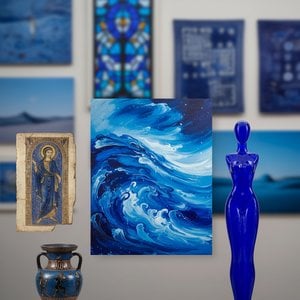
The Allure of Azure: Exploring the Symbolic & Aesthetic Depths of Blue in Art History
Explore the rich history of blue in art! Discover its symbolism, from ancient pigments to modern masterpieces by Kandinsky & Seurat. Uncover the psychological impact and cultural meanings behind this captivating hue.

Lys Rosa Magi: Topp 10 Malerier som Odefinerer Skjønnhet og Stemning
Oppdag 10 ikoniske malerier dominert av lys rosa toner! Fra Monet til Renoir, utforsk historien og skjønnheten bak disse mesterverkene. Finn kunsttrykk i museumskvalitet for ditt hjem på ArtsDot.com – inspirasjon og luksusinteriør venter!

De 10 mest ikoniske malerier dominert av slåttegrå – Kunsthistorie og interiørinspirasjon
Oppdag de 10 mest ikoniske malerier dominert av slåttegrå – fra Monet til Van Gogh. Lær om kunsthistorien, fargetoner og teknikker bak disse mesterverkene. Finn din perfekte veggkunst og interiørinspirasjon på ArtsDot.com! Utforsk samlingen online.