

 Send
Send Del med andre
 Vis detaljer

 Last ned bildet
 Liknende objekter
 Lysbildefremvisning
Untitled


 Vis hele teksten
Håndlaget oljereproduksjon
Håndmalt olje på lerret i din valgte størrelse og ramme, laget på bestilling av våre kunstnere. ( Bytt til trykk Bytt til bilde)




































Velg mellom våre forhåndsdefinerte størrelser som bevarer kunstverkets opprinnelige proporsjoner.

Du kan angi egne mål for å tilpasse en spesifikk ramme eller plass. Dersom den valgte størrelsen ikke samsvarer med originalbildets proporsjoner, vil vi enten beskjære kunstverket eller utvide maleriet med ytterligere håndmalte elementer. En digital mockup vil bli sendt til din godkjenning før produksjonen starter.
Vennligst merk at forhåndsvisningen på skjermen ikke gjenspeiler den faktiske beskjæringen eller utvidelsen. Kun mockuppen vil vise den endelige komposisjonen nøyaktig.
Selv om tilpassede størrelser er tilgjengelige, anbefaler vi å velge et mål fra den forhåndsdefinerte listen for å bevare de originale proporsjonene.
Etter bestilling vil ArtsDot.com-teamet sende e-post til kunden for instruksjoner og sende et utkast (mockup) som forhåndsvisning.
Verdensomspennende levering () på 3–4 uker i stedet for standard 5 uker. (10 August). Ingen kompromisser med kvaliteten.

Gratis ekspressfrakt over hele verden

Lerretsduk av høykvalitets lin

Full forsikring under transport

Garanti for refusjon av toll og importavgifter

Garantert korrekt fargegjengivelse

60 dagers returrett (kun ved feil)

100% pengene tilbake-garanti

Rabatt ved flere kjøp
 Glassalternativet er kun tilgjengelig i størrelser under 110 cm

Untitled
Teknikk for reproduksjon
Størrelse på reproduksjon
-


Endelig pris
$ 263
Beskrivelse av kunstverket
The Geometry of Emotion: A Study in Red
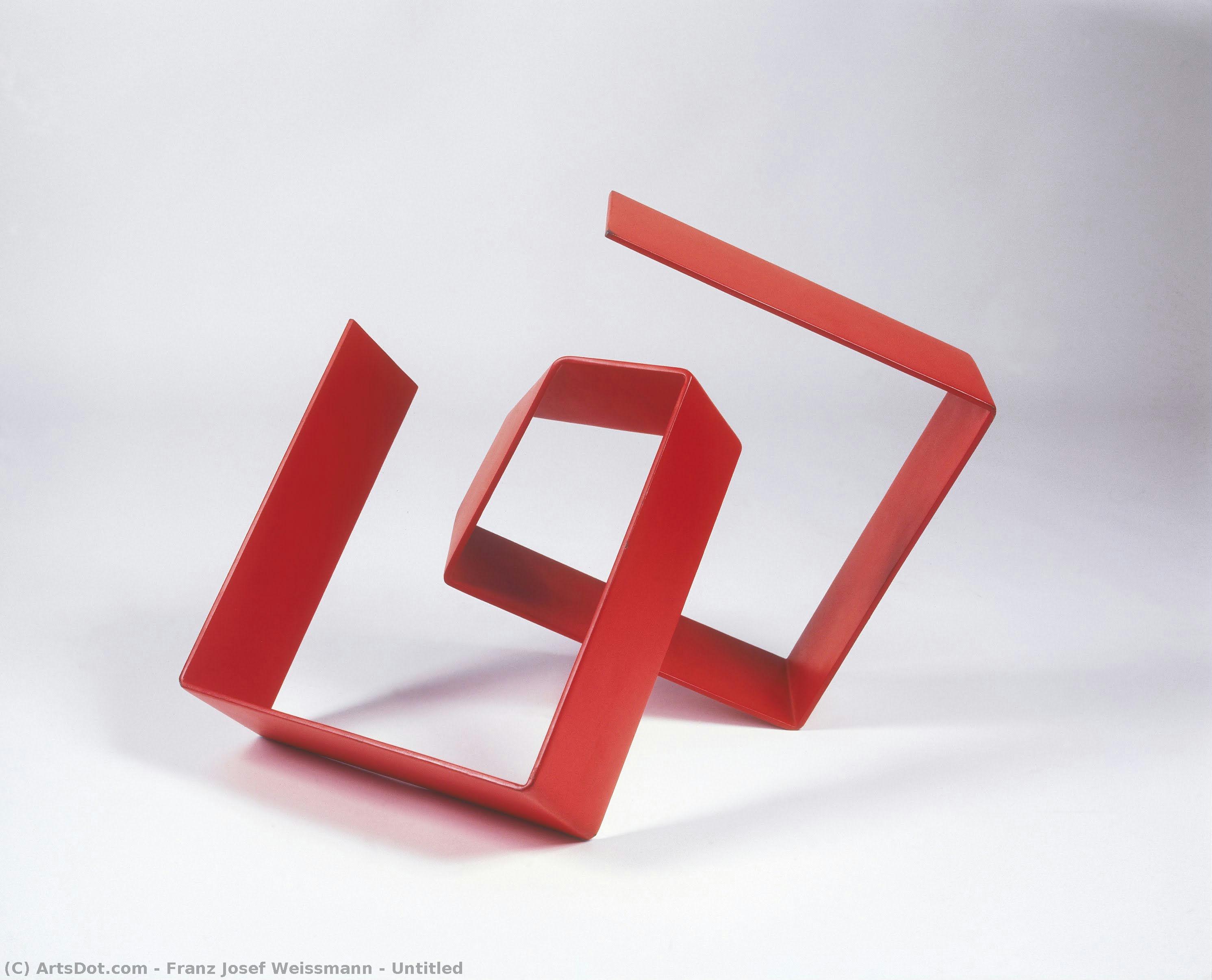
In the realm of geometric abstraction, few works command attention with such visceral intensity as this untitled masterpiece by Franz Josef Weissmann. Created in 1986, this sculpture serves as a profound meditation on form, space, and the rhythmic interplay of angles. At first glance, the eye is immediately arrested by the vibrant, saturated red that defines its surface—a color that pulses with life and energy against a stark, minimalist backdrop. The piece presents an intricate dance of curves and sharp edges, suggesting a deconstructed cube that has been liberated from its rigid, traditional constraints. It is not merely an object to be viewed, but a dynamic presence that seems to shift and evolve as the viewer moves around it.
The sculpture’s power lies in its ability to transform mathematical precision into something deeply organic and emotive. While the structure is rooted in the logic of constructivism, there is a fluid, almost biological quality to its silhouette. The way the light catches the various planes creates a shifting landscape of shadows, adding a layer of depth that invites prolonged contemplation. For the collector or interior designer, this work offers a sophisticated focal point; it possesses the rare ability to anchor a room with its bold color while simultaneously providing an intellectual lightness through its open, airy composition.
A Legacy of Neo-Concrete Innovation
To understand the soul of this work, one must look toward the historical currents that shaped Weissmann’s vision. As a pioneer of the Neo-Concrete movement in Brazil, Weissmann sought to move beyond the cold, purely mathematical nature of traditional abstraction. He aimed to infuse geometric forms with subjectivity and sensory experience. This 1986 creation is a testament to that lifelong pursuit. It reflects his mastery over material and space, demonstrating how a seemingly simple shape can be manipulated to evoke complex psychological responses.
The technique displayed here speaks to a profound command of structural balance. The artist utilizes the interplay of negative and positive space to create a sense of motion within a static medium. Every angle is deliberate, every curve calculated to guide the eye through a continuous loop of discovery. For those seeking to incorporate high-quality reproductions into a curated collection, this piece represents more than just decoration; it is an invitation to engage with the history of Brazilian modernism and the enduring beauty of structural harmony.
Whether placed in a contemporary gallery setting or as a striking centerpiece in a luxury residential interior, this reproduction captures the essence of Weissmann’s genius. It brings the bold, transformative spirit of 20th-century abstraction into the modern home, offering an eternal dialogue between the precision of art and the warmth of human emotion.
Lignende kunstverk


Om kunstneren
Franz Josef Weissmann: Pioneer of Geometric Abstraction
Franz Josef Weissmann (1911-2005) stands as a pivotal figure in Brazilian art history, recognized primarily for his groundbreaking contributions to Neo-Concrete sculpture and his unwavering dedication to exploring the fundamental principles of geometric abstraction. Born in Austria amidst the Austro-Hungarian Empire, Weissmann’s early life was marked by emigration to Brazil at the age of eleven, shaping his artistic trajectory and fostering a unique perspective on artistic innovation. His formative years instilled within him a profound appreciation for both tradition and experimentation—a duality that would become central to his distinctive style.- Early Life & Education: Weissmann’s formal education began in Knittelfeld, Austria, where he honed his skills in architecture, painting, drawing, and sculpture at the National School of Fine Arts in Rio de Janeiro between 1939 and 1941. Further refining his craft under August Zamoyski's tutelage from 1942 to 1944—studying drawing, sculpture, modeling, and foundry techniques—established a solid foundation for his artistic pursuits.
- The Rise of Neo-Concrete: Weissmann’s involvement with Grupo Frente in 1955 signaled the emergence of Neo-Concrete art in Brazil. This movement championed a radical departure from representational painting, advocating instead for pure geometric forms—primarily cubes and squares—as vehicles for conveying artistic ideas. Weissmann's leadership within Grupo Frente solidified his position as one of the foremost proponents of this influential aesthetic.
- Notable Works & Exhibitions: Weissmann’s sculptural output is characterized by meticulous attention to detail and a masterful manipulation of materials, notably zinc and aluminum sheets hammered into textured surfaces. His seminal piece, “Composition with Semicercles,” currently resides in the Syracuse University Art Collection, exemplifying his commitment to exploring spatial relationships and textural variations—elements that define his artistic vision. Weissmann’s sculptures have graced galleries across Europe and Latin America, including São Jorge Gallery in Madrid and Grupo B Gallery in Rio de Janeiro, garnering critical acclaim and cementing his legacy as a visionary sculptor.
Recognition & Awards
Weissmann's contributions to the artistic landscape were acknowledged with prestigious accolades, including the Award for Best Sculptor by the Brazilian Association of Art Critics in 1970. Furthermore, he participated in the International Outdoor Sculpture Biennial in Antwerp (Belgium) and the Venice Biennale—events that showcased his work on a global stage and solidified his reputation as an internationally respected artist. These honors underscored not only his artistic prowess but also his commitment to fostering dialogue between art and society.Legacy & Influence
Franz Josef Weissmann’s enduring impact on Brazilian sculpture is undeniable. His pioneering exploration of geometric abstraction continues to inspire artists today, demonstrating the transformative power of conceptual rigor combined with masterful craftsmanship. He remains a symbol of artistic courage—a testament to the importance of challenging conventions and pursuing innovative approaches to visual expression. Weissmann's legacy extends beyond his individual artworks; he established Neo-Concrete as an important movement in Brazilian art history.
franz josef weissmann
1911 - 2005 , Brazil
Kort om kunstneren
- Artistic Movement Or Style: Neo-Concrete
- Artists Or Movements Influenced By This Artist: ['Expressionism']
- Artists Who Influenced This Artist: ['August Zamoyski']
- Date Of Birth: September 15, 1911
- Date Of Death: 2005
- Full Name: Franz Josef Weissmann
- Nationality: Brazilian
- Notable Artworks:
- Composition with semicircles
- Amassados series
- Place Of Birth: Brasília, Brazil
Relaterte artikler

Geometrisk Abstraksjon: Topp 10 Mesterverk for Kunstelskere – ArtsDot.com
Utforsk de 10 mest innflytelsesrike verkene innen geometrisk abstraksjon! Oppdag historiene bak Mondrian, Kandinsky og Malevich. Finn inspirasjon til interiøret med ArtsDot.coms eksklusive reproduksjoner – museumskvalitet for ditt hjem. Utforsk samlingen online!

Kandinskys 25 Mesterverk: En Reise i Abstrakt Kunst og Fargeharmoni | ArtsDot.no
Utforsk Wassily Kandinskys 25 mest ikoniske malerier! Oppdag historien bak abstrakt kunst, ekspresjonisme og fargeharmoni. Finn inspirasjon til interiøret – museumskvalitet reproduksjoner på ArtsDot.com.

Bronseklassikere: 10 skulpturer som revolusjonerte kunsten | ArtsDot
Utforsk 10 legendariske bronseskulpturer som formet kunsthistorien! Fra Rodin til Michelangelo – oppdag historiene, teknikkene og skjønnheten bak tidløse mesterverk. Finn din perfekte veggkunst eller interiørdekor på ArtsDot.com.

Beyond Form & Color: Geometric Abstraction's Evolution in 20th/21st Century Art
Explore the evolution of geometric abstraction from Cubism to contemporary art. Discover key artists like Malevich & Mondrian, investment insights, and expert collecting advice at ArtsDot.

Beyond Form & Color: Geometric Abstraction's Enduring Legacy in Art History
Explore the captivating world of geometric abstraction! Discover its origins, key artists like Malevich & Mondrian, and why this movement remains highly valued by art collectors today. Expert insights at ArtsDot.

