

 Forhåndsvisning
 Send
Send Del
Del
 Vis detaljer
 Utskriftsvennlig guide

 Last ned bilde
 Liknende objekter
 Røntgenundersøkelse
 Lysbildefremvisning
 Q&A
Q&A Statistikk
The Bashful Cousin

- 63.0 x 76.0 cm


 Vis hele teksten
Kunstverket som vises på denne siden er beskyttet av opphavsretten, noe som betyr at vi ikke har juridisk tillatelse til å lage eller selge identiske reproduksjoner. Denne beskyttelsen håndheves i henhold til internasjonale avtaler som for eksempel Bernerkonvensjonen og av nasjonale lover, inkludert de som er fastsatt i Amerikansk lov om opphavsrett – Tittel 17.
Denne metoden er i fullt samsvar med opphavsrettslige regler, da den ikke innebærer kopiering eller duplisering av det beskyttede kunstverket. I stedet er det snakk om en kreativ nytolkning – et nytt maleri som er inspirert av originalen, men ikke identisk med den.
Giclée / Kunsttrykk
Giclée- eller lerretsprint av museumskvalitet med rask produksjon og fleksible valgmuligheter for etterbehandling. ( Kjøp håndmalt maleri Bytt til digitalt bilde)




P118B Nkr10

P118H Nkr10

P118W Nkr10

P438Z Nkr10

P508JH Nkr12

P508YH Nkr12

P805H Nkr10

P805Z Nkr10

P919BZ Nkr10

P919G Nkr10

P919XJ Nkr10

P959ZH Nkr10

P968JZ Nkr12

W106C Nkr8

W218G Nkr10

W218JH Nkr8

W218Y Nkr10

W307PJ Nkr10

W316G Nkr10

W316PJ Nkr8

W316Y Nkr10

W398PJ Nkr8

W4111J Nkr10

W500HY Nkr15

W500JH Nkr15

W692G Nkr12

W849H Nkr8

W940BG Nkr15

W953PJ Nkr8




Velg mellom våre forhåndsdefinerte størrelser som bevarer kunstverkets opprinnelige proporsjoner.

Skriv inn ønsket bredde og høyde for å tilpasse trykket til din ramme eller vegg. Et trykk kan kun beskjæres, aldri skaleres opp utover motivets opprinnelige størrelse, noe som betyr at et format med andre proporsjoner vil føre til tap av deler av bildet. Vi sender deg en digital mockup for godkjenning før vi starter trykkeprosessen. Bildet som vises på denne siden viser ikke den faktiske beskjæringen — det er kun mockuppen som viser dette.
Verdensomspennende levering () på 2 uker i stedet for standard 4/5 uker. (2 November)

Gratis ekspressfrakt over hele verden

Lerretsduk av lin av høy kvalitet

Full transportforsikring

Garanti for refusjon av toll og importavgifter

Garantert fargegjengivelse

100 dagers returrett ved fabrikasjonsfeil

100% pengene tilbake-garanti

Rabatt ved flere kjøp
 Glassalternativet er kun tilgjengelig i størrelser under 110 cm

The Bashful Cousin
Giclée / Kunsttrykk
Størrelse på reproduksjon
-


Totalpris for valgte alternativer
Nkr 596
Lignende kunstverk


![Life Of Saint Francis - [04] - Death And Ascension Of St Francis — Giotto Di Bondone, Italian Renaissance](/media/artworks/images-thumb/08/8b/088b102b13c1a379233690905590f156.jpg)


Om kunstneren
The Quiet Humorist of Victorian America
Francis William Edmonds remains a captivating, somewhat enigmatic figure within the tapestry of American art history—a painter who achieved considerable renown through an oeuvre characterized by remarkable consistency and an understated, elegant grace. Born on November 22, 1806, in Hudson, New York, Edmonds was raised within a large Quaker family, a background steeped in humanist ideals that would subtly inform the moral depth of his later works. His life unfolded against the dramatic backdrop of a burgeoning industrial era and the fervent social debates surrounding slavery, forces that shaped his artistic vision and lent a quiet gravity to his depictions of everyday existence.
Though he possessed a natural talent for drawing, the practicalities of the nineteenth century led him toward a dual existence. Finding formal training in etching too prohibitantly expensive, Edmonds followed the professional path of an uncle into the world of finance. For much of his life, he balanced the meticulous responsibilities of a bank cashier with the soulful pursuits of a painter. This duality perhaps contributed to the disciplined, precise nature of his brushwork, as he navigated the structured world of banking while simultaneously exploring the boundless realms of human emotion and domestic narrative.
A Mastery of Light and Dutch Influence
Edmonds’s artistic journey was profoundly shaped by a deep reverence for the seventeenth-century Dutch Masters. He found great inspiration in the works of Rembrandt and Vermeer, adopting their meticulous techniques and their unparalleled ability to capture atmospheric light. This stylistic choice became the hallmark of his aesthetic, allowing him to transform simple scenes of contemporary American life into timeless studies of light, shadow, and texture. His early experiments with etching eventually gave way to oil painting, a medium that allowed him to fully realize this fascination with luminosity.
His development as an artist was further stimulated by the opening of the National Academy of Design in New York in 1826. Registering as a student of the antique between 1827 and 1830, he refined his command over composition and color. It was during this period that he began to emerge on the exhibition circuit, sometimes even using the pseudonym E. F. Williams to shield himself from potential criticism. The success of early works like Sammy the Tailor provided the encouragement necessary to pursue his passion with renewed vigor, leading to a body of work that would eventually earn him a place among the notable genre painters of his era.
The Art of the Everyday: Genre and Narrative
The true heart of Edmonds’s legacy lies in his genre paintings—scenes of rural and domestic life rendered with a remarkable degree of realism and psychological insight. He possessed a unique ability to weave humor and pathos into a single frame, capturing the subtle nuances of social interaction and the quiet dignity of labor. His subjects often explored themes of domesticity and community, frequently imbued with a gentle, moralizing commentary that resonated with the values of his time.
Several of his masterpieces stand as testaments to this narrative skill:
- The New Bonnet: A work that exemplifies his ability to use contemporary American subjects to explore deeper themes of social interaction and subtle morality.
- The Bashful Cousin: A charming 1842 scene that showcases his mastery of the Dutch style, capturing a tender moment of domestic life with delightful intimacy.
- Preparing for Christmas: An evocative piece that demonstrates his command over complex compositions and the ability to convey warmth and seasonal anticipation.
Through these works, Edmonds did more than merely document the customs of the nineteenth century; he elevated the mundane to the level of high art. By applying the sophisticated techniques of the Old Masters to the lived experiences of his fellow Americans, he created a visual language that was both intimately familiar and profoundly beautiful. His historical significance rests in this bridge between worlds—the ability to find the extraordinary within the ordinary, leaving behind a legacy of quiet, enduring charm.

Kort om kunstneren
- Artistic Movement Or Style: Dutch Painting Style
- Artists Or Movements Influenced By This Artist: ['Genre Scene Art']
- Artists Who Influenced This Artist: ['Wilkie']
- Date Of Birth: November 22, 1806
- Date Of Death: February 7, 1863
- Full Name: Francis William Edmonds
- Nationality: American
- Notable Artworks: ['All Talk and No Work']
- Place Of Birth: Hudson, New York
Relaterte artikler

Grant Wood & American Regionalism: Identity, Myth & the Rural Landscape
Explore the world of Grant Wood & American Regionalism with ArtsDot. Discover the symbolism behind 'American Gothic', recurring themes, and the movement's lasting impact on art history. High-quality reproductions available.

Golden Age Reflections: Dutch Baroque Painting & Cultural Innovation
Explore the Dutch Golden Age of painting! Discover key artists like Vermeer & ter Borch, their innovative techniques, and the rich cultural context behind these Baroque masterpieces. Learn about collecting & appreciating this iconic art period.
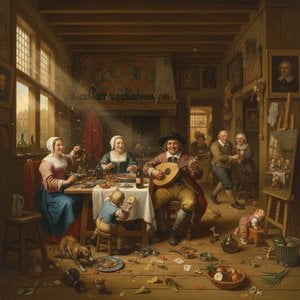
Jan Steen: A Master of Dutch Genre Painting & the Golden Age
Explore the life & art of Jan Steen, a leading Dutch Golden Age painter renowned for his humorous genre scenes & insightful social commentary. Discover his techniques, legacy, and collecting tips.

Francis Bacons 25 Mesterverk: En Reise Inn i Sjelens Dyp – Kunst for Ditt Hjem | ArtsDot.com
Utforsk Francis Bacons 25 mest ikoniske malerier! Oppdag historiene bak ekspresjonistiske mesterverk, fra 'Scream' til 'Pope Innocent X'. Finn kunsttrykk og lerretstrykk av høy kvalitet for ditt hjem på ArtsDot.com – museumskvalitet & inspirasjon.

Genre Painting: A Window into Daily Life & Societal Values of the Dutch Golden Age
Explore the captivating world of Dutch Golden Age genre painting! Discover realistic depictions of daily life, masterful artists like Ostade & Metsu, and hidden symbolism. Learn about this influential art movement with ArtsDot.