


Bildet følger dine valg: , .
Beskrivelse av objektet
Deimantas Narkevičius’ ‘The Head’ – a monumental, unfinished marble bust of Marx. Explore this photographic documentation of the sculpture's creation & its symbolic weight.
 Vis hele teksten
Om kunstneren
Lithuanian artist Deimantas Narkevičius explores memory & political history through film & video. Exhibited at Venice Biennale, Centre Pompidou & more. Explore his impactful work.
Håndlaget oljereproduksjon
Håndmalt olje på lerret i din valgte størrelse og ramme, laget på bestilling av våre kunstnere. ( Bytt til trykk Bytt til digitalt bilde)
Dette kunstverket er beskyttet av opphavsrett
Kunstverket som vises på denne siden er beskyttet av opphavsretten, noe som betyr at vi ikke har juridisk tillatelse til å lage eller selge identiske reproduksjoner. Denne beskyttelsen håndheves i henhold til internasjonale avtaler som for eksempel Bernerkonvensjonen og av nasjonale lover, inkludert de som er fastsatt i Amerikansk lov om opphavsrett – Tittel 17.
Som et respektfullt og lovlig alternativ tilbyr vi skreddersydde, håndmalte kunstverk inspirert av originalen. Våre dyktige og profesjonelle kunstnere studerer nøye originalens stil, stemning og kunstneriske essens for å skape et nytt og unikt verk som vekker den samme følelsen – samtidig som det forblir en original skapelse i seg selv.
Denne metoden er i fullt samsvar med opphavsrettslige regler, da den ikke innebærer kopiering eller duplisering av det beskyttede kunstverket. I stedet er det snakk om en kreativ nytolkning – et nytt maleri som er inspirert av originalen, men ikke identisk med den.
Les mer om dette maleriet
 Forhåndsvisning
 Send
Send Del
Del
 Vis detaljer
 Utskriftsvennlig guide

 Last ned bilde
 Liknende objekter
 Røntgenundersøkelse
 Lysbildefremvisning
 Spørsmål og svar
 Statistikk
Bestill maleriet ditt i fire enkle trinn
Ta deg god tid. Du kan endre alle svar; prisen i handlekurven din oppdateres etter hvert valg.
1 Trinn én av fire
Hvilken størrelse ønsker du?
Disse størrelsene bevarer de originale proporsjonene til maleriet. Tegningen viser ditt valg på en vegg, over en to meter lang sofa.
Eller oppgi egne mål
Velg mellom våre forhåndsdefinerte størrelser som bevarer kunstverkets opprinnelige proporsjoner.

Skriv inn ønsket bredde og høyde for å tilpasse bildet til din ramme eller vegg. Siden dette er håndmalt, kan kunstneren male litt mer rundt motivet eller beskjære det noe dersom du velger et annet format — valget er ditt. Vi sender deg en digital mockup til godkjenning før maleriet påbegynnes. Bildet som vises på denne siden representerer ikke det faktiske resultatet — kun mockuppen viser det endelige uttrykket.
2 Trinn to av fire
Hvordan skal det klargjøres: rullet, strukket eller innrammet?
Prisene nedenfor gjelder for størrelsen du valgte i trinn én.
Velg kantutførelse på lerretet
Velg din ramme

Hvit kant Nkr1

Uskarp kantfinish Nkr1

Fortsatt motiv Nkr1

P118B Nkr10

P118H Nkr10

P118W Nkr10

P438Z Nkr10

P508JH Nkr12

P508YH Nkr12

P805H Nkr10

P805Z Nkr10

P919BZ Nkr10

P919G Nkr10

P919XJ Nkr10

P959ZH Nkr10

P968JZ Nkr12

W106C Nkr8

W218G Nkr10

W218JH Nkr8

W218Y Nkr10

W307PJ Nkr10

W316G Nkr10

W316PJ Nkr8

W316Y Nkr10

W398PJ Nkr8

W4111J Nkr10

W500HY Nkr15

W500JH Nkr15

W692G Nkr12

W849H Nkr8

W940BG Nkr15

W953PJ Nkr8

H24-GOLD Nkr30

H24-SILVER Nkr30

H36-GOLD Nkr45

H36-SILVER Nkr45
Innrammet
Profil: . Total størrelse med ramme: .
3 Trinn tre av fire
Ønsker du at noe skal endres i maleriet?
De fleste svarer nei. Siden hvert maleri er håndlaget, kan kunstneren vår også tilpasse det for deg.
Etter bestilling vil ArtsDot.com-teamet sende e-post til kunden for instruksjoner og sende et utkast som forhåndsvisning
4 Trinn fire av fire
Noen valgmuligheter for finish
Alle er valgfrie. Svarene som allerede er valgt, medfører ingen ekstra kostnad.
Hvem har malt det?
Verdensomspennende levering () på 3–4 uker i stedet for standard 5 uker. (5 November). Ingen kompromisser med kvaliteten.
En navneplate, som på et museum?
Detaljer om gravert bronseplate
This elegant plaque features the artist's name and the title of the artwork, finely engraved for a timeless presentation.
It is made from bronze with a refined, elegant finish. The text is precisely laser-engraved for a sharp and permanent result. Measuring 9x2 cm, the plaque is compact yet easy to read. It's built to be durable and scratch-resistant, offering a professional, museum-quality look. Mounting is simple thanks to the included adhesive backing.
Detaljer om gjennomsiktig akrylplate
The plaque includes essential engraved details such as the artist's name, the title of the artwork, the date it was created, the type of media used-like oil on canvas or watercolor-a brief description of the piece, and a QR code that links to the complete artwork information.
It is crafted from clear acrylic, offering a sleek, modern appearance. The text is UV-engraved in black to ensure strong visual contrast. With a size of 10x15 cm, it ensures optimal readability. It comes equipped with two metal hooks for secure wall mounting. The plaque is designed to be weather-resistant, making it suitable for various environments, and it includes interactive features that work seamlessly with smartphone scanning.
Detaljer om plakett i svart akryl
This elegant plaque includes engraved information such as the artist's name, the title of the artwork, the date it was created, the type of media used (like oil on canvas or watercolor), a short description of the artwork, and a QR code for quick access to more information.
The plaque itself is made from refined black acrylic with a premium finish. The text is laser-engraved in white for high contrast and readability. Its size is 10x15 cm, designed to be easy to read. It comes with two metal hooks for professional mounting. The design is sleek and fits any interior style. It is also weather-resistant and durable, with built-in digital integration for mobile compatibility.
En beskyttende lakk?
Når trenger du det?
✓ Kontroller og bestill
Ditt maleri, slik du bestilte det

The Head
Trykkmetode
Størrelse på reproduksjon
-

Utvalgte mesterkunstnere
Mer detaljrikdom, finesse og ekstra produksjonstid
-

Innramming av reproduksjon
-
-
For kunstverk eller reproduksjoner som er større enn 105 cm (ca. 41 tommer) på noen side, vil rammen bli sendt som et sett som må monteres. Denne metoden sikrer trygg levering og forhindrer skader under transport.
Krever profesjonell montering – dette er ikke et DIY-produkt.
Settet må monteres og lerretet strammes av en erfaren profesjonell rammelegger, ved bruk av trelim (følger ikke med), en lerretstang og klemmer for å holde rammelisten vinkelrett mens limet tørker. Feilaktig montering eller ujevn stramming av lerretet kan påføre kunstverket permanente skader og er
 For kunstverk eller reproduksjoner som er større enn 105 cm (ca. 41 tommer) på noen side, vil rammen bli sendt som et sett som må monteres. Denne metoden sikrer trygg levering og forhindrer skader under transport.
Alle massive trelister er inkludert, presist tilpasset i størrelse.
Monteres med de medfølgende skruene, samt trelim til hjørnene, som ikke er inkludert og må anskaffes av din rammehandler.
Profesjonelt verktøy er nødvendig og er ikke inkludert: en lerretstang (strammer) og klemmer for å holde rammene vinkelrette mens limet tørker.
Viktig:
Hjørnene krever trelim, listene må holdes på plass med tvinger til limet er helt tørt, og stramming av lerretet på den ferdige rammen krever en lerretstang. Ingen av disse produktene er inkludert i settet. Vennligst sørg for tilgang til en erfaren profesjonell rammehandler før du bestiller denne størrelsen.

Navneskilt
-
-

Beskyttende ferniss
Blank lakk (forsterker farger, beskytter mot lys og fuktighet)
-

Tilpass mitt kunstverk
Eksempler på hva som kan endres: Erstatt ansikt med bilde av kunden; Legg til kjæledyr (f.eks. bytt ut katt med hund); Inkluder en skjult melding i bakgrunnen; Endre bakgrunnslandskap eller elementer.
-

Ekspresslevering
Verdensomspennende levering () på 3–4 uker i stedet for standard 5 uker. (5 November). Ingen kompromisser med kvaliteten.
-
Ekspresslevering
Verdensomspennende levering til innen 5 uker. (12 November).
Inkludert frakt
Totalpris for valgte alternativer
Nkr 2514
Glassalternativet er kun tilgjengelig i størrelser under 110 cm
Inkludert med hver bestilling
- Gratis ekspressfrakt over hele verden
- Lerretsduk av lin av høy kvalitet
- Full transportforsikring
- Garanti for refusjon av toll og importavgifter
- Garantert fargegjengivelse
- 100 dagers returrett ved fabrikasjonsfeil
- 100% pengene tilbake-garanti
- Rabatt ved flere kjøp


A Fragment of Monumental Ideals: Deimantas Narkevičius’ ‘The Head’
Deimantas Narkevičius' “The Head” stands as a striking testament to the intersection of artistic vision and historical circumstance—a monumental, unfinished marble bust of Karl Marx meticulously documented through cinematic observation. Captured in black and white film footage originating from East Germany during the creation and inauguration of the Marx Monument in 1971, this artwork transcends mere representation; it embodies the spirit of a bygone era and probes profound questions about legacy and artistic process. The photograph itself serves as both record and catalyst for contemplation, inviting viewers to consider not just what is seen but also what remains unseen—the latent potential within an incomplete work.The Sculptor’s Vision: Contextualizing Kerbel's Creation
The sculpture’s genesis lies in the ambitious project spearheaded by sculptor Lev Kerbel, commissioned to honor Karl Marx amidst the ideological fervor of the GDR. The film documentation illuminates the meticulous planning and logistical challenges inherent in erecting such a grand monument within the constraints of Soviet artistic dogma. Every frame captures the raw physicality of construction—scaffolding, marble dust, and the purposeful movements of artisans striving to realize Kerbel’s vision. This context is crucial for understanding “The Head” not simply as an aesthetic object but as a symbol of political aspiration and the enduring struggle to commemorate influential figures. The GDR's propagandistic intent underscores the artwork’s significance beyond its formal qualities, prompting reflection on how artistic endeavors are shaped by broader societal forces.Formal Analysis: Texture, Light, and Geometric Precision
A careful examination reveals a masterful command of sculptural technique combined with photographic realism. The dominant form—a colossal marble bust—commands attention through its sheer scale and assertive contours. Strong lines delineate the face’s musculature and facial features, emphasizing anatomical accuracy while simultaneously conveying solidity and permanence. The texture is deliberately rendered to convey the unfinished state of the sculpture; chisel marks and imperfections in the marble contribute to a tactile quality that invites viewers to imagine the sculptor's hand at work. Artificial lighting directs shadows across the surface, highlighting three-dimensional form and enhancing visual drama. Geometric shapes—spheres for the head and planes for facial features—provide structural stability and reinforce compositional balance. The flattened perspective of the photograph subtly diminishes atmospheric depth but effectively communicates the monument’s imposing presence.Symbolism Beyond Representation: An Unfinished Echo
The deliberate omission of completion speaks volumes about Narkevičius' artistic intent. “The Head” isn’t merely a depiction of Marx; it embodies the ongoing process of shaping historical memory and confronting complex ideological narratives. The unfinished state symbolizes not only the challenges inherent in achieving lasting legacies but also the dynamism of ideas themselves—their capacity to evolve and transform over time. Like Kerbel's sculpture, Narkevičius’ photograph invites viewers to contemplate the elusive nature of representation and the power of suggestion. It compels us to consider what is absent as powerfully as what is present, fostering a deeper engagement with both art and history.Emotional Resonance: Memory and Reflection
Ultimately, “The Head” resonates with an emotional depth rooted in its connection to Lithuania’s Soviet past. The artwork evokes feelings of contemplation, nostalgia, and perhaps even unease—a recognition that monumental gestures can simultaneously celebrate achievement and grapple with unresolved contradictions. Narkevičius' masterful use of photographic documentation transforms a simple image into a conduit for profound reflection on identity, trauma, and the enduring influence of ideology. It serves as an invitation to consider how art can illuminate the complexities of history while prompting viewers to confront their own perspectives on memory and legacy.Spørsmål og svar
Hvilken fase av Deimantas Narkevičius sin kunstneriske utvikling representerer "The Head"?
I Deimantas Narkevičius sin karriere tilhører "The Head" Mature Period. Denne perioden gjør det mulig å sammenligne verket med kunstnerens øvrige arbeider.
Hvor plasserer "The Head" seg blant Deimantas Narkevičius sine gjentakende motiver?
Blant Deimantas Narkevičius sine dokumenterte temaer – eisenstein's monumental forms, soviet propaganda & memory, cold war anxieties & power, lithuanian identity struggle, historical reconstruction film, marxist ideals, unfinished legacy – retter "The Head" sitt eget fokus mot marxism, sculpture, monument, history, cold war, soviet art, unfinished, portrait.
Hvordan kan jeg få tak i en digital fil av "The Head" av Deimantas Narkevičius?
Et digitalt bilde av "The Head" av Deimantas Narkevičius kan kjøpes på siden for Digitalt kunstverk: nedlasting av et digitalt bilde i høy oppløsning.
Lignende kunstverk


Deimantas Narkevičius
1964 - , Lithuania
Om kunstneren
The Cinematic Architect of Memory
In the quiet, evocative landscapes of Lithuania, where the echoes of a complex Soviet past still linger in the architecture and the atmosphere, the work of Deimantas Narkevičius emerges as a profound meditation on time itself. Born in 1964 in Utena, Narkevičius began his artistic journey not with the lens of a camera, but with the tactile discipline of a sculptor. This foundational training at the Vilnius Art Institute instilled in him a unique sensitivity to form, space, and materiality—a sensibility that would later breathe life into his cinematic explorations. While many artists use film merely as a medium for documentation, Narkevičius treats the moving image as a sculptural element, carving out narratives from the raw materials of historical footage, found photographs, and the heavy silence of abandoned industrial sites.
His transition from the physical weight of sculpture to the ephemeral nature of video and film was not a departure, but an evolution. As Lithuania navigated the turbulent disintegration of the Soviet Union and its subsequent rebirth as a democratic state, Narkeyičius found himself at the intersection of personal recollection and political upheaval. He became a chronicler of the "rupture"—that delicate, often painful space between what was lived and what is remembered. His work does not simply present history; it interrogates the very mechanisms by which we construct myths from reality, using techniques such as voice-overs, interviews, and carefully staged re-enactments to blur the lines between documentary truth and cinematic imagination.
Layers of History and the Poetics of Space
The brilliance of Narkevičius’s practice lies in his ability to transform historical trauma into a poetic inquiry. He often directs his gaze toward the remnants of the Soviet era—monumental structures, decommissioned missile bases, and industrial hubs like the town of Elektrėnai. In works such as Energy Lithuania, he explores the symbiotic relationship between human vitality and the mechanical energy of power plants, treating these sites not merely as relics of a failed ideology, but as melancholic monuments to an era of vanished utopias. Through his lens, the decay of an industrial landscape becomes a metaphor for the fragility of political structures and the enduring persistence of cultural identity.
Influenced by the atmospheric depth of filmmakers like Andrei Tarkovsky and the structural experimentation of Peter Watkins, Narkevičius employs a visual language that is both intimate and expansive. He frequently utilizes close-ups to capture the nuances of human expression, grounding his larger political critiques in the lived experiences of individuals. This approach allows him to navigate the tension between the macro-history of nations and the micro-histories of the soul. His films act as a bridge, connecting the viewer to a past that may feel unrecognizable, yet remains fundamentally intertwined with the present through the persistent pull of collective memory.
A Global Presence and Lasting Legacy
The international recognition of Deimantas Narkevičius has solidified his position as one of the most significant voices in contemporary moving-image art. His presence on the global stage is marked by participation in the world's most prestigious cultural institutions, where his work challenges audiences to confront the fluidity of truth. His achievements include:
- Representing Lithuania at the 49th Venice Biennale, a pivotal moment that introduced his nuanced explorations of identity to a global audience.
- Exhibiting in premier institutions such as the Centre Pompidou in Paris, the Tate Modern in London, and the Museum of Modern Art (MoMA) in New York.
- Contributing to the discourse of contemporary curation through his roles as an art critic and exhibition curator, further enriching the dialogue surrounding political and social art.
Ultimately, the significance of Narkevičius’s oeuvre lies in its refusal to offer easy answers. He does not seek to provide a definitive record of history, but rather to highlight the cracks and shadows where memory resides. By treating history as both material and methodology, he invites us to witness the ongoing process of creation—the way we constantly mold our past to make sense of our present. His work remains a vital, haunting testament to the power of art to navigate the complexities of time, identity, and the enduring human spirit.
Relaterte artikler

The Commanding Presence: Architectural Integration & Proportional Strategies for Monumental Art Reproductions in Luxury Interiors
Discover the art of integrating monumental reproductions into luxury interiors. Expert guidance on spatial harmony, authentic materials & bespoke design for a commanding presence in your home. Elevate your space with ArtsDot.
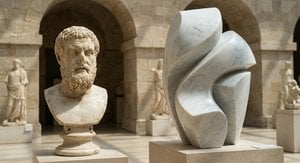
The Enduring Allure of Marble in Art History: From Classical Sculpture to Modern Abstraction
Explore the captivating history of marble sculpture from ancient Greece to modern art. Discover renowned artists like Canova & Michelangelo, carving techniques, and investment insights at ArtsDot.

Karl Blossfeldt's 'Urformen der Kunst': Pioneering Botanical Photomicrography & Aesthetic Form
Explore Karl Blossfeldt's groundbreaking *Urformen der Kunst* & pioneering botanical photography. Discover the aesthetic power of nature, New Objectivity influences, and his lasting impact on modern art. Learn about collecting key works.