


 Se i rommet
 Del som digitalt kort
 Del
Del
 Detaljer
 Studentguide

 Last ned
 Liknende objekter
 Røntgen
 Lysbildefremvisning
 Besøksstatistikk
A.158
 Acrylic On Canvas
- WallArt
- Abstract Expressionism
 100.0 x 100.0 cm
 MAGA - Museo Arte Gallarate
 Les mer
Kunstverket som vises på denne siden er beskyttet av opphavsretten, noe som betyr at vi ikke har juridisk tillatelse til å lage eller selge identiske reproduksjoner. Denne beskyttelsen håndheves i henhold til internasjonale avtaler som for eksempel Bernerkonvensjonen og av nasjonale lover, inkludert de som er fastsatt i Amerikansk opphavsrettslov – Tittel 17.
Som et respektfullt og lovlig alternativ tilbyr vi skreddersydde, håndmalte kunstverk inspirert av originalen. Våre dyktige og profesjonelle kunstnere studerer nøye originalens stil, stemning og kunstneriske essens for å skape et nytt og unikt verk som vekker den samme følelsen – samtidig som det forblir en original skapelse i seg selv.
Denne metoden er i fullt samsvar med opphavsrettslige regler, da den ikke innebærer kopiering eller duplisering av det beskyttede kunstverket. I stedet er det snakk om en kreativ nytolkning – et nytt maleri som er inspirert av originalen, men ikke identisk med den.
Håndlaget oljereproduksjon
Håndmalt olje på lerret i din valgte størrelse og ramme, laget på bestilling av våre kunstnere. ( Bytt til trykkversjon Gå til digitalt bilde)




P118B Nkr10

P118H Nkr10

P118W Nkr10

P438Z Nkr10

P508JH Nkr12

P508YH Nkr12

P805H Nkr10

P805Z Nkr10

P919BZ Nkr10

P919G Nkr10

P919XJ Nkr10

P959ZH Nkr10

P968JZ Nkr12

W106C Nkr8

W218G Nkr10

W218JH Nkr8

W218Y Nkr10

W307PJ Nkr10

W316G Nkr10

W316PJ Nkr8

W316Y Nkr10

W398PJ Nkr8

W4111J Nkr10

W500HY Nkr15

W500JH Nkr15

W692G Nkr12

W849H Nkr8

W940BG Nkr15

W953PJ Nkr8




Velg mellom våre forhåndsdefinerte størrelser som bevarer kunstverkets opprinnelige proporsjoner.

Skriv inn bredden og høyden du trenger, slik at den passer til din ramme eller vegg. Dette er håndmalt, så for en størrelse med en annen form kan kunstneren male litt mer rundt bildet, eller beskjære det noe — du velger selv. Vi sender deg en digital mockup for godkjenning før maleriet påbegynnes. Bildet som vises på denne siden viser ikke det faktiske resultatet — kun mockuppen gjør det.
Etter bestilling vil ArtsDot.com-teamet sende e-post til kunden for instruksjoner og sende et utkast (mockup) som forhåndsvisning.
Verdensomspennende levering () på 3–4 uker i stedet for standard 5 uker. (19 October). Ingen kompromisser med kvaliteten.

Gratis ekspressfrakt over hele verden

Lerretsduk av høykvalitets lin

Full transportforsikring

Garanti for refusjon av toll og importavgifter

Garantert fargeekthet

100 dagers returrett ved fabrikasjonsfeil

100% pengene tilbake-garanti

Mengderabatt
 Glassalternativet er kun tilgjengelig i størrelser under 110 cm

A.158
Reproduksjonsmetode
Format på reproduksjon
-


Totalpris
Nkr 2477
The Luminous Path: An Exploration of A.158
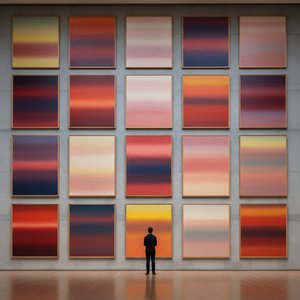
To stand before A.158 is to encounter a moment suspended between vibrant energy and serene contemplation. Claudio Verna’s canvas presents an immediate, arresting visual dialogue—a field of soft, enveloping pink bisected by a decisive, radiant yellow line. This is not merely decoration; it is a carefully orchestrated optical experience. The background itself seems imbued with the warmth of a blush-toned dawn, suggesting emotional resonance and gentle expanse. Yet, this softness is challenged, guided, and ultimately elevated by that singular streak of yellow. It draws the eye with an almost magnetic force, inviting the viewer into its luminous passage.
Technique and Compositional Flow
Verna’s mastery in this piece lies in his handling of acrylic on canvas. The application appears fluid yet controlled, allowing the pink ground to breathe while maintaining a palpable depth. The yellow line functions as more than just a compositional element; it is a vector, an invisible current guiding the viewer's gaze across the 100 x 100 cm square. While there is a subtle human presence anchored in the lower left corner, its relative quietude allows the abstract interplay of color and line to dominate the narrative. The technique speaks to a modern sensibility—one that values graphic clarity alongside atmospheric wash.
Symbolism of Color and Line
In art history, color choices are rarely accidental. Here, the pairing of soft pink with brilliant yellow evokes themes of optimism, transition, and illumination. Pink often symbolizes tenderness or nascent emotion, providing a receptive emotional field. Against this, the sharp, bright yellow acts as a conduit—a path toward understanding or breakthrough. The line itself suggests journey, connection, or perhaps even the passage of time viewed through an optimistic lens. It is the visible manifestation of an idea moving from one state to another.
Integrating Art into Living Space
For the discerning collector or interior designer, A.158 offers unparalleled versatility. Its abstract nature means it complements a vast array of décor styles, from minimalist modernism to richly textured bohemian spaces. Imagine this piece anchoring a room—the soft pink echoing blush textiles or pale wood tones, while the yellow line provides the necessary jolt of curated energy against deep jewel-toned furniture. It is a focal point that whispers rather than shouts, adding intellectual depth without overwhelming the domestic harmony.
The Enduring Resonance of Modern Abstraction
Claudio Verna’s work situates itself within a lineage of post-war Italian abstractionism, yet it possesses a distinctly contemporary lightness. It speaks to an era where academic rigor met emotional freedom. Owning this reproduction is acquiring a piece that honors the journey of modern art—a dialogue between structure and feeling. It invites daily contemplation, suggesting that even in the most structured environments, there remains room for a luminous, guiding path.
Spørsmål og svar
Hvem er opphavspersonen til "A.158", og i hvilken retning?
Claudio Verna skapte "A.158" innenfor Abstract Expressionism-bevegelsen.
Hvor kan jeg se originalen av "A.158" av Claudio Verna?
Originalen av "A.158" av Claudio Verna oppbevares i MAGA - Museo Arte Gallarate, Gallarate, Italy. En reproduksjon gjør det mulig å stille ut verket i eget hjem.
Hvor kan jeg laste ned "A.158" av Claudio Verna?
Bildet av "A.158" av Claudio Verna kan lastes ned fra verkets Last ned-side: nedlasting av et digitalt bilde i høy oppløsning.
Relaterte kunstverk


Kunstnerbiografi
Early Life and Artistic Foundations
Claudio Verna, born in the picturesque town of Guardiagrele, Italy, in 1937, embarked on an artistic journey that would establish him as a pivotal figure in Italian post-war painting. His early life, marked by a family relocation to Foligno in Umbria, instilled within him a deep appreciation for the region’s rich cultural heritage and landscape—elements that subtly permeate his later work despite its abstract nature. Verna's formal education began with studies in Umbria before he pursued a degree in political science at the University of Florence, graduating in 1961 with a thesis exploring the complex relationship between “Figurative Arts in Industrial Civilization.” This academic grounding proved crucial, providing him with a framework for understanding art’s evolving role within a rapidly changing society. It was during his time in Florence that Verna first engaged with the currents of classical abstractionism and began exhibiting his work, laying the initial foundations for a career defined by rigorous exploration and independent thought.The Birth of Pittura Analitica
Following his move to Rome in 1961, Verna deliberately withdrew from the public art scene for several years. This period wasn’t one of inactivity but rather intense self-examination—a crucial phase where he sought to define a unique artistic language and methodology. By 1967, when he re-emerged, it was with a clear vision that would give rise to *Pittura Analitica* (Analytical Painting). This movement, born from Verna’s conviction in the “ancient and indispensable reasons” of painting, represented a profound reflection on the very act of creation and its connection to artistic tradition. Pittura Analitica wasn't merely about what was depicted but *how* it was depicted—a focus on the fundamental elements of color, form, and surface. It became an Italian response to the prevailing minimalism, yet distinguished itself through a heightened sensitivity to chromatic intensity and emotional resonance.A Language of Color and Rigor
Verna’s paintings are characterized by their striking simplicity and essentiality. He strips away extraneous detail, focusing instead on the pure expressive power of color. His canvases become arenas where hues interact, vibrate, and define space—often employing vertical lines and muted tones that create a sense of contemplative calm. The artist doesn't simply apply color; he investigates its qualities, exploring saturation, light, and texture with meticulous precision. This pursuit isn’t cold or detached, however. Verna describes his work as existing “between the polarity of extreme rigor and intense emotional abandon,” suggesting a dynamic tension between intellectual control and visceral feeling. His works from the 1970s demonstrate this shift towards greater freedom of expression after an initial period of austerity linked to the principles of Analytical Painting, revealing a pulsating relationship between geometry and color.Exhibitions, Recognition, and Lasting Influence
Throughout his prolific career, Claudio Verna has held over one hundred solo exhibitions in Italy and abroad, cementing his reputation as a leading figure in contemporary Italian art. His work has been showcased at prestigious venues including the Venice Biennale (1970 and 1980), and retrospectives have graced museums in Gibellina, Spoleto, Ferrara, Conegliano, Treviso, L’Aquila, and Milan's Mudima Foundation. He has also participated in numerous group exhibitions across Europe and beyond—from Düsseldorf to London, Philadelphia to Moscow—further expanding his international reach. In 2008, Verna received the esteemed “Antonio Feltrinelli” Prize for painting from the National Academy of the Lincei, a testament to his significant contributions to the art world. His appointment as a National Academician of the Accademia di San Luca further solidified his position within Italy’s artistic establishment.A Legacy of Reflection and Innovation
Claudio Verna's enduring legacy lies in his unwavering commitment to exploring the fundamental principles of painting. He challenged conventional notions of representation, prompting viewers to engage with art on a deeper, more intellectual level. The publication of the Catalogue Raisonné of his work in 2010, curated by Volker W. Feierabend and Marco Meneguzzo, serves as a comprehensive testament to his artistic journey and its profound impact on contemporary art discourse. Verna’s influence extends beyond his own canvases; he inspired generations of artists to question the nature of their practice and to seek new ways of expressing themselves through color, form, and texture. He remains an active artist today, continuing to refine his unique vision and contribute to the ongoing evolution of abstract painting.
Claudio Verna
1937 - , Italy
Kort om kunstneren
- Full Name: Claudio Verna
- Nationality: Italian
- Date Of Birth: 1937
- Place Of Birth: Guardia Grele, Italy
- Notable Artworks:
- Pittura
- Deriva
- Costellazione
- Artistic Movement Or Style: Pittura Analitica, Minimalism
Relaterte artikler

Geometrisk Abstraksjon: Topp 10 Mesterverk for Kunstelskere – ArtsDot.com
Utforsk de 10 mest innflytelsesrike verkene innen geometrisk abstraksjon! Oppdag historiene bak Mondrian, Kandinsky og Malevich. Finn inspirasjon til interiøret med ArtsDot.coms eksklusive reproduksjoner – museumskvalitet for ditt hjem. Utforsk samlingen online!

Kandinskys 25 Mesterverk: En Reise i Abstrakt Kunst og Fargeharmoni | ArtsDot.no
Utforsk Wassily Kandinskys 25 mest ikoniske malerier! Oppdag historien bak abstrakt kunst, ekspresjonisme og fargeharmoni. Finn inspirasjon til interiøret – museumskvalitet reproduksjoner på ArtsDot.com.

Topp 10 mesterverk fra abstrakt ekspresjonisme – Kunst for ditt hjem | ArtsDot.no
Oppdag de 10 mest ikoniske verkene fra abstrakt ekspresjonisme! Lær historien bak Jackson Pollock, Mark Rothko og andre mestere. Finn kunsttrykk av høy kvalitet for ditt hjem på ArtsDot.com – museumskvalitet & inspirasjon.
Mark Rothkos 25 Mesterverk: Følelser i Farge – Kunst for Ditt Hjem | ArtsDot.no
Oppdag Mark Rothkos 25 mest ikoniske malerier! Fordyp deg i abstrakt ekspresjonisme, fargefeltmaling og emosjonell kunsthistorie. Finn inspirasjon til ditt hjem med museumskvalitets reproduksjoner på ArtsDot.com.

Lys Rosa Magi: Topp 10 Malerier som Odefinerer Skjønnhet og Stemning
Oppdag 10 ikoniske malerier dominert av lys rosa toner! Fra Monet til Renoir, utforsk historien og skjønnheten bak disse mesterverkene. Finn kunsttrykk i museumskvalitet for ditt hjem på ArtsDot.com – inspirasjon og luksusinteriør venter!