Een Celestial Revelation: Unveiling the Majesty of the Sistine Chapel
Step into a realm where earthly ambition ascends to meet divine inspiration – the Sistine Chapel within Vatican City’s magnificent Museums. More than simply a room adorned with frescoes, it's an immersive experience, a testament to human aspiration reaching for the heavens and a profoundly moving meditation on faith, creation, and our place within the cosmos. Constructed between 1473 and 1481 under the patronage of Pope Sixtus IV, this chapel initially served as a sacred space for papal ceremonies, a venue for significant religious and state functions. However, it was the subsequent artistic transformations, particularly those undertaken by Michelangelo Buonarroti, that irrevocably cemented its place among the world’s most celebrated landmarks, transforming a functional room into an eternal masterpiece.
The chapel's architecture itself is thoughtfully designed to draw the eye upwards, mirroring the spiritual journey from earthly concerns to divine contemplation. Baccio Pontelli’s design prioritizes verticality, symbolizing ascension towards God and enhancing the chapel’s auditory experience for liturgical celebrations. The careful placement of windows allows natural light to flood the space, creating a dynamic interplay between illumination and shadow – a technique crucial to Michelangelo’s fresco work. Notice how the tiered arrangement guides the viewer’s gaze upwards, mirroring the spiritual journey from earthly concerns to divine contemplation. The high ceilings and vaulted structure create a sense of grandeur and solemnity, amplifying sound during papal ceremonies, while the acoustics are remarkably suited to music. This deliberate architectural strategy wasn't merely aesthetic; it was integral to the chapel’s function as a sacred space, designed to inspire awe and reverence.
Early Renaissance Splendor: A Tapestry of Faith
Before Michelangelo’s monumental contributions, the chapel walls were already alive with exquisite frescoes by a constellation of Renaissance masters – Botticelli, Perugino, Ghirlandaio among them. These early works, commissioned by Sixtus IV himself, established a carefully considered program meant to mirror the Old and New Testaments, visually reinforcing the authority and continuity of the Church. They depict scenes brimming with life, color, and the burgeoning humanist spirit of the age – narratives of Moses leading his people, Christ’s infancy, and the early days of Christianity. These initial frescoes, executed with remarkable skill and attention to detail, served as a rich foundation for the theological complexity that Michelangelo would later bring to fruition, establishing a visual language that would guide his own ambitious undertaking.
Michelangelo's Heavenly Canvas: A Master’s Vision
In 1508, Pope Julius II summoned Michelangelo Buonarroti to undertake what would become of the most audacious and transformative projects in art history: the painting of the chapel ceiling. For four grueling years, the artist labored tirelessly on his back, meticulously applying pigment to wet plaster, bringing to life scenes from Genesis with an unprecedented level of anatomical accuracy, emotional depth, and compositional brilliance. The sheer scale of the undertaking is astonishing; a sprawling panorama unfolds above, depicting the Creation, the Fall of Man, and the Great Flood—narratives rendered with a dynamism and power that continue to captivate viewers today. The ceiling isn’t merely decoration; it's a profound theological statement, a visual interpretation of humanity’s relationship with God and the unfolding drama of salvation.
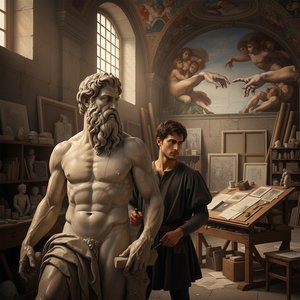
Perhaps the most iconic image within this celestial realm is “The Creation of Adam.” This masterpiece captures a profound moment of connection – God’s outstretched hand reaching towards humanity, imbuing it with life, intellect, and potential. It is not merely a depiction of a biblical story but an exploration of the very essence of human existence, our relationship to the divine, and the inherent greatness within us all. The complex interplay of figures, the masterful use of anatomy, and the vibrant color palette demonstrate Michelangelo’s unparalleled skill and his profound understanding of both artistic technique and theological meaning. The subtle gesture, the almost imperceptible connection between God and Adam, speaks volumes about the nature of faith and grace.
The Last Judgment: A Dramatic Revelation
Decades later, Michelangelo returned to the Sistine Chapel, summoned once more to adorn its walls with his genius. This time, he focused on the altar wall, creating “The Last Judgment”—a colossal fresco completed between 1536 and 1541. In stark contrast to the hopeful narrative of creation on the ceiling, this work presents a dramatically different vision: one of apocalyptic power and divine retribution. Christ is depicted as a stern judge, presiding over the separation of the saved from the damned in a swirling vortex of figures contorted in anguish or ascending towards salvation. The emotional intensity and dramatic composition of “The Last Judgment” sparked controversy upon its unveiling, with some critics deeming it too scandalous for a sacred space due to its depiction of nude figures. However, it remains a powerful testament to Michelangelo’s artistic genius and his unflinching exploration of the human condition—a visceral portrayal of faith, judgment, and the eternal struggle between good and evil.
A Legacy Enduring: Inspiration Across Centuries
The influence of the Sistine Chapel extends far beyond its walls, inspiring countless works of art that followed. From Raphael’s “School of Athens” to Bernini’s Baldachin in St. Peter's Basilica, artists have continually sought to emulate Michelangelo’s mastery and capture the chapel’s profound sense of awe and reverence. Today, millions of visitors from around the world flock to witness this extraordinary space, offering an unforgettable experience that transcends religious boundaries and speaks to the universal longing for beauty, meaning, and connection. The rotating exhibitions showcasing related artwork and historical artifacts further enrich the visitor's understanding of Renaissance art history, providing context and deeper insights into the chapel’s creation and enduring significance.
Notable Exhibitions
- Current Displays: Regularly updated displays illuminate the artistic techniques and historical context surrounding the Sistine Chapel.
Additional Research
Useful Links:
- Michelangelo – Discover Gaudenzio Ferrari, a Northern Italian Renaissance painter & sculptor (1475-1546). Known for emotive religious scenes, terracotta figures, and works at the Sacro Monte of Varallo.
- Sistine Chapel – The Sistine Chapel ( SIST-een; Latin: Sacellum Sixtinum; Italian: Cappella Sistina [kapˈpɛlla siˈstiːna]) is a chapel in the Apostolic Palace, the pope's official residence in Vatican City.
- Sistine Chapel ceiling – The Sistine Chapel ceiling (Italian: Soffitto della Cappella Sistina), painted in fresco by Michelangelo between 1508 and 1512, is a cornerstone work of High Renaissance art.
- Vatican Museums – Official Website – Welcome to the Museums, which conserve the immense collection of art amassed by the popes from the seventeenth century onwards.
- Vatican City – Vatican City, officially the Vatican City State (Italian: Stato della Città del Vaticano; Latin: Status Civitatis Vaticanae), often shortened as the Vatican, is a landlocked sovereign city-state.