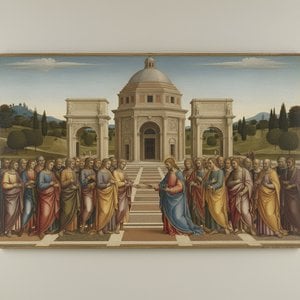
The Life of Giovanni Battista Salvi da Sassoferrato
The name Sassoferrato often eclipses the man. Born on 25 August 1609 in the Italian town of Sassoferrato, Giovanni Battista Salvi becomes known to history primarily by his birthplace. He moves through the seventeenth century as a prominent figure of the Italian Baroque, a painter whose identity is inseparable from the Marche region. His life follows a trajectory from the small town of his birth toward the bustling art scene of Rome.
Rome provides the stage for his professional maturity. Here, he navigates a landscape of intense religious fervor and shifting aesthetic tastes. He does not follow the dramatic theatricality of his contemporaries. Instead, he carves out a niche by looking backward, consciously adopting an archaizing style that echoes the grace of Raphael and Perugino. This choice marks him as a distinct presence in the Baroque era, a painter of serene, devotional clarity.
His career spans several decades of intense production. He remains active in the major centers of Italy, including Rome, Umbria, and Florence, before his death on 8 August 1685. His legacy is found in the quiet intensity of his religious subjects and his ability to meet the specific demands of the Counter-Reformation. He leaves behind a body of work that emphasizes spiritual contemplation over flamboyant movement.
Early Life, Family and Training
The story begins in the small town of Sassoferrato, located in the Marche region of central Italy. Born here in 1609, the boy would eventually take the name of his birthplace as his own. His first introduction to the mechanics of form comes through his father, Tarquinio Salvi. A sculptor by trade, Tarquinio provides the initial grounding in physical shape and texture. The son follows his father into the studio, apprenticing under him to learn the fundamentals of the craft.
Training moves beyond the family workshop into the hills of Umbria. This period of study refines his technical hand. He develops a specific sensitivity to the classical ideals that would define his later output. The influence of the Bolognese school begins to take hold as he moves through these formative years, absorbing the methods of masters like Domenichino and Guido Reni. These connections bridge the gap between his provincial beginnings and the sophisticated demands of the Roman art scene.
Patrons, Workshop and Commissions
The religious fervor of the Counter-Reformation drives much of the workshop's output. Sassoferrato produces multiple copies of various devotional images in several styles, catering to the specific tastes of private patrons. These repetitive, highly sought-after subjects ensure a steady stream of work. In 1643, a significant religious commission arrives: the Virgin of the Rosary for the chapel of Santa Caterina in Santa Sabina, Rome. This work is intended to replace a lost Raphael.
As the 1640s and 1650s progress, the focus shifts toward the Roman elite. Portraiture becomes a dominant part of his professional life. On 15 April 1642, Olimpia Aldobrandini, Princess of Rossano, engages him to paint a portrait destined for Naples. This connection to the nobility opens doors to high-ranking ecclesiastical clients. He executes portraits of several influential figures, including:
- Cardinal Francesco Angelo Rapaccioli (1643–4)
- Monsignor Ottaviano Prati (c. 1650)
- Cardinal Ottoboni (c. 1652)
The demand for his specific brand of clarity and serenity remains constant. While he navigates the social hierarchies of Rome, his studio continues to supply the market with the spiritual imagery that defines his career.
Technique and Style
Sassoferrato moves against the grain of the seventeenth century. While his contemporaries lean into the heavy, dramatic chiaroscuro of the Baroque, he turns his back on intense shadows. Instead, he employs a softer, more diffused lighting that bathes his subjects in a steady, even glow. This choice creates an atmosphere of stillness. His compositions remain strictly balanced and harmonious, favoring the clarity of the High Renaissance over theatrical movement.
His hand is a deliberate echo of the past. He practices an archaizing commitment to the style of Raphael, looking back to the fifteenth-century manner of Perugino to find his visual language. This is not mere imitation; it is a conscious, anachronistic preference for classical grace and idealized forms. He favors pyramidal structures and stable arrangements that prioritize serenity over the frantic energy of the era.
The technical execution focuses on the tactile reality of the surface. He renders the smoothness of skin and the specific sheen of various fabrics with meticulous precision. Every fold of drapery and every subtle tonal gradation serves to reinforce the sense of quietude. His skill lies in this ability to marry the idealized beauty of the Renaissance with a highly refined, individualistic technique.
Key Works and Subject Matter
The focus of his production remains fixed on the divine. Most of his paintings consist of immaculately painted devotional images of the Virgin and the Holy Family. These works often appear in several versions, catering to the high demand for Marian cult imagery during the Counter-Reformation. His compositions of the Madonna in Prayer are among his most celebrated images, capturing a sense of profound spiritual contemplation. In these scenes, he frequently varies the tilt of a head, the fold of a drapery, or the specific expression of a face to distinguish one version from another.
His output also extends to significant religious narratives and personal reflection. He produced the Annunciation (about 1632–1640) and the Virgin of the Rosary, a work commissioned to replace a lost Raphael. Beyond the sacred, he turned his attention to the self, as seen in his Self-portrait (about 1664–1670). While his religious subjects dominate his legacy, his ability to render textures—the sheen of fabric or the smoothness of skin—remains a constant across his various commissions.
- Annunciation (about 1632–1640)
- Self-portrait (about 1664–1670)
- Virgin of the Rosary
Where to See the Works Today
The physical legacy of Sassoferrato's career is scattered across Europe, tracing the paths of his former patrons and the centers of Baroque art. In Italy, his presence remains strong in several major collections. The Uffizi holds his Self-portrait, a work of intense emotional weight. In Perugia, San Pietro houses both an Annunciation and a faithful copy of Raphael's Entombment. The reach of his brush extends to the Musei Civici di Padova, where the portrait of Cardinal Ottoboni resides, and to Palazzo Barberini, which preserves the image of Monsignor Ottaviano Prati.
His influence crosses borders, moving from the Mediterranean to the Atlantic. The Sarasota, John and Mable Ringling Museum of Art in the United States maintains the portrait of Cardinal Francesco Angelo Rapaccioli. Meanwhile, the British Royal Collection at Windsor Castle preserves his drawings, offering a glimpse into the preparatory stages of his compositions.
- Annunciation (San Pietro, Perugia)
- Madonna in prayer (Accademia Carrara, Bergamo)
Vraag en antwoord
In welke stromingen heeft Sassoferrato gewerkt?
De werken van Sassoferrato kunnen per stroming worden bekeken op de Alle stromingen pagina van de kunstenaar.
Onder welke pseudoniemen of andere namen is Sassoferrato bekend?
Sassoferrato staat ook bekend als ساسوفيراتو, Сасоферато, Σασσοφερράτο, サッソフェッラート, Сассоферрато.
Hoe vind ik werken van Sassoferrato in een specifiek kleurenpalet?
Om werken van Sassoferrato in een specifiek kleurenpalet te vinden, kunt u de Op kleurpalet pagina van de kunstenaar gebruiken.
Waar kan ik de kunstwerken van Sassoferrato bekijken, gesorteerd op kleur?
De Sorteren op kleur van Sassoferrato biedt een overzicht van de kunstwerken van de kunstenaar, georganiseerd op kleur.