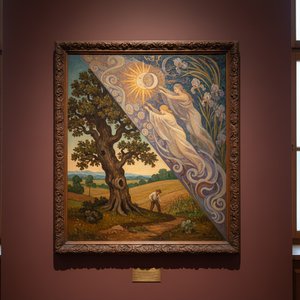
The Transition of Light and Form
The air in the churches of Tyrol carries the weight of a changing era. In the late 18th century, Josef Schöpf moves through this landscape, a painter caught between the dramatic shadows of the Baroque and the emerging clarity of Classicism. Born in Telfs, his early years lead him toward a specialized mastery of sacred spaces. He does not merely paint; he occupies the architecture, turning ceilings into windows of theological narrative. His work is defined by a tension between the old and the new, a stylistic bridge that marks the end of one epoch and the beginning of another.
His development finds its most significant catalyst in the cities of Italy. A stay in Milan, facilitated by a prestigious imperial scholarship, pulls him toward Rome. Between 1775 and 1783, the Roman influence settles into his brushwork. He absorbs the lessons of Martin Knoller, yet his hand begins to drift away from the heavy, theatrical gestures of the past. Instead, his compositions grow more structured. His color palettes cool. The frantic energy of the Baroque begins to settle into a more disciplined, orderly grace.
Sacred Spaces and Secular Shadows
Schöpf’s career is etched into the very walls of the Alpine regions. His frescoes in Innsbruck and the surrounding valleys serve as the primary evidence of his skill. In the Johanneskirche of Innsbruck, his work transforms the physical structure into a vessel for the divine. He is a painter of the ceiling and the altar, a man whose livelihood depended on the ability to command large-scale surfaces. His frescoes in Kaltern and the churches of Bavaria demonstrate a capacity to handle vast, sweeping perspectives that guide the eye upward.
His technical approach varies depending on the medium. On panel paintings, he often employs a more restrained, clear composition. The dramatic expressivity that defined his predecessors is tempered by a preference for cooler tones and precise arrangements. This duality makes him a vital figure for understanding the transition of Austrian art. He is the final voice of the late Baroque in Tyrol, yet his work speaks the language of the coming century.
The final years of his life are marked by a quiet return to his roots. After a period of illness forced his return from the Italian influence, he remained deeply connected to the Stams Abbey. His life was not one of vast worldly wealth, but of a profound, localized impact. He died in Innsbruck, leaving behind a legacy that was eventually bequeathed to the monastery that had once supported his early training. His existence was defined by the brush, the pigment, and the stone of the churches he helped to decorate.
Vraag en antwoord
Kan ik een virtueel museum bezoeken met de werken van Josef Schöpf?
De kunstwerken van Josef Schöpf zijn te bewonderen in een 3D-galerie op de 3D-galerie-pagina van de kunstenaar.
Welke kunstwerken van Josef Schöpf worden het meest bekeken?
Er is een Statistieken-pagina voor Josef Schöpf, met statistieken over de kunstwerken van de kunstenaar op deze website.
In welke historische periode werkte Josef Schöpf?
Josef Schöpf werkte in de Early Modern-periode. Deze periode plaatst het oeuvre van de kunstenaar in een historisch kader.
Hoeveel kunstwerken van Josef Schöpf zijn beschikbaar om te bekijken?
U kunt 1 kunstwerk(en) werken van Josef Schöpf bekijken op de Alle kunstwerken-pagina.