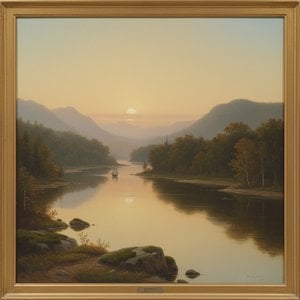
Alexander Helwig Wyant (1836-1892): A Poet of Atmospheric Landscapes
Alexander Helwig Wyant, born in Port Washington, Ohio, stands as a pivotal figure bridging the stylistic currents of the Hudson River School and Tonalism—a testament to American art’s capacity for innovation while retaining its connection to European traditions. He wasn't merely a painter *of* landscapes; he was a poet *with* landscapes, translating the subtle moods of nature onto canvas with an increasingly refined sensitivity – a characteristic that distinguishes him from many of his contemporaries. His artistic journey began modestly, sketching along the banks of the Ohio River near Cincinnati, but swiftly ascended into a vocation fueled by encounters with influential mentors and transformative experiences.Early Influences and Artistic Formation
A crucial catalyst for Wyant’s artistic trajectory arrived in 1857 when he encountered the work of George Inness. This serendipitous meeting sparked him to relocate to New York City, seeking guidance from Inness and securing invaluable support from Nicholas Longworth—a Cincinnati collector whose generosity enabled Wyant to pursue formal training at the National Academy of Design. Prior to this pivotal move, Wyant honed his skills as a sign painter in Port Washington, absorbing foundational techniques that would inform his later explorations of tonal values and atmospheric perspective. The influence of Inness extended beyond mere stylistic imitation; it instilled within Wyant a profound appreciation for capturing the elusive qualities of light and shadow—a preoccupation that would define much of his artistic output.From Detailed Observation to Atmospheric Resonance
Wyant’s initial canvases undeniably bear the imprint of the Hudson River School, characterized by meticulous depictions of natural scenes and an ardent celebration of America's unspoiled wilderness. However, even within these early works, hints of Wyant’s future direction emerge – a burgeoning interest in atmospheric effects and a tendency towards palettes imbued with subdued hues. Over time, this inclination intensified, propelling him away from purely representational painting and toward the nascent aesthetic championed by Tonalism. This movement, gaining momentum in the late 1870s and onward, prioritized mood, atmosphere, and poetic interpretation over precise detail—a deliberate departure from the academic conventions of the era. Wyant skillfully employed clouds not as dramatic focal points but as vehicles for conveying subtle emotional resonance within his landscapes – a technique that would become synonymous with his artistic vision.European Travels and Artistic Synthesis
A transformative journey to Europe in 1860 broadened Wyant’s artistic horizons, exposing him to diverse traditions originating from Germany and brief sojourns in England and Ireland. These formative experiences instilled within him an awareness of European landscape painting—particularly the work of Jean-Baptiste Camille Corot and Jules Dupré—which served as a crucial stimulus for his stylistic evolution. He studied under Hans Fredrik Gude in Düsseldorf and Karlsruhe, immersing himself in the Barbizon style – a movement that championed *plein air* painting and prioritized capturing the immediacy of natural light. This synthesis of European influences complemented Wyant’s grounding in Hudson River School principles, resulting in an oeuvre marked by both meticulous observation and atmospheric sensitivity.A Legacy Defined by Poetic Interpretation
Wyant's artistic legacy resides not merely in technical proficiency but in his ability to distill the essence of nature into emotionally resonant compositions—a characteristic that distinguishes him from many of his contemporaries. He wasn’t simply replicating visual impressions; he was actively transforming them, prioritizing mood and atmosphere over photographic accuracy. His final paintings, notably *Arkville Autumn Landscape*, exemplify this profound engagement with artistic principles – a testament to Wyant's unwavering devotion to capturing the sublime beauty of the Adirondack Mountains. As a result of a debilitating stroke in 1873—which necessitated painting with his left hand—Wyant’s artistic practice became an emblem of resilience and creative adaptation. His enduring influence continues to inspire artists today, cementing his place as a cornerstone of American landscape art history.- Notable Works: Mohawk Valley, Arkville Autumn Landscape
- Influences: George Inness, John Constable & J.M.W. Turner
- Movement: Hudson River School & Tonalism
- Affiliations: National Academy of Design, American Watercolor Society
Vraag & Antwoord
Hoeveel kunstwerken van Alexander Helwig Wyant zijn beschikbaar om te bekijken?
U kunt 74 kunstwerken werken van Alexander Helwig Wyant bekijken op de Alle kunstwerken-pagina.
Hoe vind ik werken van Alexander Helwig Wyant in een specifiek kleurenpalet?
De werken van Alexander Helwig Wyant kunnen worden bekeken op basis van kleurpalet op de Op kleurpalet pagina van de kunstenaar.
Kan ik de werken van Alexander Helwig Wyant bekijken per medium?
De werken van Alexander Helwig Wyant kunnen per medium worden bekeken op de Alle media pagina van de kunstenaar.