


Het werk volgt uw keuzes: , .
Beschrijving verzamelobject
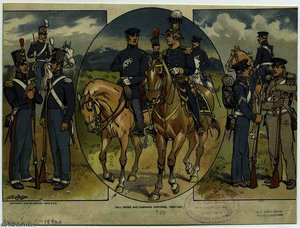
Explore William Heath’s ‘Royal Staff Corps,’ a lithograph depicting British soldiers in a formal military scene. Discover its historical illustration style & muted palette.
Biografie kunstenaar
William Heath (1795-1840) was a British artist known for his satirical caricatures, political cartoons & military scenes. Discover his prolific engravings and publications like 'Paul Pry' – a key figure in 19th-century social commentary.
 Lees meer
Handgemaakte olieverfreproductie
Met de hand geschilderd in olieverf op canvas in uw gewenste maat en lijst, op bestelling gemaakt door onze kunstenaars. ( Schakel over naar print Schakel over naar digitale afbeeldingen)
Meer over dit schilderij
 Voorvertoning
 Verstuur
 Delen
Delen
 Details bekijken
 Gids
Gids

 Download
 Vergelijkbare items
 Röntgenonderzoek
 Diavoorstelling
 Vraag & antwoord
 Statistieken
Bestel uw schilderij in vier eenvoudige stappen
Neem de tijd. U kunt elk antwoord nog wijzigen; de prijs in uw besteloverzicht wordt direct aangepast aan elke keuze.
1 Stap één van de vier
Welke maat wilt u kiezen?
Deze formaten behouden de proporties van het originele schilderij. De tekening laat uw keuze zien op een muur, boven een bank van twee meter.
Of geef uw eigen afmetingen op
Kies uit onze vooraf ingestelde maten die overeenkomen met de originele verhoudingen van het kunstwerk.

Voer de breedte en hoogte in die u nodig heeft, passend bij uw lijst of uw muur. Omdat dit handgeschilderd is, kan de kunstenaar bij een afmeting met een andere beeldverhouding iets meer rondom het schilderij schilderen of juist iets meer weglaten — u kiest zelf. Wij sturen u een digitaal mockup ter goedkeuring voordat het schilderwerk begint. De afbeelding die op deze pagina wordt getoond, is niet het uiteindelijke resultaat — alleen de mockup geeft dit weer.
2 Stap twee van vier
Hoe moet het worden geleverd: gerold, opgespannen of ingelijst?
De onderstaande prijzen zijn voor de maat die u in stap één heeft gekozen.
Kies de randen van het canvas
Kies uw lijst

Wit €1

Vervagende randen €1

Doorlopende rand €1

P118B €10

P118H €10

P118W €10

P438Z €10

P508JH €12

P508YH €12

P805H €10

P805Z €10

P919BZ €10

P919G €10

P919XJ €10

P959ZH €10

P968JZ €12

W106C €8

W218G €10

W218JH €8

W218Y €10

W307PJ €10

W316G €10

W316PJ €8

W316Y €10

W398PJ €8

W4111J €10

W500HY €15

W500JH €15

W692G €12

W849H €8

W940BG €15

W953PJ €8

H24-GOLD €30

H24-SILVER €30

H36-GOLD €45

H36-SILVER €45
Ingelijst
Lijstrand: . Totale afmetingen inclusief lijst: .
3 Stap drie van vier
Wilt u dat er iets aan het schilderij wordt aangepast?
De meeste mensen antwoorden nee. Omdat elk schilderij met de hand wordt gemaakt, kan onze kunstenaar het ook voor u aanpassen.
Na de bestelling zal het team van ArtsDot.com per e-mail contact opnemen met de klant voor instructies en een mockup-voorbeeld verstrekken
4 Stap vier van vier
Enkele afwerkingsopties
Ze zijn allemaal optioneel. De reeds geselecteerde antwoorden brengen geen extra kosten met zich mee.
Wie is de kunstenaar?
Wereldwijde levering () binnen 3 tot 4 weken in plaats van de standaard 5 weken. (9 november). Zonder concessies aan de kwaliteit.
Een naambordje, zoals in een museum?
Details van de gegraveerde bronzen plaat
This elegant plaque features the artist's name and the title of the artwork, finely engraved for a timeless presentation.
It is made from bronze with a refined, elegant finish. The text is precisely laser-engraved for a sharp and permanent result. Measuring 9x2 cm, the plaque is compact yet easy to read. It's built to be durable and scratch-resistant, offering a professional, museum-quality look. Mounting is simple thanks to the included adhesive backing.
Details transparante acrylplaat
The plaque includes essential engraved details such as the artist's name, the title of the artwork, the date it was created, the type of media used-like oil on canvas or watercolor-a brief description of the piece, and a QR code that links to the complete artwork information.
It is crafted from clear acrylic, offering a sleek, modern appearance. The text is UV-engraved in black to ensure strong visual contrast. With a size of 10x15 cm, it ensures optimal readability. It comes equipped with two metal hooks for secure wall mounting. The plaque is designed to be weather-resistant, making it suitable for various environments, and it includes interactive features that work seamlessly with smartphone scanning.
Details zwarte acrylplaat
This elegant plaque includes engraved information such as the artist's name, the title of the artwork, the date it was created, the type of media used (like oil on canvas or watercolor), a short description of the artwork, and a QR code for quick access to more information.
The plaque itself is made from refined black acrylic with a premium finish. The text is laser-engraved in white for high contrast and readability. Its size is 10x15 cm, designed to be easy to read. It comes with two metal hooks for professional mounting. The design is sleek and fits any interior style. It is also weather-resistant and durable, with built-in digital integration for mobile compatibility.
Een beschermende vernis?
Wanneer heeft u het nodig?
✓ Controleren en bestellen
Uw schilderij, zoals u het heeft besteld

Royal staff corps
Druktechniek
Afmetingen reproductie
-

Geselecteerde topkunstenaars
Meer detail, verfijning en extra productietijd
-

Lijst voor reproductie
-
-
Voor kunstwerken of reproducties die aan één zijde groter zijn dan 105 cm (ongeveer 41 inch), wordt de lijst als een losse set verzonden. Deze methode garandeert een veilige levering en voorkomt schade tijdens het transport.
Professionele montage vereist - dit is geen doe-het-zelfproduct.
De set moet worden gemonteerd en het canvas moet worden gespannen door een ervaren professionele lijstenmaker, met gebruik van houtlijm (niet inbegrepen), een doekspanter en klemmen om de sponningen recht te houden terwijl de lijm droogt. Onjuiste montage of een ongelijkmatige spanning op het canvas kan het kunstwerk permanent beschadigen en wordt niet gedekt door onze garantie.
 Voor kunstwerken of reproducties die aan één zijde groter zijn dan 105 cm (ongeveer 41 inch), wordt de lijst als een losse set verzonden. Deze methode garandeert een veilige levering en voorkomt schade tijdens het transport.
Alle massief houten onderdelen zijn inbegrepen, nauwkeurig op maat gesneden voor montage.
Te monteren met de meegeleverde schroeven, plus houtlijm voor de hoekverbindingen, die niet wordt meegeleverd en door uw lijstenmaker moet worden aangeschaft.
Professioneel gereedschap is vereist en niet inbegrepen: een spanner voor canvas en klemmen om de latten recht te houden terwijl de lijm droogt.
Belangrijk:
De hoekverbindingen vereisen houtlijm, de latten moeten met lijmklemmen worden vastgehouden tot de lijm volledig is opgedroogd, en het spannen van het canvas op het samengestelde frame vereist een doekspanter. Geen van deze artikelen is inbegrepen in de set. Wij adviseren u om een ervaren professionele lijstenmaker te raadplegen voordat u deze maat bestelt.

Naamplaatje
-
-

Beschermende vernislaag
Glanzende vernis (versterkt de kleuren en biedt bescherming tegen licht en vocht)
-

Mijn kunstwerk aanpassen
Voorbeelden van aanpassingen: vervang het gezicht door een eigen foto; voeg een huisdier toe (bijv. vervang de kat door een hond); verwerk een verborgen boodschap in de achtergrond; wijzig het landschap of andere elementen op de achtergrond.
-

Spoedlevering
Wereldwijde levering () binnen 3 tot 4 weken in plaats van de standaard 5 weken. (9 november). Geen concessies aan de kwaliteit.
-
Spoedlevering
Wereldwijde levering naar binnen 5 weken. (16 november).
Inbegrepen
Eindtotaal
€ 257
De optie voor glas is alleen beschikbaar bij een formaat kleiner dan 110 cm.
Inbegrepen bij elke bestelling
- Gratis wereldwijde expressverzending
- Hoogwaardig linnen canvas
- Volledige verzendverzekering
- Garantie op terugbetaling van invoerrechten
- Garantie op exacte kleurweergave
- Retourbeleid van 100 dagen (alleen bij defecten)
- 100% Geld-terug-garantie
- Korting bij meerdere afnames


Vergelijkbare kunstwerken




William Heath
1795 - 1840, United Kingdom
Biografie kunstenaar
The Shadowy Voice of Victorian Satire
William Heath (1795–1840) remains one of the most compelling, yet enigmatic, figures in the landscape of nineteenth-century British art. While his contemporaries often sought immortality through the sweeping grandeur of Romantic landscapes or the dignified stillness of aristocratic portraiture, Heath found his calling in the frantic, biting energy of the caricature. An artist who once described himself with humble precision as a “portrait & military painter,” he ultimately carved out a legacy defined by the sharp edge of social commentary and the intricate detail of the engraver’s needle. His work serves as a vivid, often irreverent, window into the soul of a Britain undergoing profound transformation—a nation caught between the rigid traditions of its past and the burgeoning, chaotic pulse of an industrial empire.
Born in Northumberland, England, Heath’s early life was shaped by a lineage of intellectual and professional stability; his father served as a solicitor and his grandfather as a clergyman. This foundation likely provided the observational discipline required for his later mastery of detail. His artistic journey was significantly molded by the influence of John Opie, a celebrated Romantic painter whose ability to infuse rural scenes with deep emotion left an indelible mark on Heath’s developing style. From Opie, Heath inherited a command of realism and a sensitivity to tonal depth, qualities that were first prominently displayed in his early military watercolors. These works, such as those found in The Martial Achievements and The Wars of Wellington, showcased a fascination with the kinetic energy of battle and a technical prowess that commanded respect long before he turned his gaze toward the satirical.
The Art of the Caricature and the Paul Pry Phenomenon
As the nineteenth century progressed, Heath’s focus shifted from the battlefield to the bustling streets and drawing rooms of London. It was during this period that he transitioned from a chronicler of military maneuvers to a master of social observation. His most enduring contribution to the visual culture of his era emerged through a brilliant collaboration with the playwright John Poole. Following the 1825 debut of the stage comedy Paul Pry, Heath began producing a series of engravings centered on the titular character—a figure defined by an insatiable, often intrusive, curiosity. Through these prints, Heath transformed a theatrical archetype into a powerful tool for satire, using the character of Pry to poke fun at the various strata of London society.
This era of his work was marked by a remarkable versatility in medium and message. Whether through lithographs or intricate engravings, Heath possessed an uncanny ability to distill complex social anxieties into instantly recognizable imagery. His talent for capturing the absurdities of contemporary life led him to adopt various personas, even publishing much of his most biting work under the pseudonym “Paul Pry” between 1827 and 1829. This period of prolific output allowed him to navigate the delicate boundaries of political cartooning, offering critiques that were as clever as they were unscrupulous. His ability to blend the fine lines of a trained painter with the wit of a satirist ensured that his work resonated deeply with a public hungry for both entertainment and social reflection.
Legacy and Historical Significance
Though his life was relatively short, ending in 1840, the impact of William Heath’s oeuvre continues to resonate within the study of British printmaking. He did not merely record history; he interpreted it through a lens of skepticism and humor. His work stands as a vital bridge between the classical traditions of the late eighteenth century and the more aggressive, populist political art that would define much of the Victorian era. To look upon a Heath engraving is to witness the tension of an age: the meticulousness of the old world clashing with the irreverent spirit of the new.
The historical significance of his contributions can be summarized through several key artistic pillars:
- Social Documentation: His prints provide an unparalleled visual record of the social hierarchies, domestic labors, and public follies of early Victorian England.
- Technical Mastery: He successfully merged the disciplined techniques of military painting with the expressive, fluid requirements of caricature and lithography.
- Cultural Influence: Through his association with popular theater and the use of pseudonyms, he helped pioneer a form of mass-media satire that influenced generations of cartoonists.
- The Satirical Lens: He elevated the caricature from mere mockery to a sophisticated form of social critique, capable of addressing both political upheaval and the nuances of everyday etiquette.
Today, the works of William Heath are cherished not only as artifacts of a bygone era but as masterclasses in the power of visual storytelling. His ability to find the profound within the ridiculous ensures that his voice, though once considered shadowy, remains strikingly clear in the annals of art history.
Gerelateerde artikelen

The Refined Aesthetic of Victorian Illustration: A Study in Narrative & Technique
Explore the captivating world of Victorian illustration! Discover Pre-Raphaelite influences, key artists like Rossetti & Stephens, and the era's rich narrative detail. A deep dive for art enthusiasts.

Arthur Rackham: A Master of British Illustration & the Enchanted Realm of Fairy Tales
Explore the enchanting world of Arthur Rackham (1867-1939), a leading figure in British Golden Age illustration. Discover his iconic fairy tale art, classic book illustrations & lasting legacy. Learn more at ArtsDot.
Top 10 Legendarische Lithografieën die de Kunst voor Altijd Veranderden | ArtsDot.nl
Ontdek de 10 meest legendarische lithografieën die kunstgeschiedenis schreven! Van Toulouse-Lautrec tot Munch, duik in verhalen van iconische meesterwerken. Vind museumkwaliteit reproducties & interieurinspiratie op ArtsDot.com.