


Het werk volgt uw keuzes: , .
Beschrijving verzamelobject
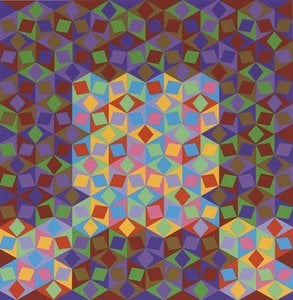
Explore 'Soeloe' by Victor Vasarely – a vibrant Op Art masterpiece of geometric abstraction! Discover layered hexagonal forms & digital artistry.
 Lees meer
Biografie kunstenaar
Op Art-pionier Victor Vasarely meesterde optische illusies. Ontdek vandaag zijn fascinerende geometrische abstracties.
Handgemaakte olieverfreproductie
Met de hand geschilderd in olieverf op canvas in uw gewenste maat en lijst, op bestelling gemaakt door onze kunstenaars. ( Schakel over naar print Schakel over naar digitale afbeeldingen)
Dit kunstwerk is auteursrechtelijk beschermd
De kunstwerken die op deze pagina worden weergegeven, zijn beschermd door de auteursrechtwetgeving, wat betekent dat het ons wettelijk niet is toegestaan om identieke reproducties te maken of te verkopen. Deze bescherming wordt gehandhaafd onder internationale overeenkomsten zoals de Conventie van Bern en door nationale wetgeving, waaronder de bepalingen van de Amerikaanse auteurswet - Titel 17. Alle rechten voorbehouden. Reproduceren of distribueren van afbeeldingen is niet toegestaan zonder uitdrukkelijke schriftelijke toestemming van WahooArt.com en de rechthebbenden.
Als een respectvol en legaal alternatief bieden wij op maat gemaakte, handgeschilderde kunstwerken aan die geïnspireerd zijn op het origineel. Onze bekwame en professionele kunstenaars bestuderen zorgvuldig de stijl, sfeer en artistieke essentie van het origineel om een nieuw, uniek werk te creëren dat dezelfde emotie oproept – terwijl het een op zichzelf staande, originele creatie blijft.
Deze methode voldoet volledig aan de auteursrechtwetgeving, omdat het niet gaat om het kopiëren of dupliceren van het beschermde kunstwerk. In plaats daarvan is er sprake van een creatieve herinterpretatie — een nieuw schilderij dat door het origineel wordt geïnspireerd, maar er niet identiek aan is.
Meer over dit schilderij
 Verstuur
 Delen
Delen
 Details bekijken
 Gids
Gids

 Download
 Vergelijkbare items
 Diavoorstelling
 Vraag & antwoord
 Statistieken
Bestel uw schilderij in vier eenvoudige stappen
Neem de tijd. U kunt elk antwoord nog wijzigen; de prijs in uw besteloverzicht wordt direct aangepast aan elke keuze.
1 Stap één van de vier
Welke maat wilt u kiezen?
Deze formaten behouden de proporties van het originele schilderij. De tekening laat uw keuze zien op een muur, boven een bank van twee meter.
Of geef uw eigen afmetingen op
Kies uit onze vooraf ingestelde maten die overeenkomen met de originele verhoudingen van het kunstwerk.

Voer de breedte en hoogte in die u nodig heeft, passend bij uw lijst of uw muur. Omdat dit handgeschilderd is, kan de kunstenaar bij een afmeting met een andere beeldverhouding iets meer rondom het schilderij schilderen of juist iets meer weglaten — u kiest zelf. Wij sturen u een digitaal mockup ter goedkeuring voordat het schilderwerk begint. De afbeelding die op deze pagina wordt getoond, is niet het uiteindelijke resultaat — alleen de mockup geeft dit weer.
2 Stap twee van vier
Hoe moet het worden geleverd: gerold, opgespannen of ingelijst?
De onderstaande prijzen zijn voor de maat die u in stap één heeft gekozen.
Kies de randen van het canvas
Kies uw lijst

Wit €1

Vervagende randen €1

Doorlopende rand €1

P118B €10

P118H €10

P118W €10

P438Z €10

P508JH €12

P508YH €12

P805H €10

P805Z €10

P919BZ €10

P919G €10

P919XJ €10

P959ZH €10

P968JZ €12

W106C €8

W218G €10

W218JH €8

W218Y €10

W307PJ €10

W316G €10

W316PJ €8

W316Y €10

W398PJ €8

W4111J €10

W500HY €15

W500JH €15

W692G €12

W849H €8

W940BG €15

W953PJ €8

H24-GOLD €30

H24-SILVER €30

H36-GOLD €45

H36-SILVER €45
Ingelijst
Lijstrand: . Totale afmetingen inclusief lijst: .
3 Stap drie van vier
Wilt u dat er iets aan het schilderij wordt aangepast?
De meeste mensen antwoorden nee. Omdat elk schilderij met de hand wordt gemaakt, kan onze kunstenaar het ook voor u aanpassen.
Na de bestelling zal het team van ArtsDot.com per e-mail contact opnemen met de klant voor instructies en een mockup-voorbeeld verstrekken
4 Stap vier van vier
Enkele afwerkingsopties
Ze zijn allemaal optioneel. De reeds geselecteerde antwoorden brengen geen extra kosten met zich mee.
Wie is de kunstenaar?
Wereldwijde levering () binnen 3 tot 4 weken in plaats van de standaard 5 weken. (13 november). Zonder concessies aan de kwaliteit.
Een naambordje, zoals in een museum?
Details van de gegraveerde bronzen plaat
This elegant plaque features the artist's name and the title of the artwork, finely engraved for a timeless presentation.
It is made from bronze with a refined, elegant finish. The text is precisely laser-engraved for a sharp and permanent result. Measuring 9x2 cm, the plaque is compact yet easy to read. It's built to be durable and scratch-resistant, offering a professional, museum-quality look. Mounting is simple thanks to the included adhesive backing.
Details transparante acrylplaat
The plaque includes essential engraved details such as the artist's name, the title of the artwork, the date it was created, the type of media used-like oil on canvas or watercolor-a brief description of the piece, and a QR code that links to the complete artwork information.
It is crafted from clear acrylic, offering a sleek, modern appearance. The text is UV-engraved in black to ensure strong visual contrast. With a size of 10x15 cm, it ensures optimal readability. It comes equipped with two metal hooks for secure wall mounting. The plaque is designed to be weather-resistant, making it suitable for various environments, and it includes interactive features that work seamlessly with smartphone scanning.
Details zwarte acrylplaat
This elegant plaque includes engraved information such as the artist's name, the title of the artwork, the date it was created, the type of media used (like oil on canvas or watercolor), a short description of the artwork, and a QR code for quick access to more information.
The plaque itself is made from refined black acrylic with a premium finish. The text is laser-engraved in white for high contrast and readability. Its size is 10x15 cm, designed to be easy to read. It comes with two metal hooks for professional mounting. The design is sleek and fits any interior style. It is also weather-resistant and durable, with built-in digital integration for mobile compatibility.
Een beschermende vernis?
Wanneer heeft u het nodig?
✓ Controleren en bestellen
Uw schilderij, zoals u het heeft besteld

Soeloe
Druktechniek
Afmetingen reproductie
-

Geselecteerde topkunstenaars
Meer detail, verfijning en extra productietijd
-

Lijst voor reproductie
-
-
Voor kunstwerken of reproducties die aan één zijde groter zijn dan 105 cm (ongeveer 41 inch), wordt de lijst als een losse set verzonden. Deze methode garandeert een veilige levering en voorkomt schade tijdens het transport.
Professionele montage vereist - dit is geen doe-het-zelfproduct.
De set moet worden gemonteerd en het canvas moet worden gespannen door een ervaren professionele lijstenmaker, met gebruik van houtlijm (niet inbegrepen), een doekspanter en klemmen om de sponningen recht te houden terwijl de lijm droogt. Onjuiste montage of een ongelijkmatige spanning op het canvas kan het kunstwerk permanent beschadigen en wordt niet gedekt door onze garantie.
 Voor kunstwerken of reproducties die aan één zijde groter zijn dan 105 cm (ongeveer 41 inch), wordt de lijst als een losse set verzonden. Deze methode garandeert een veilige levering en voorkomt schade tijdens het transport.
Alle massief houten onderdelen zijn inbegrepen, nauwkeurig op maat gesneden voor montage.
Te monteren met de meegeleverde schroeven, plus houtlijm voor de hoekverbindingen, die niet wordt meegeleverd en door uw lijstenmaker moet worden aangeschaft.
Professioneel gereedschap is vereist en niet inbegrepen: een spanner voor canvas en klemmen om de latten recht te houden terwijl de lijm droogt.
Belangrijk:
De hoekverbindingen vereisen houtlijm, de latten moeten met lijmklemmen worden vastgehouden tot de lijm volledig is opgedroogd, en het spannen van het canvas op het samengestelde frame vereist een doekspanter. Geen van deze artikelen is inbegrepen in de set. Wij adviseren u om een ervaren professionele lijstenmaker te raadplegen voordat u deze maat bestelt.

Naamplaatje
-
-

Beschermende vernislaag
Glanzende vernis (versterkt de kleuren en biedt bescherming tegen licht en vocht)
-

Mijn kunstwerk aanpassen
Voorbeelden van aanpassingen: vervang het gezicht door een eigen foto; voeg een huisdier toe (bijv. vervang de kat door een hond); verwerk een verborgen boodschap in de achtergrond; wijzig het landschap of andere elementen op de achtergrond.
-

Spoedlevering
Wereldwijde levering () binnen 3 tot 4 weken in plaats van de standaard 5 weken. (13 november). Geen concessies aan de kwaliteit.
-
Spoedlevering
Wereldwijde levering naar binnen 5 weken. (20 november).
Inbegrepen
Eindtotaal
€ 235
De optie voor glas is alleen beschikbaar bij een formaat kleiner dan 110 cm.
Inbegrepen bij elke bestelling
- Gratis wereldwijde expressverzending
- Hoogwaardig linnen canvas
- Volledige verzendverzekering
- Garantie op terugbetaling van invoerrechten
- Garantie op exacte kleurweergave
- Retourbeleid van 100 dagen (alleen bij defecten)
- 100% Geld-terug-garantie
- Korting bij meerdere afnames


Victor Vasarely’s “Soeloe”: A Dive into Geometric Perception
The artwork "Soeloe," presented here as a meticulously crafted hand-painted reproduction, offers an immersive journey into the visionary world of Victor Vasarely – a pivotal figure in the development of Op Art and a key innovator within the broader movement towards geometric abstraction. Born Károly Vaszary in 1906 in Pécs, Croatia (then part of Austria-Hungary), Vasarely’s artistic trajectory was initially far removed from the canvas; his early studies in medicine hinted at a different path before he decisively embraced the power of visual expression in 1927. This decision, fueled by an intense fascination with perception and form, led him to enroll in the Podolini-Volkmann Academy and ultimately into the influential workshop of Sándor Bortnyik – Műhely – where the principles of functional design and the Bauhaus movement profoundly shaped his artistic sensibilities. “Soeloe” embodies this legacy perfectly, showcasing a deliberate orchestration of hexagonal shapes that challenges our very understanding of space and visual experience.
- A Symphony of Color: The artwork’s dominant palette – vibrant blues ranging from deep indigo to luminous cyan, punctuated by intense reds and stark whites – immediately captivates the viewer. Vasarely masterfully employs gradient effects within each shape, subtly shifting hues and saturations that create a dynamic and almost kinetic visual experience.
- Geometric Precision: The core of “Soeloe” lies in its meticulously constructed composition of overlapping hexagonal shapes. These forms, defined by sharp edges, generate a grid-like structure that simultaneously appears ordered and deliberately disrupted, reflecting Vasarely’s fascination with the interplay between order and chaos.
- Digital Roots: Despite its seemingly analog execution through hand-painting, the artwork's genesis can be traced back to the digital techniques employed by Vasarely himself – vector graphics software used to create these complex geometric patterns. This connection highlights the evolution of artistic expression from traditional methods to modern digital tools.
The Rise of Op Art and Kinetic Perception
“Soeloe” is inextricably linked to the broader context of Op Art, a movement that emerged in the 1960s – though Vasarely’s work predates it significantly – aiming to stimulate optical illusions through carefully arranged patterns. Vasarely's exploration extended beyond mere visual trickery; he sought to understand and manipulate how our eyes perceive depth, movement, and spatial relationships. His work isn't simply about creating beautiful shapes; it’s an investigation into the fundamental principles of human perception. The tightly packed arrangement of hexagons in “Soeloe” deliberately exploits this perceptual phenomenon, inviting the viewer to actively engage with the artwork and experience its effects firsthand.
- Bauhaus Influence: Vasarely's training within Bortnyik’s workshop instilled a deep appreciation for functional design and geometric abstraction – hallmarks of the Bauhaus movement. This influence is evident in “Soeloe’s” emphasis on clarity, precision, and the reduction of form to its essential elements.
- Kinetic Art Precursor: Vasarely's work anticipated the rise of kinetic art, which explores the relationship between perception and movement. While "Soeloe" is static, it evokes a sense of dynamic energy through its complex arrangement and manipulation of visual space.
Symbolism and Emotional Impact
Interestingly, “Soeloe” deliberately avoids overt symbolism or figurative representation. Vasarely was primarily interested in exploring the formal qualities of color and shape for their own sake – a pure aesthetic pursuit. However, this lack of explicit meaning doesn’t diminish the artwork's emotional impact. The controlled chaos of the composition generates a sense of visual tension and excitement, inviting contemplation and stimulating the viewer’s imagination. The sheer density of the forms creates an immersive experience, drawing the eye across the surface and fostering a feeling of dynamic movement.
Note: This hand-painted reproduction captures the essence of Vasarely's groundbreaking work, offering a unique opportunity to own a piece of art history that continues to challenge and inspire.Veelgestelde vragen
Wie is de kunstenaar achter "Soeloe"?
De kunstenaar achter "Soeloe" is Victor Vasarely. Het werk is gecatalogiseerd onder de naam van Victor Vasarely.
Is "Soeloe" vrij van auteursrecht?
"Soeloe" door Victor Vasarely valt onder nog steeds auteursrechtelijk beschermd. Deze status bepaalt hoe de afbeelding van het werk mag worden gereproduceerd.
Wat is het formaat van "Soeloe"?
"Soeloe" door Victor Vasarely is een Square compositie. Het is raadzaam de verhoudingen te controleren voordat u een afmeting voor de print kiest.
Vergelijkbare kunstwerken




Victor Vasarely
1906 - 1997, Hongarije
Biografie kunstenaar
Het vroege leven en de opleiding van Victor Vasarely
Geboren als Károly Vaszary op 9 april 1906 in Pécs, Hongarije, begon de man die later wereldberoemd zou worden als Victor Vasarely zijn pad in een totaal ander vakgebied. In 1925 betrad hij de aula van de Eötvös Loránd Universiteit in Boedapest om medicijnen te studeren. De logica van het menselijk lichaam en de wetenschap bezighielden hem gedurende twee jaar, maar de onweerstaanbare drang naar visuele expressie kreeg uiteindelijk de overhand. Tegen 1927 had hij zijn medische studies definitief achter zich gelaten om zich te wijden aan de klassieke academische schilderkunst aan de Podolini-Volkmann Academie.
Zijn artistieke vorming zette voort toen hij zich richtte op het műhely van Sándor Bortnyik. Deze werkplaats was een broedplaats waar de principes van de Bauhaus-beweging wortel schoten, met een scherpe focus op het snijvlak tussen functioneel ontwerp en geometrische abstractie. Hier verschoof de aandacht naar het structurele en het systematische. De lessen die hij in deze ateliers leerde, vormden het fundament voor zijn latere, diepgaande onderzoek naar de manier waarop vormen en kleuren interageren met het menselijk oog.
De Ontwikkeling van een Unieke Visuele Taal
Tussen 1929 en 1944 lag de focus van Vasarely op grafisch werk. Hij bracht deze jaren door met experimenteren naar de manier waarop licht en schaduw interageren met eenvoudige vormen. Zijn vroege grafische periode bracht werken voort zoals Chess Board (1935) en Girl-power (1934). In 1937 werkte hij bovendien aan Zebras. Deze werken getuigen van een groeiende fascinatie voor de manier waarop een toeschouwer een plat oppervlak waarneemt. Hij bewoog zich weg van de traditionele schilderkunst naar een meer gestructureerde, grafische benadering.
In de periode van 1944 tot 1947 verschoof zijn koers. Hij verkende diverse stijlen, waaronder kubistische, futuristische, expressionistische, symbolistische en surrealistische benaderingen. Uiteindelijk liet hij deze experimenten achter zich om te zoeken naar een preciezere manier om de ruimte te organiseren. Deze zoektocht naar een nieuwe logica leidde tot de publicatie van zijn Gele Manifest. Zijn werk ging steeds minder over individuele expressie en steeds meer over de mechanica van het zien. Deze systematische methode zou hem uiteindelijk vestigen als een absolute leider van de Op Art-beweging.
Techniek en de Meesterschap van de Optische Illusie
De benadering van Victor Vasarely rust op een systematisch gebruik van geometrie om een fysieke reactie bij de toeschouwer uit te lokken. Hij vertrouwde niet op traditionele lichtbronnen of klassiek chiaroscuro om vorm te creëren. In plaats daarvan maakte hij gebruik van een geraffineerd samenspel van hoog-contrast pigmenten om diepte en beweging te simuleren. Door de kleurintensiteit te manipuleren, wist hij het oog te misleiden, waardoor er een perceptie van terugwijking en uitstulping ontstond op een volkomen vlak oppervlak. Deze methode transformeert een statisch vlak in een ruimte die lijkt aan te zwellen of juist weg te wijken.
Zijn methode, die hij zelf visuele kinetiek of plastique cinétique noemde, omvat een uiterst precieze ordening van vormen. Hij maakte gebruik van texturele effecten, perspectief, schaduw en licht om deze illusies op te bouwen. Het werk leunt vaak op de manier waarop het oog ritmische, interne straling interpreteert, in plaats van afhankelijk te zijn van externe verlichting. Door het gebruik van rasters en wiskundige principes creëerde hij sensaties van visuele vibratie en kolkende effecten. Het resultaat is een gevoel van beweging dat volledig binnen de perceptie van de kijker bestaat.
De precisie van zijn techniek is overduidelijk in de wijze waarop hij kleur en lijn hanteert om architecturale diepte te creëren. In werken zoals Torony-Nagy zorgt de kruising van scherpe witte lijnen met diepblauw en smaragdgroen voor een ritmische optische vibratie. Deze elementen werken samen om een sensatie van pulserend licht voort te brengen. Hij gebruikte deze instrumenten om voorbij de eenvoudige representatie te gaan, met een focus op de mechanica van hoe wij daadwerkelijk zien.
Belangrijke Werken en Prestaties
In 1937 markeerde de creatie van Zebra een cruciale verschuiving naar wat velen beschouwen als de vroegste voorbeelden van Op Art. Dit werk brak met de traditionele representatie en richtte zich in plaats daarvan op de manier waarop het oog eenvoudige vormen interpreteert. Tegen de jaren '60 hadden zijn experimenten met ritme en licht een hoogtepunt bereikt in het werk Torony-Nagy uit 1969. Dit meesterwerk maakt gebruik van vier gestileerde torens en een contrastrijk palet van blauwen, groenen en oranje om een gevoel van innerlijke gloed te creëren. De compositie leunt op de intersectie van witte lijnen en kleurintensiteit, waardoor het platte vlak lijkt te pulseren en te wijken.
Zijn fascinatie voor beweging reikte veel verder dan het platte vlak; het strekte zich uit naar de driedimensionale ruimte en alledaagse objecten. Zo ontwierp hij Georges Pompidou, een groot kinetisch object dat zijn visuele theorieën integreerde in een fysieke, bewegende vorm. Deze interesse in de praktische toepassing van zijn geometrie leidde ook tot een samenwerking met Rosenthal Studio Linie. Deze partnerschap resulteerde in de Suomi serviescollectie, een oplage van 500 stukken die zijn geometrische patronen introduceerde in de intieme sfeer van het dagelijks leven.
- Zebra (1937)
- Torony-Nagy (1969)
- Suomi serviescollectie
De oprichting van de Fondation Vasarely
In 1966 begon Victor Vasarely aan het proces voor de oprichting van de Fondation Vasarely. Dit ambitieuze project was geworteld in zijn diepgewortelde overtuigingen over het concept van "kunst voor iedereen" en zijn visionaire blik op de "stad van morgen". Hij streefde naar de creatie van een ruimte die de grenzen van de traditionele galerie-ervaring oversteeg, een plek die zijn filosofische principes werkelijk tot leven kon wekken. De fysieke bouw van dit monumentale gebouw ging in 1973 van start.
De stichting werd officieel ingewijd op 14 februari 1976 in Aix-en-Provence, Frankrijk. De locatie werd met zorg ontworpen om zijn werken te huisvesten en zijn theorieën over de interactie tussen kunst en stedelijk ontwerp te promoten. De architectuur van de ruimte zelf was een integraal onderdeel van deze visie; de indeling van het gebouw was er specifiek op gericht de manier waarop het publiek zijn geometrische vormen ervaart, te versterken en te ondersteunen.
De blijvende nalatenschap en wereldwijde erkenning
De reikwijdte van zijn visuele taal reikte veel verder dan de muren van een galerie. Zijn patronen en geometrische structuren vonden hun weg naar de texturen van het dagelijks leven, waarbij ze de lijnen van de mode, de lay-outs van het interieurontwerp en de logica van het grafisch ontwerp beïnvloedden. Zelfs de vroege ontwikkeling van de computergraphics draagt het stempel van zijn systematische benadering van vorm en perceptie. Zijn ideeën bleven niet beperkt tot het canvas; ze bewogen mee naar de functionele wereld van objecten en de digitale structuren die daarop volgden.
In 1982 reisde zijn werk zelfs de ruimte in, toen serigrafieën werden meegevoerd aan boord van het Frans-Sovjet-ruimtevaartuig Salyut 7. Dit moment onderstreepte de verbinding tussen zijn wiskundige precisie en de bredere menselijke drang naar exploratie. Hij bleef een centrale figuur in de moderne kunstgeschiedenis tot aan zijn dood in Parijs, Frankrijk, op 15 maart 1997.
Waar zijn zijn werken vandaag de dag te bewonderen
Het volgen van de fysieke aanwezigheid van zijn werk vereist een reis langs verschillende locaties in Frankrijk en Hongarije. In Aix-en-Provence, Frankrijk, herbergt de Fondation Vasarely een aanzienlijk deel van zijn oeuvre. Dit museum werd door de kunstenaar zelf opgericht om zijn ideeën over "kunst voor iedereen" te promoten. De ruimte is georganiseerd in zeven zeshoekige cellen, elk 14 meter breed en 11 meter hoog, speciaal ontworpen om vierenzestig monumentale werken van 6 bij 8 meter te huisvesten.
Zijn aanwezigheid in Hongarije is eveneens voelbaar via speciale locaties. Het Vasarely Museum bevindt zich in Pécs, de stad waar hij werd geboren. Daarnaast is er een Vasarely Museum gevestigd in het Zichy-paleis in Óbuda, Boedapest. Deze locaties bieden een directe ontmoeting met de geometrische vormen en optische effecten die zijn artistieke praktijk definieerden. In Frankrijk is een andere plek voor zijn werk het Vasarely Museum in het Saint-Firmin-paleis in Gordes.
Naast deze specifieke musea is zijn invloed terug te vinden in diverse institutionele collecties. Sommige van zijn werken maken deel uit van de collectie van het Bilbao Fine Arts Museum, terwijl andere deel uitmaken van de collecties van de Inter-American Development Bank in Washington, D.C., en het Bechtler Museum of Modern Art in Charlotte. Deze verspreide locaties zorgen ervoor dat zijn visuele experimenten toegankelijk blijven voor een divers publiek.




Gerelateerde artikelen

Top 10 Meesterwerken gedomineerd door 'Slate Blue': Kunst voor uw interieur
Ontdek 10 beroemde schilderijen gedomineerd door de prachtige tint 'Slate Blue'. Van Monet tot Van Gogh, leer over kunstgeschiedenis & techniek. Museumkwaliteit reproducties voor uw interieur op ArtsDot.com! Ontdek de collectie online.

Top 10 Meesterwerken van de Geometrische Abstractie | ArtsDot.nl
Ontdek de 10 meest invloedrijke meesterwerken van de geometrische abstractie! Van Mondriaan tot Malevich, leer over kunstenaars, technieken & kleuren. Museumkwaliteit reproducties op ArtsDot.com – voor een unieke interieurstijl.

Top 10 Abstract Expressionisme Meesterwerken: Kunst voor uw Interieur | ArtsDot.com
Ontdek de 10 meest invloedrijke werken van Abstract Expressionisme! Leer over Jackson Pollock, Mark Rothko & meer. Museumkwaliteit kunst reproducties voor uw interieur. Bekijk de collectie op ArtsDot.com.