


The picture follows your choices: , .
Beschrijving verzamelobject
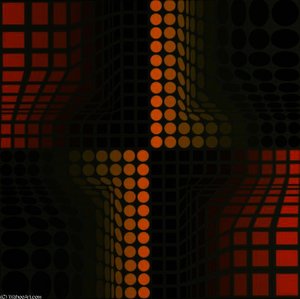
Experience Victor Vasarely’s iconic Op Art masterpiece, ‘Gonne,’ featuring a vibrant red circle amidst dynamic blue squares – a captivating exploration of geometric abstraction and visual perception. Discover this unique artwork and bring its bold design into your space.
 Lees meer
Biografie kunstenaar
Ontdek Victor Vasarely (1906-1997), de pionier van Op Art! Bewonder zijn geometrische abstracties, optische illusies & een blijvende invloed op moderne kunst en design.
Handgemaakte olieverfreproductie
Met de hand geschilderd in olieverf op canvas in uw gewenste maat en lijst, op bestelling gemaakt door onze kunstenaars. ( Schakel over naar print Schakel over naar digitale afbeeldingen)
Dit kunstwerk is auteursrechtelijk beschermd
De kunstwerken die op deze pagina worden weergegeven, zijn beschermd door de auteursrechtwetgeving, wat betekent dat het ons wettelijk niet is toegestaan om identieke reproducties te maken of te verkopen. Deze bescherming wordt gehandhaafd onder internationale overeenkomsten zoals de Conventie van Bern en door nationale wetgeving, waaronder de bepalingen van de Amerikaanse auteurswet - Titel 17. Alle rechten voorbehouden. Reproduceren of distribueren van afbeeldingen is niet toegestaan zonder uitdrukkelijke schriftelijke toestemming van WahooArt.com en de rechthebbenden.
Als een respectvol en legaal alternatief bieden wij op maat gemaakte, handgeschilderde kunstwerken aan die geïnspireerd zijn op het origineel. Onze bekwame en professionele kunstenaars bestuderen zorgvuldig de stijl, sfeer en artistieke essentie van het origineel om een nieuw, uniek werk te creëren dat dezelfde emotie oproept – terwijl het een op zichzelf staande, originele creatie blijft.
Deze methode voldoet volledig aan de auteursrechtwetgeving, omdat het niet gaat om het kopiëren of dupliceren van het beschermde kunstwerk. In plaats daarvan is er sprake van een creatieve herinterpretatie — een nieuw schilderij dat door het origineel wordt geïnspireerd, maar er niet identiek aan is.
More about this painting
 Voorvertoning
 Verstuur
 Delen
Delen
 Details bekijken
 Gids
Gids

 Download
 Vergelijkbare items
 Röntgenonderzoek
 Diavoorstelling
 Q&A
Q&A Statistieken
Order your painting in four simple steps
Take your time. You can change any answer; the price in your order card follows each choice.
1 Step one of four
Which size would you like?
These sizes keep the proportions of the original painting. The drawing shows your choice on a wall, above a two-metre sofa.
Or give your own measurements
Kies uit onze vooraf ingestelde maten die overeenkomen met de originele verhoudingen van het kunstwerk.

Voer de breedte en hoogte in die u nodig heeft, passend bij uw lijst of uw muur. Omdat dit handgeschilderd is, kan de kunstenaar bij een afmeting met een andere beeldverhouding iets meer rondom het schilderij schilderen of juist iets meer weglaten — u kiest zelf. Wij sturen u een digitaal mockup ter goedkeuring voordat het schilderwerk begint. De afbeelding die op deze pagina wordt getoond, is niet het uiteindelijke resultaat — alleen de mockup geeft dit weer.
2 Step two of four
How should it be prepared: rolled, stretched or framed?
The prices below are for the size you chose in step one.
Choose the edges of the stretched canvas
Choose your frame

White €1

Blurside €1

Extended €1

P118B €10

P118H €10

P118W €10

P438Z €10

P508JH €12

P508YH €12

P805H €10

P805Z €10

P919BZ €10

P919G €10

P919XJ €10

P959ZH €10

P968JZ €12

W106C €8

W218G €10

W218JH €8

W218Y €10

W307PJ €10

W316G €10

W316PJ €8

W316Y €10

W398PJ €8

W4111J €10

W500HY €15

W500JH €15

W692G €12

W849H €8

W940BG €15

W953PJ €8

H24-GOLD €30

H24-SILVER €30

H36-GOLD €45

H36-SILVER €45
Ingelijst
Moulding: . Overall size with the frame: .
3 Step three of four
Would you like anything changed in the painting?
Most people answer no. Because each painting is made by hand, our artist can also adapt it for you.
After order, ArtsDot.com team will email client for instructions and provide a mockup preview
4 Step four of four
A few finishing options
All of them are optional. The answers already selected cost nothing extra.
Who paints it?
Wereldwijde levering () binnen 3 tot 4 weken in plaats van de standaard 5 weken. (1 november). Zonder concessies aan de kwaliteit.
A nameplate, as in a museum?
Details van de gegraveerde bronzen plaat
This elegant plaque features the artist's name and the title of the artwork, finely engraved for a timeless presentation.
It is made from bronze with a refined, elegant finish. The text is precisely laser-engraved for a sharp and permanent result. Measuring 9x2 cm, the plaque is compact yet easy to read. It's built to be durable and scratch-resistant, offering a professional, museum-quality look. Mounting is simple thanks to the included adhesive backing.
Details transparante acrylplaat
The plaque includes essential engraved details such as the artist's name, the title of the artwork, the date it was created, the type of media used-like oil on canvas or watercolor-a brief description of the piece, and a QR code that links to the complete artwork information.
It is crafted from clear acrylic, offering a sleek, modern appearance. The text is UV-engraved in black to ensure strong visual contrast. With a size of 10x15 cm, it ensures optimal readability. It comes equipped with two metal hooks for secure wall mounting. The plaque is designed to be weather-resistant, making it suitable for various environments, and it includes interactive features that work seamlessly with smartphone scanning.
Details zwarte acrylplaat
This elegant plaque includes engraved information such as the artist's name, the title of the artwork, the date it was created, the type of media used (like oil on canvas or watercolor), a short description of the artwork, and a QR code for quick access to more information.
The plaque itself is made from refined black acrylic with a premium finish. The text is laser-engraved in white for high contrast and readability. Its size is 10x15 cm, designed to be easy to read. It comes with two metal hooks for professional mounting. The design is sleek and fits any interior style. It is also weather-resistant and durable, with built-in digital integration for mobile compatibility.
A protective varnish?
When do you need it?
✓ Check and order
Your painting, as you ordered it

Gonne
Druktechniek
Afmetingen reproductie
-

Geselecteerde topkunstenaars
Meer detail, verfijning en extra productietijd
-

Lijst voor reproductie
-
-
Voor kunstwerken of reproducties die aan één zijde groter zijn dan 105 cm (ongeveer 41 inch), wordt de lijst als een losse set verzonden. Deze methode garandeert een veilige levering en voorkomt schade tijdens het transport.
Professionele montage vereist - dit is geen doe-het-zelfproduct.
De set moet worden gemonteerd en het canvas moet worden gespannen door een ervaren professionele lijstenmaker, met gebruik van houtlijm (niet inbegrepen), een doekspanter en klemmen om de sponningen recht te houden terwijl de lijm droogt. Onjuiste montage of een ongelijkmatige spanning op het canvas kan het kunstwerk permanent beschadigen en wordt niet gedekt door onze garantie.
 Voor kunstwerken of reproducties die aan één zijde groter zijn dan 105 cm (ongeveer 41 inch), wordt de lijst als een losse set verzonden. Deze methode garandeert een veilige levering en voorkomt schade tijdens het transport.
Alle massief houten onderdelen zijn inbegrepen, nauwkeurig op maat gesneden voor montage.
Te monteren met de meegeleverde schroeven, plus houtlijm voor de hoekverbindingen, die niet wordt meegeleverd en door uw lijstenmaker moet worden aangeschaft.
Professioneel gereedschap is vereist en niet inbegrepen: een spanner voor canvas en klemmen om de latten recht te houden terwijl de lijm droogt.
Belangrijk:
De hoekverbindingen vereisen houtlijm, de latten moeten met lijmklemmen worden vastgehouden tot de lijm volledig is opgedroogd, en het spannen van het canvas op het samengestelde frame vereist een doekspanter. Geen van deze artikelen is inbegrepen in de set. Wij adviseren u om een ervaren professionele lijstenmaker te raadplegen voordat u deze maat bestelt.

Naamplaatje
-
-

Beschermende vernislaag
Glanzende vernis (versterkt de kleuren en biedt bescherming tegen licht en vocht)
-

Mijn kunstwerk aanpassen
Voorbeelden van aanpassingen: vervang het gezicht door een eigen foto; voeg een huisdier toe (bijv. vervang de kat door een hond); verwerk een verborgen boodschap in de achtergrond; wijzig het landschap of andere elementen op de achtergrond.
-

Spoedlevering
Wereldwijde levering () binnen 3 tot 4 weken in plaats van de standaard 5 weken. (1 november). Geen concessies aan de kwaliteit.
-
Spoedlevering
Wereldwijde levering naar binnen 5 weken. (8 november).
Inbegrepen
Eindtotaal
€ 234
De optie voor glas is alleen beschikbaar bij een formaat kleiner dan 110 cm.
Included with every order
- Gratis wereldwijde expressverzending
- Hoogwaardig linnen canvas
- Volledige verzendverzekering
- Garantie op terugbetaling van invoerrechten
- Garantie op exacte kleurweergave
- Retourbeleid van 100 dagen (alleen bij defecten)
- 100% Geld-terug-garantie
- Korting bij meerdere afnames


A Symphony in Squares: Exploring Victor Vasarely’s “Gonne”
Victor Vasarely's "Gonne," a vibrant explosion of red and blue, isn't merely a painting; it’s an invitation to reconsider the very nature of perception. This captivating artwork, reminiscent of a meticulously crafted optical illusion, embodies the core tenets of Op Art – Optical Art – a movement that emerged in the mid-20th century with Vasarely at its forefront. Born Károly Vaszary in 1906 in Pécs, Croatia, his artistic trajectory began unexpectedly, initially driven by an interest in medicine before he was drawn to the expressive possibilities of visual form. His formative years within the Bauhaus-influenced Műhely workshop instilled a profound understanding of geometric abstraction and its potential to manipulate our senses.
- Style & Technique: “Gonne” exemplifies Vasarely’s signature style, characterized by precisely rendered, overlapping squares and circles. The technique is painstakingly executed, relying on meticulous layering and controlled color application – a testament to the artist's dedication to scientific precision within his art. The slightly darker shade of the central red circle against the surrounding blue squares creates a dynamic contrast that actively engages the viewer’s eye, drawing attention to the subtle shifts in perspective and depth.
- Historical Context: Created during a period of rapid technological advancement and shifting artistic sensibilities, “Gonne” reflects the broader movement towards abstraction and the exploration of visual phenomena. Op Art, with its emphasis on optical illusions and the manipulation of perception, was a direct response to the increasing influence of mass media and industrial design.
Decoding the Geometry: Symbolism and Intent
While seemingly abstract, Vasarely’s work is deeply rooted in mathematical principles and an exploration of visual harmony. The geometric forms within “Gonne” aren't arbitrary; they represent a deliberate attempt to translate scientific concepts – particularly those related to optics and perception – into a tangible artistic experience. The repetition of squares and circles evokes a sense of order and rhythm, mirroring the underlying structures of the universe as perceived through mathematical models. The vibrant colors themselves are carefully chosen not just for aesthetic appeal but also for their optical effects—the red and blue hues intensify the illusion of movement and depth.
Emotional Resonance: A Visual Meditation
"Gonne" transcends mere visual stimulation; it invites a meditative state. The artwork’s dynamic composition, coupled with its bold color palette, creates a powerful emotional response – one of excitement, wonder, and perhaps even a slight disorientation. Vasarely aimed to create art that actively engaged the viewer's senses, challenging their assumptions about reality and prompting them to question how they perceive the world around them. The piece’s captivating nature makes it an ideal addition to any space seeking a touch of modern sophistication and intellectual stimulation.
Collecting “Gonne”: A Statement of Style
A hand-painted reproduction of Victor Vasarely's "Gonne" is more than just a decorative element; it’s an investment in art history and a testament to the enduring power of geometric abstraction. ArtsDot offers meticulously crafted reproductions that faithfully capture the original artwork’s vibrancy and precision, ensuring that you can experience the full impact of Vasarely’s vision within your own environment. Whether adorning a contemporary living room or adding an element of intellectual intrigue to a corporate space, “Gonne” remains a timeless masterpiece.
Veelgestelde vragen
Voor welke kamer wordt "Gonne" door Victor Vasarely aanbevolen?
Een reproductie van "Gonne" past uitstekend in een Living Room.
In welke oriëntatie staat "Gonne" door Victor Vasarely?
Het formaat van "Gonne" is Square. Dit is handig bij het plannen van de plek waar een reproductie zal worden geplaatst.
Welke kunstenaar en welke stijl staan achter "Gonne"?
"Gonne" werd gecreëerd door Victor Vasarely in de Op Art-stijl. De kunstenaar en de stroming bepalen de traditie van het werk.
Vergelijkbare kunstwerken


Victor Vasarely
1906 - 1997, Kroatië
Biografie kunstenaar
A Life Forged in Geometry: The World of Victor Vasarely
Victor Vasarely’s journey to becoming a pioneer of Op Art and kinetic art was anything but predetermined. Born Károly Vaszary in 1906 in Pécs, a city then nestled within Austria-Hungary (now Croatia), his early life hinted at a path far removed from the canvas. Initially pursuing medical studies at Eötvös Loránd University in Budapest, he abruptly abandoned this ambition for the world of painting in 1927, enrolling at the Podolini-Volkmann Academy. This decision wasn’t merely a career shift; it represented a lifelong dedication to exploring the fundamental principles governing perception and form – a quest rooted in logic and precision. A pivotal moment arrived with his enrollment in Sándor Bortnyik’s workshop – Műhely – a school deeply influenced by the Bauhaus movement. Here, Vasarely absorbed the tenets of functional design and geometric abstraction, seeds that would blossom into his signature style. These formative years weren't simply about acquiring technique; they were about dismantling traditional artistic conventions and embracing a new visual language, one designed to actively engage the viewer’s perception.From Early Abstraction to the Dawn of Op Art
The late 1920s and early 1930s witnessed Vasarely's gradual departure from representational art, as he delved deeper into the realm of geometric abstraction. Works like “Blue Study” and “Green Study,” created in 1929, exemplify this transition – a deliberate shedding of narrative content in favor of pure form and color relationships. He was profoundly influenced by masters such as Piet Mondrian and Kazimir Malevich, yet he wasn’t content to simply emulate their styles. Vasarely sought to transcend the static compositions of his predecessors, aiming for a dynamism that would actively engage the viewer's perception. This quest led him to Paris in 1930, where he established himself as a graphic designer and advertising artist, honing his skills while continuing to develop his unique artistic vision. It was during this period that he began experimenting with techniques that would later become hallmarks of Op Art – manipulating shapes and colors to create illusions of movement and depth. The seeds were sown for a revolution in visual experience.The Systematic Illusion: Defining a Movement
By the 1960s, Victor Vasarely had fully emerged as a leading figure in the burgeoning Op Art movement. Unlike many artists who relied on intuition and spontaneous expression, Vasarely approached his work with a distinctly systematic methodology. He employed grids and mathematical principles to generate patterns that created powerful optical illusions – visual vibrations, swirling effects, and sensations of depth where none physically existed. This wasn’t about trickery; it was about revealing the inherent dynamism within perception itself. He believed in reproducibility and mass appeal, aiming to democratize art by making it accessible beyond the confines of galleries and museums. His work challenged viewers to question their own visual experience, forcing them to actively participate in the creation of meaning. This deliberate engagement with perception set Op Art apart and cemented Vasarely’s place at its forefront. He wasn't merely painting pictures; he was constructing experiences.Historical Significance
Vasarely’s contribution to art history is multifaceted. He moved beyond traditional painting techniques to create works that actively engage the viewer’s perception. His systematic approach challenged conventional notions of artistic creativity and paved the way for computer-generated art and digital design. By embracing reproducibility and commercial applications, Vasarely blurred the boundaries between fine art and popular culture, leaving an enduring mark on both. He wasn't simply creating aesthetically pleasing objects; he was conducting visual experiments that revealed fundamental truths about how we see the world. His work continues to resonate today, reminding us of the power of abstraction, the beauty of geometry, and the endless possibilities of human creativity.Beyond the Canvas: Kinetic Exploration and a Lasting Legacy
Vasarely’s artistic exploration didn't stop at static illusions. He increasingly ventured into kinetic art, creating works that incorporated actual movement or appeared to move through carefully orchestrated visual effects. “Georges Pompidou” (1976), a large kinematic object installed at the Centre Pompidou in Paris, stands as a testament to this ambition – an integration of art with architecture and urban design on a grand scale. He also demonstrated remarkable innovation by applying his designs to commercial products, most notably through his collaboration with Rosenthal porcelain, resulting in the iconic “Suomi” tableware series. This willingness to blur the boundaries between fine art and functional objects further underscored his belief in art’s potential to permeate everyday life. The establishment of the Fondation Vasarely in Aix-en-Provence ensured the preservation and promotion of his extensive body of work, while a remarkable event – the inclusion of serigraphs aboard the French-Soviet spacecraft Salyut 7 in 1982 – symbolized the global recognition of his art and its connection to the broader human endeavor of exploration. Victor Vasarely’s legacy extends far beyond the realm of painting; he profoundly influenced graphic design, fashion, interior design, and even early computer graphics, inspiring generations with his innovative vision and unwavering commitment to exploring the possibilities of perception. He remains a pivotal figure in modern art history, a true visionary who dared to challenge our understanding of what art could be.




Gerelateerde artikelen

Top 10 Meesterwerken gedomineerd door 'Slate Blue': Kunst voor uw interieur
Ontdek 10 beroemde schilderijen gedomineerd door de prachtige tint 'Slate Blue'. Van Monet tot Van Gogh, leer over kunstgeschiedenis & techniek. Museumkwaliteit reproducties voor uw interieur op ArtsDot.com! Ontdek de collectie online.

Top 10 Meesterwerken van de Geometrische Abstractie | ArtsDot.nl
Ontdek de 10 meest invloedrijke meesterwerken van de geometrische abstractie! Van Mondriaan tot Malevich, leer over kunstenaars, technieken & kleuren. Museumkwaliteit reproducties op ArtsDot.com – voor een unieke interieurstijl.

Kandinsky's Meesterwerken: 25 Abstracte Kunstparels voor uw Interieur | ArtsDot
Ontdek de 25 meest iconische werken van Wassily Kandinsky! Duik in zijn abstracte wereld vol kleur, expressionisme & spirituele diepgang. Vind museumkwaliteit reproducties en interieurinspiratie op ArtsDot.com.