
- Home

- Digitale afbeeldingen
- René Magritte
- The secunder

 Preview
 Verstuur
 Delen
Delen
 Details bekijken

 Download
 Vergelijkbare werken
 Röntgenonderzoek
 Diavoorstelling
The secunder

 Lees meer
Koop een digitale afbeelding met hoge resolutie en verbeterde kwaliteit, die veel superieur is aan de online voorvertoning.
Elk bestand wordt met uiterste precisie voorbereid door onze interne specialisten, met behulp van geavanceerde tools en deskundige handmatige retouche. Wij garanderen dat elke afbeelding een uitzonderlijke helderheid, nauwkeurige kleurweergave en verfijnde details bezit.
Het uiteindelijke bestand wordt binnen 72 uur per e-mail geleverd, geoptimaliseerd voor direct gebruik in professionele, redactionele en printomgevingen. Dit is dezelfde kwaliteit waarop topontwerpstudio's, uitgevers en galerieën vertrouwen.
Digitale afbeeldingen
Download een bestand met hoge resolutie voor persoonlijke weergave, afdrukken en creatieve projecten. ( Switch to Print Switch to hand made Painting)
Inbegrepen bij elke bestelling van een digitale afbeelding
Professionele digitale levering, gegarandeerd
Wanneer u kiest voor ArtsDot.com, ontvangt u niet alleen een afbeelding – u krijgt een professioneel verbeterd digitaal kunstwerk, met precisie vervaardigd en voorzien van een tevredenheidsgarantie. Dit is alles wat automatisch bij uw bestelling is inbegrepen:

Snelle digitale levering
Uw hoogwaardige digitale afbeeldingsbestand wordt binnen 72 uur na bestelling naar u gemaild – klaar voor direct gebruik.

Met AI verbeterd digitaal bestand
Uw kunstwerk wordt professioneel geoptimaliseerd met behulp van geavanceerde AI-tools en handmatige bewerkingen, waardoor maximale details, helderheid en kleurnauwkeurigheid worden gegarandeerd.

Gratis levenslange herlevering van digitale afbeeldingen
Je bestand per ongeluk verwijderd of kwijtgeraakt? Geen zorgen – we sturen het u op elk gewenst moment gratis opnieuw toe.

Geen invoerkosten - Altijd
Geniet direct van uw kunstwerk zonder invoerrechten, belastingen of verzendkosten – digitale downloads zijn altijd belastingvrij.

Garantie op kleurgetrouwheid
Met behulp van professionele hulpmiddelen en kleurbeheer zorgen wij ervoor dat uw digitale afbeelding de originele kleuren zo nauwkeurig mogelijk weergeeft.

60 dagen tevredenheidsgarantie
Als u niet tevreden bent met uw digitale afbeelding, passen wij deze aan of storten wij 100% terug binnen 60 dagen – zonder vragen gesteld.

100% Geld-terug-garantie
Niet tevreden? Ontvang binnen 60 dagen na ontvangst van uw digitale bestand uw volledige aankoopbedrag terug – zonder vragen te stellen.

Korting bij grote bestellingen
Koop 3 afbeeldingen, bespaar 10% - Koop 5, bespaar 15% - Koop 10+, bespaar 20%. Ideaal voor creatieve projecten, galerieën en bureaus.
Beschrijving verzamelobject
The Enigmatic Mariner: A Study in Surrealist Perception
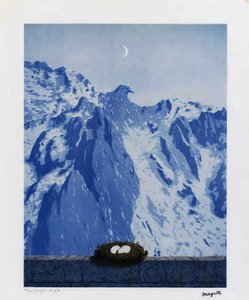
René Magritte’s “The Secunder” isn't merely a depiction of a ship on the ocean; it’s an invitation to question the very nature of reality and representation. Painted in 1928, during his intensely productive period exploring the boundaries of surrealism, this work embodies Magritte’s signature style – a deliberate disruption of familiar imagery designed to unsettle the viewer's assumptions. The painting presents a blue vessel sailing across a seemingly limitless expanse of water, beneath a sky punctuated by indistinct clouds. While superficially resembling a traditional pirate ship, its details are subtly off-kilter, hinting at an unreality that lies just beneath the surface. Notice the lack of detail in the ship’s construction; it feels almost constructed from fragments, as if assembled from memory rather than direct observation.
Magritte's fascination with the mechanics of perception is central to “The Secunder.” He wasn’t interested in simply replicating what he saw; instead, he aimed to expose the gap between our conscious experience and the underlying processes that shape it. The ship itself becomes a symbol of this disconnect – a recognizable form rendered ambiguous through its simplified features and the unsettling stillness of the scene. This deliberate ambiguity is further reinforced by the muted color palette, dominated by blues and greys, contributing to an atmosphere of quiet contemplation and subtle unease.
The Roots of Surrealism: Trauma and the Unseen
Understanding Magritte’s artistic journey requires acknowledging the profound impact of his early life. Born in Lessines, Belgium, in 1898, he experienced a deeply formative event at the age of thirteen – the suicide of his mother. The image of her body being recovered from the River Sambre, with her dress obscuring her face, became a recurring motif throughout his work, representing loss, mystery, and the hidden aspects of human experience. This trauma instilled within him a lifelong preoccupation with what remains unseen, concealed, or deliberately obscured – a theme powerfully realized in “The Secunder.” The veiled faces, the simplified forms, all contribute to this sense of something being withheld from direct comprehension.
This early experience isn’t simply a biographical detail; it fundamentally shaped Magritte's artistic approach. He wasn’t interested in creating beautiful or easily digestible images. Instead, he sought to provoke thought and challenge the viewer’s expectations, mirroring the unsettling nature of his own memories. His exploration of perception can be seen as an attempt to grapple with the unresolved grief and questions surrounding his mother’s death – a subconscious desire to bring something hidden into view.
Technique and Composition: A Deliberate Disruption
Magritte's technique in “The Secunder” is characterized by meticulous detail combined with a calculated disregard for realism. He employed oil paints on canvas, building up layers of color and texture to create the illusion of depth and atmosphere. However, he deliberately avoided creating a convincing representation of space or light. The horizon line is flat, the clouds are amorphous, and the ship lacks any sense of dynamism. This deliberate disruption of traditional artistic conventions serves to further emphasize the painting’s surreal quality.
The composition itself is carefully balanced, with the ship positioned slightly off-center, drawing the viewer's eye across the canvas. The vastness of the ocean and sky creates a sense of isolation and loneliness, while the subtle details – such as the faint reflection on the water’s surface – add to the painting’s complexity. Magritte’s control over his materials is evident in every brushstroke, yet it's precisely this control that contributes to the work’s unsettling effect.
Symbolism and Emotional Resonance
“The Secunder” resists easy interpretation, inviting viewers to project their own meanings onto the scene. The ship itself can be seen as a symbol of exploration, adventure, or even oblivion – a vessel adrift in an unknown sea. The obscured faces suggest a loss of identity, a questioning of selfhood, and perhaps a yearning for something beyond the visible world. The painting’s emotional impact is one of quiet contemplation, tinged with melancholy and a sense of mystery.
Ultimately, “The Secunder” isn't about providing answers; it’s about raising questions. It’s a testament to Magritte’s genius – his ability to create images that are both familiar and profoundly unsettling, prompting us to reconsider our assumptions about the world around us. A hand-painted reproduction of this iconic work offers a unique opportunity to experience the depth and complexity of Magritte's vision, bringing this enigmatic mariner into your home or studio.
Vergelijkbare kunstwerken




Kunstenaarsbiografie
Early Life and the Seeds of Surrealism
René Magritte, geboren René François Ghislain Magritte op 21 november 1898 in Lessines, België, kwam in een wereld terecht die zijn enigmatische artistieke visie diepgaand zou vormen. Zijn vroege jaren werden gekenmerkt door een onheilspellend incident – de zelfmoord van zijn moeder toen hij slechts dertien jaar oud was. Het beeld van haar lichaam dat uit de Samber werd opgegraven, met haar jurk die haar gezicht bedekte, werd een spookachtig motief dat subtiel terugkeerde in zijn latere werk, zich manifesteerde in verduisterde figuren en een voortdurende zoektocht naar verborgen realiteiten. Deze vroege trauma’s zaaiden een fascinatie met mysterie, verlies en de verstikkende kracht van wat onthuld blijft. Hoewel details van zijn jeugd enigszins ongrijpbaar zijn, is duidelijk dat deze vormende ervaring de basis legde voor zijn levenslange vraaging naar perceptie en representatie. Hij begon op tienjarige leeftijd met tekenen, wat een innige neiging tot visuele expressie onthulde, maar experimenteerde aanvankelijk met Impressionisme voordat hij een pad insloeg dat hem zou leiden tot het worden van een van de meest significante figuren in de Surrealistische kunst.Artistic Development and Influences
Magritte’s artistieke reis was niet direct of rechtlijnig. Hij studeerde aan de Académie Royale des Beaux-Arts in Brussel, maar vond de traditionele methoden daar verstikkend. Zijn vroege werk experimenteerde met Futurisme en Cubisme, waardoor elementen van deze avantgardistische bewegingen werden opgenomen, maar uiteindelijk weigerde hun puur formele bezorgdheid. Het was pas in 1922, toen hij de schilderij *The Song of Love* van Giorgio de Chirico ontmoette, dat Magritte een resonatie ontdekte die zijn artistieke koers onherstelbaar zou veranderen. De Chirico’s dromerige landschappen en verontrustende juxtaposities openden voor Magritte een nieuwe manier van kijken – een wereld waar het bekende vreemd kon worden gemaakt, en het alledaagse met diepe mystiek werd ingezaaid. Dit ontmoeting leidde tot zijn toewijding aan Surrealisme, hoewel hij vaak een unieke afstand behield van de meer expliciet psychologische of automatische aspecten ervan. Hij prefereerde een nauwkeurige, bijna klinische precisie in zijn schilderkunst, waarbij hij realistische technieken gebruikte om illogische scenario’s weer te geven.The Heart of Surrealism: Challenging Reality
Vanaf 1926 had Magritte zich volledig ingezet voor de principes van Surrealisme, waarbij hij *Le Jockey Perdu (The Lost Jockey)* produceerde, die breed wordt beschouwd als zijn eerste echt surrealistische werk. Echter, zijn soort Surrealisme was uniek. Hij was niet geïnteresseerd in het verkennen van het onbewuste door vrije associatie of dromerige beelden zoals sommige van zijn tijdgenoten. In plaats daarvan zocht Magritte naar een manier om de perceptie van de werkelijkheid uit te dagen door alledaagse objecten in onverwachte contexten te presenteren, waardoor kijkers werden aangemoedigd hun aannames over de wereld om hen heen in twijfel te trekken. Iconische werken zoals *The Treachery of Images (This is not a pipe)* (1929) ontleden het relatie tussen beeld en object briljant, herinnerend ons dat een representatie nooit het ding zelf is. *Les Amants (The Lovers)* (1927-1928), met zijn verduisterde figuren, echoë de trauma’s van zijn moeder dood terwijl tegelijkertijd intimiteit en verborgenheid worden onderzocht. *Time Transfixed* (1938) presenteert een locomatief die door een bakstenen muur barst, waardoor onze perceptie van ruimte en tijd wordt verstoord. En *The Human Condition* (1933), een doek in een doek, vervaagt de grenzen tussen representatie en werkelijkheid, waardoor we worden aangemoedigd om te overwegen hoe we de wereld waarnemen en interpreteren.Later Life, Recognition, and Enduring Legacy
Ondanks initiële moeilijkheden met erkenning, kreeg Magritte’s werk geleidelijk aan meer bekendheid, vooral in de Verenigde Staten door tentoonstellingen in 1936 en latere retrospectieve tentoonstellingen op het Museum of Modern Art (1965) en het Metropolitan Museum of Art (1992). Hij bleef politiek actief gedurende zijn hele leven, waarbij hij artistieke autonomie verdedigde. Hij bleef zijn kenmerkende stijl verfijnen, thema’s van herhaling, illusie en de kracht van taal onderzoeken in schilderijen die zowel intellectueel stimulerend als visueel aantrekkelijk zijn. Magritte stierf op 15 augustus 1967, waardoor een oeuvre achterbleef dat nog steeds kijkers wereldwijd fascineert en uitdaagt. Zijn invloed strekt zich verder uit dan de schilderkunst, beïnvloedt pop art, minimalistische kunst, conceptuele kunst en zelfs reclame en film. Vandaag de dag worden zijn schilderijen in belangrijke museumcollecties over de hele wereld gehouden, waaronder de Musées royaux des beaux-arts de Belgique in Brussel, die het Magritte Museum herbergen – gewijd geheel aan zijn werk en dat de grootste collectie van zijn creaties bezit.- Museum Collecties: Musées royaux des beaux-arts de Belgique, Brussels; Magritte Museum.

René Magritte
1898 - 1967 , België
Belangrijkste feiten
- Artistic Movement Or Style: Surrealisme
- Artists Or Movements Influenced By This Artist:
- Pop art
- Minimalisme
- Artists Who Influenced This Artist: ['Giorgio de Chirico']
- Date Of Birth: 21 november 1898
- Date Of Death: 15 augustus 1967
- Full Name: René François Ghislain Magritte
- Nationality: Belgisch
- Notable Artworks:
- De Lovers
- Treurkaart
- Tijd verstijfd
- Place Of Birth: Lessines, België

