
- Home

- Op canvas afdrukken
- Pieter de Hooch
- A Mother Delousing her Child
 Bestel schilderij Koop afbeelding in hoge resolutie
 Verstuur
 Delen
Delen
 Details
 Toevoegen aan favorieten

 Download
 Vergelijkbare werken
 X-Ray
X-Ray
 Diavoorstelling
A Mother Delousing her Child
 Acrylic On Canvas
- WallArt
 1660
1660- Early Modern
 61.0 x 52.0 cm
 Rijksmuseum
Giclée / Kunstafdruk
Giclée- of canvasafdruk van museumkwaliteit met snelle productie en flexibele afwerkingsopties.
 Lees meer over



P118B $10

P118H $10

P118W $10

P438Z $10

P508JH $12

P508YH $12

P805H $10

P805Z $10

P919BZ $10

P919G $10

P919XJ $10

P959ZH $10

P968JZ $12

W106C $8

W218G $10

W218JH $8

W218Y $10

W307PJ $10

W316G $10

W316PJ $8

W316Y $10

W398PJ $8

W4111J $10

W500HY $15

W500JH $15

W692G $12

W849H $8

W940BG $15

W953PJ $8




Kies uit onze vooraf ingestelde maten die overeenkomen met de originele verhoudingen van het kunstwerk.

U kunt uw eigen afmetingen opgeven om in een specifieke lijst of ruimte te passen. Als de door u gekozen maat niet overeenkomt met de proporties van het originele kunstwerk, zullen wij de afbeelding bijsnijden of uitbreiden met een gespiegelde of effen rand. Een digitaal mockup wordt ter goedkeuring naar u verzonden voordat de productie begint.
Houd er rekening mee dat de preview op het scherm de werkelijke bijsneding of uitbreiding niet weergeeft. Alleen de mockup toont de uiteindelijke compositie nauwkeurig.
Hoewel aangepaste maten beschikbaar zijn, raden wij aan een afmeting uit de vooraf bepaalde lijst te kiezen om de originele proporties te behouden.
Wereldwijde levering () binnen 2 weken in plaats van de standaard 4/5 weken. (1 juli)

Gratis wereldwijde expressverzending

Hoogwaardig linnen canvas

Volledige verzendverzekering

Garantie op terugbetaling van invoerrechten

Garantie op exacte kleurweergave

60 dagen retourbeleid (alleen bij defecten)

100% Geld-terug-garantie

Korting bij meerdere afnames
 De optie voor glas is alleen beschikbaar bij een formaat kleiner dan 110 cm.

A Mother Delousing her Child
Giclée / Kunstafdruk
Afmetingen reproductie
-


Eindtotaal
-
Beschrijving verzamelobject
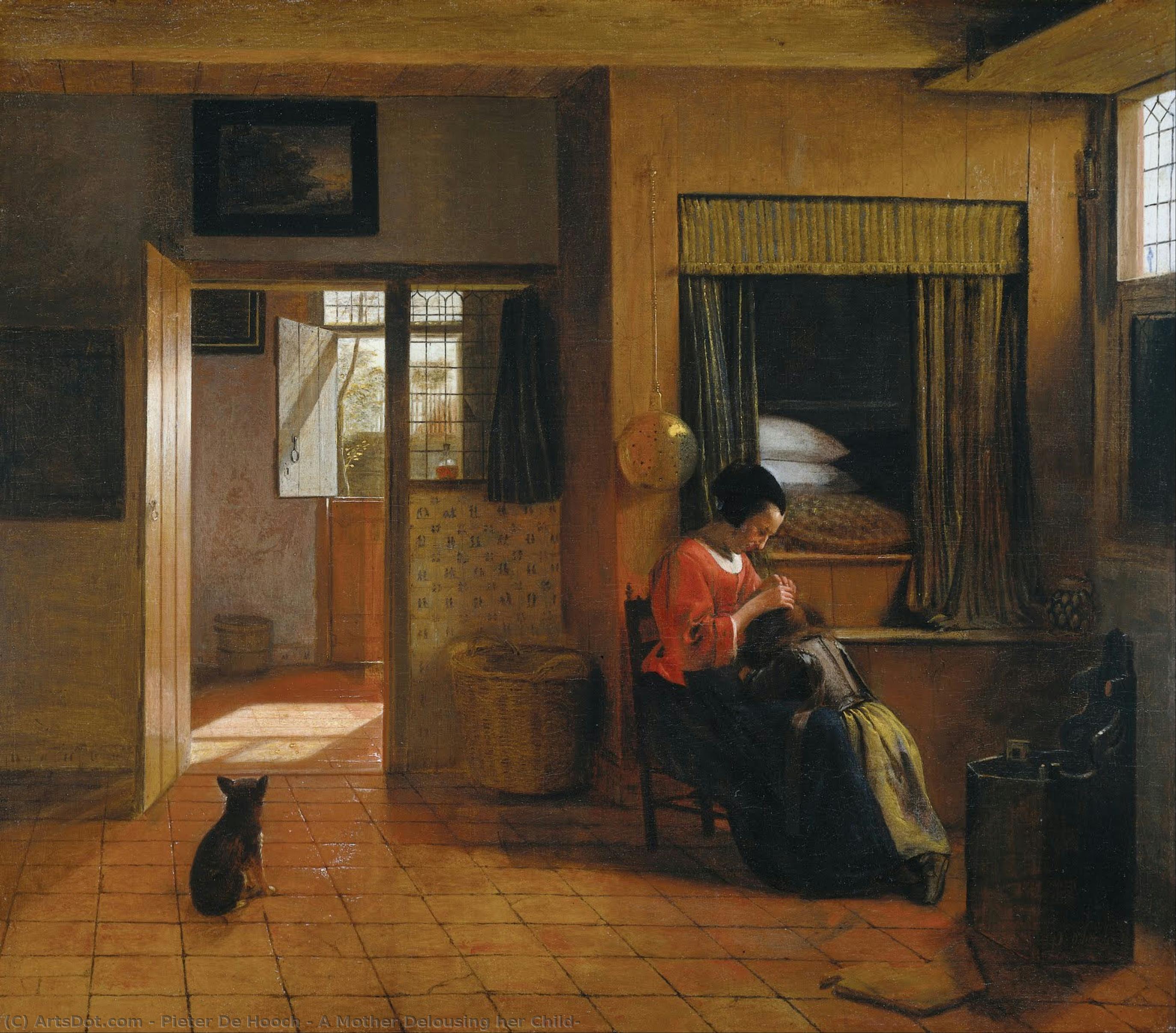
A Moment of Domesticity: Pieter de Hooch’s “A Mother Delousing Her Child”
Pieter de Hooch's "A Mother Delousing Her Child," painted circa 1660, is more than just a depiction of a mundane household task; it’s a poignant window into the burgeoning middle-class life of 17th-century Holland. This intimate scene, now housed within the Rijksmuseum in Amsterdam, captures a fleeting moment of vulnerability and care amidst the bustling world of the Dutch Golden Age. The painting, measuring just 61 x 52 cm, belies its small scale with an astonishingly detailed portrayal of everyday life – a testament to de Hooch’s mastery of light, shadow, and the subtle nuances of human emotion. It's a work that speaks volumes about family, hygiene, and the quiet dignity of domesticity.The Scene Unfolds: Composition and Setting
The composition is remarkably restrained, drawing the viewer’s eye immediately to the central figures – a mother diligently examining her child’s head for lice. The setting is a modestly furnished interior, likely a bedroom or sitting room, rendered with meticulous attention to detail. Delft blue tiles adorn the floor, hinting at the wealth and status of the household, while a simple bed stands in the background, partially obscured by a curtain. A dining table holds a bowl, suggesting a recent meal, and a ‘kakstoel’ – a small potty chair – adds an element of realism to the scene, grounding it firmly within the realities of daily life. The inclusion of a cat, calmly observing from beneath the woman's feet, introduces a touch of domestic tranquility and perhaps even a subtle commentary on observation and vigilance. The doorway glimpsed in the background offers a tantalizing suggestion of another room, expanding the spatial awareness of the scene without disrupting its intimate focus.Technique and Style: De Hooch’s Signature Approach
De Hooch was a master of *doorway paintings*, a technique he perfected during his time in Haarlem under Nicolaes Berchem. This style is characterized by an ambiguous space, often featuring a partially visible doorway or window that invites the viewer to imagine what lies beyond. In “A Mother Delousing Her Child,” this technique serves not only as a compositional device but also as a metaphor for the hidden complexities of domestic life. De Hooch’s brushwork is remarkably delicate and precise, creating an illusion of depth through subtle variations in light and shadow. He employed a muted palette – predominantly browns, creams, and blues – to evoke a sense of quietness and understated elegance. The lighting, diffused and naturalistic, further enhances the painting's realism, casting soft shadows that accentuate the figures’ forms and textures. Notably, de Hooch was known for his ability to capture the fleeting expressions on his subjects’ faces, imbuing each scene with a sense of lived experience.Symbolism and Context: A Reflection of Dutch Society
The act of delousing itself carries significant symbolic weight within the context of 17th-century Holland. Lice were a persistent and widespread problem, particularly in densely populated urban areas, and meticulous hygiene was considered essential for maintaining health and social standing. The mother’s focused attention on her child underscores the importance placed on family care and the responsibility of parents to protect their offspring. Furthermore, the scene reflects the growing emphasis on domesticity within the emerging middle class – a shift away from the more overtly public life of merchants and artisans towards a greater focus on home and family. The painting’s realism—the inclusion of everyday objects like the ‘kakstoel’—demonstrates de Hooch's commitment to portraying the lives of ordinary people, capturing a slice of Dutch society that was increasingly valued for its quiet dignity and understated beauty.Emotional Resonance: A Quiet Moment of Connection
Despite its seemingly simple subject matter, “A Mother Delousing Her Child” possesses a remarkable emotional resonance. The mother’s expression is one of focused determination mingled with tenderness, conveying both the burden of responsibility and the deep affection she feels for her child. The scene evokes a sense of intimacy and vulnerability, reminding us of the fundamental human need for connection and care. It's a painting that invites contemplation on themes of family, health, and the quiet moments of everyday life—moments often overlooked but profoundly meaningful. ArtsDot’s hand-painted reproductions offer an unparalleled opportunity to experience the beauty and subtlety of this iconic work by Pieter de Hooch, bringing its timeless charm into your home or studio.Vergelijkbare kunstwerken


Biografie van de kunstenaar
Pieter de Hooch - Een Gouden Eeuwse Meisterwerk
Pieter Hendricksz. de Hooch (Rotterdam, geboren op 20 november 1629 – overleden na 1684) was een Nederlandse kunstschilder die een prominente plaats inneemt in de Gouden Eeuw van de Nederlandse kunstgeschiedenis. Hij staat bekend om zijn prachtige lichtgevende afbeeldingen van huizen en binnenplaatsen, waarbij hij een bijzondere aandacht schenkt aan het gebruik van natuurlijke kleuren en lichtintensiteit. Zijn stijl wordt vaak vergeleken met die van Jan Vermeer en hij oefende een belangrijke invloed uit op latere kunstenaars.
- Geboren: Rotterdam, Nederland (1629)
- Opleiding: Haarlem onder Nicolaes Berchem
- Belangrijke Samenwerkingen: Jacob Ochtervelt
Stijl en Thema’s
De Hooch's kunst wordt gekenmerkt door een ongeëvenaarde aandacht voor detail, natuurlijke kleuren en lichtintensiteit. Hij gebruikte vaak het *doorkirkjie*-techniek, waarbij hij een kijkje naar de buitenwereld binnenbracht in zijn huizeninterieurs. Deze techniek zorgde ervoor dat zijn schilderijen niet alleen een prachtige weergave waren van het huiselijke leven maar ook een gevoel voor ruimte en perspectief konden oproepen dat ongeëvenaard was.
- Kenmerken: Lichtgevende kleuren, natuurlijke perspectieven
- Techniek: Doorkirkjie-techniek
- Thema’s: Huizeninterieurs, familieleven
Bekende Werken
Een aantal van zijn meest bekende werken omvat:
- De Leeg Glas (c. 1658): Een huiskamer scène waarin een dronken militair een lege glas aanwijst aan een barmaid
- Een vrouw met een kind in een huiskamer (1658): Een intieme afbeelding van een moeder en dochter die zich in een warme huiskamer bevinden
- De Tuin van een Huise
- Een Soldatenfamilie (1660)
Deze werken zijn gekenmerkt door een prachtige lichtintensiteit en een zorgvuldige aandacht voor detail, waardoor ze een gevoel voor ruimte en perspectief oproepen dat ongeëvenaard is.
Invloed en Erfgoed
De Hooch wordt beschouwd als een pionier van het genre schilderen en hij oefende een belangrijke invloed uit op zijn tijdgenoten. Zijn stijl werd gekopieerd door vele kunstenaars en hij staat bekend om zijn prachtige lichtgevende afbeeldingen van huizen en binnenplaatsen, waarbij hij een bijzondere aandacht schenkt aan het gebruik van natuurlijke kleuren en lichtintensiteit. Hij wordt vaak gezien als een voorloper van de Nederlandse Impressionisme.
- Voorlopers: Jacob Ochtervelt
- Stijl: Een stijl die werd gekopieerd door vele kunstenaars
- Erfgoed: Een belangrijke invloed op het Nederlandse Impressionisme
Musea en Collecties
De Hooch’s werken zijn te vinden in verschillende musea, waaronder:
- Het Rijksmuseum Amsterdam
- Het Mauritshuis Den Haag
- Het Kunsthistorisches Museum Wien
Een bezoek aan deze musea biedt een prachtige kans om zijn kunstwerken te bewonderen en kennis te maken met de prachtige lichtgevende afbeeldingen van huizen en binnenplaatsen, waarbij hij een bijzondere aandacht schenkt aan het gebruik van natuurlijke kleuren en lichtintensiteit.

Pieter de Hooch
1629 - 1694 , Nederland
Belangrijkste feiten
- Artistic Movement Or Style: Dutch Gouden Eeuw
- Artists Or Movements Influenced By This Artist: ['Jan Vermeer']
- Artists Who Influenced This Artist:
- Nicolaes Berchem
- Hendrik Sorgh
- Date Of Birth: 20 december 1629
- Date Of Death: na 1683
- Full Name: Pieter Hendricksz. de Hooch
- Nationality: Nederlands
- Notable Artworks:
- Een vrouw met een kind in een kelderkamer
- De lege glas
- Een minuet
- Place Of Birth: Rotterdam, Nederland
Gerelateerde artikelen

Top 10 Meesterwerken van de Gouden Eeuw: Kunst voor uw interieur | ArtsDot.nl
Ontdek de 10 meesterwerken van de Gouden Eeuw! Leer over Rembrandt, Vermeer & andere Hollandse schilders. Prachtige kunst reproducties voor uw interieur. Museumkwaliteit prints op ArtsDot.com.


Golden Age Reflections: Dutch Baroque Painting & Cultural Innovation
Explore the Dutch Golden Age of painting! Discover key artists like Vermeer & ter Borch, their innovative techniques, and the rich cultural context behind these Baroque masterpieces. Learn about collecting & appreciating this iconic art period.
Illuminating Realism: Exploring the Dutch Golden Age of Painting (1600-1700)
Explore the Dutch Golden Age of painting (1600-1700) with ArtsDot. Discover Rembrandt, Vermeer & other masters. Learn about techniques, history & find museum-quality reproductions.

Willem van de Velde the Elder: Master of Maritime Painting & Chronicler of the Dutch Golden Age
Discover the captivating maritime paintings of Willem van de Velde the Elder, a master chronicler of the Dutch Golden Age. Explore his unparalleled realism and lasting influence on naval art history.

Jan Jansz Wijnants: A Study in Dutch Golden Age Still Life & Floral Transience
Explore the captivating world of Jan Wijnants and Dutch Golden Age still life painting. Discover symbolism, masterful techniques & lasting influence on floral art history. Learn more!



