


Het werk volgt uw keuzes: , .
Beschrijving verzamelobject
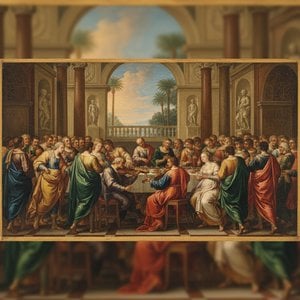
Discover Paolo Veronese’s ‘Plato’! A Renaissance masterpiece featuring a dignified Plato surrounded by classical motifs. Explore this iconic painting's beauty & significance in Venice.
 Lees meer
Biografie kunstenaar
Paolo Veronese (1528-1588): Een Venetiaanse meester van kleur, drama & weelderige feesten. Ontdek zijn iconische schilderijen en de grandeur van 16e eeuwse Venetië!
Handgemaakte olieverfreproductie
Met de hand geschilderd in olieverf op canvas in uw gewenste maat en lijst, op bestelling gemaakt door onze kunstenaars. ( Schakel over naar print Schakel over naar digitale afbeeldingen)
Meer over dit schilderij
 Voorvertoning
 Verstuur
 Delen
Delen
 Details bekijken
 Gids
Gids

 Download
 Vergelijkbare items
 Röntgenonderzoek
 Diavoorstelling
 Vraag & antwoord
 Statistieken
Bestel uw schilderij in vier eenvoudige stappen
Neem de tijd. U kunt elk antwoord nog wijzigen; de prijs in uw besteloverzicht wordt direct aangepast aan elke keuze.
1 Stap één van de vier
Welke maat wilt u kiezen?
Deze formaten behouden de proporties van het originele schilderij. De tekening laat uw keuze zien op een muur, boven een bank van twee meter.
Of geef uw eigen afmetingen op
Kies uit onze vooraf ingestelde maten die overeenkomen met de originele verhoudingen van het kunstwerk.

Voer de breedte en hoogte in die u nodig heeft, passend bij uw lijst of uw muur. Omdat dit handgeschilderd is, kan de kunstenaar bij een afmeting met een andere beeldverhouding iets meer rondom het schilderij schilderen of juist iets meer weglaten — u kiest zelf. Wij sturen u een digitaal mockup ter goedkeuring voordat het schilderwerk begint. De afbeelding die op deze pagina wordt getoond, is niet het uiteindelijke resultaat — alleen de mockup geeft dit weer.
2 Stap twee van vier
Hoe moet het worden geleverd: gerold, opgespannen of ingelijst?
De onderstaande prijzen zijn voor de maat die u in stap één heeft gekozen.
Kies de randen van het canvas
Kies uw lijst

Wit €1

Vervagende randen €1

Doorlopende rand €1

P118B €10

P118H €10

P118W €10

P438Z €10

P508JH €12

P508YH €12

P805H €10

P805Z €10

P919BZ €10

P919G €10

P919XJ €10

P959ZH €10

P968JZ €12

W106C €8

W218G €10

W218JH €8

W218Y €10

W307PJ €10

W316G €10

W316PJ €8

W316Y €10

W398PJ €8

W4111J €10

W500HY €15

W500JH €15

W692G €12

W849H €8

W940BG €15

W953PJ €8

H24-GOLD €30

H24-SILVER €30

H36-GOLD €45

H36-SILVER €45
Ingelijst
Lijstrand: . Totale afmetingen inclusief lijst: .
3 Stap drie van vier
Wilt u dat er iets aan het schilderij wordt aangepast?
De meeste mensen antwoorden nee. Omdat elk schilderij met de hand wordt gemaakt, kan onze kunstenaar het ook voor u aanpassen.
Na de bestelling zal het team van ArtsDot.com per e-mail contact opnemen met de klant voor instructies en een mockup-voorbeeld verstrekken
4 Stap vier van vier
Enkele afwerkingsopties
Ze zijn allemaal optioneel. De reeds geselecteerde antwoorden brengen geen extra kosten met zich mee.
Wie is de kunstenaar?
Wereldwijde levering () binnen 3 tot 4 weken in plaats van de standaard 5 weken. (4 november). Zonder concessies aan de kwaliteit.
Een naambordje, zoals in een museum?
Details van de gegraveerde bronzen plaat
This elegant plaque features the artist's name and the title of the artwork, finely engraved for a timeless presentation.
It is made from bronze with a refined, elegant finish. The text is precisely laser-engraved for a sharp and permanent result. Measuring 9x2 cm, the plaque is compact yet easy to read. It's built to be durable and scratch-resistant, offering a professional, museum-quality look. Mounting is simple thanks to the included adhesive backing.
Details transparante acrylplaat
The plaque includes essential engraved details such as the artist's name, the title of the artwork, the date it was created, the type of media used-like oil on canvas or watercolor-a brief description of the piece, and a QR code that links to the complete artwork information.
It is crafted from clear acrylic, offering a sleek, modern appearance. The text is UV-engraved in black to ensure strong visual contrast. With a size of 10x15 cm, it ensures optimal readability. It comes equipped with two metal hooks for secure wall mounting. The plaque is designed to be weather-resistant, making it suitable for various environments, and it includes interactive features that work seamlessly with smartphone scanning.
Details zwarte acrylplaat
This elegant plaque includes engraved information such as the artist's name, the title of the artwork, the date it was created, the type of media used (like oil on canvas or watercolor), a short description of the artwork, and a QR code for quick access to more information.
The plaque itself is made from refined black acrylic with a premium finish. The text is laser-engraved in white for high contrast and readability. Its size is 10x15 cm, designed to be easy to read. It comes with two metal hooks for professional mounting. The design is sleek and fits any interior style. It is also weather-resistant and durable, with built-in digital integration for mobile compatibility.
Een beschermende vernis?
Wanneer heeft u het nodig?
✓ Controleren en bestellen
Uw schilderij, zoals u het heeft besteld

Plato
Druktechniek
Afmetingen reproductie
-

Geselecteerde topkunstenaars
Meer detail, verfijning en extra productietijd
-

Lijst voor reproductie
-
-
Voor kunstwerken of reproducties die aan één zijde groter zijn dan 105 cm (ongeveer 41 inch), wordt de lijst als een losse set verzonden. Deze methode garandeert een veilige levering en voorkomt schade tijdens het transport.
Professionele montage vereist - dit is geen doe-het-zelfproduct.
De set moet worden gemonteerd en het canvas moet worden gespannen door een ervaren professionele lijstenmaker, met gebruik van houtlijm (niet inbegrepen), een doekspanter en klemmen om de sponningen recht te houden terwijl de lijm droogt. Onjuiste montage of een ongelijkmatige spanning op het canvas kan het kunstwerk permanent beschadigen en wordt niet gedekt door onze garantie.
 Voor kunstwerken of reproducties die aan één zijde groter zijn dan 105 cm (ongeveer 41 inch), wordt de lijst als een losse set verzonden. Deze methode garandeert een veilige levering en voorkomt schade tijdens het transport.
Alle massief houten onderdelen zijn inbegrepen, nauwkeurig op maat gesneden voor montage.
Te monteren met de meegeleverde schroeven, plus houtlijm voor de hoekverbindingen, die niet wordt meegeleverd en door uw lijstenmaker moet worden aangeschaft.
Professioneel gereedschap is vereist en niet inbegrepen: een spanner voor canvas en klemmen om de latten recht te houden terwijl de lijm droogt.
Belangrijk:
De hoekverbindingen vereisen houtlijm, de latten moeten met lijmklemmen worden vastgehouden tot de lijm volledig is opgedroogd, en het spannen van het canvas op het samengestelde frame vereist een doekspanter. Geen van deze artikelen is inbegrepen in de set. Wij adviseren u om een ervaren professionele lijstenmaker te raadplegen voordat u deze maat bestelt.

Naamplaatje
-
-

Beschermende vernislaag
Glanzende vernis (versterkt de kleuren en biedt bescherming tegen licht en vocht)
-

Mijn kunstwerk aanpassen
Voorbeelden van aanpassingen: vervang het gezicht door een eigen foto; voeg een huisdier toe (bijv. vervang de kat door een hond); verwerk een verborgen boodschap in de achtergrond; wijzig het landschap of andere elementen op de achtergrond.
-

Spoedlevering
Wereldwijde levering () binnen 3 tot 4 weken in plaats van de standaard 5 weken. (4 november). Geen concessies aan de kwaliteit.
-
Spoedlevering
Wereldwijde levering naar binnen 5 weken. (11 november).
Inbegrepen
Eindtotaal
€ 234
De optie voor glas is alleen beschikbaar bij een formaat kleiner dan 110 cm.
Inbegrepen bij elke bestelling
- Gratis wereldwijde expressverzending
- Hoogwaardig linnen canvas
- Volledige verzendverzekering
- Garantie op terugbetaling van invoerrechten
- Garantie op exacte kleurweergave
- Retourbeleid van 100 dagen (alleen bij defecten)
- 100% Geld-terug-garantie
- Korting bij meerdere afnames


The Enigmatic Plato: A Renaissance Portrait of Wisdom
Paolo Veronese’s “Plato,” painted circa 1560 and currently residing in the Biblioteca Nazionale Marciana in Venice, is more than simply a portrait; it's a meticulously crafted embodiment of classical philosophy and humanist ideals. This masterpiece transcends the conventions of its time, offering a profound meditation on knowledge, contemplation, and the enduring legacy of ancient Greece. Veronese, a master of Mannerism – a style characterized by rich color palettes, intricate detail, and dramatic lighting – expertly captures the essence of Plato, not merely as a historical figure but as an intellectual archetype.
The painting immediately draws the eye to its central subject: Plato himself. He is depicted in a dignified pose, seated within a richly ornamented niche that functions almost as a stage for his philosophical presence. His gaze is directed upwards, suggesting a state of profound thought and introspection – a visual representation of the pursuit of wisdom. The drapery enveloping him is rendered with astonishing realism, showcasing Veronese’s mastery of texture and form; each fold and pleat seems to ripple with life, adding depth and volume to the composition. Notice how the deep reds of his robes contrast sharply with the muted tones of the surrounding walls and ceiling – a deliberate choice that emphasizes Plato's importance within the scene.
A Symphony of Color and Architectural Detail
Veronese’s signature style is vividly displayed in “Plato.” The color palette is extraordinarily vibrant, employing hues rarely seen in portraits of this period. Deep reds dominate, lending a sense of gravitas and authority to Plato's figure, while golds and blues subtly illuminate the architectural setting. The artist’s use of light is equally masterful, creating dramatic contrasts that sculpt the form of the subject and heighten the emotional impact of the scene. The arched doorway framing Plato isn’t merely an architectural element; it acts as a powerful symbol – representing both confinement and transition, suggesting the philosopher's journey from earthly concerns to higher realms of thought.
Beyond the immediate visual appeal, “Plato” is laden with symbolic meaning. The surrounding architecture—a lavishly decorated niche reminiscent of classical Roman design—references the philosophical traditions that shaped Plato’s thinking. The inclusion of various objects within the scene – scrolls, books, and perhaps even a lyre – further reinforces his intellectual pursuits. These details aren't simply decorative; they are carefully chosen to communicate Plato’s dedication to learning, debate, and the pursuit of truth. The overall effect is one of profound contemplation, inviting the viewer to join Plato in his quest for understanding.
Historical Context and Artistic Legacy
“Plato” was created during a period of immense artistic and intellectual ferment in Venice – a city renowned for its patronage of the arts and its embrace of humanist ideals. Veronese’s work reflects this vibrant cultural landscape, blending classical influences with Venetian traditions. The painting stands as a testament to the enduring power of Greek philosophy and its continued relevance in Western thought. It's important to note that Veronese was working within the Mannerist style, which emphasized elegance, artificiality, and complex compositions – qualities that are beautifully exemplified in this portrait.
Reproductions of “Plato” by ArtsDot.com offer a unique opportunity to experience the beauty and intellectual depth of this remarkable painting firsthand. Owning a hand-painted reproduction allows you to bring a piece of Renaissance history into your home, transforming any space into a sanctuary for contemplation and artistic appreciation. For those interested in learning more about Paolo Veronese or the Biblioteca Nazionale Marciana, we encourage you to explore the resources linked below – a journey that promises to deepen your understanding of this extraordinary artist and his timeless masterpiece.
- Learn more about Paolo Veronese: https://ArtsDot.com
- Explore the Biblioteca Nazionale Marciana: https://Wikipedia
Veelgestelde vragen
Is "Plato" door Paolo Veronese een bekend kunstwerk?
Het populariteitsniveau van "Plato" door Paolo Veronese is Iconic.
Wat is de dominante kleur van "Plato" door Paolo Veronese?
"Plato" neigt naar een Amber to Saffron tint.
Welke afdrukinstellingen worden aanbevolen voor "Plato" door Paolo Veronese?
Formaat Large, Tall oriëntatie: dit is de aanbevolen printinstelling voor "Plato" door Paolo Veronese.
Vergelijkbare kunstwerken


Paolo Veronese
1528 - 1588, Italië
Biografie kunstenaar
A Venetian Visionary: The Life and Art of Paolo Veronese
Paolo Caliari, known to the world as Paolo Veronese, emerged from the vibrant artistic landscape of 16th-century Venice as a master of color, composition, and opulent spectacle. Born in Verona in 1528, the son of a stonecutter, his early life was steeped in the visual richness of his surroundings – the classical architecture, sculpted forms, and burgeoning humanist ideals that characterized the region. His initial training under Antonio Badile and Giovanni Francesco Caroto laid a foundation in traditional techniques, but it was his move to Venice in the 1550s that truly ignited his artistic genius. The city itself became his muse, its bustling marketplaces, grand palazzi, and shimmering waterways informing the scale and drama of his work. He quickly absorbed the influences of established Venetian masters like Titian, whose mastery of color profoundly impacted Veronese’s palette, yet he forged a distinct style characterized by an unparalleled sense of theatricality and grandeur.The Painter of Feasts and Grand Narratives
Veronese's reputation rests upon his monumental paintings, particularly those depicting lavish feasts and biblical scenes transformed into dazzling displays of Venetian life. The Wedding at Cana, completed in 1563 for the Benedictine monastery of San Giorgio Maggiore, stands as a testament to his skill. This colossal canvas isn’t merely an illustration of the miracle; it's a vibrant panorama of 16th-century society, teeming with elegantly dressed figures, musicians, and architectural details rendered with breathtaking precision. The painting is not just about what happened at Cana but *how* it would have looked if it had occurred in Venice during Veronese’s time – a deliberate choice that challenged conventional religious depictions. Similarly, The Feast in the House of Levi, originally titled The Last Supper, caused controversy with the Inquisition due to its inclusion of contemporary figures and a seemingly irreverent atmosphere. Veronese defended his artistic license, asserting that painters were entitled to the same creative freedom as poets and jesters – a bold statement reflecting his belief in art’s power to interpret and reimagine sacred narratives. These works weren't simply religious depictions; they were celebrations of life, wealth, and the splendor of Venice itself. He wasn’t interested in austere spirituality but rather in capturing the joy and abundance of existence. His ability to seamlessly blend historical accuracy with imaginative embellishment set him apart from his contemporaries.Influences and Artistic Development
While Titian’s influence on Veronese’s colorism is undeniable, his artistic development was a complex interplay of various influences. The architectural precision he brought to his compositions owes much to the classical tradition prevalent in Verona during his formative years, particularly the work of architects like Michele Sanmicheli. He also absorbed elements from Central Italian masters such as Raphael and Parmigianino, evident in the graceful lines and harmonious arrangements within his paintings. However, Veronese didn’t simply imitate these influences; he synthesized them into a uniquely Venetian style characterized by its dramatic use of light, vibrant color palettes, and meticulous attention to detail. He excelled at creating illusions of space and depth, employing perspective techniques to draw viewers into the heart of his elaborate scenes. His mastery of oil painting allowed him to achieve an unparalleled luminosity and richness of texture. He also ran a large workshop, with contributions from his brother Benedetto and sons Gabriele and Carlo, ensuring that his style continued to flourish even after his death in 1588. The scale of his projects demanded a significant team of assistants, allowing him to focus on the overall design and execution while maintaining a consistent artistic vision.Major Achievements and Notable Works
Veronese’s career produced an astonishing array of masterpieces, each showcasing his distinctive style and technical prowess. Beyond The Wedding at Cana and The Feast in the House of Levi, several works stand out as particularly significant:- Villa Barbaro at Maser (1560-1573): This complex cycle of paintings for the Barbaro family villa is considered one of Veronese’s most ambitious projects. It includes a Sacrifice of Isaac and a Mystical Marriage of Bacchus and Ariadne, both renowned for their opulent settings and dynamic compositions.
- Decorations of San Sebastiano (1556-1570): Veronese’s extensive decorations for the church of San Sebastiano in Venice are a testament to his ability to transform an entire building into a work of art. The ceiling frescoes, in particular, are breathtaking in their scale and detail.
- Portrait of Daniele Barbaro (1556-1567): This portrait exemplifies Veronese’s skill in capturing the likeness and personality of his subjects. It is considered one of his finest works in the genre.
Legacy and Historical Significance
Paolo Veronese’s impact extends far beyond the realm of Renaissance art. His work has resonated through centuries, inspiring artists across various disciplines. His dramatic compositions and vibrant color schemes have been cited as influences on everything from Baroque painting to modern cinema – even finding echoes in the visual aesthetics of Spaghetti Westerns. He was part of the “great trio” of Venetian painters—alongside Titian and Tintoretto—each contributing uniquely to the city’s artistic legacy, yet Veronese often stands apart for his sheer exuberance and celebration of earthly pleasures. His paintings continue to captivate audiences with their grandeur and spectacle, offering a glimpse into the opulent world of 16th-century Venice. Veronese's legacy is a testament to his artistic genius, his ability to capture the essence of an era, and his enduring contribution to the history of art.


Gerelateerde artikelen

Top 10 Meesterwerken van het Neoclassicisme: Kunst voor een Verfijnd Interieur
Ontdek de 10 meest iconische meesterwerken van het Neoclassicisme! Van David tot Ingres, leer over kunst, techniek & geschiedenis. Vind museumkwaliteit reproducties en verfijnde decoratie op ArtsDot.com. Exploreer de collectie online!

The Enduring Legacy of Oil on Canvas: Technique, History & Aesthetic Impact
Explore the rich history & techniques of oil painting – from Renaissance masters to Impressionism. Discover pigments, layering methods, and why this timeless medium endures. Expert insights for artists & art enthusiasts.
Paolo Veronese: A Renaissance Master of Color, Composition, and Venetian Splendor
Explore the vibrant world of Paolo Veronese, a Renaissance master renowned for his opulent compositions, masterful use of color, and dramatic Venetian scenes. Discover key artworks & legacy.