


 Verstuur
 Delen
Delen
 Details bekijken
 Gids
Gids

 Download
 Vergelijkbare items
 Diavoorstelling
 Statistieken
Fortune


 Lees meer
Handgemaakte olieverfreproductie
Met de hand geschilderd in olieverf op canvas in uw gewenste maat en lijst, op bestelling gemaakt door onze kunstenaars. ( Schakel over naar print Schakel over naar digitale afbeeldingen)




































Kies uit onze vooraf ingestelde maten die overeenkomen met de originele verhoudingen van het kunstwerk.

U kunt uw eigen afmetingen invoeren om in een specifieke lijst of ruimte te passen. Als de door u gekozen maat niet overeenkomt met de verhoudingen van het originele beeld, zullen we het kunstwerk bijsnijden of het schilderij uitbreiden met extra handgeschilderde elementen. Een digitale mockup wordt ter goedkeuring naar u verzonden voordat de productie begint.
Houd er rekening mee dat de preview op het scherm niet de werkelijke uitsnede of uitbreiding weergeeft. Alleen de mockup toont de uiteindelijke compositie nauwkeurig.
Hoewel aangepaste afmetingen mogelijk zijn, raden we aan een maat uit de vooraf gedefinieerde lijst te selecteren om de originele verhoudingen te behouden.
Na de bestelling zal het team van ArtsDot.com per e-mail contact opnemen met de klant voor instructies en een mockup-voorbeeld sturen.
Wereldwijde levering () binnen 3 tot 4 weken in plaats van de standaard 5 weken. (24 september). Zonder concessies aan de kwaliteit.

Gratis wereldwijde expressverzending

Hoogwaardig linnen canvas

Volledige verzendverzekering

Garantie op terugbetaling van invoerrechten

Garantie op exacte kleurweergave

Retourbeleid van 100 dagen (alleen bij defecten)

100% Geld-terug-garantie

Korting bij meerdere afnames
 De optie voor glas is alleen beschikbaar bij een formaat kleiner dan 110 cm.

Fortune
Reproductiemethode
Formaat reproductie
-


Totaalprijs
$ 263
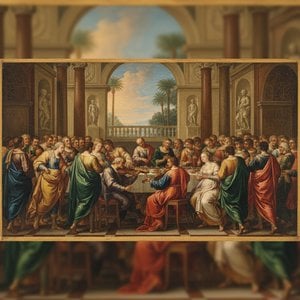
A Venetian Masterpiece: The Grandeur of Veronese’s Fortune
Within the hallowed, sun-drenched halls of Villa Barbaro in Maser, Italy, lies one of the most profound expressions of the Venetian Renaissance: Paolo Veronese’s "Fortune." Painted in 1560, this monumental fresco is far more than a mere decorative element of a ceiling; it is a breathtaking window into the humanist soul of the sixteenth century. As viewers gaze upward, they are not simply looking at paint on plaster, but are instead invited into a lavish, allegorical banquet that celebrates both the opulence of aristocratic life and the profound philosophical truths regarding the volatility of human existence. Veronese, a master of spectacle, transforms the architectural space into an immersive stage where myth and reality intertwine.
At the heart of this complex composition sits the titular figure, Fortune herself. She is depicted with a regal, commanding presence, seated upon a colossal wheel—a potent and ancient symbol of the cyclical nature of fate. This wheel serves as a silent narrator, reminding all who behold it that prosperity is often followed by adversity, and that triumph is but a fleeting moment in the eternal rotation of destiny. To surround this central tension, Veronese has populated the scene with personifications of virtue, including Wisdom, Justice, Temperance, and Faith. These figures, draped in classical, flowing garments, act as moral anchors within the swirling grandeur of the feast, suggesting that while worldly luck may be unpredictable, a life anchored in ethical conduct provides a steadying influence against the whims of chance.
Technique, Color, and the Art of Illusion
Veronese’s technical prowess is nothing short of extraordinary, making "Fortune" a primary inspiration for those who appreciate the heights of Renaissance craftsmanship. The artist employs a sophisticated palette that breathes life into the fresco; warm, earthy tones of burnt sienna, ochre, and deep umber provide a grounded, classical foundation, which is then brilliantly interrupted by luminous splashes of cerulean blue and verdant green. Through the masterful use of sfumato—the subtle, smoky blending of edges—Veronese achieves a soft, lifelike gradation of form that lends an incredible sense of volume to the figures and a palpable atmosphere to the air itself.
The architectural setting within the painting is equally vital to its impact. Veronese utilizes meticulous linear perspective to create a convincing illusion of depth, where ornate columns and sweeping arches seem to extend far beyond the physical limits of the villa's ceiling. This architectural trompe l'oeil effect draws the eye into a deep, theatrical space, making the banquet feel as though it is unfolding in a real, grand hall. For the collector or interior designer, this piece offers an unparalleled sense of scale and sophistication. A high-quality reproduction of "Fortune" does not merely decorate a room; it elevates the entire environment, bringing with it the weight of history, the richness of Venetian light, and a timeless conversation about the beautiful, unpredictable dance of life.
Gerelateerde kunstwerken


Biografie van de kunstenaar
A Venetian Visionary: The Life and Art of Paolo Veronese
Paolo Caliari, known to the world as Paolo Veronese, emerged from the vibrant artistic landscape of 16th-century Venice as a master of color, composition, and opulent spectacle. Born in Verona in 1528, the son of a stonecutter, his early life was steeped in the visual richness of his surroundings – the classical architecture, sculpted forms, and burgeoning humanist ideals that characterized the region. His initial training under Antonio Badile and Giovanni Francesco Caroto laid a foundation in traditional techniques, but it was his move to Venice in the 1550s that truly ignited his artistic genius. The city itself became his muse, its bustling marketplaces, grand palazzi, and shimmering waterways informing the scale and drama of his work. He quickly absorbed the influences of established Venetian masters like Titian, whose mastery of color profoundly impacted Veronese’s palette, yet he forged a distinct style characterized by an unparalleled sense of theatricality and grandeur.The Painter of Feasts and Grand Narratives
Veronese's reputation rests upon his monumental paintings, particularly those depicting lavish feasts and biblical scenes transformed into dazzling displays of Venetian life. The Wedding at Cana, completed in 1563 for the Benedictine monastery of San Giorgio Maggiore, stands as a testament to his skill. This colossal canvas isn’t merely an illustration of the miracle; it's a vibrant panorama of 16th-century society, teeming with elegantly dressed figures, musicians, and architectural details rendered with breathtaking precision. The painting is not just about what happened at Cana but *how* it would have looked if it had occurred in Venice during Veronese’s time – a deliberate choice that challenged conventional religious depictions. Similarly, The Feast in the House of Levi, originally titled The Last Supper, caused controversy with the Inquisition due to its inclusion of contemporary figures and a seemingly irreverent atmosphere. Veronese defended his artistic license, asserting that painters were entitled to the same creative freedom as poets and jesters – a bold statement reflecting his belief in art’s power to interpret and reimagine sacred narratives. These works weren't simply religious depictions; they were celebrations of life, wealth, and the splendor of Venice itself. He wasn’t interested in austere spirituality but rather in capturing the joy and abundance of existence. His ability to seamlessly blend historical accuracy with imaginative embellishment set him apart from his contemporaries.Influences and Artistic Development
While Titian’s influence on Veronese’s colorism is undeniable, his artistic development was a complex interplay of various influences. The architectural precision he brought to his compositions owes much to the classical tradition prevalent in Verona during his formative years, particularly the work of architects like Michele Sanmicheli. He also absorbed elements from Central Italian masters such as Raphael and Parmigianino, evident in the graceful lines and harmonious arrangements within his paintings. However, Veronese didn’t simply imitate these influences; he synthesized them into a uniquely Venetian style characterized by its dramatic use of light, vibrant color palettes, and meticulous attention to detail. He excelled at creating illusions of space and depth, employing perspective techniques to draw viewers into the heart of his elaborate scenes. His mastery of oil painting allowed him to achieve an unparalleled luminosity and richness of texture. He also ran a large workshop, with contributions from his brother Benedetto and sons Gabriele and Carlo, ensuring that his style continued to flourish even after his death in 1588. The scale of his projects demanded a significant team of assistants, allowing him to focus on the overall design and execution while maintaining a consistent artistic vision.Major Achievements and Notable Works
Veronese’s career produced an astonishing array of masterpieces, each showcasing his distinctive style and technical prowess. Beyond The Wedding at Cana and The Feast in the House of Levi, several works stand out as particularly significant:- Villa Barbaro at Maser (1560-1573): This complex cycle of paintings for the Barbaro family villa is considered one of Veronese’s most ambitious projects. It includes a Sacrifice of Isaac and a Mystical Marriage of Bacchus and Ariadne, both renowned for their opulent settings and dynamic compositions.
- Decorations of San Sebastiano (1556-1570): Veronese’s extensive decorations for the church of San Sebastiano in Venice are a testament to his ability to transform an entire building into a work of art. The ceiling frescoes, in particular, are breathtaking in their scale and detail.
- Portrait of Daniele Barbaro (1556-1567): This portrait exemplifies Veronese’s skill in capturing the likeness and personality of his subjects. It is considered one of his finest works in the genre.
Legacy and Historical Significance
Paolo Veronese’s impact extends far beyond the realm of Renaissance art. His work has resonated through centuries, inspiring artists across various disciplines. His dramatic compositions and vibrant color schemes have been cited as influences on everything from Baroque painting to modern cinema – even finding echoes in the visual aesthetics of Spaghetti Westerns. He was part of the “great trio” of Venetian painters—alongside Titian and Tintoretto—each contributing uniquely to the city’s artistic legacy, yet Veronese often stands apart for his sheer exuberance and celebration of earthly pleasures. His paintings continue to captivate audiences with their grandeur and spectacle, offering a glimpse into the opulent world of 16th-century Venice. Veronese's legacy is a testament to his artistic genius, his ability to capture the essence of an era, and his enduring contribution to the history of art.
Paolo Veronese
1528 - 1588 , Italië
Snelle feiten
- Artistic Movement Or Style: Renaissance, Mannerisme
- Artists Or Movements Influenced By This Artist: ['Raphael']
- Artists Who Influenced This Artist: ['Titian']
- Date Of Birth: 1528
- Date Of Death: 1588
- Full Name: Paolo Caliari Veronese
- Nationality: Italiaans
- Notable Artworks:
- Bruiloft Kana
- Feest Levi
- Place Of Birth: Verona, Italië
Gerelateerde artikelen

F.A.Q.: Grootformaat Kunstwerken – Een Gids voor Veelgestelde Vragen
biedt hoogwaardige grootformaat kunstwerken en reproducties van museumkwaliteit. Ontdek onze expertise in op maat gemaakte schilderijen en profiteer van een uitstekende service voor veeleisende kunstliefhebbers.
Paolo Veronese: A Renaissance Master of Color, Composition, and Venetian Splendor
Explore the vibrant world of Paolo Veronese, a Renaissance master renowned for his opulent compositions, masterful use of color, and dramatic Venetian scenes. Discover key artworks & legacy.


