


Het werk volgt uw keuzes: , .
Beschrijving verzamelobject
 Lees meer
Biografie kunstenaar
Explore the abstract art of Osvaldo Licini (1894-1958), an Italian painter blending abstraction, surrealism & symbolic figures. Discover his unique style & legacy.
Handgemaakte olieverfreproductie
Met de hand geschilderd in olieverf op canvas in uw gewenste maat en lijst, op bestelling gemaakt door onze kunstenaars. ( Schakel over naar print Schakel over naar digitale afbeeldingen)
Dit kunstwerk is auteursrechtelijk beschermd
De kunstwerken die op deze pagina worden weergegeven, zijn beschermd door de auteursrechtwetgeving, wat betekent dat het ons wettelijk niet is toegestaan om identieke reproducties te maken of te verkopen. Deze bescherming wordt gehandhaafd onder internationale overeenkomsten zoals de Conventie van Bern en door nationale wetgeving, waaronder de bepalingen van de Amerikaanse auteurswet - Titel 17. Alle rechten voorbehouden. Reproduceren of distribueren van afbeeldingen is niet toegestaan zonder uitdrukkelijke schriftelijke toestemming van WahooArt.com en de rechthebbenden.
Als een respectvol en legaal alternatief bieden wij op maat gemaakte, handgeschilderde kunstwerken aan die geïnspireerd zijn op het origineel. Onze bekwame en professionele kunstenaars bestuderen zorgvuldig de stijl, sfeer en artistieke essentie van het origineel om een nieuw, uniek werk te creëren dat dezelfde emotie oproept – terwijl het een op zichzelf staande, originele creatie blijft.
Deze methode voldoet volledig aan de auteursrechtwetgeving, omdat het niet gaat om het kopiëren of dupliceren van het beschermde kunstwerk. In plaats daarvan is er sprake van een creatieve herinterpretatie — een nieuw schilderij dat door het origineel wordt geïnspireerd, maar er niet identiek aan is.
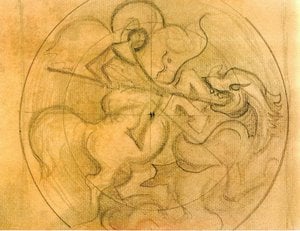
Meer over dit schilderij
 Voorvertoning
 Verstuur
 Delen
Delen
 Details bekijken
 Gids
Gids

 Download
 Vergelijkbare items
 Röntgenonderzoek
 Diavoorstelling
 Vraag & antwoord
 Statistieken
Bestel uw schilderij in vier eenvoudige stappen
Neem de tijd. U kunt elk antwoord nog wijzigen; de prijs in uw besteloverzicht wordt direct aangepast aan elke keuze.
1 Stap één van de vier
Welke maat wilt u kiezen?
Deze formaten behouden de proporties van het originele schilderij. De tekening laat uw keuze zien op een muur, boven een bank van twee meter.
Of geef uw eigen afmetingen op
Kies uit onze vooraf ingestelde maten die overeenkomen met de originele verhoudingen van het kunstwerk.

Voer de breedte en hoogte in die u nodig heeft, passend bij uw lijst of uw muur. Omdat dit handgeschilderd is, kan de kunstenaar bij een afmeting met een andere beeldverhouding iets meer rondom het schilderij schilderen of juist iets meer weglaten — u kiest zelf. Wij sturen u een digitaal mockup ter goedkeuring voordat het schilderwerk begint. De afbeelding die op deze pagina wordt getoond, is niet het uiteindelijke resultaat — alleen de mockup geeft dit weer.
2 Stap twee van vier
Hoe moet het worden geleverd: gerold, opgespannen of ingelijst?
De onderstaande prijzen zijn voor de maat die u in stap één heeft gekozen.
Kies de randen van het canvas
Kies uw lijst

Wit €1

Vervagende randen €1

Doorlopende rand €1

P118B €10

P118H €10

P118W €10

P438Z €10

P508JH €12

P508YH €12

P805H €10

P805Z €10

P919BZ €10

P919G €10

P919XJ €10

P959ZH €10

P968JZ €12

W106C €8

W218G €10

W218JH €8

W218Y €10

W307PJ €10

W316G €10

W316PJ €8

W316Y €10

W398PJ €8

W4111J €10

W500HY €15

W500JH €15

W692G €12

W849H €8

W940BG €15

W953PJ €8

H24-GOLD €30

H24-SILVER €30

H36-GOLD €45

H36-SILVER €45
Ingelijst
Lijstrand: . Totale afmetingen inclusief lijst: .
3 Stap drie van vier
Wilt u dat er iets aan het schilderij wordt aangepast?
De meeste mensen antwoorden nee. Omdat elk schilderij met de hand wordt gemaakt, kan onze kunstenaar het ook voor u aanpassen.
Na de bestelling zal het team van ArtsDot.com per e-mail contact opnemen met de klant voor instructies en een mockup-voorbeeld verstrekken
4 Stap vier van vier
Enkele afwerkingsopties
Ze zijn allemaal optioneel. De reeds geselecteerde antwoorden brengen geen extra kosten met zich mee.
Wie is de kunstenaar?
Wereldwijde levering () binnen 3 tot 4 weken in plaats van de standaard 5 weken. (9 november). Zonder concessies aan de kwaliteit.
Een naambordje, zoals in een museum?
Details van de gegraveerde bronzen plaat
This elegant plaque features the artist's name and the title of the artwork, finely engraved for a timeless presentation.
It is made from bronze with a refined, elegant finish. The text is precisely laser-engraved for a sharp and permanent result. Measuring 9x2 cm, the plaque is compact yet easy to read. It's built to be durable and scratch-resistant, offering a professional, museum-quality look. Mounting is simple thanks to the included adhesive backing.
Details transparante acrylplaat
The plaque includes essential engraved details such as the artist's name, the title of the artwork, the date it was created, the type of media used-like oil on canvas or watercolor-a brief description of the piece, and a QR code that links to the complete artwork information.
It is crafted from clear acrylic, offering a sleek, modern appearance. The text is UV-engraved in black to ensure strong visual contrast. With a size of 10x15 cm, it ensures optimal readability. It comes equipped with two metal hooks for secure wall mounting. The plaque is designed to be weather-resistant, making it suitable for various environments, and it includes interactive features that work seamlessly with smartphone scanning.
Details zwarte acrylplaat
This elegant plaque includes engraved information such as the artist's name, the title of the artwork, the date it was created, the type of media used (like oil on canvas or watercolor), a short description of the artwork, and a QR code for quick access to more information.
The plaque itself is made from refined black acrylic with a premium finish. The text is laser-engraved in white for high contrast and readability. Its size is 10x15 cm, designed to be easy to read. It comes with two metal hooks for professional mounting. The design is sleek and fits any interior style. It is also weather-resistant and durable, with built-in digital integration for mobile compatibility.
Een beschermende vernis?
Wanneer heeft u het nodig?
✓ Controleren en bestellen
Uw schilderij, zoals u het heeft besteld

Marine
Druktechniek
Afmetingen reproductie
-

Geselecteerde topkunstenaars
Meer detail, verfijning en extra productietijd
-

Lijst voor reproductie
-
-
Voor kunstwerken of reproducties die aan één zijde groter zijn dan 105 cm (ongeveer 41 inch), wordt de lijst als een losse set verzonden. Deze methode garandeert een veilige levering en voorkomt schade tijdens het transport.
Professionele montage vereist - dit is geen doe-het-zelfproduct.
De set moet worden gemonteerd en het canvas moet worden gespannen door een ervaren professionele lijstenmaker, met gebruik van houtlijm (niet inbegrepen), een doekspanter en klemmen om de sponningen recht te houden terwijl de lijm droogt. Onjuiste montage of een ongelijkmatige spanning op het canvas kan het kunstwerk permanent beschadigen en wordt niet gedekt door onze garantie.
 Voor kunstwerken of reproducties die aan één zijde groter zijn dan 105 cm (ongeveer 41 inch), wordt de lijst als een losse set verzonden. Deze methode garandeert een veilige levering en voorkomt schade tijdens het transport.
Alle massief houten onderdelen zijn inbegrepen, nauwkeurig op maat gesneden voor montage.
Te monteren met de meegeleverde schroeven, plus houtlijm voor de hoekverbindingen, die niet wordt meegeleverd en door uw lijstenmaker moet worden aangeschaft.
Professioneel gereedschap is vereist en niet inbegrepen: een spanner voor canvas en klemmen om de latten recht te houden terwijl de lijm droogt.
Belangrijk:
De hoekverbindingen vereisen houtlijm, de latten moeten met lijmklemmen worden vastgehouden tot de lijm volledig is opgedroogd, en het spannen van het canvas op het samengestelde frame vereist een doekspanter. Geen van deze artikelen is inbegrepen in de set. Wij adviseren u om een ervaren professionele lijstenmaker te raadplegen voordat u deze maat bestelt.

Naamplaatje
-
-

Beschermende vernislaag
Glanzende vernis (versterkt de kleuren en biedt bescherming tegen licht en vocht)
-

Mijn kunstwerk aanpassen
Voorbeelden van aanpassingen: vervang het gezicht door een eigen foto; voeg een huisdier toe (bijv. vervang de kat door een hond); verwerk een verborgen boodschap in de achtergrond; wijzig het landschap of andere elementen op de achtergrond.
-

Spoedlevering
Wereldwijde levering () binnen 3 tot 4 weken in plaats van de standaard 5 weken. (9 november). Geen concessies aan de kwaliteit.
-
Spoedlevering
Wereldwijde levering naar binnen 5 weken. (16 november).
Inbegrepen
Eindtotaal
€ 235
De optie voor glas is alleen beschikbaar bij een formaat kleiner dan 110 cm.
Inbegrepen bij elke bestelling
- Gratis wereldwijde expressverzending
- Hoogwaardig linnen canvas
- Volledige verzendverzekering
- Garantie op terugbetaling van invoerrechten
- Garantie op exacte kleurweergave
- Retourbeleid van 100 dagen (alleen bij defecten)
- 100% Geld-terug-garantie
- Korting bij meerdere afnames


Veelgestelde vragen
Zijn de kleuren van "Marine" levendig of gedempt?
De kleur van "Marine" heeft een verzadiging van Clear Color Presence en een intensiteit van Vivid.
Wat zijn de reproductierechten van "Marine" in Galleria Civica di Arte Moderna e Contemporanea Torino?
Het originele "Marine" bevindt zich in Galleria Civica di Arte Moderna e Contemporanea Torino en het werk is nog steeds auteursrechtelijk beschermd.
Welke kleur domineert de compositie van "Marine" door Osvaldo Licini?
De kleur die het meest opvalt in "Marine" is Bronze (#b8811f). De dominante kleur is handig bij het afstemmen van een kunstwerk op een interieur.
Vergelijkbare kunstwerken




Osvaldo Licini
1894 - 1958, Italy
Biografie kunstenaar
Early Life and Artistic Foundations
Osvaldo Licini, born on March 22nd, 1894, in the small Italian town of Monte Vidon Corrado in the Marche region, embarked on an artistic journey that would see him become a pivotal figure in the development of abstract art. His early life was somewhat unconventional; his parents relocated to Paris shortly after his birth to pursue work opportunities, leaving young Osvaldo in the care of his paternal grandfather, Filippo, back in Monte Vidon Corrado. This separation instilled in him a sense of independence and perhaps contributed to an introspective nature that would later inform his artistic vision. While his parents established themselves in Paris—his father as a commercial poster designer and his mother running a fashion house—Osvaldo received a traditional art education, beginning studies at the Accademia di Belle Arti di Bologna in 1908. It was here he forged a significant friendship with Giorgio Morandi, a fellow student who would become a lifelong companion and influence.
Licini’s initial artistic explorations were rooted in figurative representation, but even during his academic years, a subtle questioning of form and space began to emerge. He continued his studies at the Academy of Fine Arts in Florence, where he encountered the burgeoning Futurist movement. While intrigued by their dynamism and rejection of traditional aesthetics, Licini never fully embraced Futurism’s tenets, maintaining a critical distance that allowed him to forge his own unique path.
The Path to Abstraction
The 1920s marked a period of transition for Licini. He became increasingly interested in the “Return to Order” movement and the *Novecento Italiano*, participating in exhibitions organized by Margherita Sarfatti, a prominent figure in promoting Italian art during the Fascist era. However, his participation was always tempered by a desire to simplify volumes and explore two-dimensionality without fully adhering to the rigid classicism favored by the group. This period saw him exhibiting still lifes and landscapes that hinted at an underlying abstraction, a move away from strict representation towards a more conceptual approach.
A pivotal moment arrived in 1935 with Licini’s relocation back to Paris. It was here he encountered the Circle et Carré and Abstraction-Création groups—collectives of artists dedicated to pure abstraction. Exposure to figures like Vasily Kandinsky, Alberto Magnelli, and František Kupka profoundly impacted his artistic development. He immersed himself in abstract research, fueled by a growing intellectual curiosity and a desire to express inner realities through non-representational forms. This year also saw him participate in the first Italian Abstract Art Exhibition in Turin, solidifying his position within the burgeoning abstract art scene.
Mature Style and Symbolic Language
By the late 1930s, Licini had fully embraced abstraction, developing a distinctive style characterized by biomorphic shapes, floating forms, and a subtle yet powerful use of color. His paintings are not entirely devoid of reference; they often evoke organic structures, symbolic figures, and dreamlike landscapes. He sought to create a visual language that transcended the literal, tapping into universal emotions and subconscious realms.
His compositions frequently feature balanced arrangements of shapes—often described as ‘equilibristic’—suggesting a delicate interplay between opposing forces. While abstract, his works are imbued with a sense of poetic resonance, hinting at narratives and emotional states without explicitly depicting them. The influence of Surrealism is also discernible in his art, particularly in the juxtaposition of unexpected forms and the exploration of psychological themes.
Later Life and Legacy
Following World War II, Licini returned to Monte Vidon Corrado where he unexpectedly entered public life, being elected Mayor in 1946. He continued to paint prolifically throughout his later years, refining his abstract language and exploring new compositional possibilities. His work gained increasing recognition both nationally and internationally.
Osvaldo Licini passed away on October 11th, 1958, leaving behind a significant body of work that continues to captivate and inspire. In 1986, the town of Monte Vidon Corrado established the Centro Studi Osvaldo Licini—a testament to his enduring legacy and commitment to his artistic vision. Licini’s contribution lies in his ability to blend abstraction with a subtle symbolic depth, creating paintings that are both visually compelling and emotionally resonant. He stands as a key figure in Italian abstract art, bridging the gap between figurative tradition and the radical experimentation of the avant-garde.
- Key Influences: Giorgio Morandi, Futurist movement, Circle et Carré, Abstraction-Création group, Surrealism
- Major Themes: Abstraction, symbolic figures, organic forms, emotional resonance, balance and equilibrium.
- Notable Achievements: Participation in key Italian art exhibitions (Novecento Italiano, Quadriennale), development of a distinctive abstract style, election as Mayor of Monte Vidon Corrado, establishment of the Centro Studi Osvaldo Licini.