

 Voorvertoning
 Verstuur
 Delen
Delen
 Details bekijken

 Download
 Vergelijkbare items
 Röntgenonderzoek
 Diavoorstelling
Flowers
 Acrylic On Canvas
- WallArt
- Symbolist Painting
 1905
1905 58.0 x 47.0 cm
 Kunstmuseum
 Lees meer
Handgemaakte olieverfreproductie
Met de hand geschilderd in olieverf op canvas in uw gewenste maat en lijst, op bestelling gemaakt door onze kunstenaars. ( Bestel print Koop afbeelding)




P118B $10

P118H $10

P118W $10

P438Z $10

P508JH $12

P508YH $12

P805H $10

P805Z $10

P919BZ $10

P919G $10

P919XJ $10

P959ZH $10

P968JZ $12

W106C $8

W218G $10

W218JH $8

W218Y $10

W307PJ $10

W316G $10

W316PJ $8

W316Y $10

W398PJ $8

W4111J $10

W500HY $15

W500JH $15

W692G $12

W849H $8

W940BG $15

W953PJ $8




Kies uit onze vooraf ingestelde maten die overeenkomen met de originele verhoudingen van het kunstwerk.

U kunt uw eigen afmetingen invoeren om in een specifieke lijst of ruimte te passen. Als de door u gekozen maat niet overeenkomt met de verhoudingen van het originele beeld, zullen we het kunstwerk bijsnijden of het schilderij uitbreiden met extra handgeschilderde elementen. Een digitale mockup wordt ter goedkeuring naar u verzonden voordat de productie begint.
Houd er rekening mee dat de preview op het scherm niet de werkelijke uitsnede of uitbreiding weergeeft. Alleen de mockup toont de uiteindelijke compositie nauwkeurig.
Hoewel aangepaste afmetingen mogelijk zijn, raden we aan een maat uit de vooraf gedefinieerde lijst te selecteren om de originele verhoudingen te behouden.
Na de bestelling zal het team van ArtsDot.com per e-mail contact opnemen met de klant voor instructies en een mockup-voorbeeld sturen.
Wereldwijde levering () binnen 3 tot 4 weken in plaats van de standaard 5 weken. (20 augustus). Zonder concessies aan de kwaliteit.

Gratis wereldwijde expressverzending

Hoogwaardig linnen canvas

Volledige verzendverzekering

Garantie op terugbetaling van invoerrechten

Garantie op exacte kleurweergave

Retourbeleid van 60 dagen (alleen bij defecten)

100% Geld-terug-garantie

Korting bij meerdere afnames
 De optie voor glas is alleen beschikbaar bij een formaat kleiner dan 110 cm.

Flowers
Druktechniek
Afmetingen reproductie
-


Eindtotaal
$ 263
Beschrijving kunstwerk
Odilon Redon’s “Flowers”: A Dreamscape of Color and Subconscious
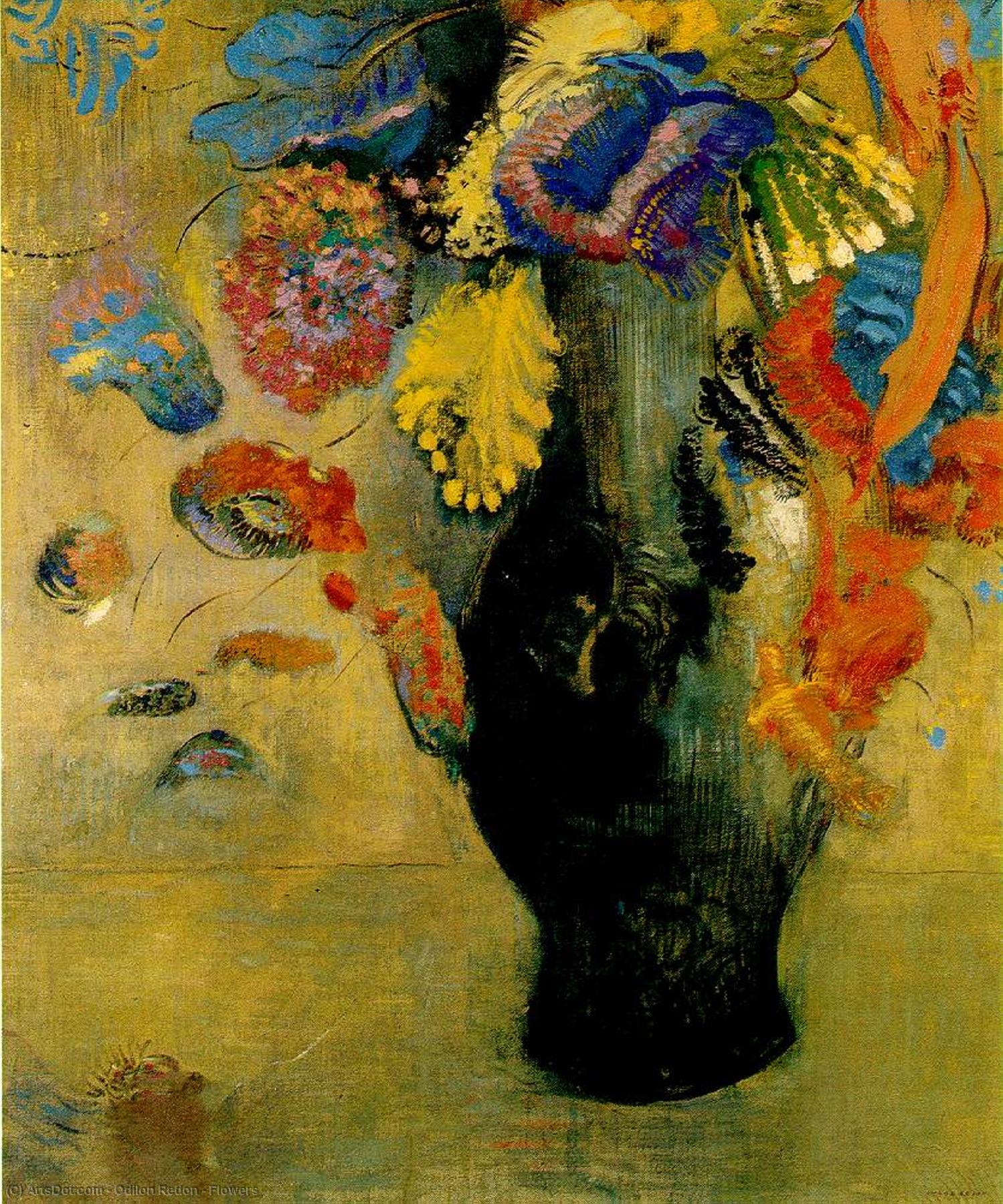
Odilon Redon's "Flowers," painted around 1905, isn’t merely a depiction of botanical beauty; it’s an immersion into the artist’s intensely personal and often unsettling inner world. This captivating work, rendered in oil on canvas, transcends simple still life, offering instead a glimpse into the realms of dream, memory, and perhaps even a touch of melancholy. Redon, a pivotal figure in the Symbolist movement, deliberately eschewed academic realism, favoring instead an evocative style that prioritized mood and suggestion over precise representation.
The painting immediately draws the eye with its vibrant yet muted palette. Deep blues and purples dominate, creating a sense of twilight or shadowed introspection. Within this subdued atmosphere, bursts of color – fiery reds, sunny yellows, and delicate greens – emerge from the arrangement of flowers within a simple black vase. These aren’t the bright, celebratory blooms of a typical still life; rather, they possess an almost otherworldly quality, as if illuminated by an unseen light source. The flowers themselves are rendered with loose, expressive brushstrokes, hinting at their fragility and suggesting a fleeting beauty.
The Influence of Symbolism and Japanese Art
Redon’s artistic journey was profoundly shaped by the Symbolist movement, which sought to express subjective emotions and ideas rather than objective reality. He was deeply influenced by artists like Gustave Moreau and Edvard Munch, both known for their exploration of psychological themes and dreamlike imagery. Furthermore, Redon developed a deep appreciation for Japanese art, particularly its emphasis on suggestion, asymmetry, and the use of color to evoke mood. This influence is evident in the painting’s flattened perspective, simplified forms, and the careful orchestration of colors – techniques borrowed from traditional Japanese prints.
Interestingly, Redon's artistic development wasn't linear. He began his career with meticulously detailed charcoal drawings, known as “noirs,” which explored themes of death, decay, and the subconscious. However, he gradually moved towards more colorful and expressive forms, embracing oil paints and pastels to capture the elusive qualities of dreams and visions. "Flowers" represents a pivotal moment in this transition, showcasing his newfound ability to translate inner experiences into tangible visual form.
Decoding the Symbolism: Flowers as Vessels of Emotion
The choice of flowers themselves is laden with symbolic meaning. Redon frequently depicted flowers in his work, often associating them with themes of mortality, beauty, and the passage of time. In "Flowers," the arrangement seems deliberately unbalanced, creating a sense of unease or instability. The dark vase acts as a container, not just for the blooms but also for the artist’s emotions – perhaps hinting at a hidden sadness or longing.
The specific colors used are equally significant. Red, often associated with passion and vitality, is tempered by the surrounding blues and purples, suggesting a delicate balance between joy and sorrow. The yellow flowers evoke feelings of hope and optimism, while the greens represent growth and renewal. It’s important to note that Redon's use of color wasn't purely decorative; he employed it strategically to create specific emotional responses in the viewer.
A Legacy of Dreamlike Visions
"Flowers" is a testament to Odilon Redon’s unique artistic vision. It’s a painting that invites contemplation, prompting viewers to delve beneath the surface and explore the depths of their own subconscious. Redon's work continues to resonate with audiences today, offering a powerful reminder of the enduring power of art to capture the intangible qualities of human experience. Reproductions of this evocative piece are highly sought after by collectors and interior designers alike, who appreciate its ability to infuse any space with a sense of mystery and beauty.
Vergelijkbare kunstwerken


Biografie van de kunstenaar
A World Beyond the Visible: The Enigmatic Art of Odilon Redon
Odilon Redon, geboren Bertrand-Jean Redon in 1840 in Bordeaux, Frankrijk, was een kunstenaar die voortdurend streefde om de onzichtbare rijkten van verbeelding en droom tot concrete vorm te vertalen. Zijn artistieke reis begon niet met ambitieuze plannen, maar met stille observatie; al op zijn tiende won hij een tekenprijs – een voorspelling van de visuele gevoeligheid die zijn hele leven zou definiëren. Hoewel hij aanvankelijk werd geleid naar architectuur door familiale verwachtingen, lag Redon’s ware roeping elders, verlicht door instructie van Jean-Léon Gérôme en, cruciaal, Rodolphe Bresdin, die hem begeleidde in de fijne kunsten van gravure en lithografie. Deze technieken vormden de basis voor zijn vroege verkenningswerk, waardoor hij kon duiken in een wereld van schaduwfiguren en dubbelzinnige vormen die spoedig de aandacht trokken van hen die op zoek waren naar een alternatief voor academische realisme. De onderbreking van de Franco-Pruisische oorlog zag Redon kortstondig dienst doen in het leger, maar na zijn terugkeer naar Parijs begon zijn artistieke visie daadwerkelijk te komen tot uiting.De Geboorte van Symbolisme: ‘Noirs’ en Vroege Visioenen
Redon's vroege carrière werd gekenmerkt door een bewuste terugtrekking uit heersende kunststromingen. Hij zocht niet de zichtbare wereld te reproduceren, maar eerder om de verborgen stromingen – de angsten, verlangens en spirituele lange slagen die zich onder het oppervlak van alledaagse het leven bevonden – te oproepen. Dit leidde tot zijn beroemde reeks “noirs”, monochrome werken uitgevoerd in houtskool en lithografie. Deze waren niet simpelweg studies in duisternis; ze waren verkenningsreizen naar de onderbewuste geest, bevolkt door vreemde wezens, losse ogen en spookachtige figuren die opstegen uit wervelende misten. De invloed van schrijvers als Edgar Allan Poe en Charles Baudelaire is hier voelbaar – een gedeelde fascinatie met het macabere, het mysterieuze en de kracht van suggestie. Deze werken werden niet onmiddellijk omarmd; Redon bleef jarenlang grotendeels onbekend. Echter, er kwam in 1884 een keerpunt met Joris-Karl Huysmans’ roman *À rebours*, waarin de decadente aristocraat Des Esseintes Redon's tekeningen promootte, waardoor zijn status binnen avantgardecirkels onmiddellijk werd verhoogd. Deze erkenning opende deuren en stelde Redon in staat om zijn unieke artistieke taal verder te ontwikkelen. Hij beschreef zijn werk als ambigu en ondefinieerbaar, waarbij hij zei dat het “ons moet plaatsen, net zoals muziek, in het ambigue rijk van het onbepaalde.”Van Monochrome naar Levendige Expressie: Een Evolutie
Hoewel de “noirs” Redon’s positie als een belangrijke kracht binnen het Symbolisme vestigden, onderging zijn kunst in de jaren ’90 een opmerkelijke transformatie. Hij begon kleur – eerst pastels, vervolgens oliën – in zijn composities te infuseren met een nieuwe levendigheid en luminositeit. Deze verschuiving was niet alleen technisch; ze weerspiegelde een evoluerend emotioneel landschap binnen de kunstenaar zelf. De vroege werken droegen vaak een gevoel van melancholie en isolatie, maar de latere schilderijen onthullen een groeiende interesse in mythologie, het Oosten en Japanisme – *Japonisme* was een significante invloed. Werken zoals *De Dood van Boeddha* (1899) tonen deze fascinatie met Oost-religie, terwijl stukken die door baron Robert de Domecy werden besteld voor zijn château een gevoel van innerlijk leven en psychologische diepte overbrengen. De portretten van Baroness de Domecy en haar dochter Jeanne zijn bijzonder opvallende voorbeelden van deze periode. Redon verkende zijn interne gevoelens en psyche door zijn kunst, met als doel “het zichtbare te dienen aan het onzichtbare.”Invloeden en Erfgoed: Een Pijler voor Surrealisme
Odilon Redon’s impact op de kunstwereld strekt zich uit verder dan zijn eigen leven. Hij ontving de Legioen van Eer in 1903, en zijn werk werd breder erkend door tentoonstellingen in de Armory Show in New York in 1913. Het was echter pas na zijn dood in 1916 dat zijn ware betekenis volledig tot uiting kwam. Redon’s verkenning van dromen, de onderbewuste geest en irrationele krachten legden de basis voor het Surrealisme, inspireerden kunstenaars als Marcel Duchamp en Max Ernst om soortgelijke gebieden te verkennen. Zijn nadruk op subjectieve ervaring en emotionele expressie resoneerde ook met expressionistische schilders. Hij deed niet alleen wat hij zag; hij visualiseerde wat hij voelde – een principe dat nog steeds kunstenaars inspireert. Redon’s nalatenschap is één van artistieke moed, een bereidheid om het ambigue te omarmen en een diep gevoel voor de kracht van kunst om de verborgen dimensies van menselijke ervaring te onthullen.Belangrijke Kenmerken & Thema's
- Symbolisme: Redon wordt beschouwd als een centrale figuur in de Symbolistische beweging, waarbij de nadruk ligt op emotionele en spirituele expressie in plaats van realistische representatie.
- Droomachtige Beeldspraak: Zijn werken worden vaak gekenmerkt door fantastische wezens, dubbelzinnige landschappen en scènes die de sfeer van dromen oproepen.
- Verkenning van de Onderbewuste Geest: Redon duikelde in thema's als angst, verlangen en de verborgen diepten van de menselijke psyche.
- Invloed van Literatuur & Mythologie: Hij putte inspiratie uit werken van schrijvers zoals Poe en Baudelaire, evenals uit mythologie en religie.
- Technologische Innovatie: Redon’s meesterschap in lithografie en zijn innovatieve gebruik van kleur in pastels en oliën waren cruciaal voor zijn artistieke visie.

Odilon Redon
1840 - 1916 , Frankrijk
Belangrijkste feiten
- Artistic Movement Or Style: Symbolisme
- Artists Or Movements Influenced By This Artist:
- Surrealisme
- Duchamp
- Artists Who Influenced This Artist:
- Gérôme
- Bresdin
- Date Of Birth: 1840
- Date Of Death: 1916
- Full Name: Odilon Redon
- Nationality: Frans
- Notable Artworks:
- Centaurs
- Onnes
- Portrait van Ari Redon
- Place Of Birth: Bordeaux, Frankrijk
Gerelateerde artikelen

Crimson Threads of Narrative: Exploring Symbolism & Representation in Artworks Featuring the Red Dress
Explore the rich symbolism of the red dress in art history! From ancient power displays to iconic portraits like Cézanne’s 'Madame Cezanne', discover the cultural and artistic significance behind this captivating color. Expert analysis & insights.

Top 10 Impressionistische Meesterwerken: Kleur, Licht & Emotie voor uw Interieur
Ontdek de top 10 impressionistische meesterwerken van Monet, Renoir & meer! Duik in kleur, licht en emotie met deze iconische schilderijen. Vind museumkwaliteit kunst reproducties voor uw interieur op ArtsDot.com.

Paul Cézanne's Top 25 Meesterwerken: Kleur, Vorm & De Basis van Modern Art | ArtsDot
Ontdek de 25 meest iconische schilderijen van Paul Cézanne! Duik in zijn kleurrijke wereld, leer over impressionisme & post-impressionisme en bewonder meesterwerken als 'De Baders'. Vind museumkwaliteit reproducties & interieurinspiratie op ArtsDot.com.

Blossoming Symbolism: A Historical Journey Through Flowers in Western Painting
Explore the rich history of flower symbolism in Western painting! Discover how artists from the Renaissance to Modernism used blossoms to convey meaning, emotion & beauty. Learn about iconic artworks and movements.

Fleeting Moments & Radiant Light: Exploring the Enduring Legacy of Impressionism
Explore the captivating world of Impressionism! Discover its history, key artists like Monet & Renoir, defining techniques, and lasting impact on modern art. Expert insights for collectors.



