

 Print kopen Koop afbeelding in hoge resolutie
 Verstuur
 Delen
Delen
 Details
 Toevoegen aan favorieten

 Download
 Vergelijkbare werken
 X-Ray
X-Ray
 Diavoorstelling
Vaydelots


 Lees meer
Handgemaakte olieverfreproductie
Met de hand geschilderd in olieverf op canvas in uw gewenste maat en lijst, op bestelling gemaakt door onze kunstenaars.




P118B $10

P118H $10

P118W $10

P438Z $10

P508JH $12

P508YH $12

P805H $10

P805Z $10

P919BZ $10

P919G $10

P919XJ $10

P959ZH $10

P968JZ $12

W106C $8

W218G $10

W218JH $8

W218Y $10

W307PJ $10

W316G $10

W316PJ $8

W316Y $10

W398PJ $8

W4111J $10

W500HY $15

W500JH $15

W692G $12

W849H $8

W940BG $15

W953PJ $8




Kies uit onze vooraf ingestelde maten die overeenkomen met de originele verhoudingen van het kunstwerk.

U kunt uw eigen afmetingen invoeren om in een specifieke lijst of ruimte te passen. Als de door u gekozen maat niet overeenkomt met de verhoudingen van het originele beeld, zullen we het kunstwerk bijsnijden of het schilderij uitbreiden met extra handgeschilderde elementen. Een digitale mockup wordt ter goedkeuring naar u verzonden voordat de productie begint.
Houd er rekening mee dat de preview op het scherm niet de werkelijke uitsnede of uitbreiding weergeeft. Alleen de mockup toont de uiteindelijke compositie nauwkeurig.
Hoewel aangepaste afmetingen mogelijk zijn, raden we aan een maat uit de vooraf gedefinieerde lijst te selecteren om de originele verhoudingen te behouden.
Na de bestelling zal het team van ArtsDot.com per e-mail contact opnemen voor instructies en een mockup-voorbeeld sturen.
Wereldwijde levering () binnen 3/4 weken in plaats van de standaard 5 weken. (2 juli). Geen concessies aan de kwaliteit.

Gratis wereldwijde expressverzending

Hoogwaardig linnen canvas

Volledige verzendverzekering

Garantie op terugbetaling van invoerrechten

Garantie op exacte kleurweergave

60 dagen retourbeleid (alleen bij defecten)

100% Geld-terug-garantie

Korting bij meerdere afnames
 De optie voor glas is alleen beschikbaar bij een formaat kleiner dan 110 cm.

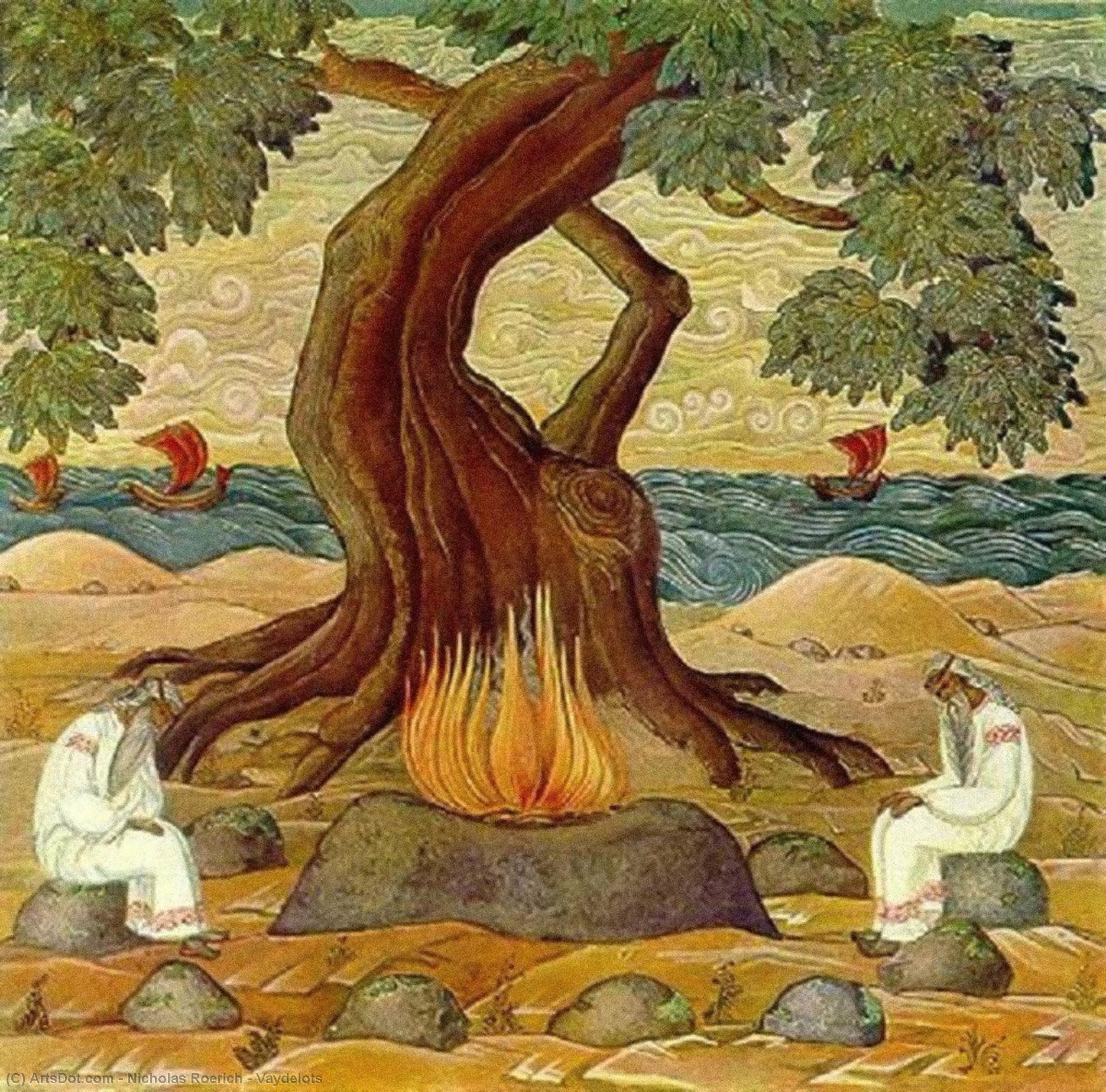
Vaydelots
Techniek reproductie
Afmetingen reproductie
-


Eindtotaal
-
Beschrijving kunstwerk
Vaydelots: A Symphony of Symbolism from Nicholas Roerich
Nicholas Roerich’s 1914 painting, “Vaydelots,” isn't merely a depiction of a coastal scene; it’s an immersive experience, a carefully constructed tableau brimming with symbolic resonance and the artist’s signature blend of Symbolism, mysticism, and profound connection to nature. The work transports the viewer to a serene beach bathed in the warm glow of twilight, yet beneath its tranquil surface lies a complex tapestry of meaning rooted in ancient traditions and Roerich's own evolving spiritual beliefs.
At first glance, “Vaydelots” presents a simple composition: two figures seated by a crackling fire pit on a rocky outcrop overlooking the sea. These aren’t isolated individuals; they are integral parts of a larger narrative woven through the landscape itself. The central tree, its roots seemingly emerging from the sand and reaching towards the heavens, dominates the scene – a potent symbol of life, growth, and connection to the earth's core. The fire pit, radiating warmth and light, represents not just physical comfort but also the enduring power of tradition, community, and spiritual contemplation. The figures themselves, shrouded in shadow yet clearly engaged in conversation, embody harmony and balance within this elemental setting.
Decoding the Symbolism
Roerich’s work is renowned for its intricate symbolism, often drawing from sources as diverse as ancient mythologies, Eastern philosophies, and his own personal spiritual journey. In “Vaydelots,” several key symbols converge to create a layered meaning. The presence of boats in the background evokes journeys – both literal and metaphorical – suggesting themes of exploration, transition, and the search for inner truth. The birds scattered throughout the scene represent messengers, guides, or perhaps even glimpses into other realms. More subtly, the arrangement of elements—the placement of the tree, the positioning of the figures—mirrors patterns found in sacred geometry and ancient cosmologies.
Notably, the painting’s title itself – “Vaydelots” – is significant. It refers to a mythical figure from Baltic folklore, often associated with wisdom, prophecy, and the guardianship of sacred places. This connection elevates the scene beyond a simple beachscape, imbuing it with an aura of ancient knowledge and spiritual significance. The painting’s creation during a period of immense social upheaval in Russia—the aftermath of the 1905 Revolution and the rise of Bolshevism—further underscores the symbolic weight of its themes: resilience, continuity, and the enduring power of tradition amidst chaos.
Roerich's Technique and Artistic Style
“Vaydelots” exemplifies Roerich’s distinctive artistic style, a synthesis of Symbolist aesthetics with elements of Russian landscape painting. He employed loose, expressive brushstrokes to capture the fluidity of light and shadow, creating an atmosphere of both serenity and mystery. The use of warm earth tones—ochres, browns, and golds—dominates the palette, evoking the warmth of the fire and the golden hues of a setting sun. Roerich’s masterful handling of texture adds depth and realism to the scene, particularly in the depiction of the rough-hewn rocks and the flickering flames of the fire.
The painting's composition is carefully balanced, drawing the eye towards the central tree and the figures while simultaneously creating a sense of spaciousness and openness. Roerich’s meticulous attention to detail—the subtle variations in color, the delicate rendering of foliage—contributes to the overall feeling of authenticity and invites the viewer to lose themselves within the scene.
A Timeless Masterpiece – Reproduction Possibilities
ArtsDot.com is proud to offer meticulously crafted hand-painted oil painting reproductions of “Vaydelots,” allowing art enthusiasts to experience the beauty and depth of this iconic work firsthand. Our skilled artisans replicate Roerich’s unique style with exceptional accuracy, capturing not only the visual details but also the emotional resonance of the original. Whether you're seeking a stunning addition to your home décor or an investment in a timeless piece of art history, our reproductions provide a faithful and accessible representation of this remarkable painting.
Explore the full depth of Nicholas Roerich’s artistic vision through ArtsDot.com – where artistry meets preservation.
Vergelijkbare kunstwerken


Biografie van de kunstenaar
A Life Immersed in Art and Spirit
Nicholas Roerich, geboren op 9 oktober 1874 in het levendige culturele hart van Sint Petersburg, Rusland, was een figuur wiens leven verder ging dan de grenzen van artistieke expressie. Hij was niet alleen een schilder; hij was een archeoloog, schrijver, filosoof en een vastberaden pleitbezorger voor vrede en cultureel behoud. Zijn opvoeding, doordrenkt van intellectuele ernst – zijn vader was notaris – en artistieke waardering dankzij zijn moeder, legde de basis voor een buitengewoon veelzijdige carrière. Roerich studeerde tegelijkertijd zowel rechten als kunst aan de Universiteit van Sint Petersburg en de Academie voor Kunstnijverheid beginnend in 1893, wat een vroege toewijding aan een brede begrip van de wereld weerspiegelde. Deze dubbele weg was niet contradictorisch voor hem; het spiegelde eerder een overtuiging dat artistieke visie een gronding nodig had in historische context en intellectuele discipline. Hij ontving zijn kunstdiploma in 1897 en voltooide zijn rechtenstudie het daaropvolgende jaar, waardoor de scène werd gezet voor een leven gewijd aan zowel creatieve exploratie als rationele actie.De Verleiding van Symbolisme en Theatraal Innovatie
Roerich’s artistieke ontwikkeling werd diep beïnvloed door de stromingen van het Russische Symbolisme, een beweging die emotionele en spirituele diepten probeerde te roepen door evocatieve beelden en suggestieve vormen. Hij kwam snel in contact met de invloedrijke “Wereld van Kunst” (Mir Iskusstva) van Sergei Diaghilev, en trad uiteindelijk op als president vanaf 1910 tot 1916. Deze associatie bleek cruciaal te zijn, waardoor hij werd blootgesteld aan een netwerk van innovatieve kunstenaars, componisten en denkers die het landschap van de Russische kunst opnieuw vormgaven. Zijn vroege werk toonde een fascinatie met archeologie en toneelontwerp, wat leidde tot baanbrekende samenwerkingen met Diaghilev’s Ballets Russes. Roerich’s ontwerpen voor producties zoals Alexander Borodin's *Prins Igor* (1909) en vooral Igor Stravinsky’s revolutionaire *De Rite van de Lente* (1913), waren niet alleen achtergronden; ze waren integraal onderdeel van de theatrale ervaring. Hij combineerde zorgvuldige historische onderzoek met een gedurfd imaginaire visie, waardoor indrukwekkende visuele omgevingen werden gecreëerd die de emotionele kracht van de muziek en choreografie versterkten. Deze ontwerpen waren niet alleen decoratief; ze probeerden oerkrachten en oude rituelen te oproepen, wat de symbolistische interesse in mythe en spiritualiteit weerspiegelde. Zijn werk werd ook beïnvloed door apocrypha en middeleeuwse sektarische geschriften zoals het Boek van de Dove, waardoor lagen esoterische betekenis werden toegevoegd aan zijn artistieke creaties.Een Reis Naar Spiritualiteit en Himalayaanse Visioenen
Naarmate Roerich’s carrière voortvorderde, ondergingen zijn schilderijen een significante transformatie, waarbij steeds meer spirituele en mystieke thema's werden benadrukt. Deze verschuiving werd gevoed door zijn groeiende interesse in Theosofie en Oosterse religies, filosofieën die de verbondenheid van alles benadrukten en het nastreven van innerlijke wijsheid. Zijn *Architecturale Studies* serie (1904–1905) toonde niet alleen zijn architectonische vaardigheid, maar ook een diepe toewijding aan het behoud van cultureel erfgoed, wat later zijn inspanningen om kunst te beschermen tijdens tijden van conflict voorspelde. Herkenbare motieven begonnen op te duiken in zijn werk: majestueuze landschappen, oude steden gehuld in mysterie en figuren doordrenkt van spirituele betekenis zoals St. Panteleimon en Kuan Yin. Hij maakte uitgebreide reizen door Centraal-Azië, waarbij hij archeologisch onderzoek verrichtte en oude culturen documenteerde, ervaringen die zijn artistische visie diepgaand vormden en zijn overtuiging versterkten dat cultureel begrip essentieel is.Erfgoed van Behoud en Duurzaam Invloed
Nicholas Roerich’s toewijding strekte zich verder uit dan het doek; hij was een toegewijd pleitbezorger voor het beschermen van kunst en architectuur tijdens tijden van oorlog. Erkend de kwetsbaarheid van culturele schatten, heeft hij de oprichting van het Roerich Pact in 1935 voorgelegd – een internationaal verdrag ontworpen om culturele objecten te beschermen tegen vernietiging. Deze initiatief leverde hem meerdere nominaties op voor de Nobelprijs voor de Vrede, wat zijn humanitaire inspanningen onderstreept. Zijn onvermoeibare inspanningen toonden een overtuiging dat het behoud van cultureel erfgoed niet alleen essentieel is voor het begrijpen van het verleden, maar ook voor het bouwen aan een vreedzamere toekomst. Hij liet een oeuvre achter dat niet alleen visueel indrukwekkend is, maar ook diep betekenisvol, en een tijdloze boodschap van vrede, begrip en respect voor alle culturen biedt.Belangrijke Werken & Duurzaam Invloed
- Saint Nicholas: Een gedetailleerde monochrome muurschildering die middeleeuwse kunst en heraldische symboliek toont.
- City: Evocative beelden van oude stedelijke landschappen, die zijn archeologische interesses weerspiegelen.
- Lake of the Nagas: Een tempera schilderij dat symboliek en natuur combineert, een voorbeeld van zijn unieke artistieke visie.

Nikolaas Roerich
1874 - 1947 , Rusland
Belangrijkste feiten
- Artistic Movement Or Style: Symbolisme, Spirituele kunst
- Artists Or Movements Influenced By This Artist: ['Russisch Symbolisme']
- Artists Who Influenced This Artist: ['Diaghilev']
- Date Of Birth: 9 oktober 1874
- Date Of Death: 13 december 1947
- Full Name: Nicholas Konstantinovich Roerich
- Nationality: Russisch
- Notable Artworks:
- Saint Nicholas
- City
- Lake Nagas
- Place Of Birth: Sint-Petersburg, Rusland
Gerelateerde artikelen

The Pursuit of Power & Prestige: Hunting Scenes in Western Art
Explore the rich history of hunting scenes in Western art, from royal pursuits to powerful allegories. Discover masterpieces & expert insights for discerning collectors. ArtsDot offers museum-quality reproductions.

Depicting Life's Stages: 'Scene' as Narrative in Art History
Explore the rich history of genre painting – art that depicts everyday life. Discover Dutch Masters, hidden symbolism & its enduring influence on art history. Learn more at ArtsDot.

Kuzma Petrov-Vodkin: A Pioneer of Russian Spiritual Symbolism & the Avant-Garde
Explore the captivating world of Kuzma Petrov-Vodkin, a pivotal figure in Russian avant-garde and spiritual symbolism. Discover his iconic works, unique style & lasting influence on 20th-century art.
Beyond Symbolism: Exploring the Spiritual Landscapes of Mikalojus Konstantinas Čiurlionis's Art
Explore the captivating world of Mikalojus Konstantinas Čiurlionis, a pioneer of abstract art. Discover his unique blend of music and painting, spiritual themes, and lasting influence on Lithuanian culture. Learn more at ArtsDot.

Gustav Klimt: A Golden Legacy of Sensuality & Symbolism in Viennese Art
Explore the captivating world of Gustav Klimt with ArtsDot. Discover his iconic paintings, the Vienna Secession movement, & enduring legacy. High-quality reproductions available.



