

The picture follows your choices: , .
Biografie kunstenaar
A pioneer of American portraiture and landscape painting, Matthew Harris Jouett captured historical figures like Thomas Jefferson with a unique Romantic sensibility that invites you to discover his evocative legacy.
 Lees meer
Handgemaakte olieverfreproductie
Met de hand geschilderd in olieverf op canvas in uw gewenste maat en lijst, op bestelling gemaakt door onze kunstenaars. ( Schakel over naar print Schakel over naar digitale afbeeldingen)
More about this painting
 Voorvertoning
 Verstuur
 Delen
Delen
 Details bekijken
 Gids
Gids

 Download
 Vergelijkbare items
 Röntgenonderzoek
 Diavoorstelling
 Q&A
Q&A Statistieken
Order your painting in four simple steps
Take your time. You can change any answer; the price in your order card follows each choice.
1 Step one of four
Which size would you like?
These sizes keep the proportions of the original painting. The drawing shows your choice on a wall, above a two-metre sofa.
Or give your own measurements
Kies uit onze vooraf ingestelde maten die overeenkomen met de originele verhoudingen van het kunstwerk.

Voer de breedte en hoogte in die u nodig heeft, passend bij uw lijst of uw muur. Omdat dit handgeschilderd is, kan de kunstenaar bij een afmeting met een andere beeldverhouding iets meer rondom het schilderij schilderen of juist iets meer weglaten — u kiest zelf. Wij sturen u een digitaal mockup ter goedkeuring voordat het schilderwerk begint. De afbeelding die op deze pagina wordt getoond, is niet het uiteindelijke resultaat — alleen de mockup geeft dit weer.
2 Step two of four
How should it be prepared: rolled, stretched or framed?
The prices below are for the size you chose in step one.
Choose the edges of the stretched canvas
Choose your frame

White €1

Blurside €1

Extended €1

P118B €10

P118H €10

P118W €10

P438Z €10

P508JH €12

P508YH €12

P805H €10

P805Z €10

P919BZ €10

P919G €10

P919XJ €10

P959ZH €10

P968JZ €12

W106C €8

W218G €10

W218JH €8

W218Y €10

W307PJ €10

W316G €10

W316PJ €8

W316Y €10

W398PJ €8

W4111J €10

W500HY €15

W500JH €15

W692G €12

W849H €8

W940BG €15

W953PJ €8

H24-GOLD €30

H24-SILVER €30

H36-GOLD €45

H36-SILVER €45
Ingelijst
Moulding: . Overall size with the frame: .
3 Step three of four
Would you like anything changed in the painting?
Most people answer no. Because each painting is made by hand, our artist can also adapt it for you.
After order, ArtsDot.com team will email client for instructions and provide a mockup preview
4 Step four of four
A few finishing options
All of them are optional. The answers already selected cost nothing extra.
Who paints it?
Wereldwijde levering () binnen 3 tot 4 weken in plaats van de standaard 5 weken. (2 november). Zonder concessies aan de kwaliteit.
A nameplate, as in a museum?
Details van de gegraveerde bronzen plaat
This elegant plaque features the artist's name and the title of the artwork, finely engraved for a timeless presentation.
It is made from bronze with a refined, elegant finish. The text is precisely laser-engraved for a sharp and permanent result. Measuring 9x2 cm, the plaque is compact yet easy to read. It's built to be durable and scratch-resistant, offering a professional, museum-quality look. Mounting is simple thanks to the included adhesive backing.
Details transparante acrylplaat
The plaque includes essential engraved details such as the artist's name, the title of the artwork, the date it was created, the type of media used-like oil on canvas or watercolor-a brief description of the piece, and a QR code that links to the complete artwork information.
It is crafted from clear acrylic, offering a sleek, modern appearance. The text is UV-engraved in black to ensure strong visual contrast. With a size of 10x15 cm, it ensures optimal readability. It comes equipped with two metal hooks for secure wall mounting. The plaque is designed to be weather-resistant, making it suitable for various environments, and it includes interactive features that work seamlessly with smartphone scanning.
Details zwarte acrylplaat
This elegant plaque includes engraved information such as the artist's name, the title of the artwork, the date it was created, the type of media used (like oil on canvas or watercolor), a short description of the artwork, and a QR code for quick access to more information.
The plaque itself is made from refined black acrylic with a premium finish. The text is laser-engraved in white for high contrast and readability. Its size is 10x15 cm, designed to be easy to read. It comes with two metal hooks for professional mounting. The design is sleek and fits any interior style. It is also weather-resistant and durable, with built-in digital integration for mobile compatibility.
A protective varnish?
When do you need it?
✓ Check and order
Your painting, as you ordered it

Thomas Smith
Druktechniek
Afmetingen reproductie
-

Geselecteerde topkunstenaars
Meer detail, verfijning en extra productietijd
-

Lijst voor reproductie
-
-
Voor kunstwerken of reproducties die aan één zijde groter zijn dan 105 cm (ongeveer 41 inch), wordt de lijst als een losse set verzonden. Deze methode garandeert een veilige levering en voorkomt schade tijdens het transport.
Professionele montage vereist - dit is geen doe-het-zelfproduct.
De set moet worden gemonteerd en het canvas moet worden gespannen door een ervaren professionele lijstenmaker, met gebruik van houtlijm (niet inbegrepen), een doekspanter en klemmen om de sponningen recht te houden terwijl de lijm droogt. Onjuiste montage of een ongelijkmatige spanning op het canvas kan het kunstwerk permanent beschadigen en wordt niet gedekt door onze garantie.
 Voor kunstwerken of reproducties die aan één zijde groter zijn dan 105 cm (ongeveer 41 inch), wordt de lijst als een losse set verzonden. Deze methode garandeert een veilige levering en voorkomt schade tijdens het transport.
Alle massief houten onderdelen zijn inbegrepen, nauwkeurig op maat gesneden voor montage.
Te monteren met de meegeleverde schroeven, plus houtlijm voor de hoekverbindingen, die niet wordt meegeleverd en door uw lijstenmaker moet worden aangeschaft.
Professioneel gereedschap is vereist en niet inbegrepen: een spanner voor canvas en klemmen om de latten recht te houden terwijl de lijm droogt.
Belangrijk:
De hoekverbindingen vereisen houtlijm, de latten moeten met lijmklemmen worden vastgehouden tot de lijm volledig is opgedroogd, en het spannen van het canvas op het samengestelde frame vereist een doekspanter. Geen van deze artikelen is inbegrepen in de set. Wij adviseren u om een ervaren professionele lijstenmaker te raadplegen voordat u deze maat bestelt.

Naamplaatje
-
-

Beschermende vernislaag
Glanzende vernis (versterkt de kleuren en biedt bescherming tegen licht en vocht)
-

Mijn kunstwerk aanpassen
Voorbeelden van aanpassingen: vervang het gezicht door een eigen foto; voeg een huisdier toe (bijv. vervang de kat door een hond); verwerk een verborgen boodschap in de achtergrond; wijzig het landschap of andere elementen op de achtergrond.
-

Spoedlevering
Wereldwijde levering () binnen 3 tot 4 weken in plaats van de standaard 5 weken. (2 november). Geen concessies aan de kwaliteit.
-
Spoedlevering
Wereldwijde levering naar binnen 5 weken. (9 november).
Inbegrepen
Eindtotaal
€ 234
De optie voor glas is alleen beschikbaar bij een formaat kleiner dan 110 cm.
Included with every order
- Gratis wereldwijde expressverzending
- Hoogwaardig linnen canvas
- Volledige verzendverzekering
- Garantie op terugbetaling van invoerrechten
- Garantie op exacte kleurweergave
- Retourbeleid van 100 dagen (alleen bij defecten)
- 100% Geld-terug-garantie
- Korting bij meerdere afnames


Vergelijkbare kunstwerken


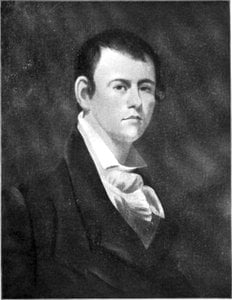
Matthew Harris Jouett
1788 - 1827, United States of America
Biografie kunstenaar
A Legacy Captured in Light and Shadow
Matthew Harris Jouett remains an enigmatic and profound figure within the early annals of American art, a painter whose brush captured the very essence of a burgeoning nation. Born in Mercer County, Kentucky, Jouett’s life was marked by both the ruggedness of the American frontier and the refined pursuit of classical beauty. While history often remembers him through the lens of his notable subjects, his true contribution lies in his ability to translate the psychological depth of his sitters and the sublime atmosphere of the wilderness onto canvas. Though his career was tragically cut short, he left behind a body of work that serves as a vital window into the Romantic sensibility of the early nineteenth century.
His journey as an artist was one of both duty and devotion. A graduate of Transylvania University who briefly studied law, Jouett’s path took a decidedly more creative turn, much to the chagrin of his father, a hero of the American Revolution. Beyond the studio, he served with distinction as a volunteer officer in the 2 .8th Kentucky Infantry during the War of 1812. It was during these turbulent years that his artistry met necessity; he famously used his own earnings to restore missing militia funds and captured the likenesses of his fellow soldiers from memory, imbuing these portraits with a raw, human energy born of shared experience.
Mastery of Portraiture and Landscape
Jouett’s artistic development was shaped by a pursuit of excellence that led him far beyond the borders of Kentucky. Seeking to refine his craft, he traveled to Boston to study under the legendary Gilbert Stuart, an encounter that undoubtedly deepened his understanding of portraiture. This training allowed him to execute works of immense historical significance, earning commissions to paint luminaries such as Thomas Jefferson, George Rogers Clark, and the Marquis de Lafayette. His portraits are characterized by a masterful use of chiaroscuro, where dramatic contrasts of light and dark sculpt the features of his subjects, creating a sense of presence that transcends time.
While he is celebrated for his portraits, Jouett also emerged as a pioneer in the realm of American landscape painting. He possessed an unwavering dedication to capturing the Appalachian wilderness, focusing on the intimate and evocative beauty of the Kentucky and Tennessee landscapes. His approach to the land was not one of monumental scale, but rather an exploration of subtle tonal variations and atmospheric effects. In his landscapes, one finds a unique blend of Romantic idealism and meticulous observation, often utilizing watercolor to achieve luminous color palettes and delicate textures that resonate with the soul of the American frontier.
Artistic Style and Historical Significance
The stylistic hallmarks of Jouett’s work represent a fascinating intersection of classical tradition and emerging modern sensibilities. His technique can be described as a form of Romantic Impressionism, where he adopted the idealized forms and dramatic lighting reminiscent of masters like Claude Lorrain and Nicolas Poussin, yet infused them with a looser, more fluid brushwork. This ability to balance Neoclassical structure with a restless, human energy allowed him to create works that were both dignified and deeply emotive.
Though his fame was not fully realized until the 1893 Chicago World Fair, Jouett’s impact on the American artistic landscape is undeniable. His work stands as a testament to a period of transition in the United States—a time when artists were beginning to find their own visual language, separate from European traditions, by looking closely at the faces and the forests of their own soil. Today, his paintings are cherished not merely as historical artifacts, but as profound explorations of character and nature.