


 Bekijk op ware grootte
 Verstuur
 Delen
Delen
 Details bekijken
 Gids voor studentenkunstwerken

 Download
 Vergelijkbare items
 Röntgenonderzoek
 Diavoorstelling
 Statistieken
Selifan
 Charcoal
- WallArt
- Expressionism
 1923
1923- Modern
 221.0 x 286.0 cm
 Lees meer
De kunstwerken die op deze pagina worden weergegeven, zijn beschermd door de auteursrechtwetgeving, wat betekent dat het ons wettelijk niet is toegestaan om identieke reproducties te maken of te verkopen. Deze bescherming wordt gehandhaafd onder internationale overeenkomsten zoals de Conventie van Bern en door nationale wetgeving, waaronder de bepalingen van de Amerikaanse auteurswet - Titel 17. Alle rechten voorbehouden. Reproduceren of distribueren van afbeeldingen is niet toegestaan zonder uitdrukkelijke schriftelijke toestemming van WahooArt.com en de rechthebbenden.
Deze methode voldoet volledig aan de auteursrechtwetgeving, omdat het niet gaat om het kopiëren of dupliceren van het beschermde kunstwerk. In plaats daarvan is er sprake van een creatieve herinterpretatie — een nieuw schilderij dat door het origineel wordt geïnspireerd, maar er niet identiek aan is.
Giclée / Kunstafdrukken
Giclée- of canvasafdruk van museumkwaliteit met een snelle productie en flexibele afwerkingsmogelijkheden. ( Koop handgeschilderd kunstwerk Schakel over naar digitale afbeeldingen)




P118B €10

P118H €10

P118W €10

P438Z €10

P508JH €12

P508YH €12

P805H €10

P805Z €10

P919BZ €10

P919G €10

P919XJ €10

P959ZH €10

P968JZ €12

W106C €8

W218G €10

W218JH €8

W218Y €10

W307PJ €10

W316G €10

W316PJ €8

W316Y €10

W398PJ €8

W4111J €10

W500HY €15

W500JH €15

W692G €12

W849H €8

W940BG €15

W953PJ €8




Kies uit onze vooraf ingestelde maten die overeenkomen met de originele verhoudingen van het kunstwerk.

Voer de breedte en de hoogte in die u nodig heeft, passend bij uw lijst of uw muur. Een afdruk kan alleen worden ingekort, nooit groter worden gemaakt dan het origineel, waardoor een formaat met een andere verhouding een deel van de afbeelding verliest. Wij sturen u een digitaal mockup ter goedkeuring voordat we iets drukken. De afbeelding op deze pagina toont niet de werkelijke uitsnede — dit is alleen te zien op het mockup.
Wereldwijde levering () binnen 2 weken in plaats van de standaard 4/5 weken. (24 oktober)

Gratis wereldwijde expressverzending

Hoogwaardig linnen canvas

Volledige verzendverzekering

Garantie op terugbetaling van invoerrechten

Garantie op exacte kleurweergave

Retourbeleid van 100 dagen (alleen bij defecten)

100% Geld-terug-garantie

Korting bij meerdere afnames
 De optie voor glas is alleen beschikbaar bij een formaat kleiner dan 110 cm.

Selifan
Giclée / Kunstafdrukken
Formaat reproductie
-


Totaalprijs
€ 55
A Dreamscape Rendered in Charcoal: The Ethereal World of Selifan
In the quiet, monochromatic depths of Marc Chagall’s 1923 masterpiece, Selifan, we find ourselves transported far beyond the boundaries of the physical world. This is not merely a drawing; it is a fragment of a lost memory, a visual poem etched in graphite and charcoal that invites the viewer into a realm where the laws of gravity and logic surrender to the whims of the imagination. At its heart, the artwork presents a solitary figure—a man seated atop a horse—positioned with a dynamic, off-center tension that suggests a moment caught in mid-motion. As the eye wanders through the swirling, rhythmic lines of the background, additional horses emerge from the shadows, creating a sense of a pastoral landscape transformed into a dreamlike procession. The composition is masterfully asymmetrical, utilizing a flattened perspective to prioritize emotional resonance over anatomical accuracy, much like a scene from a half-remembered folk tale.
The technical execution of Selifan is a testament to Chagall’s ability to command the most elemental of tools to achieve profound complexity. Eschewing the vibrant palette for which he is often celebrated, Chagall utilizes a stark, monochromatic range of blacks, whites, and greys to amplify the expressive power of his linework. Through the meticulous application of hatching and cross-hasting, he sculpts form out of darkness, building tonal variations that suggest depth and texture without the need for traditional shading. The charcoal strokes possess an immediacy and a raw, gestural energy, reflecting the spirit of Naïve Art and Expressionism. Every line feels intentional yet fluid, contributing to a sense of movement that makes the static paper feel as though it is breathing with the pulse of the horses and the rider.
Symbolism and the Echoes of Heritage
To look upon Selifan is to glimpse the profound connection Chagall maintained with his Jewish heritage and the folklore of his Belarusian upbringing. The subject matter, rooted in rural life and the bond between humans and animals, serves as a vessel for deeper symbolic meaning. The horse, a recurring motif throughout Chagall’s oeuvre, often represents vitality, freedom, and the untamed spirit of the soul. In this piece, the interplay between the central figure and the surrounding horses evokes a sense of cosmic connection, suggesting that the individual is inextricably linked to the natural and spiritual rhythms of the universe. There is a gentle whimsy present here, a touch of the surreal that softens the starkness of the monochrome palette, turning a simple pastoral scene into a profound meditation on existence.
For the discerning collector or interior designer, Selifan offers an unparalleled opportunity to introduce a piece of art history into a contemporary space. Its sophisticated use of texture and its commanding presence make it an ideal focal point for rooms that value intellectual depth and understated elegance. Because the work relies on the strength of its composition and the nuance of its tonal range rather than loud colors, it integrates seamlessly into diverse decor styles—from minimalist modernism to classic, textured interiors. Owning a high-quality reproduction of this work is more than an aesthetic choice; it is an invitation to live alongside a fragment of Chagall’s dreamscape, bringing a sense of poetic movement and historical gravity into the home.
Vragen & Antwoorden
Wat is de dominante kleur van "Selifan" door Marc Chagall?
Rosy Brown (#b3afad) is de dominante kleur van "Selifan" door Marc Chagall.
Wat is het kleurenpalet van "Selifan" door Marc Chagall?
De kleuridentiteit van "Selifan" door Marc Chagall: een Neutrals palet, gedomineerd door Rosy Brown (#b3afad).
Waarvoor wordt het gebruik van "Selifan" door Marc Chagall aanbevolen?
Een reproductie van "Selifan" door Marc Chagall wordt aanbevolen voor Conversation. Dit advies is gebaseerd op het onderwerp, de sfeer en de kleuren van het werk.
Gerelateerde kunstwerken


Biografie van de kunstenaar
A Life Painted in Dreams: The World of Marc Chagall
Marc Chagall, born Moishe Shagal in 1887 in the small Belarussian town of Liozna near Vitebsk, wasn’t merely a painter; he was a poet of color, a weaver of dreams, and a chronicler of memory. His life, spanning nearly a century, mirrored the tumultuous currents of the twentieth century, yet his art remained steadfastly rooted in a deeply personal vision—one infused with the folklore of his Hasidic Jewish upbringing and an unwavering belief in the power of imagination. Vitebsk itself was more than just a birthplace; it became the emotional core of his artistic universe, a recurring motif populated by flying figures, whimsical animals, and the vibrant hues of remembered landscapes. The town’s unique blend of cultures—Russian Orthodox churches alongside bustling Jewish marketplaces—forged an aesthetic sensibility that would defy easy categorization throughout his long career. Though he sought formal training first with a local sign painter and later in St. Petersburg under Léon Bakst, and then in Paris at the Académie de la Grande Chaumière, Chagall never fully embraced any single artistic movement. He absorbed elements of Cubism, Symbolism, and Fauvism, but always filtered them through his own intensely personal lens, creating a style that was uniquely, unmistakably Chagall.Early Influences and Artistic Beginnings
Chagall’s formative years were marked by the traditions of Vitebsk’s Jewish community—a vibrant tapestry woven with religious rituals, folk tales, and ancestral memories. These influences would permeate his artistic vision throughout his life, informing his use of symbolism and his fascination with biblical narratives. His initial training was modest, focusing on practical skills as a sign painter – a craft that instilled in him an appreciation for visual communication and meticulous attention to detail. However, he quickly recognized the limitations of realism and sought inspiration in the expressive techniques championed by Impressionists like Léon Bakst, whose theatrical productions captivated him with their bold colors and dynamic compositions. This exposure to avant-garde aesthetics broadened his artistic horizons and propelled him toward experimentation with new forms of expression. His early canvases—such as I and the Village (1911)—already demonstrated his ability to distill complex emotions into simplified visual language, prioritizing feeling over precise representation. The village isn’t rendered realistically but as a fragmented collection of recollections, imbued with symbolic meaning – a technique that would become central to his distinctive style.The Symbolism of Flight and Memory
Chagall's artistic breakthrough arrived in the wake of World War I, during which he served briefly in the Russian army. This experience instilled in him a profound awareness of human suffering and loss—themes that would recur throughout his oeuvre. His paintings from this period are characterized by an ethereal quality, achieved through masterful use of color and perspective. Figures float effortlessly against backgrounds of luminous hues, defying gravity and logic – a deliberate departure from traditional artistic conventions. This fascination with flight symbolizes liberation from earthly constraints and represents Chagall’s yearning for transcendence—a recurring motif that appears in numerous works throughout his career. Equally important is his preoccupation with memory—the way in which past experiences shape our perceptions of the present. Landscapes are often depicted as dreamlike visions, blending elements of reality with fantastical imagery – reflecting Chagall's belief that art can capture the elusive essence of human experience.Exploring Formal Movements and Personal Vision
Despite rejecting rigid artistic doctrines, Chagall remained attuned to developments in European modernism. He experimented with Cubist techniques—particularly in his early portraits—to dissect forms and explore multiple viewpoints simultaneously. However, he quickly abandoned this approach in favor of a more expressive style that prioritized emotional impact over intellectual rigor. His embrace of Fauvist color palettes – bold splashes of pigment divorced from naturalistic representation – further solidified his artistic identity. Yet, Chagall’s true genius lay in his ability to synthesize these influences into a wholly original vision—one rooted in his Jewish heritage and informed by the spiritual traditions of Vitebsk. He sought to convey not just what he saw but what he felt—a quest for beauty and truth that permeated every aspect of his artistic practice.Later Years and Legacy
The Russian Revolution profoundly impacted Chagall’s life, returning him to Vitebsk where he established an art school dedicated to fostering creativity and cultural exchange. This period was marked by both artistic productivity and political disillusionment—a tension that would continue to shape his creative output. Following the outbreak of World War II, Chagall fled occupied France for New York City, where he found refuge amidst a thriving artistic community. During his time in America, he produced some of his most ambitious canvases – monumental works that explored themes of exile and displacement. He received numerous prestigious commissions, including the ceiling of the Paris Opera (1964), which showcased his unparalleled mastery of color and form—a testament to his enduring influence on subsequent generations of artists. Chagall’s stained glass windows for Jerusalem's Hadassah Hebrew University Medical Center synagogue stand as a poignant reminder of his commitment to Jewish faith and culture. His art continues to inspire awe and wonder, inviting viewers to contemplate the mysteries of existence and celebrating the transformative power of imagination. Marc Chagall died in 1985 at the age of 97, leaving behind an unparalleled legacy—a body of work that transcends stylistic boundaries and speaks directly to the human spirit.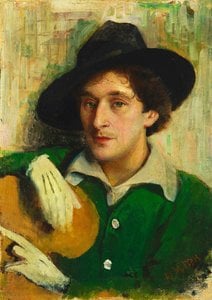
Marc Chagall
1887 - 1985 , Belarus
Snelle feiten
- Artistic Movement Or Style: Modernisme, Cubisme
- Artists Or Movements Influenced By This Artist:
- Surrealisme
- Kunstenaars
- Artists Who Influenced This Artist:
- Bakst
- Delaunay
- Borovikovsky
- Date Of Birth: 6 juli 1887
- Date Of Death: 28 maart 1985
- Full Name: Marc Chagall
- Nationality: Russisch, later Frans
- Notable Artworks:
- I en het dorp
- Over Vitebsk
- Het witte kruis
- Place Of Birth: Liozna, Belarus
Gerelateerde artikelen

The Magic of Charcoal: An Expert Guide to Mastering Light, Shadow, and Chiaroscuro
Unlock the secrets of charcoal drawing with our expert guide. Learn to master chiaroscuro, explore essential tools like vine and compressed charcoal, and discover professional techniques for capturing breathtaking light and shadow in your monochrome masterpieces.

10 Iconic Drawings That Revolutionized the World of Art
Journey through history with 10 legendary drawings that redefined art. From Renaissance sketches to iconic charcoal works, explore the stories behind these timeless masterpieces. Find museum-quality reproductions and decor inspiration at ArtsDot.com. Discover all masterpieces online.

The Eloquent Line: Exploring the Artistic Significance of Sketches Across Movements and Media
Explore the profound artistic significance of sketches throughout history. From Renaissance masters to modern innovators like Van Gogh & Guston, discover how these foundational works reveal technique, emotion, and vision. Learn more at ArtsDot.

10 Iconic Charcoal Masterpieces That Redefined Art History
Journey through history with 10 legendary charcoal masterpieces. Explore the dramatic techniques and emotive power of iconic monochrome art. Find museum-quality reproductions and curated decor inspiration for your space. Discover all masterpieces on ArtsDot.com.

The Art of the Line: Discover Captivating Drawings to Transform Your Home with Sophisticated Minimalist Elegance
Elevate your home with the profound elegance of fine art drawings. From soulful charcoal sketches to minimalist line art, discover how captivating textures and masterful contours can transform your interior design. Explore expert curation for a sophisticated, meaningful living space.


