


 Bekijk op ware grootte
 Verstuur
 Delen
Delen
 Details bekijken
 Gids voor studentenkunstwerken

 Download
 Vergelijkbare items
 Röntgenonderzoek
 Diavoorstelling
 Statistieken
Over de stad
 Olieverf op canvas
- Wanddecoratie
- Surrealist Expressionism
 1918
1918- Modern
 45.0 x 56.0 cm
 Lees meer
De kunstwerken die op deze pagina worden weergegeven, zijn beschermd door de auteursrechtwetgeving, wat betekent dat het ons wettelijk niet is toegestaan om identieke reproducties te maken of te verkopen. Deze bescherming wordt gehandhaafd onder internationale overeenkomsten zoals de Conventie van Bern en door nationale wetgeving, waaronder de bepalingen van de Amerikaanse auteurswet - Titel 17. Alle rechten voorbehouden. Reproduceren of distribueren van afbeeldingen is niet toegestaan zonder uitdrukkelijke schriftelijke toestemming van WahooArt.com en de rechthebbenden.
Deze methode voldoet volledig aan de auteursrechtwetgeving, omdat het niet gaat om het kopiëren of dupliceren van het beschermde kunstwerk. In plaats daarvan is er sprake van een creatieve herinterpretatie — een nieuw schilderij dat door het origineel wordt geïnspireerd, maar er niet identiek aan is.
Giclée / Kunstafdrukken
Giclée- of canvasafdruk van museumkwaliteit met een snelle productie en flexibele afwerkingsmogelijkheden. ( Koop handgeschilderd kunstwerk Schakel over naar digitale afbeeldingen)




P118B €10

P118H €10

P118W €10

P438Z €10

P508JH €12

P508YH €12

P805H €10

P805Z €10

P919BZ €10

P919G €10

P919XJ €10

P959ZH €10

P968JZ €12

W106C €8

W218G €10

W218JH €8

W218Y €10

W307PJ €10

W316G €10

W316PJ €8

W316Y €10

W398PJ €8

W4111J €10

W500HY €15

W500JH €15

W692G €12

W849H €8

W940BG €15

W953PJ €8




Kies uit onze vooraf ingestelde maten die overeenkomen met de originele verhoudingen van het kunstwerk.

Type the width and the height you need, to fit your frame or your wall. A print can only be cut, never made bigger than the picture, so a size with a different shape loses a part of the image. We send you a digital mockup to approve before we print anything. The picture shown on this page does not show the real cut — only the mockup does.
Wereldwijde levering () binnen 2 weken in plaats van de standaard 4/5 weken. (14 oktober)

Gratis wereldwijde expressverzending

Hoogwaardig linnen canvas

Volledige verzendverzekering

Garantie op terugbetaling van invoerrechten

Garantie op exacte kleurweergave

Retourbeleid van 100 dagen (alleen bij defecten)

100% Geld-terug-garantie

Korting bij meerdere afnames
 De optie voor glas is alleen beschikbaar bij een formaat kleiner dan 110 cm.

Over de stad
Giclée / Kunstafdrukken
Formaat reproductie
-


Totaalprijs
€ 55
Een vlucht in de verbeelding: Een verkenning van Chagalls droomwereld
Dit meeslepende kunstwerk, geschilderd in 1918, transporteert de kijker naar een rijk waar de realiteit en de verbeelding onlosmakelijk met elkaar verweven zijn. Met twee figuren die boven een gestileerde stad zweven, belichaamt het werk Marc Chagalls kenmerkende mengeling van persoonlijke symboliek, levendige kleuren en een dromerige atmosfeer – wat het tot een aangrijpend middelpunt maakt voor elke kunstcollectie of interieur.
Stijlvernieuwing & Artistieke Wortels
Dit werk is diep geworteld in de modernistische beweging, waarbij het specifiek put uit elementen van het surrealisme, het expressionisme en Chagalls eigen unieke artistieke visie. Door strikte representatie te verwerpen, hanteert Chagall een afgeplat perspectief en vereenvoudigde vormen om een gevoel van buitenaardse schoonheid te creëren. De invloed van zijn Wit-Russisch-Joodse erfgoed en de vroege blootstelling aan folklore zijn voelbaar en geven de scène een betoverende kwaliteit. Hoewel er echo's van de fragmentatie uit het kubisme waarneembaar zijn, worden deze verzacht door vloeiende lijnen en een lyrische gevoeligheid die onmiskenbaar Chagall is.
Techniek & Materialiteit
Uitgevoerd in olieverf op canvas (met afmetingen van 45 x 56 cm), toont het schilderij Chagalls meesterlijke beheersing van kleur en textuur. De aanbreng van de verf is relatief glad, wat een lichtgevend oppervlak creëert dat de dromerige kwaliteit versterkt. Subtiele gelaagdheid van tinten voegt diepte toe zonder het algemene platte karakter dat zo kenmerkend is voor zijn stijl op te offeren. Het ingetogen maar effectieve palet – gedomineerd door aardetinten, onderbroken door levendige accenten – draagt bij aan de emotionerende kracht van het kunstwerk.
Historische Context & Persoonlijk Narratief
Geschilderd tijdens een periode van grote omwentelingen na de Russische Revolutie, kan dit schilderij worden geïnterpreteerd als een uitdrukking van hoop en bevrijding te midden van de chaos. Chagalls persoonlijke leven op dat moment – zijn recente huwelijk met Bella Rosenfeld – heeft waarschijnlijk de weergave van twee figuren die verenigd zijn in hun vlucht beïnvloed. De stad beneden kan herinneringen vertegenwoordigen aan zijn geboortestad Vitebsk, een plek die hij in zijn kunst vaak opnieuw bezocht.
Symboliek & Emotionele Resonantie
De handeling van het vliegen staat centraal in de symboliek van het werk en vertegenwoordigt vrijheid, transcendentie en misschien wel een verlangen naar ontsnapping aan aardse beperkingen. De man die de vrouw draagt, suggereert bescherming, steun en een diepe verbinding tussen twee zielen. Dit intieme gebaar, geplaatst tegen de achtergrond van een sprookjesachtig stadsgezicht, roept gevoelens van vreugde, nostalgie en romantische liefde op. De algehele emotionele toon is er een van lichtheid en optimisme, die de kijker uitnodigt om de eigen dromen en ambities te omarmen.
Een Tijdloos Meesterwerk voor Moderne Interieurs
De blijvende aantrekkingskracht van dit kunstwerk ligt in het vermogen om kijkers naar een wereld van verbeelding en verwondering te transporteren. Het harmonieuze kleurenpalet en de evocatieve beelden maken het een veelzijdige toevoeging aan diverse interieurstijlen, van hedendaagse woonruimtes tot meer traditionele omgevingen. Een reproductie van hoge kwaliteit stelt kunstliefhebbers en ontwerpers in staat om de magie van Chagalls visie te ervaren en hun omgeving te doordrenken met schoonheid en inspiratie.
Vragen & Antwoorden
Wat is de kunsthistorische betekenis van "Over de stad" door Marc Chagall?
"Over de stad" door Marc Chagall behoort tot de Surrealist Expressionism-stroming, binnen de Modern-periode. Samen geven zij het werk zijn plaats in de kunstgeschiedenis.
Hoe past "Over de stad" binnen de thema's en stijl van Marc Chagall?
"Over de stad" behoort tot het Surrealist Expressionism-werk van Marc Chagall, waarvan de bekende thema's onder meer surrealist roots, chagall vision, jewish symbolism, vitebsk memory, revolution hope, artistic freedom, dreamlike style, folklore echoes omvatten.
Wie verkoopt handgeschilderde reproducties van "Over de stad" door Marc Chagall?
Hand-painted copies of "Over de stad" door Marc Chagall are sold on deze website: een met de hand geschilderde olieverfreproductie op linnen canvas, ordered from its Hand-Painted Reproduction page.
Gerelateerde kunstwerken


Biografie van de kunstenaar
A Life Painted in Dreams: The World of Marc Chagall
Marc Chagall, born Moishe Shagal in 1887 in the small Belarussian town of Liozna near Vitebsk, wasn’t merely a painter; he was a poet of color, a weaver of dreams, and a chronicler of memory. His life, spanning nearly a century, mirrored the tumultuous currents of the twentieth century, yet his art remained steadfastly rooted in a deeply personal vision—one infused with the folklore of his Hasidic Jewish upbringing and an unwavering belief in the power of imagination. Vitebsk itself was more than just a birthplace; it became the emotional core of his artistic universe, a recurring motif populated by flying figures, whimsical animals, and the vibrant hues of remembered landscapes. The town’s unique blend of cultures—Russian Orthodox churches alongside bustling Jewish marketplaces—forged an aesthetic sensibility that would defy easy categorization throughout his long career. Though he sought formal training first with a local sign painter and later in St. Petersburg under Léon Bakst, and then in Paris at the Académie de la Grande Chaumière, Chagall never fully embraced any single artistic movement. He absorbed elements of Cubism, Symbolism, and Fauvism, but always filtered them through his own intensely personal lens, creating a style that was uniquely, unmistakably Chagall.Early Influences and Artistic Beginnings
Chagall’s formative years were marked by the traditions of Vitebsk’s Jewish community—a vibrant tapestry woven with religious rituals, folk tales, and ancestral memories. These influences would permeate his artistic vision throughout his life, informing his use of symbolism and his fascination with biblical narratives. His initial training was modest, focusing on practical skills as a sign painter – a craft that instilled in him an appreciation for visual communication and meticulous attention to detail. However, he quickly recognized the limitations of realism and sought inspiration in the expressive techniques championed by Impressionists like Léon Bakst, whose theatrical productions captivated him with their bold colors and dynamic compositions. This exposure to avant-garde aesthetics broadened his artistic horizons and propelled him toward experimentation with new forms of expression. His early canvases—such as I and the Village (1911)—already demonstrated his ability to distill complex emotions into simplified visual language, prioritizing feeling over precise representation. The village isn’t rendered realistically but as a fragmented collection of recollections, imbued with symbolic meaning – a technique that would become central to his distinctive style.The Symbolism of Flight and Memory
Chagall's artistic breakthrough arrived in the wake of World War I, during which he served briefly in the Russian army. This experience instilled in him a profound awareness of human suffering and loss—themes that would recur throughout his oeuvre. His paintings from this period are characterized by an ethereal quality, achieved through masterful use of color and perspective. Figures float effortlessly against backgrounds of luminous hues, defying gravity and logic – a deliberate departure from traditional artistic conventions. This fascination with flight symbolizes liberation from earthly constraints and represents Chagall’s yearning for transcendence—a recurring motif that appears in numerous works throughout his career. Equally important is his preoccupation with memory—the way in which past experiences shape our perceptions of the present. Landscapes are often depicted as dreamlike visions, blending elements of reality with fantastical imagery – reflecting Chagall's belief that art can capture the elusive essence of human experience.Exploring Formal Movements and Personal Vision
Despite rejecting rigid artistic doctrines, Chagall remained attuned to developments in European modernism. He experimented with Cubist techniques—particularly in his early portraits—to dissect forms and explore multiple viewpoints simultaneously. However, he quickly abandoned this approach in favor of a more expressive style that prioritized emotional impact over intellectual rigor. His embrace of Fauvist color palettes – bold splashes of pigment divorced from naturalistic representation – further solidified his artistic identity. Yet, Chagall’s true genius lay in his ability to synthesize these influences into a wholly original vision—one rooted in his Jewish heritage and informed by the spiritual traditions of Vitebsk. He sought to convey not just what he saw but what he felt—a quest for beauty and truth that permeated every aspect of his artistic practice.Later Years and Legacy
The Russian Revolution profoundly impacted Chagall’s life, returning him to Vitebsk where he established an art school dedicated to fostering creativity and cultural exchange. This period was marked by both artistic productivity and political disillusionment—a tension that would continue to shape his creative output. Following the outbreak of World War II, Chagall fled occupied France for New York City, where he found refuge amidst a thriving artistic community. During his time in America, he produced some of his most ambitious canvases – monumental works that explored themes of exile and displacement. He received numerous prestigious commissions, including the ceiling of the Paris Opera (1964), which showcased his unparalleled mastery of color and form—a testament to his enduring influence on subsequent generations of artists. Chagall’s stained glass windows for Jerusalem's Hadassah Hebrew University Medical Center synagogue stand as a poignant reminder of his commitment to Jewish faith and culture. His art continues to inspire awe and wonder, inviting viewers to contemplate the mysteries of existence and celebrating the transformative power of imagination. Marc Chagall died in 1985 at the age of 97, leaving behind an unparalleled legacy—a body of work that transcends stylistic boundaries and speaks directly to the human spirit.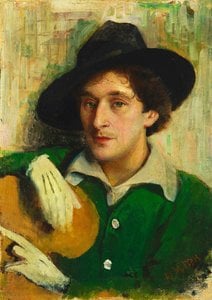
Marc Chagall
1887 - 1985 , Belarus
Snelle feiten
- Artistic Movement Or Style: Modernisme, Cubisme
- Artists Or Movements Influenced By This Artist:
- Surrealisme
- Kunstenaars
- Artists Who Influenced This Artist:
- Bakst
- Delaunay
- Borovikovsky
- Date Of Birth: 6 juli 1887
- Date Of Death: 28 maart 1985
- Full Name: Marc Chagall
- Nationality: Russisch, later Frans
- Notable Artworks:
- I en het dorp
- Over Vitebsk
- Het witte kruis
- Place Of Birth: Liozna, Belarus
Gerelateerde artikelen

Top 10 Surrealistische Meesterwerken: Kunst die de Realiteit Uitdaagt | ArtsDot
Ontdek de 10 meest iconische surrealistische meesterwerken van Dalí, Magritte & Miró. Duik in hun droomwerelden en laat je inspireren door deze baanbrekende kunst. Museumkwaliteit reproducties op ArtsDot.com – Kunst voor elke wand!
Top 10 Legendarische Lithografieën die de Kunst voor Altijd Veranderden | ArtsDot.nl
Ontdek de 10 meest legendarische lithografieën die kunstgeschiedenis schreven! Van Toulouse-Lautrec tot Munch, duik in verhalen van iconische meesterwerken. Vind museumkwaliteit reproducties & interieurinspiratie op ArtsDot.com.

Top 10 Surrealistische Meesterwerken: Kunst die de Realiteit Uitdaagt | ArtsDot
Ontdek de 10 meest iconische surrealistische schilderijen van Dalí, Magritte & Miró. Duik in de droomwereld en onbewuste kunst met ArtsDot's collectie hoogwaardige reproducties. Vind jouw perfecte wandkunst! Explore the full collection online.

Salvador Dalí's Top 25 Meesterwerken: Surrealisme voor uw Interieur | ArtsDot
Ontdek de top 25 meesterwerken van Salvador Dalí! Duik in de wereld van surrealisme, droombeelden & iconische schilderijen. Vind museumkwaliteit kunst reproducties en interieurinspiratie op ArtsDot.com. Exploreer de collectie online!

Katsushika Hokusai's 25 Meesterwerken: Japanse Kunst voor uw Interieur | ArtsDot
Ontdek de 25 meesterwerken van Katsushika Hokusai, de Japanse Ukiyo-e kunstenaar! Reis door zijn iconische prints zoals 'The Great Wave' en Mount Fuji. Vind museumkwaliteit reproducties & inspiratie voor uw interieur op ArtsDot.com.


