

 Voorvertoning
 Verstuur
 Delen
Delen
 Details bekijken
 Gids
Gids

 Download
 Vergelijkbare items
 Röntgenonderzoek
 Diavoorstelling
 Vraag & antwoord
 Statistieken
Clown in Love

- 32.0 x 25.0 cm


 Lees meer
De kunstwerken die op deze pagina worden weergegeven, zijn beschermd door de auteursrechtwetgeving, wat betekent dat het ons wettelijk niet is toegestaan om identieke reproducties te maken of te verkopen. Deze bescherming wordt gehandhaafd onder internationale overeenkomsten zoals de Conventie van Bern en door nationale wetgeving, waaronder de bepalingen van de Amerikaanse auteurswet - Titel 17. Alle rechten voorbehouden. Reproduceren of distribueren van afbeeldingen is niet toegestaan zonder uitdrukkelijke schriftelijke toestemming van WahooArt.com en de rechthebbenden.
Deze methode voldoet volledig aan de auteursrechtwetgeving, omdat het niet gaat om het kopiëren of dupliceren van het beschermde kunstwerk. In plaats daarvan is er sprake van een creatieve herinterpretatie — een nieuw schilderij dat door het origineel wordt geïnspireerd, maar er niet identiek aan is.
Giclée / Kunstafdrukken
Giclée- of canvasafdruk van museumkwaliteit met een snelle productie en flexibele afwerkingsmogelijkheden. ( Bestel handgeschilderde reproductie Schakel over naar digitale afbeeldingen)




P118B €10

P118H €10

P118W €10

P438Z €10

P508JH €12

P508YH €12

P805H €10

P805Z €10

P919BZ €10

P919G €10

P919XJ €10

P959ZH €10

P968JZ €12

W106C €8

W218G €10

W218JH €8

W218Y €10

W307PJ €10

W316G €10

W316PJ €8

W316Y €10

W398PJ €8

W4111J €10

W500HY €15

W500JH €15

W692G €12

W849H €8

W940BG €15

W953PJ €8




Kies uit onze vooraf ingestelde maten die overeenkomen met de originele verhoudingen van het kunstwerk.

Voer de gewenste breedte en hoogte in, passend bij uw lijst of muur. Een afdruk kan alleen worden ingekort en nooit groter worden gemaakt dan het origineel; een formaat met andere verhoudingen zal daarom een deel van de afbeelding verliezen. Wij sturen u een digitaal mockup ter goedkeuring voordat we tot drukwerk overgaan. De afbeelding op deze pagina toont niet de werkelijke uitsnede — dit is alleen te zien op het mockup.
Wereldwijde levering () binnen 2 weken in plaats van de standaard 4/5 weken. (6 november)

Gratis wereldwijde expressverzending

Hoogwaardig linnen canvas

Volledige verzendverzekering

Garantie op terugbetaling van invoerrechten

Garantie op exacte kleurweergave

Retourbeleid van 100 dagen (alleen bij defecten)

100% Geld-terug-garantie

Korting bij meerdere afnames
 De optie voor glas is alleen beschikbaar bij een formaat kleiner dan 110 cm.

Clown in Love
Giclée / Kunstafdrukken
Afmetingen reproductie
-


Eindtotaal
€ 56
Marc Chagall’s “Clown in Love”: A Descent into Surrealist Emotion
Marc Chagall's "Clown in Love," created in 1963, isn’t merely a depiction of two figures; it’s an immersion into a world where the familiar dissolves and primal emotions take center stage. This lithograph, rendered in stark black and white against a deceptively simple background, pulsates with an unsettling energy—a testament to Chagall's mastery of Expressionism and his ability to distill profound psychological states onto paper. The image immediately commands attention, not through overt beauty, but through its inherent tension: a nude woman and a clown, positioned off-center, locked in what appears to be a fraught interaction. It’s a scene that feels both intensely personal and universally resonant, inviting viewers into a realm of vulnerability, power dynamics, and perhaps even unspoken anxieties.
The work's foundation lies firmly within Chagall’s established style, yet “Clown in Love” possesses a unique intensity. He was deeply influenced by the Naïve Art movement, characterized by its directness, lack of illusionism, and focus on emotional expression. This is evident in the simplified forms, bold lines, and almost childlike quality of the figures. However, unlike the purely decorative elements often associated with Naïve Art, Chagall imbues his work with a complex psychological depth. The lithographic process itself—utilizing stone etching to transfer ink onto paper—contributes significantly to this effect. The grainy texture, the strong contrasts between light and shadow, and the deliberate roughness of the lines create a palpable sense of immediacy and rawness, mirroring the emotional turmoil at the heart of the scene.
The Clown: A Symbol of Paradox
The figure of the clown is central to understanding “Clown in Love.” Chagall frequently employed clowns as potent symbols within his work—not simply as comic figures, but as representations of human duality. The clown embodies both joy and sorrow, vulnerability and strength, innocence and experience. In this particular lithograph, the clown’s posture – a slight lean forward, a hand tentatively reaching out – suggests a hesitant attempt at connection, perhaps even a plea for understanding. His exaggerated features—a wide-eyed expression, a slightly downturned mouth—heighten his emotional vulnerability, transforming him from a traditional comedic character into a figure of profound pathos.
The woman’s position is equally significant. Her nudity isn't presented as overtly sexual; rather, it evokes a sense of exposed vulnerability and raw emotion. She appears to be both receptive and wary, her gaze fixed on the clown with a mixture of curiosity and apprehension. The lack of context—the absence of any discernible setting or narrative—further amplifies this feeling of ambiguity and invites viewers to project their own interpretations onto the scene.
Historical Context & Artistic Technique
Created in 1963, “Clown in Love” reflects a period of significant artistic experimentation and social upheaval. Chagall was already an established master by this point, having navigated the tumultuous years of World War II and the rise of totalitarianism. His art became increasingly introspective and emotionally charged during this time, grappling with themes of displacement, loss, and the enduring power of memory. The lithograph technique itself—a process he frequently employed—allowed for precise control over line and tone, while retaining a sense of spontaneity and immediacy.
The use of black and white further emphasizes the work’s emotional intensity. Color, in Chagall's earlier works, often served to heighten the dreamlike quality of his scenes; here, the absence of color forces viewers to confront the raw emotions at play without distraction. The stark contrast between light and shadow creates a dramatic effect, drawing attention to the figures’ faces and gestures and intensifying their psychological impact.
A Timeless Exploration of Human Connection
“Clown in Love” transcends its specific historical context to offer a timeless meditation on human connection—or perhaps, the absence thereof. It's a work that lingers in the mind long after it’s been viewed, prompting reflection on themes of vulnerability, intimacy, and the complexities of relationships. Reproductions of this powerful lithograph can serve as striking additions to interior spaces, injecting a dose of emotional depth and artistic intrigue into any room. Its evocative imagery and masterful technique make it a compelling choice for collectors and art enthusiasts alike—a testament to Marc Chagall’s enduring legacy as one of the 20th century's most visionary artists.
Veelgestelde vragen
Maakt "Clown in Love" door Marc Chagall gebruik van sterke contrasten of zachte harmonieën?
De kleuranalyse van "Clown in Love" door Marc Chagall legt een Statement contrast en een Softly Mixed Palette harmonie vast.
Is er een factsheet over "Clown in Love" door Marc Chagall voor studenten?
De Informatieblad-pagina van "Clown in Love" door Marc Chagall biedt een printbaar factsheet van twee pagina's: het kunstwerk met de bijbehorende identificatietabel, een tijdlijn die het werk plaatst binnen de levensloop van de kunstenaar, andere werken van de kunstenaar, het gemeten kleurenpalet en kant-en-klare citaten in vier verschillende stijlen.
Welke emotie straalt "Clown in Love" door Marc Chagall uit?
De emotionele toon die is vastgelegd voor "Clown in Love" door Marc Chagall is Melancholic. Het vat het gevoel samen dat het werk uitdrukt.
Vergelijkbare kunstwerken


Biografie kunstenaar
A Life Painted in Dreams: The World of Marc Chagall
Marc Chagall, born Moishe Shagal in 1887 in the small Belarussian town of Liozna near Vitebsk, wasn’t merely a painter; he was a poet of color, a weaver of dreams, and a chronicler of memory. His life, spanning nearly a century, mirrored the tumultuous currents of the twentieth century, yet his art remained steadfastly rooted in a deeply personal vision—one infused with the folklore of his Hasidic Jewish upbringing and an unwavering belief in the power of imagination. Vitebsk itself was more than just a birthplace; it became the emotional core of his artistic universe, a recurring motif populated by flying figures, whimsical animals, and the vibrant hues of remembered landscapes. The town’s unique blend of cultures—Russian Orthodox churches alongside bustling Jewish marketplaces—forged an aesthetic sensibility that would defy easy categorization throughout his long career. Though he sought formal training first with a local sign painter and later in St. Petersburg under Léon Bakst, and then in Paris at the Académie de la Grande Chaumière, Chagall never fully embraced any single artistic movement. He absorbed elements of Cubism, Symbolism, and Fauvism, but always filtered them through his own intensely personal lens, creating a style that was uniquely, unmistakably Chagall.Early Influences and Artistic Beginnings
Chagall’s formative years were marked by the traditions of Vitebsk’s Jewish community—a vibrant tapestry woven with religious rituals, folk tales, and ancestral memories. These influences would permeate his artistic vision throughout his life, informing his use of symbolism and his fascination with biblical narratives. His initial training was modest, focusing on practical skills as a sign painter – a craft that instilled in him an appreciation for visual communication and meticulous attention to detail. However, he quickly recognized the limitations of realism and sought inspiration in the expressive techniques championed by Impressionists like Léon Bakst, whose theatrical productions captivated him with their bold colors and dynamic compositions. This exposure to avant-garde aesthetics broadened his artistic horizons and propelled him toward experimentation with new forms of expression. His early canvases—such as I and the Village (1911)—already demonstrated his ability to distill complex emotions into simplified visual language, prioritizing feeling over precise representation. The village isn’t rendered realistically but as a fragmented collection of recollections, imbued with symbolic meaning – a technique that would become central to his distinctive style.The Symbolism of Flight and Memory
Chagall's artistic breakthrough arrived in the wake of World War I, during which he served briefly in the Russian army. This experience instilled in him a profound awareness of human suffering and loss—themes that would recur throughout his oeuvre. His paintings from this period are characterized by an ethereal quality, achieved through masterful use of color and perspective. Figures float effortlessly against backgrounds of luminous hues, defying gravity and logic – a deliberate departure from traditional artistic conventions. This fascination with flight symbolizes liberation from earthly constraints and represents Chagall’s yearning for transcendence—a recurring motif that appears in numerous works throughout his career. Equally important is his preoccupation with memory—the way in which past experiences shape our perceptions of the present. Landscapes are often depicted as dreamlike visions, blending elements of reality with fantastical imagery – reflecting Chagall's belief that art can capture the elusive essence of human experience.Exploring Formal Movements and Personal Vision
Despite rejecting rigid artistic doctrines, Chagall remained attuned to developments in European modernism. He experimented with Cubist techniques—particularly in his early portraits—to dissect forms and explore multiple viewpoints simultaneously. However, he quickly abandoned this approach in favor of a more expressive style that prioritized emotional impact over intellectual rigor. His embrace of Fauvist color palettes – bold splashes of pigment divorced from naturalistic representation – further solidified his artistic identity. Yet, Chagall’s true genius lay in his ability to synthesize these influences into a wholly original vision—one rooted in his Jewish heritage and informed by the spiritual traditions of Vitebsk. He sought to convey not just what he saw but what he felt—a quest for beauty and truth that permeated every aspect of his artistic practice.Later Years and Legacy
The Russian Revolution profoundly impacted Chagall’s life, returning him to Vitebsk where he established an art school dedicated to fostering creativity and cultural exchange. This period was marked by both artistic productivity and political disillusionment—a tension that would continue to shape his creative output. Following the outbreak of World War II, Chagall fled occupied France for New York City, where he found refuge amidst a thriving artistic community. During his time in America, he produced some of his most ambitious canvases – monumental works that explored themes of exile and displacement. He received numerous prestigious commissions, including the ceiling of the Paris Opera (1964), which showcased his unparalleled mastery of color and form—a testament to his enduring influence on subsequent generations of artists. Chagall’s stained glass windows for Jerusalem's Hadassah Hebrew University Medical Center synagogue stand as a poignant reminder of his commitment to Jewish faith and culture. His art continues to inspire awe and wonder, inviting viewers to contemplate the mysteries of existence and celebrating the transformative power of imagination. Marc Chagall died in 1985 at the age of 97, leaving behind an unparalleled legacy—a body of work that transcends stylistic boundaries and speaks directly to the human spirit.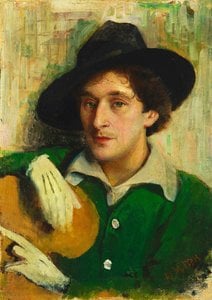
Marc Chagall
1887 - 1985 , Belarus
Belangrijkste feiten
- Artistic Movement Or Style: Modernisme, Cubisme
- Artists Or Movements Influenced By This Artist:
- Surrealisme
- Kunstenaars
- Artists Who Influenced This Artist:
- Bakst
- Delaunay
- Borovikovsky
- Date Of Birth: 6 juli 1887
- Date Of Death: 28 maart 1985
- Full Name: Marc Chagall
- Nationality: Russisch, later Frans
- Notable Artworks:
- I en het dorp
- Over Vitebsk
- Het witte kruis
- Place Of Birth: Liozna, Belarus
Gerelateerde artikelen

Monochrome Visions: Exploring the Aesthetic & Historical Significance of Black & White Photography
Explore the rich history & artistic power of black and white photography. From early techniques to iconic masters like Ansel Adams, discover why monochrome continues to captivate art lovers today. Expert insights for collectors.

Timeless & Chic: Elevating Your New Home with the Sophistication of Black and White Photography
Transform your new home with the timeless allure of black and white photography. ArtsDot.com specializes in elegant monochrome decor and custom hand-painted wedding portraits that turn cherished milestones into lasting, soulful masterpieces. Elevate your space with ease.

Top 10 Witte Meesterwerken: Kunstgeschiedenis & Interieurinspiratie
Ontdek de top 10 witte meesterwerken uit de kunstgeschiedenis! Van Monet tot Mondriaan, bewonder abstracte vormen & serene kleuren. Vind museumkwaliteit reproducties en interieurinspiratie op ArtsDot.com.

Meesterwerken in Zwart: Top 10 Schilderijen Gedreven door Donkere Tinten | ArtsDot.nl
Ontdek de kracht van donker! Verlies jezelf in onze top 10 zwarte schilderijen, van Caravaggio tot Manet. Leer over meesterwerken, technieken & emotie. Museumkwaliteit reproducties op ArtsDot.com – Kunst voor uw interieur.

Top 10 Expressionistische Meesterwerken: Kunst die de Ziel Raakt | ArtsDot
Ontdek de 10 meest iconische Expressionistische meesterwerken! Duik in de emotionele wereld van Kirchner, Kandinsky & Nolde. Museumkwaliteit kunst reproducties voor uw interieur. Exploreer de collectie op ArtsDot.com.


