

 Voorvertoning
 Verstuur
 Delen
Delen
 Details bekijken
 Gids
Gids

 Download
 Vergelijkbare items
 Röntgenonderzoek
 Diavoorstelling
 Vraag & antwoord
 Statistieken
Carp En Iris

 Lees meer
Giclée / Kunstafdrukken
Giclée- of canvasafdruk van museumkwaliteit met een snelle productie en flexibele afwerkingsmogelijkheden. ( Bestel handgeschilderde reproductie Schakel over naar digitale afbeeldingen)




P118B €10

P118H €10

P118W €10

P438Z €10

P508JH €12

P508YH €12

P805H €10

P805Z €10

P919BZ €10

P919G €10

P919XJ €10

P959ZH €10

P968JZ €12

W106C €8

W218G €10

W218JH €8

W218Y €10

W307PJ €10

W316G €10

W316PJ €8

W316Y €10

W398PJ €8

W4111J €10

W500HY €15

W500JH €15

W692G €12

W849H €8

W940BG €15

W953PJ €8




Kies uit onze vooraf ingestelde maten die overeenkomen met de originele verhoudingen van het kunstwerk.

Voer de gewenste breedte en hoogte in, passend bij uw lijst of muur. Een afdruk kan alleen worden ingekort en nooit groter worden gemaakt dan het origineel; een formaat met andere verhoudingen zal daarom een deel van de afbeelding verliezen. Wij sturen u een digitaal mockup ter goedkeuring voordat we tot drukwerk overgaan. De afbeelding op deze pagina toont niet de werkelijke uitsnede — dit is alleen te zien op het mockup.
Wereldwijde levering () binnen 2 weken in plaats van de standaard 4/5 weken. (15 november)

Gratis wereldwijde expressverzending

Hoogwaardig linnen canvas

Volledige verzendverzekering

Garantie op terugbetaling van invoerrechten

Garantie op exacte kleurweergave

Retourbeleid van 100 dagen (alleen bij defecten)

100% Geld-terug-garantie

Korting bij meerdere afnames
 De optie voor glas is alleen beschikbaar bij een formaat kleiner dan 110 cm.

Carp En Iris
Giclée / Kunstafdrukken
Afmetingen reproductie
-


Eindtotaal
€ 56
Carp And Iris: A Reflection of Tranquility and Prosperity
Katsushika Hokusai’s *Carp And Iris*, produced circa 1830-32 during the Edo period, stands as a quintessential example of Japanese woodblock printing (Ukiyo-e), embodying not merely visual beauty but also profound cultural symbolism. This masterful print captures a serene scene—a koi fish gracefully swimming amidst lush aquatic plants—against a backdrop of blurred foliage and water, skillfully conveying movement and depth within the confines of a flattened perspective.
- Composition & Style: The vertical orientation immediately establishes dominance by the koi fish, positioned centrally against a softly rendered landscape. Characteristic Ukiyo-e techniques – bold outlines delineating shapes, flat planes of color achieved through layered washes—create an impressionistic effect that prioritizes mood and suggestion over meticulous realism.
- Technique: Hokusai’s mastery lies in his masterful use of sumi ink and gampi paper. The printing process involved carving intricate woodblocks, applying ink with precise brushstrokes, and transferring the image onto the paper—a testament to centuries-old craftsmanship. Subtle textural variations contribute to a grainy appearance that enhances the print's aged aesthetic.
- Symbolism: Koi fish hold immense significance in Japanese culture, representing perseverance, resilience, and ultimately, transformation into dragons – symbols of imperial power and good fortune. The iris flower, similarly revered for its purity and longevity, complements the fish’s symbolism, reinforcing themes of harmony and spiritual enlightenment.
- Historical Context: Produced during Hokusai's prolific output—particularly his celebrated *Thirty-Six Views of Mount Fuji* series—this print reflects the broader artistic trends of the Edo period. It exemplifies a fascination with nature as inspiration for art, aligning closely with Zen Buddhist ideals and capturing the spirit of Japan’s golden age.
- Emotional Impact: The overall impression is one of tranquility and contemplative beauty. The muted palette and diffused lighting evoke an atmosphere of stillness, inviting viewers to contemplate the profound connection between humanity and the natural world—a timeless message that continues to resonate with audiences today.
A reproduction of *Carp And Iris* offers a captivating glimpse into Hokusai’s artistic vision and the enduring legacy of Ukiyo-e. Its delicate detail and evocative composition make it an ideal addition to any interior space, fostering a sense of serenity and celebrating Japan's rich artistic heritage.
Veelgestelde vragen
Hoe bekend is "Carp En Iris" van Katsushika Hokusai?
"Carp En Iris" wordt geclassificeerd als Iconisch.
Waar kan ik statistieken vinden over "Carp En Iris" door Katsushika Hokusai?
Statistieken over "Carp En Iris" door Katsushika Hokusai zijn te vinden op de Statistieken-pagina van het kunstwerk: maandelijkse weergaven van het kunstwerk, weergaven van de werken van de kunstenaar en een uitsplitsing naar land en taal van recente bezoekers.
Is "Carp En Iris" door Katsushika Hokusai een licht of een donker kunstwerk?
Wat betreft de waargenomen helderheid is "Carp En Iris" door Katsushika Hokusai stralend.
Vergelijkbare kunstwerken


Biografie kunstenaar
De rusteloze zoektocht naar de vlietende wereld
In de drukke straten van Edo begint de zoon van een spiegelmaker te tekenen. Al op zesjarige leeftijd maakt de jongen schetsen, gedreven door een honger naar creatie die zijn vader, Nakajima Ise, weliswaar herkent, maar niet volledig kan sturen. Dit is geen leven van comfort; het is een gestage, zware klim door de sociale lagen van het Tokugawa-shogunaat. Tegen zijn twaalfde treedt hij in dienst bij de studio van Katsukawa Shunshō, waar hij de veeleisende precisie van de ukiyo-e houtsnedekunst onder de knie krijgt. Hij is er echter niet om zijn meester simpelweg te imiteren. In plaats daarvan absorbeert hij de technieken van de "vlietende wereld"—de afbeeldingen van acteurs en courtisanes—en begint hij aan de draden van het genre te trekken, op zoek naar iets dat veel expansiever is.
Zijn carrière is een aaneenschakeling van heruitvindingen. Hij verandert zijn naam meer dan dertig keer, een gewoonte die zijn wisselende artistieke affiliaties en zijn weigering om statisch te blijven markeert. Hij beweegt zich van het illustreren van boeken naar de creatie van losse prenten, een overgang die zijn visie de ruimte geeft om te groeien. Hij is een man van constante beweging, een rusteloze geest die kunst beschouwt als een levenslange evolutie in plaats van een eindbestemming.
De geometrie van de natuur
De focus verschuift. De stedelijke scènes van Edo maken plaats voor de immense schaal van het natuurlijke landschap. Rond 1831 verschijnt de serie Zesendertig gezichten op de berg Fuji, die de reikwijdte van de Japanse prentkunst fundamenteel verandert. In De grote golf bij Kanagawa is de oceaan een torenhoge, klauwachtige kracht; een studie in spanning en perspectief die de angstaanjagende macht van de zee vangt tegenover de fragiliteit van menselijke vaartuigen. Dit is niet louter een landschap; het is een confrontatie met het sublieme. Hij maakt gebruik van Pruisisch blauw, een pigment dat uit Europa werd geïmporteerd, om een nieuwe diepte te geven aan het water en de lucht, waardoor een visuele taal ontstaat die zowel eeuwenoud als verrassend modern aanvoelt.
Zijn observaties reiken verder dan het monumentale; ze raken ook het minuscule. De Hokusai Manga-collecties onthullen een geest die geobsedeerd is door de mechanica van het leven. Hij schetst alles: de curve van de ruggengraat van een dier, de hectische beweging van een menigte, de vreemde anatomie van mythologische wezens. Zijn lijnvoering is krachtig en beslist. Hij legt het vluchtige vast—de nevel van een golf, de plotselinge beweging van een reiziger—met een precisie die de kloof overbrugt tussen wat men ziet en wat men voelt.
Een wereldwijde resonantie
Wanneer Japan aan het eind van de 19e eeuw zijn grenzen opent, reist zijn invloed over de oceanen heen. Het fenomeen van het Japonisme krijgt voet aan de grond in Europa. Zijn composities, gekenmerkt door onconventionele perspectieven en vlakke vlakken, bereiken de ogen van Claude Monet en Vincent van Gogh. In zijn werk zien zij een manier om te breken met het traditionele westerse realisme. De impact is diepgaand. Zijn vermogen om betekenis te vinden in zowel het alledaagse als het monumentale laat een blijvende stempel achter op het verloop van de moderne kunst.
Hij blijft een leerling tot het einde. Zelfs in zijn tachtigste spreekt hij over zichzelf als Gakyō Rōjin, de "oude man die dol is op schilderen". Hij sterft in 1849, met een enorm oeuvre dat bijna negen decennia van voortdurende experimenten beslaat. Hij heeft de wereld niet alleen gedocumenteerd; hij heeft de manier waarop de wereld wordt gezien, fundamenteel herijkt.

Katsushika Hokusai
1760 - 1849 , Japan
Belangrijkste feiten
- Artistic Movement Or Style: Ukiyo-e
- Artists Or Movements Influenced By This Artist:
- Claude Monet
- Edgar Degas
- Vincent van Gogh
- Japonisme
- Date Of Birth: 1760
- Date Of Death: 1849
- Full Name: Katsushika Hokusai
- Nationality: Japans
- Notable Artworks:
- De grote golf bij Kanagawa
- Zesendertig gezichten op de berg Fuji
- Place Of Birth: Tokio, Japan
Gerelateerde artikelen
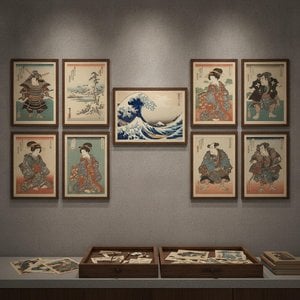
10 Iconic Ukiyo-e Masterpieces That Defined Japanese Art
Immerse yourself in the floating world of Ukiyo-e. Explore the stories behind Hokusai and Hiroshige’s iconic woodblock masterpieces. Find museum-quality reproductions and curated decor inspiration at ArtsDot.com. Discover all masterpieces on ArtsDot.com.

Katsushika Hokusai's 25 Meesterwerken: Japanse Kunst voor uw Interieur | ArtsDot
Ontdek de 25 meesterwerken van Katsushika Hokusai, de Japanse Ukiyo-e kunstenaar! Reis door zijn iconische prints zoals 'The Great Wave' en Mount Fuji. Vind museumkwaliteit reproducties & inspiratie voor uw interieur op ArtsDot.com.


