

- 74.0 x 195.0 cm


Het werk volgt uw keuzes: , .
Beschrijving verzamelobject
Admire Jean Goujon's 'Naiad,' a stunning Renaissance sculpture depicting a graceful water nymph from 1547. A masterpiece of detail and classical beauty, showcasing intricate drapery and serene form.
 Lees meer
Biografie kunstenaar
Jean Goujon (1510-1567) was een vooraanstaande Franse Renaissance-beeldhouwer & architect, bekend om zijn maniëristische stijl en werk in het Louvre. Ontdek zijn sculpturen van nimfen, allegorieën en invloedrijke gravures.
Handgemaakte olieverfreproductie
Met de hand geschilderd in olieverf op canvas in uw gewenste maat en lijst, op bestelling gemaakt door onze kunstenaars. ( Schakel over naar print Schakel over naar digitale afbeeldingen)
Meer over dit schilderij
 Verstuur
 Delen
Delen
 Details bekijken
 Gids
Gids

 Download
 Vergelijkbare items
 Diavoorstelling
 Vraag & antwoord
 Statistieken
Bestel uw schilderij in vier eenvoudige stappen
Neem de tijd. U kunt elk antwoord nog wijzigen; de prijs in uw besteloverzicht wordt direct aangepast aan elke keuze.
1 Stap één van de vier
Welke maat wilt u kiezen?
Deze formaten behouden de proporties van het originele schilderij. De tekening laat uw keuze zien op een muur, boven een bank van twee meter.
Of geef uw eigen afmetingen op
Kies uit onze vooraf ingestelde maten die overeenkomen met de originele verhoudingen van het kunstwerk.

Voer de breedte en hoogte in die u nodig heeft, passend bij uw lijst of uw muur. Omdat dit handgeschilderd is, kan de kunstenaar bij een afmeting met een andere beeldverhouding iets meer rondom het schilderij schilderen of juist iets meer weglaten — u kiest zelf. Wij sturen u een digitaal mockup ter goedkeuring voordat het schilderwerk begint. De afbeelding die op deze pagina wordt getoond, is niet het uiteindelijke resultaat — alleen de mockup geeft dit weer.
2 Stap twee van vier
Hoe moet het worden geleverd: gerold, opgespannen of ingelijst?
De onderstaande prijzen zijn voor de maat die u in stap één heeft gekozen.
Kies de randen van het canvas
Kies uw lijst

Wit €1

Vervagende randen €1

Doorlopende rand €1

P118B €10

P118H €10

P118W €10

P438Z €10

P508JH €12

P508YH €12

P805H €10

P805Z €10

P919BZ €10

P919G €10

P919XJ €10

P959ZH €10

P968JZ €12

W106C €8

W218G €10

W218JH €8

W218Y €10

W307PJ €10

W316G €10

W316PJ €8

W316Y €10

W398PJ €8

W4111J €10

W500HY €15

W500JH €15

W692G €12

W849H €8

W940BG €15

W953PJ €8

H24-GOLD €30

H24-SILVER €30

H36-GOLD €45

H36-SILVER €45
Ingelijst
Lijstrand: . Totale afmetingen inclusief lijst: .
3 Stap drie van vier
Wilt u dat er iets aan het schilderij wordt aangepast?
De meeste mensen antwoorden nee. Omdat elk schilderij met de hand wordt gemaakt, kan onze kunstenaar het ook voor u aanpassen.
Na de bestelling zal het team van ArtsDot.com per e-mail contact opnemen met de klant voor instructies en een mockup-voorbeeld verstrekken
4 Stap vier van vier
Enkele afwerkingsopties
Ze zijn allemaal optioneel. De reeds geselecteerde antwoorden brengen geen extra kosten met zich mee.
Wie is de kunstenaar?
Wereldwijde levering () binnen 3 tot 4 weken in plaats van de standaard 5 weken. (6 november). Zonder concessies aan de kwaliteit.
Een naambordje, zoals in een museum?
Details van de gegraveerde bronzen plaat
This elegant plaque features the artist's name and the title of the artwork, finely engraved for a timeless presentation.
It is made from bronze with a refined, elegant finish. The text is precisely laser-engraved for a sharp and permanent result. Measuring 9x2 cm, the plaque is compact yet easy to read. It's built to be durable and scratch-resistant, offering a professional, museum-quality look. Mounting is simple thanks to the included adhesive backing.
Details transparante acrylplaat
The plaque includes essential engraved details such as the artist's name, the title of the artwork, the date it was created, the type of media used-like oil on canvas or watercolor-a brief description of the piece, and a QR code that links to the complete artwork information.
It is crafted from clear acrylic, offering a sleek, modern appearance. The text is UV-engraved in black to ensure strong visual contrast. With a size of 10x15 cm, it ensures optimal readability. It comes equipped with two metal hooks for secure wall mounting. The plaque is designed to be weather-resistant, making it suitable for various environments, and it includes interactive features that work seamlessly with smartphone scanning.
Details zwarte acrylplaat
This elegant plaque includes engraved information such as the artist's name, the title of the artwork, the date it was created, the type of media used (like oil on canvas or watercolor), a short description of the artwork, and a QR code for quick access to more information.
The plaque itself is made from refined black acrylic with a premium finish. The text is laser-engraved in white for high contrast and readability. Its size is 10x15 cm, designed to be easy to read. It comes with two metal hooks for professional mounting. The design is sleek and fits any interior style. It is also weather-resistant and durable, with built-in digital integration for mobile compatibility.
Een beschermende vernis?
Wanneer heeft u het nodig?
✓ Controleren en bestellen
Uw schilderij, zoals u het heeft besteld

Naiad
Druktechniek
Afmetingen reproductie
-

Geselecteerde topkunstenaars
Meer detail, verfijning en extra productietijd
-

Lijst voor reproductie
-
-
Voor kunstwerken of reproducties die aan één zijde groter zijn dan 105 cm (ongeveer 41 inch), wordt de lijst als een losse set verzonden. Deze methode garandeert een veilige levering en voorkomt schade tijdens het transport.
Professionele montage vereist - dit is geen doe-het-zelfproduct.
De set moet worden gemonteerd en het canvas moet worden gespannen door een ervaren professionele lijstenmaker, met gebruik van houtlijm (niet inbegrepen), een doekspanter en klemmen om de sponningen recht te houden terwijl de lijm droogt. Onjuiste montage of een ongelijkmatige spanning op het canvas kan het kunstwerk permanent beschadigen en wordt niet gedekt door onze garantie.
 Voor kunstwerken of reproducties die aan één zijde groter zijn dan 105 cm (ongeveer 41 inch), wordt de lijst als een losse set verzonden. Deze methode garandeert een veilige levering en voorkomt schade tijdens het transport.
Alle massief houten onderdelen zijn inbegrepen, nauwkeurig op maat gesneden voor montage.
Te monteren met de meegeleverde schroeven, plus houtlijm voor de hoekverbindingen, die niet wordt meegeleverd en door uw lijstenmaker moet worden aangeschaft.
Professioneel gereedschap is vereist en niet inbegrepen: een spanner voor canvas en klemmen om de latten recht te houden terwijl de lijm droogt.
Belangrijk:
De hoekverbindingen vereisen houtlijm, de latten moeten met lijmklemmen worden vastgehouden tot de lijm volledig is opgedroogd, en het spannen van het canvas op het samengestelde frame vereist een doekspanter. Geen van deze artikelen is inbegrepen in de set. Wij adviseren u om een ervaren professionele lijstenmaker te raadplegen voordat u deze maat bestelt.

Naamplaatje
-
-

Beschermende vernislaag
Glanzende vernis (versterkt de kleuren en biedt bescherming tegen licht en vocht)
-

Mijn kunstwerk aanpassen
Voorbeelden van aanpassingen: vervang het gezicht door een eigen foto; voeg een huisdier toe (bijv. vervang de kat door een hond); verwerk een verborgen boodschap in de achtergrond; wijzig het landschap of andere elementen op de achtergrond.
-

Spoedlevering
Wereldwijde levering () binnen 3 tot 4 weken in plaats van de standaard 5 weken. (6 november). Geen concessies aan de kwaliteit.
-
Spoedlevering
Wereldwijde levering naar binnen 5 weken. (13 november).
Inbegrepen
Eindtotaal
€ 257
De optie voor glas is alleen beschikbaar bij een formaat kleiner dan 110 cm.
Inbegrepen bij elke bestelling
- Gratis wereldwijde expressverzending
- Hoogwaardig linnen canvas
- Volledige verzendverzekering
- Garantie op terugbetaling van invoerrechten
- Garantie op exacte kleurweergave
- Retourbeleid van 100 dagen (alleen bij defecten)
- 100% Geld-terug-garantie
- Korting bij meerdere afnames


A Whisper from the Waters: Jean Goujon’s Naiad
Jean Goujon's "Naiad," sculpted in 1547, is more than just a depiction of a water nymph; it’s a frozen moment of graceful longing and timeless beauty. This limestone relief, now housed within the Royal Łazienki Park in Warsaw, Poland, offers a captivating glimpse into the heart of Renaissance Mannerism – a style characterized by its elegant fluidity, heightened emotion, and subtle distortions that imbue figures with an almost palpable sense of movement.
The sculpture immediately draws the eye to the reclining figure, whose form is both powerfully sculpted and exquisitely delicate. Goujon masterfully renders the flowing drapery, creating an illusion of water swirling around her body, a direct reference to the nymph’s aquatic origins. The pose itself—one arm extended downwards as if reaching for the depths, the other gracefully bent—suggests a quiet contemplation, a yearning for something beyond the visible world. Her face, though partially obscured by the folds of her garment, retains an expression of serene vulnerability, hinting at both beauty and a touch of melancholy.
Dominating the scene to the right is a smaller winged figure – often interpreted as an angel or cherub – seemingly observing the naiad with a mixture of concern and admiration. This pairing elevates the sculpture beyond a simple depiction of a mythological subject; it introduces elements of divine intervention and perhaps even a cautionary tale, suggesting the potential dangers inherent in pursuing unattainable desires. The contrast in scale between the two figures further emphasizes this dynamic, creating a visual dialogue that invites interpretation.
The Renaissance Embrace: Style and Technique
Goujon’s “Naiad” is a quintessential example of Mannerist sculpture, a style flourishing during the late 15th and early 16th centuries. Unlike the idealized forms of High Renaissance art, Mannerism embraced asymmetry, elongated proportions, and dramatic lighting to evoke intense emotion and psychological complexity. Goujon skillfully employs these techniques here, subtly distorting the naiad’s form – her limbs are slightly exaggerated, her features delicately rendered – to create a sense of heightened realism and emotional depth.
The sculpture's surface is remarkably smooth, achieved through meticulous carving and polishing. The artist demonstrates a profound understanding of texture, particularly in the rendering of the drapery, which appears both fluid and substantial. Notice how Goujon uses subtle variations in tone to create an illusion of light and shadow, enhancing the three-dimensionality of the relief and drawing the viewer’s eye across its surface. The use of limestone – a relatively soft stone – allowed for intricate detailing and graceful curves, essential elements of the Mannerist style.
A Mythological Echo: Symbolism and Context
The naiad herself is a figure deeply rooted in Greek mythology, representing the spirits of springs, streams, and wells. In ancient Greece, these nymphs were often associated with fertility, purity, and healing – qualities that resonated strongly within Renaissance culture. The sculpture’s placement within the Łazienki Park, originally designed as a royal retreat, further reinforces this connection to nature and the divine.
The inclusion of the winged figure adds another layer of symbolic meaning. Angels and cherubs frequently represented divine grace and protection in Renaissance art, suggesting that the naiad’s yearning is not merely a personal desire but also a reflection of humanity's longing for spiritual fulfillment. The sculpture can be seen as an allegory for the pursuit of beauty, knowledge, or even immortality – themes that preoccupied artists and intellectuals during this period.
A Legacy in Stone: Reproduction and Appreciation
Reproductions of Jean Goujon’s “Naiad” offer a remarkable opportunity to bring this exquisite work of art into your home or office. The original sculpture, crafted over 500 years ago, is a testament to the enduring power of human creativity and artistic skill. When commissioning a reproduction, consider the materials used – high-quality canvas stretched over a wooden frame will faithfully capture the essence of Goujon’s masterpiece.
More than just a decorative object, “Naiad” invites contemplation and reflection. Its graceful lines, evocative symbolism, and masterful technique make it a timeless treasure—a poignant reminder of the beauty, mystery, and enduring allure of the natural world and the human spirit. It’s a piece that speaks to our deepest longings and reminds us of the power of art to transcend time and connect us to the past.
Veelgestelde vragen
Welke afmeting voor de reproductie wordt aanbevolen voor "Naiad" door Jean Goujon?
Voor "Naiad" door Jean Goujon wordt een reproductie van Medium aanbevolen. De afmetingen kunnen worden aangepast met behoud van de verhoudingen.
Waarvoor wordt het gebruik van "Naiad" door Jean Goujon aanbevolen?
Een afdruk van "Naiad" wordt aanbevolen voor Statement.
Welke plaatsing past bij het formaat van "Naiad" door Jean Goujon?
Formaat (Panoramic) en aanbevolen ruimte (Living Room) zijn de twee plaatsingskenmerken vastgelegd voor "Naiad" door Jean Goujon.
Vergelijkbare kunstwerken


Jean Goujon
1510 - 1567, Frankrijk
Biografie kunstenaar
De Beeldhouwer die de Parijse Elegantie Vormgaf
Jean Goujon (ca. 1510 – ca. 1567) staat te boek als een hoeksteen van de Franse renaissance-sculptuur en -architectuur, waarbij hij de stilistische passie van het maniërisme belichaamde en tegelijkertijd diep geworteld bleef in klassieke idealen. Geboren in Normandië, blijft zijn vroege leven gehuld in mysterie, maar zijn enorme productie vestigde hem al snel als een van de belangrijkste artistieke stemmen van zijn tijd—een getuigenis van zijn prodigieuze talent en onwankelbare toewijding aan zijn ambacht. De reis van Goujon begon met vormende ervaringen in Italië, waar hij de grandeur van de Romeinse beeldhouwkunst in zich opnam en de principes ervan integreerde in zijn eigen, unieke stijl. Deze invloed is voelbaar door zijn gehele oeuvre, wat vooral zichtbaar is in zijn meesterlijke behandeling van draperieën en zijn anatomische precisie.
Zijn artistieke opmars begon in de Kathedraal van Rouen (1541-42), waar hij de monumentale taak op zich nam om het grafmonument voor Louis de Brézé, seigneur d'Anet, te beeldhouwen—een opdracht die zijn ontluikende vaardigheid en ambitie ten toon legde. Dit ambitieuze project bezegelde zijn reputatie als een opkomende ster binnen het Franse sculpturale landschap. Tegelijkertief verfijnde hij zijn architecturale kunde bij de Saint-Maclou Kerk, waarmee hij een aangeboren vermogen toonde om artistieke visie te versmelten met structurele techniek. Het resulterende bouwwerk staat als een prachtig voorbeeld van renaissance-kerkelijk architectuur, een weerspiegeling van Goujons toewijding aan zowel esthetische schoonheid als functionele integriteit.
Een Partnerschap van Visionaire Grandeur
Na zijn verhuizing naar Parijs in 1544 ging Goujon een cruciale samenwerking aan met Pierre Lescot, de architect die toezicht hield op de ambitieuze reconstructie van de Saint-Germain-l'Auxerrois kathedraal. Samen ontwierpen en realiseerden zij adembenemende sculpturale decoraties—met name de kansel—een meesterwerk dat de neoclassicistische gevoeligheden van Lescot en Goujons meesterlijke techniek in draperieën perfect belichaamt. Deze periode van samenwerking definieerde de visuele taal van de Franse renaissance, aangezien Goujon begon steen te voorzien van een gevoel van vloeiende beweging en etherische gratie.
Het hoogtepunt van zijn invloed is wellicht het meest zichtbaar in zijn bijdragen aan het Louvre. Zijn werk aan de Façade van de Cour Carrée (vleugel Lescot) blijft een iconische prestatie, die klassieke elegantie toont door middel van ingewikende snijwerken die de Franse artistieke briljantie weerspiegelen. In deze werken kan men het delicate samenspel van licht en schaduw op de gebeeldhouwde figuren waarnemen, een kenmerk van zijn vermogen om leven in koud marmer te blazen. Zijn meesterschap strekte zich uit tot de Façade van het Louvre (detail), waar zijn voortreffelijke oog voor detail een meesterwerk van maniëristische stijl creëerde, waarbij klassieke elegantie werd vermengd met complexe ornamenten die kijkers eeuwen later nog steeds betoveren.
Erfenis van Gratie en Klassieke Vorm
Goujons nalatenschap wordt gedefinieerd door een ongeëvenaard vermogen om de spanning van het maniërisme te harmoniseren met de sereniteit van het classicisme. Zijn sculpturen bevatten vaak nimfen en allegorische figuren die lijken te zweven binnen hun architecturale omgeving, een techniek die het meest beroemd tot uiting kwam in zijn Kariatiden. Deze tien meesterlijke figuren vertegenwoordigen het hoogtepunt van de 16e-eeuwse Franse renaissance-sculptuur en brengen een gevoel van klassieke grandeur en verfijnde elegantie naar de toeschouwer. Door deze werken deed Goujon meer dan alleen gebouwen decoreren; hij beeldhouwde de identiteit van de Franse esthetische verfijning zelf.
De historische betekenis van zijn werk kan niet worden overschat, aangezien zijn benadering van anatomie en draperie generaties Europese kunstenaars heeft beïnvloed. Zijn vermogen om zwaar steen te transformeren in vloeiende, ritmische vormen vestigde een standaard voor het Frans classicisme die lang na zijn dood zou voortduren. Vandaag de dag dienen de resten van zijn genie—van de ingewikkelde details van de vleugels van het Louvre tot zijn diepgaande invloed op architecturale ornamentiek—als een blijvend eerbetoon aan een man die de elegantie van Parijs werkelijk vormgaf.
Gerelateerde artikelen
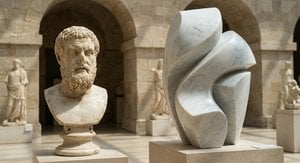
The Enduring Allure of Marble in Art History: From Classical Sculpture to Modern Abstraction
Explore the captivating history of marble sculpture from ancient Greece to modern art. Discover renowned artists like Canova & Michelangelo, carving techniques, and investment insights at ArtsDot.

The Enduring Form: Sculpture Across History, Technique & Emotional Resonance
Explore the rich history of sculpture with ArtsDot. Discover key techniques, influential artists & investment potential for discerning collectors. Expert insights into valuing and collecting timeless masterpieces.

The Enduring Form: Exploring Themes & Techniques in Sculpture Across Historical Periods
Explore the rich history of sculpture from ancient masterpieces to contemporary innovations. Discover key techniques, influential artists & investment potential for discerning art collectors.