


 Bekijk op ware grootte
 Verstuur
 Delen
Delen
 Details bekijken
 Gids voor studentenkunstwerken

 Download
 Vergelijkbare items
 Röntgenonderzoek
 Diavoorstelling
 Statistieken
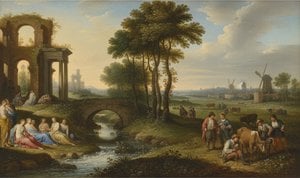
Italian Landscape with Roman Warriors
 Oil On Canvas
- WallArt
- Baroque Landscape
 1650
1650 154.0 x 174.0 cm
 Hermitage Museum
 Lees meer
Handgemaakte olieverfreproductie
Met de hand geschilderd in olieverf op canvas in uw gewenste maat en lijst, op bestelling gemaakt door onze kunstenaars. ( Schakel over naar print Schakel over naar digitale afbeeldingen)




P118B €10

P118H €10

P118W €10

P438Z €10

P508JH €12

P508YH €12

P805H €10

P805Z €10

P919BZ €10

P919G €10

P919XJ €10

P959ZH €10

P968JZ €12

W106C €8

W218G €10

W218JH €8

W218Y €10

W307PJ €10

W316G €10

W316PJ €8

W316Y €10

W398PJ €8

W4111J €10

W500HY €15

W500JH €15

W692G €12

W849H €8

W940BG €15

W953PJ €8




Kies uit onze vooraf ingestelde maten die overeenkomen met de originele verhoudingen van het kunstwerk.

Voer de breedte en de hoogte in die u nodig heeft, passend bij uw lijst of uw muur. Dit is handgeschilderd, dus bij een afmeting met een andere vormverhouding kan de kunstenaar iets meer rondom het schilderij schilderen of juist iets meer weglaten — u kiest zelf. Wij sturen u een digitaal mockup ter goedkeuring voordat het schilderwerk begint. De afbeelding die op deze pagina wordt getoond, is niet het uiteindelijke resultaat — alleen de mockup geeft dit weer.
Na de bestelling zal het team van ArtsDot.com per e-mail contact opnemen met de klant voor instructies en een mockup-voorbeeld sturen.
Wereldwijde levering () binnen 3 tot 4 weken in plaats van de standaard 5 weken. (24 oktober). Zonder concessies aan de kwaliteit.

Gratis wereldwijde expressverzending

Hoogwaardig linnen canvas

Volledige verzendverzekering

Garantie op terugbetaling van invoerrechten

Garantie op exacte kleurweergave

Retourbeleid van 100 dagen (alleen bij defecten)

100% Geld-terug-garantie

Korting bij meerdere afnames
 De optie voor glas is alleen beschikbaar bij een formaat kleiner dan 110 cm.

Italian Landscape with Roman Warriors
Reproductiemethode
Formaat reproductie
-


Totaalprijs
€ 231
The Vision of Jan Both: A Mediterranean Masterpiece
Jan Dirksz Both’s “Italian Landscape with Roman Warriors,” painted around 1650, isn't merely a depiction of a picturesque Italian vista; it’s an immersive experience. Born in Utrecht and trained within the traditions of Flemish painting, Both embarked on a transformative journey to Rome, a pivotal moment that fundamentally altered his artistic trajectory. This work stands as a testament to that shift – a vibrant synthesis of Northern realism and Southern light, capturing not just a scene but a mood, an atmosphere steeped in the grandeur and drama of the Italian Renaissance.
The painting immediately draws the eye with its expansive composition. A sweeping river dominates the foreground, reflecting the azure sky above, while rolling hills cascade into the distance, culminating in hazy mountains that seem to bleed into the horizon. Yet, it’s not simply a topographical rendering; Both masterfully employs atmospheric perspective – a technique borrowed from Claude Lorrain and other Italian landscape masters – to create an illusion of depth and vastness. The colors become softer, cooler, and less saturated as they recede, drawing the viewer's eye into the heart of the scene.
The Language of Light: A Baroque Revelation
Both’s signature style is characterized by a luminous quality that elevates the landscape beyond mere representation. He was deeply influenced by the Baroque tradition, particularly its emphasis on dramatic lighting and theatrical effects. Notice how the sunlight, seemingly originating from an unseen source, bathes the scene in a golden glow, highlighting specific elements – the shimmering water, the textured foliage, and the confident postures of the Roman warriors. This isn’t a flat, even illumination; it's a dynamic interplay of light and shadow that imbues the painting with a sense of vitality and movement.
The use of color is equally deliberate. Rich ochres, deep greens, and vibrant blues are juxtaposed to create visual interest and depth. The earthy tones of the landscape contrast sharply with the gleaming armor of the soldiers, further emphasizing their power and authority. The subtle variations in hue – a hint of purple in the distant mountains, a touch of pink in the clouds – contribute to the overall sense of realism and atmospheric detail.
Symbolism and Power: The Roman Presence
Beyond its purely aesthetic qualities, “Italian Landscape with Roman Warriors” is laden with symbolic meaning. The presence of the Roman soldiers, clad in their imposing armor and wielding spears, speaks to themes of power, conquest, and military might. They are not simply figures within a landscape; they are active participants, shaping the scene and asserting dominance over it. The bandits leading prisoners further reinforces this narrative, suggesting a world of conflict and political intrigue.
However, the painting isn’t solely focused on warfare. The inclusion of a river, trees, and a sense of leisure hints at a more complex vision – one that acknowledges both the beauty and the brutality of the Italian landscape. The figures are engaged in activities that suggest a harmonious coexistence between humanity and nature, albeit within a framework of power and control.
A Legacy of Light: Both’s Enduring Influence
Jan Dirksz Both's “Italian Landscape with Roman Warriors” represents a pivotal moment in the development of Dutch landscape painting. It showcases his mastery of technique, his deep understanding of color and light, and his ability to synthesize diverse artistic influences. His work continues to captivate viewers today, offering a glimpse into a world of beauty, drama, and timeless symbolism. Reproductions of this stunning artwork capture the essence of Both’s vision, allowing us to experience its luminous quality and evocative power firsthand.
Vragen & Antwoorden
In welke ruimte wordt het tonen van "Italian Landscape with Roman Warriors" aanbevolen, gezien het kleurenpalet?
Met zijn Earthy palet wordt "Italian Landscape with Roman Warriors" door Jan Both aanbevolen voor een Living Room. De kleuren zijn een van de redenen voor dit advies.
Wat deelt "Italian Landscape with Roman Warriors" met het overige werk van Jan Both?
Binnen het oeuvre van Jan Both past "Italian Landscape with Roman Warriors" binnen de Baroque Landscape-stijl, samen met de thema's van mediterranean light, roman ideals, classical landscape, heroic figures, religious allegory, moral themes, baroque drama, emotional depth.
Welk kleurenpalet wordt gebruikt in "Italian Landscape with Roman Warriors"?
De kleuren van "Italian Landscape with Roman Warriors" vormen een Earthy palet. Deze classificatie beschrijft de dominante kleurfamilies.
Gerelateerde kunstwerken


Biografie van de kunstenaar
Jan Both (1610-1652): Meester van het Mediterrane Licht
Jan Dirksz Both was een Nederlandse schilder, tekenaar en etser die opkwam als een van de belangrijkste figuren binnen de bloeiende "Italianiserende" landschapsbeweging tijdens de Nederlandse Gouden Eeuw. Geboren rond 1615/16 แน 1618 in Utrecht, was hij de jongere broer van Andries Both. Hun vader, Dirck Both, een glasmaker, bracht hen van jongs af een diep respect voor artistiek vakmanschap bij. Hoewel biografische details schaars blijven, suggereert wetenschappelijk onderzoek dat de opleiding van Jan de lessen van Abraham Bloemaert en Gerrit van Honthorst omvatte, wat hem plaatste onder de meest invloedrijke kunstenaars van zijn tijd.- Vroege jaren & Opleiding: De vormende jaren van Both werden doorgebracht in Utrecht, waar hij zijn vaardigheden verfijnde naast zijn broer Andries, terwijl hij technieken absorbeerde uit de glaswerkpraktijk van hun vader – een ambacht dat diep geworteld was in Vlaamse tradities.
- Romeinse Invloed: Rond 1638 ondernamen Jan en Andries een transformerende reis naar Rome via Frankrijk, waar zij zich onderdompelden in de artistieke passie van het pauselijke hof en grootheden zoals Bloemaert en Gerrit van Honthorst ontmoetten. Deze blootstelling vormde hun stilistische gevoels op diepgaande wijze.
De Romanate Stijl & Samenwerking met Lorrain
Rome bleek een smeltkroes voor de artistieke ontwikkeling van Both. Terwijl Andries zich concentreerde op genrescènes in de stijl van Pieter van Laer, wijdde Jan zich voornamelijk aan de landschapsschilderkunst—een stijl die zwaar leunde op Claude Lorrain—waarbij hij de etherische schoonheid van de mediterrane regio vastlegde met een ongeëvenaarde beheersing van licht en kleur. Opmerkelijk genoeg werkte hij nauw samen met Herman van Swanevelt aan een monumentaal project voor het Buen Retiro Paleis in Madrid, waarmee hij zijn ambitie en artistieke kracht bewees binnen de hoogste kringen van het Europese mecenaat. Deze samenwerking bezegelde Boths reputatie als een leidende innovator in de landschapskunst.Opmerkelijke Schilderijen & Artistieke Kenmerken
Het oeuvre van Both wordt gekenmerende door uitgestrekte, verbeeldingsrijke landschappen, badend in een lumineus gouden licht—een handelsmerk van de stijl van Lorrain en indicatief voor de bredere artistieke stromingen die door heel Europa circuleerden. Zijn meesterwerk, “Landschap met bandieten die gevangenen leiden” (Museum of Fine Arts, Boston), is een toonbeeld van deze esthetische briljantie. De diagonale weg trekt het oog de scène in, waarbij realistische figuren worden afgezet tegen een achtergrond van idyllische vergezichten vol minutieus weergegeven vegetatie. Terugkerende motieven zijn religieuze of mythologische figuren—zoals te zien in “Het Oordeel van Paris” (Londen, National Gallery)—vaak uitgevoerd door medekunstenaars uit Utrecht zoals Cornelis van Poelenburch, wat de betrokkenheid van Both bij humanistische idealen en artistieke conventies onderstreept.Erfenis & Invloed
De broer van Jan Both, Andries, kwam tragisch om het leven door ziekte in Venetië tijdens hun terugreis uit Rome. Ondanks de korte duur van zijn leven, vestigde Andries zich als een gerespecteerd kunstenaar die gespecialiseerd was in boerenscènes—een genre dat de sociale realiteit van die tijd weerspiegelde. De artistieke nalatenschap van Jan Both reikt verder dan individuele schilderijen; hij diende als leraar voor getalenteerde leerlingen zoals Barend Bispinck en Willem de Heusch, waardoor hij ervoor zorgde dat zijn stilistische innovaties generaties kunstenaars zouden blijven inspireren. Zijn werk wordt nog steeds gevierd om de evocatieve atmosfeer, de meesterlijke techniek en zijn bijdrage aan de ontwikkeling van de Nederlandse landschapsschilderkunst—een testament aan de blijvende invloed van Both op de Europese kunstgeschiedenis.Collecties
- Fitzwilliam Museum aan de Universiteit van Cambridge
- Hermitage, Sint-Petersburg
- Kunsthistorisches Museum, Wenen
- Louvre, Parijs
- Mauritshuis Koninklijke Galerie

Jan Both
1610 - 1652 , Nederland
Snelle feiten
- Artistic Movement Or Style: Italiaanse landschapsschilderkunst
- Artists Or Movements Influenced By This Artist: ['Claude Lorrain']
- Artists Who Influenced This Artist:
- Abraham Bloemaert
- Gerrit van Honthorst
- Date Of Birth: Utrecht, Nederland (1610)
- Date Of Death: 9 augustus 1652
- Full Name: Jan Dirksz Both
- Nationality: Nederlands
- Notable Artworks:
- Sint-Anna met de Maagd en het Kind
- Landschap met bandieten die gevangenen leiden
- Het oordeel van Paris
- Place Of Birth: Utrecht
Gerelateerde artikelen
Cornelis van Poelenburch: Bridging Mannerism & the Dutch Baroque Landscape
Discover Cornelis van Poelenburch, a pivotal Dutch Baroque landscape painter bridging Mannerism & Italianate styles. Explore his life, key works, and lasting influence on 17th-century art with ArtsDot.

Romantische Landschappen: Top 10 Meesterwerken voor een Sfeervol Interieur | ArtsDot.nl
Ontdek de 10 meest iconische meesterwerken van de Romantiek! Reis door de tijd met Caspar David Friedrich, Turner & Delacroix. Laat je inspireren en vind museumkwaliteit kunst reproducties voor een sfeervol interieur op ArtsDot.com.

Evocations of Place: A Historical Journey Through Landscape Art
Explore the rich history of landscape art with ArtsDot. Discover renowned artists, movements like Impressionism & Romanticism, and expert guidance for collecting timeless pieces. Find your perfect serene escape today!

Jan Brueghel the Elder: A Master of Flemish Landscape & Allegory – Exploring Innovation & Influence
Explore the captivating world of Jan Brueghel the Elder, a Flemish Baroque master renowned for his stunning landscapes & allegorical paintings. Discover his collaborations with Rubens and lasting artistic legacy.

Claude Lorrain: Master of Light & Landscape in the Golden Age
Explore the luminous landscapes of Claude Lorrain, a Baroque master renowned for his masterful use of light & atmosphere. Discover his life, techniques, key works & enduring influence on art history.
