


 Bekijk op ware grootte
 Verstuur
 Delen
Delen
 Details bekijken
 Gids voor studentenkunstwerken

 Download
 Vergelijkbare items
 Röntgenonderzoek
 Diavoorstelling
 Statistieken
Self Portrait (8)


 Lees meer
Handgemaakte olieverfreproductie
Met de hand geschilderd in olieverf op canvas in uw gewenste maat en lijst, op bestelling gemaakt door onze kunstenaars. ( Schakel over naar print Schakel over naar digitale afbeeldingen)




P118B $10

P118H $10

P118W $10

P438Z $10

P508JH $12

P508YH $12

P805H $10

P805Z $10

P919BZ $10

P919G $10

P919XJ $10

P959ZH $10

P968JZ $12

W106C $8

W218G $10

W218JH $8

W218Y $10

W307PJ $10

W316G $10

W316PJ $8

W316Y $10

W398PJ $8

W4111J $10

W500HY $15

W500JH $15

W692G $12

W849H $8

W940BG $15

W953PJ $8




Kies uit onze vooraf ingestelde maten die overeenkomen met de originele verhoudingen van het kunstwerk.

U kunt uw eigen afmetingen invoeren om in een specifieke lijst of ruimte te passen. Als de door u gekozen maat niet overeenkomt met de verhoudingen van het originele beeld, zullen we het kunstwerk bijsnijden of het schilderij uitbreiden met extra handgeschilderde elementen. Een digitale mockup wordt ter goedkeuring naar u verzonden voordat de productie begint.
Houd er rekening mee dat de preview op het scherm niet de werkelijke uitsnede of uitbreiding weergeeft. Alleen de mockup toont de uiteindelijke compositie nauwkeurig.
Hoewel aangepaste afmetingen mogelijk zijn, raden we aan een maat uit de vooraf gedefinieerde lijst te selecteren om de originele verhoudingen te behouden.
Na de bestelling zal het team van ArtsDot.com per e-mail contact opnemen met de klant voor instructies en een mockup-voorbeeld sturen.
Wereldwijde levering () binnen 3 tot 4 weken in plaats van de standaard 5 weken. (26 september). Zonder concessies aan de kwaliteit.

Gratis wereldwijde expressverzending

Hoogwaardig linnen canvas

Volledige verzendverzekering

Garantie op terugbetaling van invoerrechten

Garantie op exacte kleurweergave

Retourbeleid van 100 dagen (alleen bij defecten)

100% Geld-terug-garantie

Korting bij meerdere afnames
 De optie voor glas is alleen beschikbaar bij een formaat kleiner dan 110 cm.

Self Portrait (8)
Reproductiemethode
Formaat reproductie
-


Totaalprijs
$ 263
Giorgio de Chirico’s “Self Portrait (8)” – A Dreamscape of Isolation
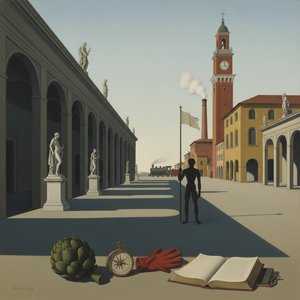
Giorgio de Chirico's "Self Portrait (8)," painted in 1967, isn’t merely a depiction of an artist; it’s a meticulously constructed fragment of the subconscious, a distilled essence of the anxieties and intellectual currents that defined his entire oeuvre. This particular iteration, created later in his career, leans heavily into the neo-baroque style he embraced during this period, offering a glimpse into a mind grappling with memory, alienation, and the unsettling beauty of the familiar transformed. The painting immediately draws the viewer in with its stark simplicity – a solitary figure, rendered in muted tones against a backdrop that simultaneously evokes classical Roman architecture and an unnerving sense of emptiness. It’s a portrait not just of a man, but of a state of being.
The Anatomy of Disquiet: Style and Technique
De Chirico's technique in this self-portrait is deliberately restrained, almost austere. The brushwork is visible, lending the painting a tactile quality that contrasts sharply with the dreamlike atmosphere. He employs a flattened perspective, reminiscent of Byzantine icons, creating an illusion of depth that simultaneously draws the eye inward and reinforces the feeling of confinement. Notice the careful attention to detail in the figure’s face – the slightly furrowed brow, the intense gaze directed squarely at the viewer—a direct challenge to the observer's presence within this carefully constructed space. The use of dark clothing against a lighter background further emphasizes the figure’s isolation and creates a dramatic interplay of light and shadow that contributes significantly to the painting’s overall mood.
Philosophical Echoes: Schopenhauer, Nietzsche, and the Uncanny
To understand “Self Portrait (8),” one must delve into the philosophical landscape that profoundly shaped de Chirico's artistic vision. Heavily influenced by Arthur Schopenhauer’s philosophy of pessimism and Friedrich Nietzsche’s exploration of nihilism and the will to power, de Chirico sought to capture the unsettling feeling of reality as a deceptive illusion—a “veil” concealing an underlying chaos. The painting embodies this concept perfectly. The Roman-inspired background, with its echoing arches and distant water, is not a genuine place but rather a construct of memory and imagination, imbued with a sense of longing and loss. The mannequins, often present in his earlier works, subtly hint at the artificiality of human relationships and the inherent loneliness of existence—a recurring motif reflecting his engagement with Schopenhauer’s ideas about the will as a relentless striving for satisfaction ultimately leading to suffering.
Symbolism and Emotional Resonance: Birds, Perspective, and the Viewer
Beyond the philosophical influences, several symbolic elements contribute to the painting's layered meaning. The two birds—one perched near the top left corner, another in the lower right—represent fleeting moments of beauty or perhaps even a sense of escape within an otherwise desolate landscape. The illogical perspective, a hallmark of de Chirico’s metaphysical style, further destabilizes our perception and creates a feeling of disorientation. Most importantly, the direct gaze of the self-portrait is profoundly unsettling. It forces the viewer to confront their own reflection in this strange, dreamlike world—a silent acknowledgment of shared isolation and the inherent mystery of human consciousness. “Self Portrait (8)” isn’t simply a portrait; it's an invitation to contemplate the complexities of the inner life and the enduring power of art to capture the elusive nature of reality.
A Reproduction for the Soul: Bringing De Chirico Home
ArtsDot offers meticulously hand-painted reproductions of “Self Portrait (8),” allowing you to bring this iconic work into your own space. Our artists recreate de Chirico’s distinctive style and evocative atmosphere with exceptional skill, ensuring that every detail—from the subtle brushstrokes to the nuanced color palette—is faithfully reproduced. This is more than just a print; it's an authentic artistic experience, a window into the mind of one of the 20th century’s most enigmatic artists. Consider this reproduction not as a mere decoration, but as a conversation starter, a meditation on themes of isolation, memory, and the enduring power of art to illuminate the human condition.
Gerelateerde kunstwerken


Biografie van de kunstenaar
Giorgio de Chirico: Een Droomlandschap van de Geest
Giorgio de Chirico, geboren in 1888 in Volos, Griekenland, als zoon van Italiaanse ouders – een Genoese moeder en een Siciliaanse vader – begon zijn artistieke reis met een unieke combinatie van klassieke erfenis en een groeiend gevoel van moderne vervreemding. Zijn vroege opleiding aan de Athenische Polytechnische Academie legde een basis in traditionele technieken, maar het was zijn latere studie in München die zijn creatieve geest werkelijk ontvloog. Daar, midden in de intellectuele fermentatie van Europa vóór de oorlog, ontmoette hij de werken van Arnold Böcklin en Max Klinger, kunstenaars wiens symbolische landschappen en spookachtige beelden een diepe indruk op hem achterlieten. Even invloedrijk waren de filosofische stromingen van die tijd – de schrijfsels van Friedrich Nietzsche, Arthur Schopenhauer en Otto Weininger – die thema’s van existentialisme, de irrationele aard van menselijk verlangen en de subjectieve aard van realiteit onderzochten. Deze ideeën zouden centraal staan in de baanbrekende artistieke visie van de Chirico.De Geboorte van Metafysische Kunst
Omstreeks 1909 begon er een unieke stijl te ontstaan uit de verkenningen van de Chirico – een stijl die hij zelf “Metafysieke” kunst noemde. Dit was niet slechts een stijlinnovatie; het was een diepe poging om de verborgen realiteiten onder de oppervlakte van alledaagse ontmoetingen vast te leggen, om de onheilspellende poëzie te onthullen die in vertrouwdere ruimtes schommelde. Een cruciale gebeurtenis vond plaats tijdens een bezoek aan Florence en een ervaring in Piazza Santa Croce, wat leidde tot zijn iconische ‘Metafysische Plaatsverkeer’ serie. Deze schilderijen kenmerken zich door hun spookachtige stilte, lange dramatische schaduwen, logische perspectieven en de aanwezigheid van klassieke architectuur gecombineerd met onheilspellende elementen zoals gezichtsloze mannekens en reusachtige standbeelden. Het effect is diep verontrustend, roept een gevoel van nostalgie, isolatie en een bijna ondraaglijke heimwee naar iets verloren of ontoegankelijks op. De Chirico richtte de *Scuola Metafisica* op, wat een diepe impact had op Surrealisme, hoewel hij later afstand nam van de interpretaties van zijn werk door deze stroming. Zijn schilderijen waren niet bedoeld als illustraties van dromen, maar eerder als pogingen om realiteit vast te leggen buiten het zichtbare wereld – een rijk waar tijd en ruimte vloeibaar zijn en de grenzen tussen bewustzijn en onbewustzijn vervagen. Bekende werken zoals *De Verjagde Denkbeeld*, *Het Enigma van de Herfstmiddag* en *Het Lied van de Liefde* illustreren deze spookachtige esthetiek, uitnodigend kijkers om na te denken over de mysteries van het bestaan en de kwetsbaarheid van menselijke perceptie.Een Verandering in Stijl en een Duurzaam Erfgoed
Na de Eerste Wereldoorlog, rond 1919, nam de artistieke weg van de Chirico een onverwachte wending. Hij verwierp zijn eerdere metafysische benadering en omarmde daarentegen een meer traditionele neoclassieke of neobaroque stijl. Deze verschuiving werd met aanzienlijke controverse ontvangen; velen betreurden het verlies van de innovatieve geest die zijn vroege werk had gedefinieerd. De Chirico bleef echter vasthoudend aan zijn artistieke keuzes, herhaalde thema’s uit zijn verleden, maar presenteerde ze met een andere esthetische gevoeligheid. Hij bleef schilderen en exposeren gedurende zijn hele leven, verkende verschillende stijlen en onderwerpen terwijl hij tegelijkertijd een consistente toewijding aan vakmanschap en technische vaardigheid behield. Ondanks de kritiek is zijn invloed op latere generaties van kunstenaars niet te overschatten. Zijn innovatieve gebruik van ruimte, perspectief en symboliek daagde conventionele artistieke normen uit en legde de basis voor nieuwe vormen van expressie.Invloeden en Duurzaam Erfgoed
- Gevloed door: Arnold Böcklin, Max Klinger, Friedrich Nietzsche, Arthur Schopenhauer.
- Gevloed door: Surrealisme, met name kunstenaars zoals René Magritte en Salvador Dalí. Zijn werk had ook invloed op latere stromingen zoals Magic Realism, die een verhoogde gevoeligheid voor mysterie en psychologische diepte zocht in alledaagse realiteit.

Giorgio de Chirico
1888 - 1978 , Griekenland
Snelle feiten
- Artistic Movement Or Style: Metafysische kunst
- Artists Or Movements Influenced By This Artist:
- Surrealisme
- René Magritte
- Artists Who Influenced This Artist:
- Arnold Böcklin
- Max Klinger
- Date Of Birth: 10 juli 1888
- Date Of Death: 20 november 1978
- Full Name: Giorgio de Chirico
- Nationality: Italiaans
- Notable Artworks:
- Het Vrezen van de Denkende
- De Enigma van een Herfst Middag
- Het Lied van de Liefde
- Place Of Birth: Volos, Griekenland
Gerelateerde artikelen

Top 10 Barok Meesterwerken: Kunstgeschiedenis voor uw Interieur | ArtsDot.nl
Ontdek de 10 meest iconische Barok meesterwerken van Caravaggio, Rembrandt & Rubens! Duik in de geschiedenis en passie achter deze klassieke schilderijen. Vind museumkwaliteit reproducties voor uw interieur op ArtsDot.com.

Beyond Reality's Veil: Exploring the Enigmatic World of Metaphysical Art
Explore the captivating world of Metaphysical art with ArtsDot. Discover Giorgio de Chirico's iconic paintings, philosophical influences & lasting impact on Surrealism. Expert insights for collectors.

Over ons
Ontdek ons verhaal! Wij brengen wereldklasse kunst in uw leven door een deskundige selectie, gepersonaliseerde creaties en gratis previews. Goedgekeurd door particulieren en bedrijven sinds 2000.

Goya's Meesterwerken: 25 Iconische Schilderijen voor Kunstliefhebbers | ArtsDot
Ontdek de 25 meest iconische schilderijen van Francisco Goya! Duik in zijn Spaanse romantiek, donkere kleuren & emotionele kracht. Museumkwaliteit reproducties voor jouw interieur op ArtsDot.com.
Giorgio de Chirico: Metaphysical Realities & the Poetics of Absence
Explore the captivating world of Giorgio de Chirico and his groundbreaking Metaphysical painting movement. Discover the philosophical depths & surreal imagery that influenced generations of artists. Learn more at ArtsDot.


