
- Home

- Op canvas afdrukken
- Gerard David
- Virgin and Child

 Bestel schilderij Koop afbeelding in hoge resolutie
 Verstuur
 Delen
Delen
 Details
 Toevoegen aan favorieten

 Download
 Vergelijkbare werken
 X-Ray
X-Ray
 Diavoorstelling
Virgin and Child
 Acryl op canvas
- Wandkunst
- Early Netherlandish
 1523
1523 16.0 x 11.0 cm
 Metropolitan Museum of Art
Giclée / Kunstafdruk
Giclée- of canvasafdruk van museumkwaliteit met snelle productie en flexibele afwerkingsopties.
 Lees meer over



P118B $10

P118H $10

P118W $10

P438Z $10

P508JH $12

P508YH $12

P805H $10

P805Z $10

P919BZ $10

P919G $10

P919XJ $10

P959ZH $10

P968JZ $12

W106C $8

W218G $10

W218JH $8

W218Y $10

W307PJ $10

W316G $10

W316PJ $8

W316Y $10

W398PJ $8

W4111J $10

W500HY $15

W500JH $15

W692G $12

W849H $8

W940BG $15

W953PJ $8




Kies uit onze vooraf ingestelde maten die overeenkomen met de originele verhoudingen van het kunstwerk.

U kunt uw eigen afmetingen opgeven om in een specifieke lijst of ruimte te passen. Als de door u gekozen maat niet overeenkomt met de proporties van het originele kunstwerk, zullen wij de afbeelding bijsnijden of uitbreiden met een gespiegelde of effen rand. Een digitaal mockup wordt ter goedkeuring naar u verzonden voordat de productie begint.
Houd er rekening mee dat de preview op het scherm de werkelijke bijsneding of uitbreiding niet weergeeft. Alleen de mockup toont de uiteindelijke compositie nauwkeurig.
Hoewel aangepaste maten beschikbaar zijn, raden wij aan een afmeting uit de vooraf bepaalde lijst te kiezen om de originele proporties te behouden.
Wereldwijde levering () binnen 2 weken in plaats van de standaard 4/5 weken. (1 juli)

Gratis wereldwijde expressverzending

Hoogwaardig linnen canvas

Volledige verzendverzekering

Garantie op terugbetaling van invoerrechten

Garantie op exacte kleurweergave

60 dagen retourbeleid (alleen bij defecten)

100% Geld-terug-garantie

Korting bij meerdere afnames
 De optie voor glas is alleen beschikbaar bij een formaat kleiner dan 110 cm.

Virgin and Child
Giclée / Kunstafdruk
Afmetingen reproductie
-


Eindtotaal
-
Beschrijving verzamelobject
A Window into Flemish Devotion: Gerard David’s ‘Virgin and Child’
The Virgin and Child by Gerard David stands as a testament to the profound artistic achievements of Early Netherlandish painting—a genre characterized by meticulous realism, luminous color palettes, and an unwavering focus on conveying spiritual contemplation. Executed in 1523, this diminutive panel painting transcends its modest dimensions, offering viewers a glimpse into the heart of humanist piety and the enduring fascination with familial love. Produced during David’s prolific workshop years in Bruges, it exemplifies the stylistic trends prevalent at the time—a deliberate simplification of form coupled with an astonishing level of detail aimed at capturing the essence of biblical narrative.A Masterful Synthesis of Style and Technique
David's approach to painting was revolutionary for his era. Unlike many artists who prioritized grand narratives or elaborate ornamentation, he honed in on conveying emotion through subtle gestures and nuanced expressions. The artist skillfully employed oil paint on a wooden panel—a technique favored by Flemish masters—to build up form and texture with painstaking precision. Layers of pigment were applied to achieve a velvety surface, subtly capturing the contours of drapery folds and the delicate musculature of Jesus’s body. Lines are rendered with exceptional accuracy, particularly evident in the rendering of Mary's hair – meticulously sculpted to convey both softness and volume—and the facial features of both figures. The diffused lighting emanating from an unseen source illuminates the scene, casting a gentle glow upon their faces and enhancing the overall sense of serenity.Historical Context: Bruges’ Artistic Renaissance
Bruges in the early sixteenth century was experiencing a remarkable artistic flourishing, fueled by burgeoning trade and patronage—particularly from wealthy merchants eager to adorn their homes with devotional imagery. Gerard David skillfully navigated this dynamic market landscape, adapting his creative output to meet evolving tastes while maintaining stylistic integrity. This painting likely served as part of a larger diptych – perhaps paired with an image depicting Christ Taking Leave of His Mother – reflecting the prevalent practice of commissioning multi-panel artworks for private devotion. Such pieces were easily transported during pilgrimages and journeys, underscoring their importance within the spiritual life of the time.Symbolism: The Embodiment of Divine Love
Beyond its technical brilliance, ‘Virgin and Child’ resonates deeply with symbolic meaning. At its core lies a depiction of maternal tenderness—Mary cradling Jesus in her arms as they gently touch cheeks – an image that encapsulates the profound love between mother and child. This gesture speaks to universal themes of compassion, protection, and familial bonds—values central to humanist thought during the Renaissance. The dark blue background serves not merely as visual grounding but also symbolizes heaven—creating a contemplative space for reflection and reinforcing the painting’s spiritual significance.Emotional Impact: A Moment Frozen in Time
The artwork's enduring appeal stems from its ability to evoke feelings of peace, reverence, and intimacy. David’s masterful rendering captures a fleeting moment of connection between Mary and Jesus – a scene imbued with palpable emotion—that speaks across centuries. It invites viewers to contemplate the beauty of faith and the sanctity of familial relationships. A reproduction of this exquisite panel offers an opportunity to bring a touch of Flemish Renaissance artistry into any interior space, preserving its timeless elegance and conveying its profound spiritual message.Vergelijkbare kunstwerken


Biografie van de kunstenaar
A Master of Flemish Light: The Enigmatic World of Gerard David
Gerard David, a name that resonates with the brilliance of early Netherlandish painting, remains an artist shrouded in intriguing mystery. Born around 1460 in Oudewater, Netherlands, his life story is pieced together from fragmented archival records and the eloquent testimony of his art. Unlike some contemporaries whose lives are richly documented, David’s personal narrative is sparse, allowing his paintings to speak volumes where biographical details fall silent. What is known suggests a remarkably successful career, likely managing workshops in both Antwerp and Bruges – centers of artistic innovation during the Renaissance. His reputation experienced an ebb in the 17th century, only to be gloriously resurrected by 19th-century art historians who recognized his unique contributions to the Northern Renaissance. He was inducted as a free master into the Corporation of Imagemakers and Saddlers in Bruges in 1484, marking a pivotal moment in his ascent. His later involvement with the Antwerp guild in 1515 further solidifies his standing within the artistic community.Formative Influences and Artistic Development
David’s artistic journey began under influences that shaped the very foundation of his style. Early works reveal a clear debt to painters like Jacob Janszoon, Dieric Bouts, and Geertgen tot Sint Jans – masters who instilled in him a meticulous attention to detail and a sensitivity to religious narrative. It is believed he spent time in Haarlem absorbing these lessons before relocating to Bruges, a vibrant hub of artistic exchange attracting talent from across Europe. Here, David encountered the masterpieces of Jan van Eyck, Rogier van der Weyden, and Hans Memling, absorbing their techniques while forging his own distinct path. He didn’t merely imitate; he synthesized these influences into something uniquely his own – a style characterized by luminous color, serene compositions, and an increasingly sophisticated understanding of landscape. His early paintings demonstrate this evolution, moving from the doll-like figures reminiscent of Haarlem traditions towards more sculptural forms grounded in their environment. This transition is visible in works like *Christ Nailed to the Cross*, where the influence of Bouts’ spatial construction blends with David’s emerging coloristic sensibility. The use of perspective and the dramatic lighting, hallmarks of Memling's style, are subtly integrated into David’s compositions, creating a sense of depth and realism that was groundbreaking for its time.Innovation in Landscape and Religious Narrative
Gerard David’s artistic signature lies in his innovative approach to both landscape and religious subject matter. He wasn’t simply depicting backgrounds; he was creating immersive environments that enhanced the emotional resonance of his scenes. His landscapes are not merely decorative, but integral components of the narrative, often imbued with symbolic meaning. This fascination with natural settings – dense forests, rolling hills, expansive skies – set him apart from many of his contemporaries and foreshadowed the development of landscape painting as an independent genre. Consider *View in a Forest*, outer wing of a triptych; it’s not simply a backdrop but a world unto itself, rendered with meticulous detail and atmospheric perspective. The trees are depicted with astonishing realism, their branches intertwined to create a sense of enclosure, while the light filtering through the leaves casts dappled shadows on the ground. This attention to naturalistic detail was unprecedented in religious painting at the time. Within his religious works, David demonstrated a remarkable ability to convey both profound spirituality and human emotion. Paintings like *The Marriage of St. Catherine* exemplify this skill. The scene is rendered with exquisite detail, yet it’s the subtle expressions on the figures' faces – their piety, contemplation, or gentle joy – that truly captivate the viewer. He possessed a gift for imbuing his sacred subjects with a sense of quiet dignity and relatable humanity. The *Triptych of the Madonna Enthroned and Saints* in Genoa showcases this mastery, presenting a harmonious composition filled with vibrant color and delicate detail. The figures are not idealized but portrayed with a remarkable degree of realism, their faces reflecting a range of emotions – serenity, compassion, and devotion. His *Virgin Among the Virgins*, donated to the Carmelite nuns of Sion at Bruges, is another testament to his skill, featuring a self-portrait within the painting itself – a rare and intimate gesture from an artist of his time. This self-representation underscores David’s desire to connect with his audience on a personal level, blurring the boundaries between the sacred and the secular.Major Achievements and Artistic Style
David's career spanned several decades, during which he produced a remarkable body of work that established him as one of the leading artists of the Bruges school. His most celebrated achievements include the *Judgment of Cambyses*, a monumental altarpiece depicting the judgment of Pharaoh by Isis, and the *Triptych of the Madonna Enthroned*, a masterpiece of devotional art. These works demonstrate his mastery of color, composition, and perspective – all hallmarks of his distinctive style. David’s palette was exceptionally rich and luminous, employing subtle gradations of color to create a sense of depth and atmosphere. He skillfully used light and shadow to model forms and evoke emotion, creating paintings that are both visually stunning and spiritually evocative. His compositions were often characterized by their balance and harmony, with figures arranged in carefully considered groupings. Furthermore, David was one of the first Northern Renaissance painters to incorporate elements of Italian Renaissance art into his work, particularly the use of perspective and classical motifs. This fusion of styles resulted in a uniquely powerful and expressive artistic vision.Legacy and Enduring Influence
Though his fame waned for a period after his death in 1523, Gerard David’s influence on subsequent generations of artists is undeniable. His innovative use of color, his masterful handling of light and shadow, and his pioneering approach to landscape all left an indelible mark on the development of Flemish painting. He paved the way for artists who would further explore the expressive potential of natural settings, such as Jacob Patinir and Jacob van Ruisdael.- A Bridge Between Traditions: David successfully bridged the gap between the late medieval tradition and the emerging Renaissance style.
- Influence on Landscape Painting: His detailed and atmospheric landscapes foreshadowed the development of landscape as a distinct genre.
- Masterful Colorist: He was renowned for his vibrant palette and skillful use of color to create emotional impact.
Exploring Further
- ArtsDot.com: Discover an extensive collection of Gerard David’s paintings, including *The Adoration of the Magi*.
- View in a Forest: Explore this stunning Northern Renaissance landscape painting.
- The Early Netherlandish Art Movement: Delve deeper into the artistic context of David’s work.

Gerard David
1450 - 1523 , Nederland
Belangrijkste feiten
- Artistic Movement Or Style: Vlaamse Primitieven
- Artists Or Movements Influenced By This Artist:
- Jan van Eyck
- Rogier van der Weyden
- Hans Memling
- Artists Who Influenced This Artist:
- Jacob Janszoon
- Dieric Bouts
- Geertgen tot Sint Jans
- Date Of Birth: c. 1460
- Date Of Death: 1523
- Full Name: Gerard David
- Nationality: Nederlands
- Notable Artworks:
- Bruiloft Sint Catharina
- Madonna onder de Engelen
- Landschap met het bos
- Place Of Birth: Oudewater, Nederland
Gerelateerde artikelen
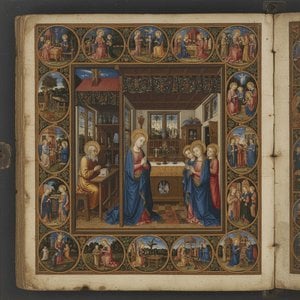
Robert Campin: Pioneering Realism & Spiritual Depth in Early Netherlandish Painting
Explore the revolutionary work of Robert Campin, a pioneer of Early Netherlandish painting. Discover his naturalistic style, religious symbolism in masterpieces like the Mérode Altarpiece, and lasting influence on art history.


Jan van Eyck: Innovation, Symbolism & the Dawn of Early Netherlandish Painting
Explore the revolutionary art of Jan van Eyck! Discover his groundbreaking oil painting techniques, hidden symbolism, and lasting impact on the Early Netherlandish Renaissance. A deep dive for art enthusiasts.

Top 10 Meesterwerken van de Vroege Nederlandse Schilderkunst | ArtsDot
Ontdek de 10 meesterwerken van Jan van Eyck, Rogier van der Weyden & andere Vlaamse Primitieven. Duik in de rijke symboliek en olieverfschilderijen van de Vroege Nederlandse Schilderkunst. Vind museumkwaliteit reproducties op ArtsDot.com!

Top 10 Meesterwerken van de Vroege Nederlandse Renaissance | Kunst & Decoratie
Ontdek de 10 meesterwerken van de Vroege Nederlandse Renaissance! Van Jan van Eyck tot Rogier van der Weyden, leer over hun techniek & symboliek. Vind museumkwaliteit kunst reproducties en decoratie-inspiratie op ArtsDot.com.

Illuminating Realism: Early Netherlandish Painting (15th-16th Centuries)
Explore the captivating world of Early Netherlandish painting (15th-16th centuries). Discover Jan van Eyck, Hans Memling & more. Uncover revolutionary techniques and hidden symbolism in this definitive guide.



