


 Voorvertoning
 Verstuur
 Delen
Delen
 Details bekijken

 Download
 Vergelijkbare items
 Röntgenonderzoek
 Diavoorstelling
Still life


 Lees meer
Handgemaakte olieverfreproductie
Met de hand geschilderd in olieverf op canvas in uw gewenste maat en lijst, op bestelling gemaakt door onze kunstenaars. ( Bestel print Koop afbeelding)




P118B $10

P118H $10

P118W $10

P438Z $10

P508JH $12

P508YH $12

P805H $10

P805Z $10

P919BZ $10

P919G $10

P919XJ $10

P959ZH $10

P968JZ $12

W106C $8

W218G $10

W218JH $8

W218Y $10

W307PJ $10

W316G $10

W316PJ $8

W316Y $10

W398PJ $8

W4111J $10

W500HY $15

W500JH $15

W692G $12

W849H $8

W940BG $15

W953PJ $8




Kies uit onze vooraf ingestelde maten die overeenkomen met de originele verhoudingen van het kunstwerk.

U kunt uw eigen afmetingen invoeren om in een specifieke lijst of ruimte te passen. Als de door u gekozen maat niet overeenkomt met de verhoudingen van het originele beeld, zullen we het kunstwerk bijsnijden of het schilderij uitbreiden met extra handgeschilderde elementen. Een digitale mockup wordt ter goedkeuring naar u verzonden voordat de productie begint.
Houd er rekening mee dat de preview op het scherm niet de werkelijke uitsnede of uitbreiding weergeeft. Alleen de mockup toont de uiteindelijke compositie nauwkeurig.
Hoewel aangepaste afmetingen mogelijk zijn, raden we aan een maat uit de vooraf gedefinieerde lijst te selecteren om de originele verhoudingen te behouden.
Na de bestelling zal het team van ArtsDot.com per e-mail contact opnemen met de klant voor instructies en een mockup-voorbeeld sturen.
Wereldwijde levering () binnen 3 tot 4 weken in plaats van de standaard 5 weken. (15 augustus). Zonder concessies aan de kwaliteit.

Gratis wereldwijde expressverzending

Hoogwaardig linnen canvas

Volledige verzendverzekering

Garantie op terugbetaling van invoerrechten

Garantie op exacte kleurweergave

Retourbeleid van 60 dagen (alleen bij defecten)

100% Geld-terug-garantie

Korting bij meerdere afnames
 De optie voor glas is alleen beschikbaar bij een formaat kleiner dan 110 cm.

Still life
Druktechniek
Afmetingen reproductie
-


Eindtotaal
$ 263
Beschrijving kunstwerk
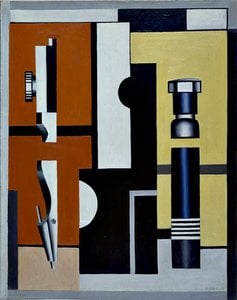
A Symphony of Form: Fernand Léger’s 1919 Still Life
This captivating still life from 1919 exemplifies Fernand Léger's distinctive contribution to the Cubist movement – a style he uniquely evolved into what became known as “Tubism.” Rather than depicting traditional floral arrangements or fruit, Léger turns his attention to the burgeoning industrial world, presenting an abstracted arrangement of mechanical components. The artwork isn’t merely *of* machines; it embodies their spirit—their power, precision, and fragmented nature.Deconstructing Reality: Style & Technique
- Cubist Foundations: Rooted in the principles of Cubism pioneered by Picasso and Braque, this work breaks down objects into geometric forms—primarily cylinders, rectangles, and cones. However, Léger moves beyond analytical Cubism’s muted palette, embracing a bolder, more vibrant aesthetic.
- Tubism Defined: The emphasis on cylindrical shapes is characteristic of Léger's style. These “tubes” create a sense of solidity and mechanical strength, reflecting his fascination with the modern industrial landscape.
- Painterly Texture: While geometrically driven, the painting isn’t cold or sterile. Léger employs visible brushstrokes and likely utilized a palette knife to build up layers of paint, creating a tactile surface that adds depth and visual interest.
- Dynamic Composition: Overlapping planes and intersecting lines generate a dynamic composition, suggesting movement and energy despite the static subject matter. The flattened perspective further emphasizes the two-dimensionality of the canvas while simultaneously hinting at three-dimensional forms.
Historical Context: Post-War Modernity
Created in 1919, just after the end of World War I, this artwork reflects a period of rapid technological advancement and societal change. The horrors of war fueled a fascination with machinery – both as instruments of destruction *and* symbols of progress. Léger’s choice to depict industrial objects can be seen as an embrace of modernity, a celebration of the machine age, and perhaps even a commentary on humanity's evolving relationship with technology. He served as a soldier during WWI, and this experience profoundly impacted his artistic vision.Symbolism & Interpretation
The symbolism within Léger’s still life is open to interpretation. The fragmented forms could represent the disruption of traditional order in the wake of war, or the deconstruction of reality itself through the lens of modern science and technology. The bold colors—reds, blues, greens, and yellows—inject a sense of vitality into the otherwise mechanical subject matter. While not overtly emotional, the painting evokes a feeling of energy, dynamism, and perhaps even a subtle tension between order and chaos.Emotional Resonance & Interior Design
This artwork is more than just an aesthetic object; it’s a visual statement about the modern world. Its bold colors and geometric forms make it a striking focal point for any interior space. It would complement contemporary or Art Deco interiors particularly well, adding a touch of intellectual sophistication and historical significance. The painting's energy can invigorate a living room, study, or office, sparking conversation and inspiring creativity. A high-quality reproduction captures the essence of Léger’s vision, bringing a piece of art history into your home or workspace.Vergelijkbare kunstwerken




Biografie van de kunstenaar
Fernand Léger: Een Leven Gebeeldhouwd in Vorm
Fernand Léger, geboren Joseph Fernand Henri Léger in 1881 in het rustige Argentan, Normandië, staat als een cruciale figuur in de evolutie van moderne kunst. Zijn reis van de landelijke gebieden van zijn jeugd naar de voorhoede van de Parijse avant-garde is een bewijs van een onwrikbare artistieke visie en een voortdurende zoektocht naar het vastleggen van de geest van de machine-tijdperk. Anders dan veel van zijn tijdgenoten die abstractie omarmden als een terugtrekking uit representatie, zocht Léger naar *integratie* van moderniteit – haar dynamiek, haar mechanische vormen, haar essentie – in een nieuwe visuele taal die zowel krachtig abstract als diep geworteld was in de waargenomen wereld. Zijn vroege leven, doordrenkt met de fysieke ervaringen van landbouwwerk, bood een contrasterende basis ten opzichte van de geindustrialiseerde toekomst waar hij zo gepassioneerd over zou schilderen. In eerste instantie was Léger bestemd voor architectuur, maar zijn pad veranderde naar schilderkunst na aankomst in Parijs rond 1900, waar hij zichzelf steunde door tekenwerk terwijl hij zijn artistieke vaardigheden verder ontwikkelde. Deze periode werd gekenmerkt door traditionele academische training, maar het was pas toen hij de baanbrekende werken van Paul Cézanne ontmoette dat een ware transformatie begon.De Geboorte van ‘Tubism’ en de Section d’Or
Cézanne's retrospectief in 1907 diende als katalysator, bevrijd Léger van conventionele representatie en stuwde hem naar een meer geometrische en structurele benadering. Hij begon vormen te ontmantelen, hun onderliggende structuren te analyseren en ze op het doek opnieuw op te bouwen met nadruk op soliditeit en volume. Deze verkenning leidde snel tot zijn omgang met Cubisme, maar Léger was niet tevreden om Picasso's of Braque's stijlen simpelweg te kopiëren. In plaats daarvan ontwikkelde hij zijn eigen onderscheidende idiom – een persoonlijke vorm van Cubisme die critici humoristisch ‘Tubism’ noemden. Karakteristiek voor Tubism waren cilindrische vormen, platte vlakken en felle kleurcontrasten, die de mechanische esthetiek vierden nog voordat deze wijdverspreid werd. Het was kunst geboren uit het observeren van de opkomende industriële wereld, met een erkenning van schoonheid in haar functionele vormen en mechanische ritmes. Deze periode zag Léger actief deelnemen aan de avant-garde scène, zich verenigen met kunstenaars zoals Jean Metzinger, Henri Le Fauconnier, Francis Picabia en Marcel Duchamp binnen de Puteaux Group, ook bekend als de Section d’Or (De Gouden Schnitt). De groep onderzocht wiskundige principes van harmonie en proportie, strevend naar het inbrengen van een gevoel van orde en rationaliteit in hun kunst. Hun gezamenlijke onderzoek bracht de grenzen van artistieke expressie op de proef, legde de basis voor toekomstige ontwikkelingen in abstracte kunst.Oorlog, Mechanisatie en Een Nieuwe Esthetiek
Het uitbreken van de Eerste Wereldoorlog had een diepgaande impact op Léger's leven en werk. Zijn dienstplicht vanaf 1914 leidde hem naar het front, waar hij getuige was van de gruwelen van de moderne oorlogsvoering – artillerievuur, luchtgevechten en de dehumaniserende effecten van mechanische oorlogvoering. Deze ervaring leidde niet tot ontgoocheling of een afwijzing van moderniteit; eerder versterkte het zijn fascinatie voor machines en hun kracht. Schetsen die hij tijdens zijn dienst maakte documenteerden de schitterende schoonheid van militaire technologie, transformeerden instrumenten van vernietiging in onderwerpen voor artistieke contemplatie. Na terugkeer naar de burgerlijke wereld onderging Léger's esthetiek een verdere evolutie. Zijn schilderijen begonnen te reflecteren op een meer gestroomlijnde, mechanische sensatie, die de dynamiek en efficiëntie van de industriële wereld vierden. *Soldier met een pijp* (1916) illustreert deze verschuiving, waarbij vereenvoudigde vormen en felle kleuren een gevoel van mechanische precisie oproepen. Dit was niet alleen een esthetische keuze; het was een filosofisch statement – een bevestiging van de potentie van moderniteit voor vooruitgang en wederopbouw, ondanks de verwoestingen van de oorlog.Erfgoed en Laatste Invloed
In zijn latere jaren bleef Léger de kruising tussen kunst en industrie verkennen, werken creërend die de moderne levenswijze vierden met een unieke combinatie van abstractie en figuratie. Zijn *Paysages animés* (Geanimeerde Landschappen) reeks uit 1921 toonde figuren en dieren die naadloos in gestroomlijnde composities waren geïntegreerd, waardoor de grenzen tussen organisch en onorganisch werden vervaagd. Hij experimenteerde ook met beeldhouwkunst en filmmaken, breidde zijn artistieke praktijk uit tot buiten de traditionele schilderkunst. Léger's invloed op latere generaties kunstenaars is onmiskenbaar. Zijn gedurfde vereenvoudiging van vorm, zijn omhelzing van industriële beelden en zijn viering van populaire cultuur anticipeerden op het ontstaan van Pop Art decennia later. Kunstenaars als Roy Lichtenstein en Andy Warhol schuldigen een duidelijke staatgenoot aan Léger's baanbrekende werk. Hij bracht de kloof tussen abstracte kunst en figuratieve representatie in kaart, waardoor het mogelijk werd om werken te creëren die zowel intellectueel uitdagend als visueel boeiend waren. Vandaag de dag blijven Fernand Léger's schilderijen worden bewaard in belangrijke musea wereldwijd, waaronder het Musée d’Art et d’Histoire in Frankrijk en het Musée National Fernand Léger, gewijd uitsluitend aan zijn werk. Hij blijft een toonaangevende figuur van de 20e eeuwse kunst – een visionair die durfde schoonheid te vinden in de machine-tijdperk en deze op het doek met ongeëvenaarde moed en originaliteit vast te leggen. Zijn nalatenschap is niet alleen als schilder, maar als profeet van de moderniteit. *Een ware pionier wiens werk nog steeds resoneren met het publiek.*
Fernand Léger
1881 - 1955 , Frankrijk
Belangrijkste feiten
- Artistic Movement Or Style: Cubisme, Tubisme
- Artists Or Movements Influenced By This Artist: ['Pop Art']
- Artists Who Influenced This Artist: ['Paul Cézanne']
- Date Of Birth: 4 feb 1881
- Date Of Death: 17 aug 1955
- Full Name: Fernand Léger
- Nationality: Frans
- Notable Artworks:
- Nudes in de Bos
- Machine Element
- De Grote Parade
- De Stad
- Place Of Birth: Argentan, Frankrijk
Gerelateerde artikelen
Fernand Léger's Top 25 Meesterwerken: Kleur, Vorm & Moderniteit | ArtsDot
Ontdek de 25 meest iconische werken van Fernand Léger! Duik in zijn kubistische wereld, machine esthetiek & kleurrijke composities. Vind museumkwaliteit kunst reproducties en interieur inspiratie op ArtsDot.com.

Top 10 Meesterwerken van de Geometrische Abstractie | ArtsDot.nl
Ontdek de 10 meest invloedrijke meesterwerken van de geometrische abstractie! Van Mondriaan tot Malevich, leer over kunstenaars, technieken & kleuren. Museumkwaliteit reproducties op ArtsDot.com – voor een unieke interieurstijl.

Beyond Form & Color: Geometric Abstraction's Evolution in 20th/21st Century Art
Explore the evolution of geometric abstraction from Cubism to contemporary art. Discover key artists like Malevich & Mondrian, investment insights, and expert collecting advice at ArtsDot.

Beyond Form & Color: Geometric Abstraction's Enduring Legacy in Art History
Explore the captivating world of geometric abstraction! Discover its origins, key artists like Malevich & Mondrian, and why this movement remains highly valued by art collectors today. Expert insights at ArtsDot.

Kandinsky's Meesterwerken: 25 Abstracte Kunstparels voor uw Interieur | ArtsDot
Ontdek de 25 meest iconische werken van Wassily Kandinsky! Duik in zijn abstracte wereld vol kleur, expressionisme & spirituele diepgang. Vind museumkwaliteit reproducties en interieurinspiratie op ArtsDot.com.



