


Het werk volgt uw keuzes: , .
Beschrijving verzamelobject
A hauntingly introspective watercolor by Austrian Expressionist Egon Schiele captures a moment of profound contemplation through bold lines and ethereal tones, inviting you to explore this masterpiece of raw emotion.
 Lees meer
Biografie kunstenaar
Verken de intense emoties van Egon Schiele: rauwe portretten, psychologische thema's & unieke lijnen. Ontdek iconische reproducties van deze expressionistische meester.
Handgemaakte olieverfreproductie
Met de hand geschilderd in olieverf op canvas in uw gewenste maat en lijst, op bestelling gemaakt door onze kunstenaars. ( Schakel over naar print Schakel over naar digitale afbeeldingen)
Meer over dit schilderij
 Voorvertoning
 Verstuur
 Delen
Delen
 Details bekijken
 Gids
Gids

 Download
 Vergelijkbare items
 Röntgenonderzoek
 Diavoorstelling
 Vraag & antwoord
 Statistieken
Bestel uw schilderij in vier eenvoudige stappen
Neem de tijd. U kunt elk antwoord nog wijzigen; de prijs in uw besteloverzicht wordt direct aangepast aan elke keuze.
1 Stap één van de vier
Welke maat wilt u kiezen?
Deze formaten behouden de proporties van het originele schilderij. De tekening laat uw keuze zien op een muur, boven een bank van twee meter.
Of geef uw eigen afmetingen op
Kies uit onze vooraf ingestelde maten die overeenkomen met de originele verhoudingen van het kunstwerk.

Voer de breedte en hoogte in die u nodig heeft, passend bij uw lijst of uw muur. Omdat dit handgeschilderd is, kan de kunstenaar bij een afmeting met een andere beeldverhouding iets meer rondom het schilderij schilderen of juist iets meer weglaten — u kiest zelf. Wij sturen u een digitaal mockup ter goedkeuring voordat het schilderwerk begint. De afbeelding die op deze pagina wordt getoond, is niet het uiteindelijke resultaat — alleen de mockup geeft dit weer.
2 Stap twee van vier
Hoe moet het worden geleverd: gerold, opgespannen of ingelijst?
De onderstaande prijzen zijn voor de maat die u in stap één heeft gekozen.
Kies de randen van het canvas
Kies uw lijst

Wit €1

Vervagende randen €1

Doorlopende rand €1

P118B €10

P118H €10

P118W €10

P438Z €10

P508JH €12

P508YH €12

P805H €10

P805Z €10

P919BZ €10

P919G €10

P919XJ €10

P959ZH €10

P968JZ €12

W106C €8

W218G €10

W218JH €8

W218Y €10

W307PJ €10

W316G €10

W316PJ €8

W316Y €10

W398PJ €8

W4111J €10

W500HY €15

W500JH €15

W692G €12

W849H €8

W940BG €15

W953PJ €8

H24-GOLD €30

H24-SILVER €30

H36-GOLD €45

H36-SILVER €45
Ingelijst
Lijstrand: . Totale afmetingen inclusief lijst: .
3 Stap drie van vier
Wilt u dat er iets aan het schilderij wordt aangepast?
De meeste mensen antwoorden nee. Omdat elk schilderij met de hand wordt gemaakt, kan onze kunstenaar het ook voor u aanpassen.
Na de bestelling zal het team van ArtsDot.com per e-mail contact opnemen met de klant voor instructies en een mockup-voorbeeld verstrekken
4 Stap vier van vier
Enkele afwerkingsopties
Ze zijn allemaal optioneel. De reeds geselecteerde antwoorden brengen geen extra kosten met zich mee.
Wie is de kunstenaar?
Wereldwijde levering () binnen 3 tot 4 weken in plaats van de standaard 5 weken. (3 november). Zonder concessies aan de kwaliteit.
Een naambordje, zoals in een museum?
Details van de gegraveerde bronzen plaat
This elegant plaque features the artist's name and the title of the artwork, finely engraved for a timeless presentation.
It is made from bronze with a refined, elegant finish. The text is precisely laser-engraved for a sharp and permanent result. Measuring 9x2 cm, the plaque is compact yet easy to read. It's built to be durable and scratch-resistant, offering a professional, museum-quality look. Mounting is simple thanks to the included adhesive backing.
Details transparante acrylplaat
The plaque includes essential engraved details such as the artist's name, the title of the artwork, the date it was created, the type of media used-like oil on canvas or watercolor-a brief description of the piece, and a QR code that links to the complete artwork information.
It is crafted from clear acrylic, offering a sleek, modern appearance. The text is UV-engraved in black to ensure strong visual contrast. With a size of 10x15 cm, it ensures optimal readability. It comes equipped with two metal hooks for secure wall mounting. The plaque is designed to be weather-resistant, making it suitable for various environments, and it includes interactive features that work seamlessly with smartphone scanning.
Details zwarte acrylplaat
This elegant plaque includes engraved information such as the artist's name, the title of the artwork, the date it was created, the type of media used (like oil on canvas or watercolor), a short description of the artwork, and a QR code for quick access to more information.
The plaque itself is made from refined black acrylic with a premium finish. The text is laser-engraved in white for high contrast and readability. Its size is 10x15 cm, designed to be easy to read. It comes with two metal hooks for professional mounting. The design is sleek and fits any interior style. It is also weather-resistant and durable, with built-in digital integration for mobile compatibility.
Een beschermende vernis?
Wanneer heeft u het nodig?
✓ Controleren en bestellen
Uw schilderij, zoals u het heeft besteld

Self Portrait with Brown Background
Druktechniek
Afmetingen reproductie
-

Geselecteerde topkunstenaars
Meer detail, verfijning en extra productietijd
-

Lijst voor reproductie
-
-
Voor kunstwerken of reproducties die aan één zijde groter zijn dan 105 cm (ongeveer 41 inch), wordt de lijst als een losse set verzonden. Deze methode garandeert een veilige levering en voorkomt schade tijdens het transport.
Professionele montage vereist - dit is geen doe-het-zelfproduct.
De set moet worden gemonteerd en het canvas moet worden gespannen door een ervaren professionele lijstenmaker, met gebruik van houtlijm (niet inbegrepen), een doekspanter en klemmen om de sponningen recht te houden terwijl de lijm droogt. Onjuiste montage of een ongelijkmatige spanning op het canvas kan het kunstwerk permanent beschadigen en wordt niet gedekt door onze garantie.
 Voor kunstwerken of reproducties die aan één zijde groter zijn dan 105 cm (ongeveer 41 inch), wordt de lijst als een losse set verzonden. Deze methode garandeert een veilige levering en voorkomt schade tijdens het transport.
Alle massief houten onderdelen zijn inbegrepen, nauwkeurig op maat gesneden voor montage.
Te monteren met de meegeleverde schroeven, plus houtlijm voor de hoekverbindingen, die niet wordt meegeleverd en door uw lijstenmaker moet worden aangeschaft.
Professioneel gereedschap is vereist en niet inbegrepen: een spanner voor canvas en klemmen om de latten recht te houden terwijl de lijm droogt.
Belangrijk:
De hoekverbindingen vereisen houtlijm, de latten moeten met lijmklemmen worden vastgehouden tot de lijm volledig is opgedroogd, en het spannen van het canvas op het samengestelde frame vereist een doekspanter. Geen van deze artikelen is inbegrepen in de set. Wij adviseren u om een ervaren professionele lijstenmaker te raadplegen voordat u deze maat bestelt.

Naamplaatje
-
-

Beschermende vernislaag
Glanzende vernis (versterkt de kleuren en biedt bescherming tegen licht en vocht)
-

Mijn kunstwerk aanpassen
Voorbeelden van aanpassingen: vervang het gezicht door een eigen foto; voeg een huisdier toe (bijv. vervang de kat door een hond); verwerk een verborgen boodschap in de achtergrond; wijzig het landschap of andere elementen op de achtergrond.
-

Spoedlevering
Wereldwijde levering () binnen 3 tot 4 weken in plaats van de standaard 5 weken. (3 november). Geen concessies aan de kwaliteit.
-
Spoedlevering
Wereldwijde levering naar binnen 5 weken. (10 november).
Inbegrepen
Eindtotaal
€ 235
De optie voor glas is alleen beschikbaar bij een formaat kleiner dan 110 cm.
Inbegrepen bij elke bestelling
- Gratis wereldwijde expressverzending
- Hoogwaardig linnen canvas
- Volledige verzendverzekering
- Garantie op terugbetaling van invoerrechten
- Garantie op exacte kleurweergave
- Retourbeleid van 100 dagen (alleen bij defecten)
- 100% Geld-terug-garantie
- Korting bij meerdere afnames


A Portrait of Introspection: Egon Schiele’s ‘Self Portrait with Brown Background’
Egon Schiele, an Austrian Expressionist painter born in 1890 in Tulln an der Donau, embarked on a life profoundly shaped by artistic passion and personal tragedy. His father succumbed to syphilis when he was just fourteen, leaving him grappling with grief and fostering within him a preoccupation with mortality—a theme that would permeate his oeuvre. Raised initially by his mother and later under the watchful eye of his uncle Leopold Czihaczek, Schiele’s childhood lacked conventional stability but nurtured an unwavering independence, evident even in his fascination with trains – a motif subtly recurring throughout his artistic explorations. Despite familial challenges, he cultivated exceptional drawing skills, defying expectations that prioritized practicality over creative pursuits. The untimely death of his sister Elvira further deepened the artist's emotional landscape, contributing to a sensitivity that would translate into powerfully evocative imagery.The Watercolor’s Delicate Embrace: Style and Technique
Schiele’s masterful use of watercolor distinguishes ‘Self Portrait with Brown Background’ as a cornerstone of Expressionist aesthetics. Unlike oil paints which offer rich textures and blending capabilities, watercolor allows for an ethereal quality—a luminosity that captures the immediacy of observation and conveys profound emotion. Schiele employed bold lines to delineate the contours of his figure and the background, creating a striking contrast between solidity and vulnerability. The artist’s brushstrokes are deliberate yet fluid, layering washes of color to build up tonal variations and imbue the painting with an atmospheric depth that transcends mere representation. This technique prioritizes capturing psychological states over photographic accuracy, aligning perfectly with Expressionist ideals.A Window into Schiele's Soul: Context and Significance
Painted in 1912, ‘Self Portrait with Brown Background’ resides within a pivotal moment in art history—the burgeoning Expressionist movement. Rejecting Impressionistic notions of objective perception, Expressionists sought to convey inner feelings and anxieties through distorted forms and jarring colors. Schiele's work reflects the broader cultural preoccupation with psychological exploration during this era, mirroring anxieties surrounding identity and existential uncertainty. The painting serves as a poignant self-examination, revealing Schiele’s own contemplation and confronting viewers with an unflinching gaze—a characteristic of his artistic vision that distinguishes him from many contemporaries. It exemplifies Expressionism's commitment to portraying the human condition with raw honesty and emotional intensity.Symbolic Resonance: The Brown Background and Its Implications
The choice of brown as a dominant color in the background is laden with symbolic significance. Often associated with earth, decay, and introspection, it underscores Schiele’s preoccupation with mortality—a central concern throughout his artistic output. The muted hue contrasts sharply with the woman's pale complexion, emphasizing her vulnerability and highlighting the psychological tension inherent in the portrait. Furthermore, the brown color can be interpreted as representing a subconscious awareness of darkness and shadow, mirroring the artist’s own internal struggles. It invites contemplation on themes of loss, transformation, and confronting one's inner demons—elements that resonate powerfully within the viewer’s experience.Emotional Impact: A Moment Frozen in Time
‘Self Portrait with Brown Background’ transcends mere visual depiction; it communicates a palpable sense of melancholy and quiet contemplation. Schiele’s gaze directs outwards, yet simultaneously conveys inwardness—a feeling of profound solitude and self-awareness. The painting's simplicity – combined with its masterful execution – compels viewers to confront uncomfortable truths about human existence. It remains an enduring testament to Schiele’s ability to distill complex emotions into a single image, securing its place as a seminal work within Expressionist art history and continuing to inspire admiration for its psychological depth and artistic brilliance.Veelgestelde vragen
Waarvoor wordt een reproductie van "Self Portrait with Brown Background" door Egon Schiele aanbevolen?
Een afdruk van "Self Portrait with Brown Background" wordt aanbevolen voor Accent.
Hoe populair is "Self Portrait with Brown Background" binnen Expressionism?
"Self Portrait with Brown Background" door Egon Schiele wordt geclassificeerd als Iconic en behoort tot de Expressionism-stroming.
Welk palet en welke emotie komen samen in "Self Portrait with Brown Background"?
In "Self Portrait with Brown Background" versterken Neutrals kleuren een Reflective gevoel.
Vergelijkbare kunstwerken


Egon Schiele
1890 - 1918, Oostenrijk
Biografie kunstenaar
A Life Forged in Expression
Egon Schiele’s life, a turbulent and intensely personal journey, unfolded from 1890 to 1918 within the vibrant yet often unsettling landscape of Vienna. Born in Tulln an der Donau, Austria, his early years were shadowed by profound loss – the death of his father due to syphilis at just fourteen, followed tragically by the demise of his sister Elvira. Raised initially by his mother and later under the watchful eye of his uncle Leopold Czihaczek, Schiele’s childhood lacked the stability common to many, fostering within him a remarkable independence and an acute sensitivity. From a young age, he displayed a deep fascination with trains – a motif that would subtly reappear throughout his work, symbolizing both movement and perhaps, the relentless passage of time. Though initially discouraged by his father for pursuing drawing as a distraction from more “practical” endeavors, Schiele’s innate talent blossomed, laying the foundation for his future artistic expression. These formative experiences—illness, loss, and an unconventional upbringing—instilled within him a profound awareness of mortality and the fragility of human existence, themes that would become central to his art.The Crucible of Vienna: Artistic Development
Schiele’s formal artistic training began at the Kunstgewerbeschule in Vienna, but he quickly found himself stifled by its conservative approach. Seeking a more expressive outlet, he transferred to the Akademie der bildenden Künste, only to discover that even this institution's academic traditions felt restrictive. Dissatisfied with the rigid constraints of traditional art education, Schiele deliberately chose to forge his own path, rejecting formal training altogether – a bold decision reflecting his unwavering artistic conviction. Crucially, he found inspiration in the work of Gustav Klimt, deeply admiring Klimt’s decorative style and exploration of symbolism. Klimt's influence was significant, yet Schiele ultimately diverged from his mentor’s aesthetic, developing a distinctly individual voice characterized by stark honesty and psychological intensity. He became a founding member of the Neues Wiener Kunstgruppe (New Viennese Art Group) in 1909, alongside other progressive artists who challenged the prevailing artistic norms of the time. His early works—often unsettling portraits and self-portraits—began to emerge as powerful statements of emotional turmoil, featuring distorted figures and a palpable sense of vulnerability. These paintings weren’t merely representations of physical form; they were explorations of the inner landscape – the anxieties, desires, and fears that haunted the human psyche. He sought to depict not what he *saw*, but what he *felt*.Raw Emotion and Unflinching Truth
Egon Schiele's art is immediately recognizable for its raw honesty and psychological depth. He fearlessly confronted themes often considered taboo – sexuality, death, anxiety, isolation – with an unflinching gaze. His distinctive style features elongated figures, contorted poses, and expressive lines that convey a sense of unease and emotional intensity. The human form, particularly the nude, became his primary subject, not as an object of idealized beauty but as a vessel for exploring the complexities of human experience. Self-portraits constitute a significant portion of his oeuvre, offering intimate glimpses into his inner world—a world often marked by loneliness and self-doubt. He didn’t shy away from depicting himself in unflattering or vulnerable poses, revealing a profound level of self-awareness and introspection. Beyond self-portraiture, Schiele created numerous portraits of others, capturing their likenesses with an unsettling realism that seemed to penetrate beneath the surface. Recurring motifs like the *Physalis* plant – symbolizing death and transience with its delicate, papery husk – further underscore this preoccupation with mortality. His use of line is particularly striking; it’s not merely a tool for defining shape but an expressive force that conveys emotion and psychological tension.A Legacy Cut Short: Achievements & Significance
Despite facing censorship and legal challenges—including a brief imprisonment for allegedly corrupting minors with his art—Schiele gained recognition within Vienna’s avant-garde circles. His work challenged the conventions of the time, provoking both admiration and outrage. By the time of his untimely death during the Spanish flu pandemic in 1918 at the age of twenty-eight, he had established himself as a leading figure in Austrian Expressionism. Significant works such as *Self-Portrait with Physalis*, *Couple Embracing*, and *Field Landscape (Kreuzberg near Krumau)* stand as testaments to his artistic genius. His influence on subsequent generations of artists is undeniable, particularly those interested in exploring psychological themes and challenging conventional artistic norms. Schiele’s bold approach to form and subject matter continues to resonate with audiences today, making him one of the most important and influential figures in early 20th-century art. His paintings are now held in major museum collections worldwide, including the Leopold Museum in Vienna and the Egon Schiele Art Centrum in Český Krumlov, ensuring his artistic legacy endures. He left behind a body of work that is not merely aesthetically compelling but profoundly human—a testament to the power of art to confront the complexities of existence with honesty, courage, and unwavering vision.- Key Themes: Mortality, sexuality, isolation, psychological turmoil.
- Influences: Gustav Klimt, Viennese Secession, personal trauma.
- Style Characteristics: Elongated figures, contorted poses, expressive lines, raw emotion.


Gerelateerde artikelen
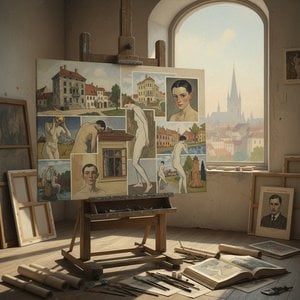
Egon Schiele's Top 25 Meesterwerken: Kunstprints voor een Unieke Woonstijl
Ontdek de 25 meest iconische werken van Egon Schiele! Duik diep in zijn expressionistische wereld vol intense portretten en emotionele kracht. Vind museumkwaliteit reproducties & unieke wanddecoratie op ArtsDot.com. Exploreer de collectie online!

Ephemeral Visions: Exploring the Artistic Legacy & Contemporary Practice of Watercolor Painting
Explore the captivating world of watercolor painting! Discover its rich history, essential techniques, influential artists & collecting tips. A comprehensive guide for art enthusiasts from ArtsDot.

Ephemeral Visions: Exploring the History & Emotional Resonance of Watercolor Painting
Explore the captivating history of watercolor painting, from ancient techniques to modern masters like Kandinsky & Blake. Discover essential artists, collecting tips & the emotional power of this luminous medium. Expert insights for art enthusiasts.