

 Voorvertoning
 Verstuur
 Delen
Delen
 Details bekijken
 Gids
Gids

 Download
 Vergelijkbare items
 Röntgenonderzoek
 Diavoorstelling
 Vraag & antwoord
 Statistieken
Virgin and Child

- 62.0 x 42.0 cm


 Lees meer
Giclée / Kunstafdrukken
Giclée- of canvasafdruk van museumkwaliteit met een snelle productie en flexibele afwerkingsmogelijkheden. ( Bestel handgeschilderde reproductie Schakel over naar digitale afbeeldingen)




P118B €10

P118H €10

P118W €10

P438Z €10

P508JH €12

P508YH €12

P805H €10

P805Z €10

P919BZ €10

P919G €10

P919XJ €10

P959ZH €10

P968JZ €12

W106C €8

W218G €10

W218JH €8

W218Y €10

W307PJ €10

W316G €10

W316PJ €8

W316Y €10

W398PJ €8

W4111J €10

W500HY €15

W500JH €15

W692G €12

W849H €8

W940BG €15

W953PJ €8




Kies uit onze vooraf ingestelde maten die overeenkomen met de originele verhoudingen van het kunstwerk.

Voer de gewenste breedte en hoogte in, passend bij uw lijst of muur. Een afdruk kan alleen worden ingekort en nooit groter worden gemaakt dan het origineel; een formaat met andere verhoudingen zal daarom een deel van de afbeelding verliezen. Wij sturen u een digitaal mockup ter goedkeuring voordat we tot drukwerk overgaan. De afbeelding op deze pagina toont niet de werkelijke uitsnede — dit is alleen te zien op het mockup.
Wereldwijde levering () binnen 2 weken in plaats van de standaard 4/5 weken. (3 november)

Gratis wereldwijde expressverzending

Hoogwaardig linnen canvas

Volledige verzendverzekering

Garantie op terugbetaling van invoerrechten

Garantie op exacte kleurweergave

Retourbeleid van 100 dagen (alleen bij defecten)

100% Geld-terug-garantie

Korting bij meerdere afnames
 De optie voor glas is alleen beschikbaar bij een formaat kleiner dan 110 cm.

Virgin and Child
Giclée / Kunstafdrukken
Afmetingen reproductie
-


Eindtotaal
€ 56
Exquisite Subject and Sacred Symbolism
This captivating painting depicts the revered Madonna and Child, a timeless symbol of divine grace and maternal tenderness. The central figures radiate serenity and spiritual intimacy, inviting viewers into a sacred moment of reverence. The Madonna’s gentle gaze and the infant Jesus’s innocent expression evoke a profound sense of devotion, making this piece a powerful focal point for both personal reflection and spiritual inspiration.Masterful Style and Artistic Technique
Created during the Renaissance or Baroque period, this artwork exemplifies meticulous craftsmanship and a deep understanding of religious iconography. The artist employs fine brushwork and a rich palette of colors—subtle pinks, warm oranges, and luminous golds—that enhance the divine atmosphere. The careful use of light and perspective creates a sense of depth, drawing the viewer’s eye directly to the sacred figures and emphasizing their spiritual significance.Historical Context and Artistic Significance
Produced around 1520, this painting reflects the era’s devotion to religious themes and the revival of classical artistic principles. During this period, religious artworks served as both devotional objects and expressions of cultural identity. The balanced composition and symbolic elements—such as the serene landscape background—situate the divine within a natural, earthly realm, bridging the spiritual and the worldly.Symbolism and Emotional Impact
Every detail in this piece is imbued with meaning: the tender embrace signifies divine love and maternal care, while the harmonious composition underscores spiritual harmony. The use of radiant colors and delicate textures evokes feelings of peace, hope, and reverence. This artwork not only celebrates religious devotion but also inspires a sense of calm and spiritual elevation in its viewers.Perfect for Collection and Interior Design
Ideal for art collectors, interior designers, and those seeking a meaningful centerpiece, this hand-painted reproduction offers a high-quality, timeless addition to any space. Its profound symbolism and exquisite craftsmanship make it a compelling conversation piece, enriching both private collections and sacred environments. Whether displayed in a living room, chapel, or gallery, this piece transforms any setting into a sanctuary of beauty and spiritual reflection.Veelgestelde vragen
Welk kleurenpalet wordt gebruikt in "Virgin and Child"?
"Virgin and Child" door Cranach The Elder maakt gebruik van een Earthy kleurenpalet. Dit palet vat het algemene kleurkarakter van het werk samen.
Zijn de kleuren van "Virgin and Child" door Cranach The Elder levendig of gedempt?
De kleuren van "Virgin and Child" door Cranach The Elder vertonen een Balanced Soft verzadiging met een Balanced intensiteit.
Zijn er werken die lijken op "Virgin and Child"?
Op de Vergelijkbare werken-pagina van dit kunstwerk vindt u vergelijkbare werken als "Virgin and Child" door Cranach The Elder.
Vergelijkbare kunstwerken


Biografie kunstenaar
Lucas Cranach the Elder: Life and Legacy
Early Life and Training
- Born around 1472 in Kronach, Germany, Lucas Cranach the Elder was a pivotal figure of the German Renaissance.
- His father, Hans Maler (meaning “the painter”), provided his initial artistic training.
- The specifics of his early education remain somewhat unclear, but it’s believed he studied with South German masters and potentially spent time in Vienna.
Career at the Saxon Court
- In 1504, Cranach entered the service of Duke Frederick III, Elector of Saxony (Frederick the Wise), marking a turning point in his career.
- He became the court painter and remained in this position for life, creating portraits, altarpieces, and woodcuts.
- His workshop flourished, becoming one of the most productive artistic centers in Germany.
Artistic Style and Influences
- Cranach’s style is characterized by elegant elongated figures, delicate colors, and a keen observational skill.
- He was influenced by the Northern Renaissance emphasis on realism and detail.
- Early works show influences from traditional religious art, but his style evolved over time.
- His work often blended mythological and religious themes with a distinctive aesthetic sensibility.
Major Works and Themes
- Notable paintings include Judith victorious, Venus and Cupid, and The Golden Age.
- He produced numerous portraits, including a series of depictions of Catherine Bore.
- Cranach is particularly famous for his portraits of Martin Luther, creating eleven surviving images of the reformer.
- His work frequently explored themes of love, beauty, morality, and religious faith.
The Reformation and Cranach’s Role
- Cranach was a staunch supporter of the Protestant Reformation and embraced its cause with enthusiasm.
- He used his art to promote Reformation ideals, creating images that challenged traditional Catholic iconography.
- His close friendship with Martin Luther profoundly influenced his artistic output.
Legacy and Historical Significance
- Cranach’s workshop continued to produce works in his style after his death in 1553, carried on by his son, Lucas Cranach the Younger.
- He is considered one of the most successful German artists of his time.
- His art provides valuable insights into the social, religious, and political landscape of the 16th century.
- Cranach’s influence can be seen in the work of later Renaissance and Baroque artists.

Cranach The Elder
1553 , Germany
Belangrijkste feiten
- Name: Lucas Cranach the Elder
- Movement: German Renaissance, Northern Renaissance
- Birth_Date: c. 1472
- Death_Date: 1553
- Influenced: His son, Lucas Cranach the Younger
- Birth_Place: Kronach, Germany
- Nationality: German
- Date Of Death: 1553
- Influenced_By: South German masters
- Notable_Works:
- Judith victorious
- Venus and Cupid
- The Golden Age
- Portraits of Catherine Bore
- Hans Melber
- Portraits of Martin Luther
- Place Of Birth: Kronach, Germany
Gerelateerde artikelen

Illuminating Belief: Faith & Symbolism Across Art History's Canvas
Explore the rich history of faith through art! Discover religious symbolism, Renaissance masterpieces & iconic artists. Expert analysis for collectors & enthusiasts. Learn more at ArtsDot.
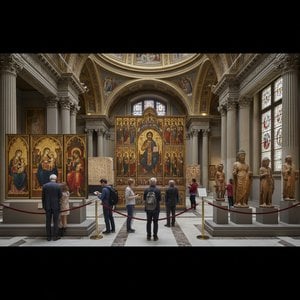
Sacred Narratives Embodied: A Comprehensive Exploration of Religious Iconography in Art History
Explore the rich history of religious iconography in art! Discover symbolism, movements & masterpieces from Byzantine to Renaissance periods. Expert insights for collectors and enthusiasts at ArtsDot.

Fra Angelico's Top 25 Meesterwerken: Renaissance Kunst voor uw Interieur | ArtsDot.com
Ontdek de 25 mooiste meesterwerken van Fra Angelico! Verlies u in de spirituele schoonheid van Renaissance fresco's & panel schilderijen. Koop museumkwaliteit reproducties en breng Italiaanse kunst naar uw interieur op ArtsDot.com.

Raphael's Meesterwerken: 25 Iconische Kunstwerken voor uw Interieur | ArtsDot
Ontdek de 25 meest iconische meesterwerken van Raphael! Duik in de Renaissance kunst, bewonder zijn portretten & religieuze schilderijen. Hoogwaardige reproducties voor uw interieur op ArtsDot.com.

Sacred Narratives on Canvas: Exploring Religious Painting Through History
Explore the rich history of religious painting with ArtsDot.com! Discover iconic artworks, symbolism & techniques from antiquity to the Renaissance. Enhance your art appreciation today.