

 Voorvertoning
 Verstuur
 Delen
Delen
 Details bekijken
 Gids
Gids

 Download
 Vergelijkbare items
 Röntgenonderzoek
 Diavoorstelling
 Vraag & antwoord
 Statistieken
neubrandenburg

 Lees meer
Giclée / Kunstafdrukken
Giclée- of canvasafdruk van museumkwaliteit met een snelle productie en flexibele afwerkingsmogelijkheden. ( Bestel handgeschilderde reproductie Schakel over naar digitale afbeeldingen)




P118B €10

P118H €10

P118W €10

P438Z €10

P508JH €12

P508YH €12

P805H €10

P805Z €10

P919BZ €10

P919G €10

P919XJ €10

P959ZH €10

P968JZ €12

W106C €8

W218G €10

W218JH €8

W218Y €10

W307PJ €10

W316G €10

W316PJ €8

W316Y €10

W398PJ €8

W4111J €10

W500HY €15

W500JH €15

W692G €12

W849H €8

W940BG €15

W953PJ €8




Kies uit onze vooraf ingestelde maten die overeenkomen met de originele verhoudingen van het kunstwerk.

Voer de gewenste breedte en hoogte in, passend bij uw lijst of muur. Een afdruk kan alleen worden ingekort en nooit groter worden gemaakt dan het origineel; een formaat met andere verhoudingen zal daarom een deel van de afbeelding verliezen. Wij sturen u een digitaal mockup ter goedkeuring voordat we tot drukwerk overgaan. De afbeelding op deze pagina toont niet de werkelijke uitsnede — dit is alleen te zien op het mockup.
Wereldwijde levering () binnen 2 weken in plaats van de standaard 4/5 weken. (12 november)

Gratis wereldwijde expressverzending

Hoogwaardig linnen canvas

Volledige verzendverzekering

Garantie op terugbetaling van invoerrechten

Garantie op exacte kleurweergave

Retourbeleid van 100 dagen (alleen bij defecten)

100% Geld-terug-garantie

Korting bij meerdere afnames
 De optie voor glas is alleen beschikbaar bij een formaat kleiner dan 110 cm.

neubrandenburg
Giclée / Kunstafdrukken
Afmetingen reproductie
-


Eindtotaal
€ 56
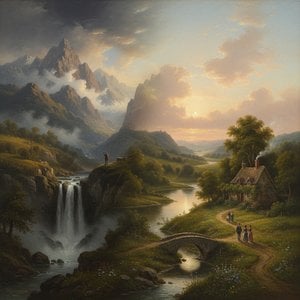
A Vista of Quietude: Exploring Caspar David Friedrich’s *neubrandenburg*
This evocative landscape by Caspar David Friedrich transports viewers to a serene yet subtly melancholic world. *neubrandenburg* is not merely a depiction of a town and its cathedral; it's an exploration of humanity’s place within the vastness of nature, a hallmark of the Romantic era. The painting presents a distant view of Neubrandenburg, dominated by the imposing spire of its cathedral, set against a dramatic skyscape.Style & Historical Context
Friedrich was a pivotal figure in the German Romantic movement (early 19th century), a period characterized by an emphasis on emotion, individualism, and the sublime power of nature. Rejecting the Enlightenment’s focus on reason, Romantics sought spiritual truth through experiencing the natural world. *neubrandenburg* exemplifies this ethos. The painting's style leans heavily into Romantic ideals – it isn’t a precise topographical rendering but rather an emotional response to the landscape. This was a time of significant societal shifts; the rise of industrialization and urbanization led many to yearn for a connection with the unspoiled beauty of nature, which Friedrich masterfully captures. His work often served as a counterpoint to the increasingly materialistic world.Composition & Technique
The composition is powerfully structured around horizontal lines – the horizon dividing the scene into foreground, middle ground and background. This reinforces the sense of expansive space. The small figures in the lower right corner are crucial; they provide a scale reference, emphasizing the immensity of the landscape and subtly suggesting human insignificance within it. Friedrich’s technique is characterized by loose brushstrokes and a muted color palette. He expertly employs atmospheric perspective – colors become paler and less saturated with distance – to create a convincing illusion of depth. The oil on canvas medium allows for rich texture and nuanced tonal variations, particularly in the swirling clouds that dominate the sky.Symbolism & Interpretation
The cathedral spire is arguably the focal point, rising above the town as a symbol of faith and spiritual aspiration. However, its distance and relative smallness within the vast landscape suggest a questioning of traditional religious authority. The dramatic sky, transitioning from dark greys to golden hues, can be interpreted as representing both hope and uncertainty – the transient nature of life itself. The figures in the foreground, seemingly lost in contemplation, invite viewers to share their quiet introspection. Friedrich frequently used landscapes not just as representations of places but as mirrors reflecting inner emotional states.Emotional Impact & Legacy
*neubrandenburg* evokes a sense of peaceful solitude and contemplative melancholy. It’s a painting that encourages viewers to pause, reflect, and connect with the natural world on a deeper level. The work's enduring appeal lies in its ability to tap into universal human emotions – awe, wonder, and a longing for something beyond the material realm. Friedrich’s influence can be seen in subsequent artistic movements, including Symbolism and Expressionism, and his landscapes continue to inspire artists and viewers alike today. A reproduction of this painting would bring a sense of tranquility and intellectual depth to any interior space.Veelgestelde vragen
Waarvoor wordt een afdruk van "neubrandenburg" aanbevolen?
Een afdruk van "neubrandenburg" wordt aanbevolen voor Accent.
Waar kan ik een digitale afbeelding van "neubrandenburg" door Caspar David Friedrich kopen?
Om een digitale afbeelding van "neubrandenburg" door Caspar David Friedrich te verkrijgen, kunt u een digitale afbeelding in hoge resolutie om te downloaden bestellen op de Digitale afbeelding pagina.
Wat is de algemene sfeer van "neubrandenburg" door Caspar David Friedrich?
"neubrandenburg" door Caspar David Friedrich wordt qua stemming beschreven als Romantic. Deze classificatie kan helpen om het werk te laten aansluiten bij een bepaalde omgeving.
Vergelijkbare kunstwerken


Biografie kunstenaar
Een Eenzame Visie
Geboren in de Baltische havenstad Greifswald in 1774, werden de vroege jaren van Caspar David Friedrich gevormd door een diep gevoel van verlies. De dood van zijn moeder en broers wierp een lange schaduw over zijn jeugd, wat leidde tot een gevoeligheid voor sterfelijkheid die een centraal thema in zijn werk zou worden. Hij begon zijn opleiding onder zijn broer Christian, voordat hij kunst en theologie ging studeren aan de Universiteit van Leipzig. Hoewel hij geen van beide studies voltooide, zou deze dubbele interesse in het visuele en het spirituele zijn creatieve pad bepalen. Zijn technische vaardigheden werden verder verfijnd in Kopenhagen, waar hij in aanraking kwam met landschapstradities die hij uiteindelijk zou transformeren tot een medium om innerlijke emotionele staten uit te drukken.
Zijn benadering van het landschap bewoog zich weg van het minutieuze detail dat zijn voorgangers prefereerden. In plaats daarvan streefde hij ernaar de natuur te doordrenken met symbolische betekenis, waarbij hij natuurlijke elementen gebruikte om de menselijke ziel te representeren. Hij maakte vaak gebruik van Rückenfiguren—figuren die van achteren worden gezien—om de kijker uit te nodigen deel te nemen aan een contemplatieve ervaring. Zijn palet, vaak samengesteld uit gedempte blauwen, grijzen en bruinen, versterkte de sfeer van introspectie en plechtigheid die zijn oeuvre doordringt. Hij schilderde niet louter wat hij zag; hij schilderde het innerlijke weer van de menselijke geest.
De Taal van het Verhevene
Het werk van Friedrich benadrukt het verhevene, waarbij hij streeft naar een spirituele verbinding door de schaal van de natuurlijke wereld. Zijn composities plaatsen vaak eenzame figuren tegenover een uitgestrekt, vaak overweldigend landschap. In "Wanderer above the Sea of Fog" (ca. 1818) confronteert de silhouetachtige figuur een kolkende zee van mist, wat de spanning belichaamt tussen de menselijke aanwezigheid en het oneindige. "The Sea of Ice" (1824) presenteert een ijzige Arctische wildernis, een weergave van de immense kracht van de natuur en haar onverschilligheid tegenover het menselijk lot. Deze werken weerspiegelen een preoccupatie met de fragiliteit van het bestaan en de zoektocht naar betekenis binnen het landschap.
Zijn schilderijen maken vaak gebruik van specifieke elementen om deze innerlijke staten over te brengen:
- "The Abbey in the Oakwood" (1809-1810), waar een ruïne van een kerkhof en kale bomen wijzen op sterfelijkheid en spiritueel verval.
- "Chalk Cliffs on Rügen" (1818), dat atmosferisch licht gebruikt om de kustlijn te definiëren.
- "The Watzmann," een weergave van de majesteit van de bergen.
- "Evening Landscape with Two Men" (1830), een verstilde scène van contemplatie tijdens de schemering.
Nalatenschap en Herontdekking
De loopbaan van Friedrich kende geen gestage opmars. Hoewel hij tijdens zijn leven erkenning kreeg, nam zijn populariteit af naarmate de artistieke smaak verschoof naar andere stromingen. Hij stierf in Dresden in 1840, en voor een tijd verdween zijn naam uit de voorgrond van de kunstwereld. Zijn reputatie onderging een significante herontdekking in de late 20e eeuw, toen hij werd erkend als een centrale figuur in de Duitse Romantiek. Zijn nadruk op subjectieve ervaring en emotionele expressie plaveide de weg voor latere bewegingen, waaronder het Symbolisme en het Surrealisme.
Zijn invloed reikte tot kunstenaars die de innerlijke wereld wilden verkennen via visuele middelen. Door het rationalisme van de Verlichting te verwerpen ten gunste van emotie en verbeelding, legde hij de geest van een tijdperk vast. Zijn landschappen dienden als symbolen van nationale identiteit tijdens een periode van politieke fragmentatie in Duitsland. Vandaag de dag blijft zijn werk resoneren en herinnert het het publiek aan de diepe verbinding tussen de mensheid en de natuurlijke wereld.

Caspar David Friedrich
1774 - 1840 , Duitsland
Belangrijkste feiten
- Artistic Movement Or Style: Romantiek
- Artists Or Movements Influenced By This Artist:
- Symbolisten
- Surrealisten
- Artists Who Influenced This Artist:
- Nederlandse meesters
- J.C. Dahl
- Date Of Birth: 1774
- Date Of Death: 1840
- Full Name: Caspar David Friedrich
- Nationality: Duits
- Notable Artworks:
- Abbey in the Oakwood
- Wanderer above the Sea...
- Kreidefelsen auf Rügen
- The Sea of Ice
- Place Of Birth: Greifswald, Duitsland
Gerelateerde artikelen

Evoking Nature's Sublime: A Comprehensive Exploration of 19th-Century Landscape Painting
Explore the captivating world of 19th-century landscape painting! Discover renowned artists like Friedrich & Monet, key movements, and find the perfect artwork to bring nature's serenity into your home. Expert insights at ArtsDot.

The Sublime and the Picturesque: Exploring Emotion & Nature in Romantic Landscape Painting
Explore the emotional power of Romantic landscape painting! Discover the sublime & picturesque traditions, key artists like Friedrich & Cole, and find your perfect artwork at ArtsDot.

Romantische Landschappen: Top 10 Meesterwerken voor een Sfeervol Interieur | ArtsDot.nl
Ontdek de 10 meest iconische meesterwerken van de Romantiek! Reis door de tijd met Caspar David Friedrich, Turner & Delacroix. Laat je inspireren en vind museumkwaliteit kunst reproducties voor een sfeervol interieur op ArtsDot.com.
The Sublime and the Picturesque: Exploring Emotion & Nature in Romantic Landscape Painting
Explore the emotional power of Romantic landscape painting! Discover the sublime & picturesque aesthetics, key artists like Friedrich & Cole, and lasting influence on art history. Find your perfect piece at ArtsDot.

Caspar David Friedrich: Romanticism's Master of Landscape & the Sublimity of Inner Experience
Explore the profound landscapes of Caspar David Friedrich, a master of German Romanticism. Discover the symbolism, themes & enduring influence of this iconic artist. A deep dive into his life and work.


