
- Home

- Op canvas afdrukken
- Caspar David Friedrich
- Cross in the Mountains (Tetschen Altar)
 Bestel schilderij Koop afbeelding in hoge resolutie
 Verstuur
 Delen
Delen
 Details
 Toevoegen aan favorieten

 Download
 Vergelijkbare werken
 X-Ray
X-Ray
 Diavoorstelling
Cross in the Mountains (Tetschen Altar)
 Olieverf op canvas
- Wandkunst
- Romanticism
 1808
1808- 19e eeuw
 115.0 x 110.0 cm
 Gemäldegalerie Alte Meister
Giclée / Kunstafdruk
Giclée- of canvasafdruk van museumkwaliteit met snelle productie en flexibele afwerkingsopties.
 Lees meer over



P118B $10

P118H $10

P118W $10

P438Z $10

P508JH $12

P508YH $12

P805H $10

P805Z $10

P919BZ $10

P919G $10

P919XJ $10

P959ZH $10

P968JZ $12

W106C $8

W218G $10

W218JH $8

W218Y $10

W307PJ $10

W316G $10

W316PJ $8

W316Y $10

W398PJ $8

W4111J $10

W500HY $15

W500JH $15

W692G $12

W849H $8

W940BG $15

W953PJ $8




Kies uit onze vooraf ingestelde maten die overeenkomen met de originele verhoudingen van het kunstwerk.

U kunt uw eigen afmetingen opgeven om in een specifieke lijst of ruimte te passen. Als de door u gekozen maat niet overeenkomt met de proporties van het originele kunstwerk, zullen wij de afbeelding bijsnijden of uitbreiden met een gespiegelde of effen rand. Een digitaal mockup wordt ter goedkeuring naar u verzonden voordat de productie begint.
Houd er rekening mee dat de preview op het scherm de werkelijke bijsneding of uitbreiding niet weergeeft. Alleen de mockup toont de uiteindelijke compositie nauwkeurig.
Hoewel aangepaste maten beschikbaar zijn, raden wij aan een afmeting uit de vooraf bepaalde lijst te kiezen om de originele proporties te behouden.
Wereldwijde levering () binnen 2 weken in plaats van de standaard 4/5 weken. (1 juli)

Gratis wereldwijde expressverzending

Hoogwaardig linnen canvas

Volledige verzendverzekering

Garantie op terugbetaling van invoerrechten

Garantie op exacte kleurweergave

60 dagen retourbeleid (alleen bij defecten)

100% Geld-terug-garantie

Korting bij meerdere afnames
 De optie voor glas is alleen beschikbaar bij een formaat kleiner dan 110 cm.

Cross in the Mountains (Tetschen Altar)
Giclée / Kunstafdruk
Afmetingen reproductie
-


Eindtotaal
-
Beschrijving verzamelobject
A Vision of Faith and Nature: Exploring Caspar David Friedrich’s ‘Cross in the Mountains’
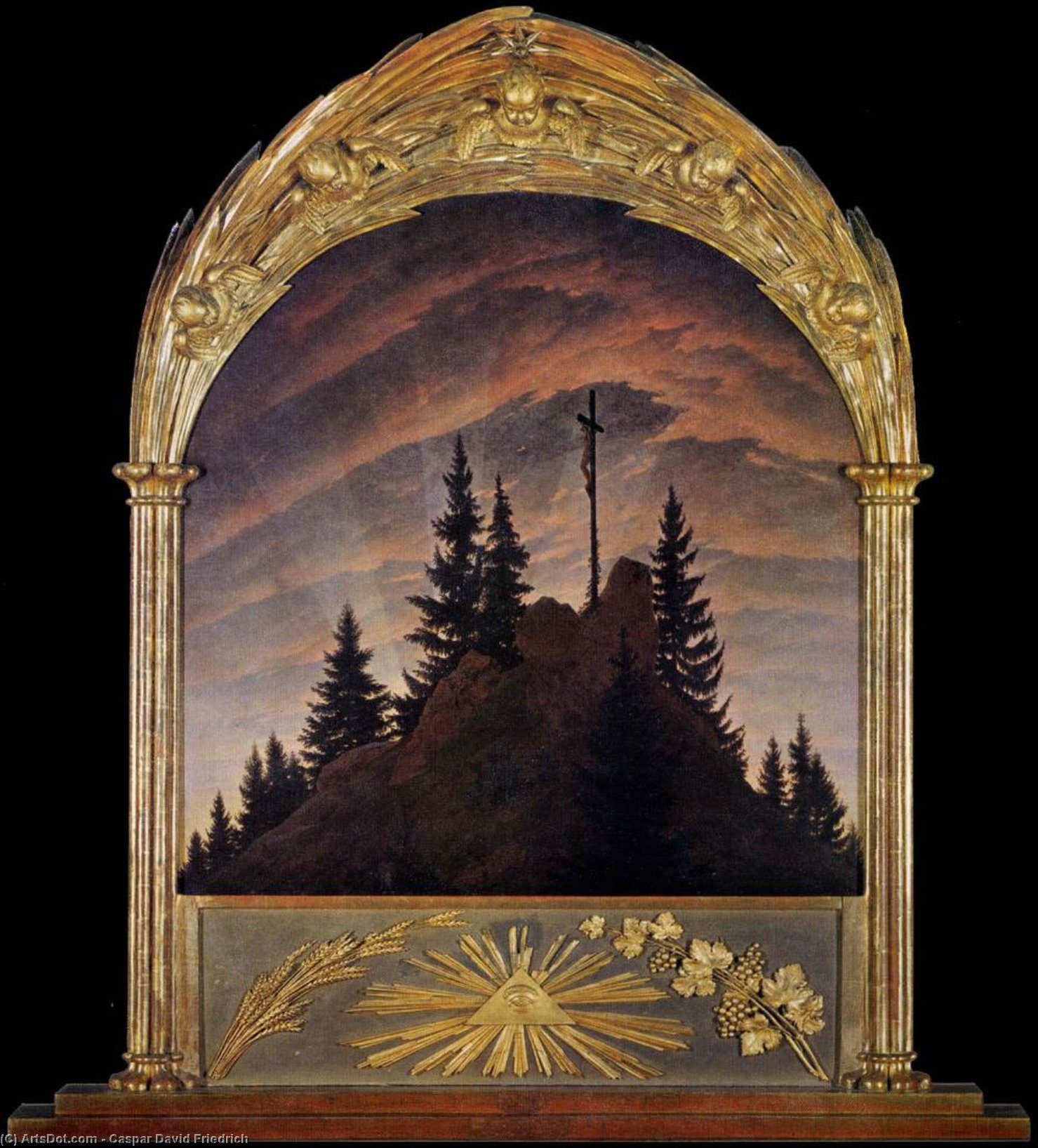
Caspar David Friedrich's “Cross in the Mountains (Tetschen Altar),” painted in 1808, stands as a cornerstone of Romantic art—a profound meditation on spirituality, nature, and the human condition. More than simply a landscape depiction, it’s an immersive experience, inviting viewers into a realm where earthly beauty intertwines with divine symbolism. Housed within the Gemäldegalerie in Dresden, Germany, this oil-on-canvas masterpiece transcends its physical dimensions to evoke a powerful emotional response, solidifying Friedrich's legacy as one of art history’s most influential figures.
The painting immediately captivates with its dramatic composition. A towering mountain dominates the scene, rendered in layers of atmospheric perspective that create an astonishing sense of depth and scale. Atop this rugged peak sits a solitary cross, bearing a Christ figure shrouded in shadow—a subtle yet potent symbol of sacrifice and redemption. Foreground elements are carefully considered: two trees, strategically placed on either side, draw the eye inward, while three more recede into the distance, anchoring the viewer within the landscape. The dark background serves not as mere backdrop but as a canvas for the light, intensifying the drama and highlighting the central figure of the cross.
Romanticism’s Soul: Symbolism and Spiritual Resonance
“Cross in the Mountains” is deeply rooted in the tenets of Romanticism—an artistic movement that prioritized emotion, intuition, and a profound connection with nature. Unlike the Neoclassical emphasis on reason and order, Friedrich sought to capture the sublime—that overwhelming sense of awe and terror inspired by the grandeur of the natural world. The cross itself isn’t simply a religious icon; it represents humanity's yearning for salvation, its struggle against mortality, and its connection to something larger than itself. The light emanating from behind the cross is often interpreted as divine illumination, suggesting that faith can be found even in the darkest corners of existence.
Furthermore, the painting’s ambiguity invites multiple interpretations. The distant location of the viewer—as if standing on a precipice overlooking the scene—creates a sense of isolation and contemplation. The lack of explicit narrative encourages viewers to project their own experiences and beliefs onto the image, making it profoundly personal. Friedrich's masterful use of light and shadow further enhances this effect, creating an atmosphere of mystery and spiritual intensity.
Technique and Context: A Master’s Vision
Friedrich’s technical skill is evident in every brushstroke. He meticulously rendered the textures of the rock face, the foliage of the trees, and the folds of the fabric draped over the cross. His use of color is restrained yet evocative—a palette dominated by cool blues and greens, punctuated by the warm glow of the sunlight. The painting’s scale – 115 x 110 cm – allows for a remarkable level of detail, inviting close inspection and revealing the artist's dedication to capturing the nuances of nature.
Commissioned for the private chapel of Schloss Tetschen by the Duke and Duchess of Thun-Hohenstein, “Cross in the Mountains” reflects Friedrich’s evolving artistic style. Initially influenced by Dutch Golden Age painters, he gradually developed a unique voice characterized by emotional intensity and symbolic depth. The painting's subsequent influence can be seen across various art movements, from Expressionism to Abstract Expressionism, demonstrating Friedrich’s enduring legacy as an innovator in the realm of landscape painting.
A Timeless Masterpiece: Reproduction Possibilities
ArtsDot offers meticulously crafted hand-painted reproductions of “Cross in the Mountains (Tetschen Altar),” allowing art enthusiasts to experience this iconic work firsthand. Our skilled artists faithfully recreate Friedrich’s masterful technique and evocative atmosphere, ensuring that each reproduction captures the painting's profound beauty and spiritual resonance. Whether you seek a stunning addition to your home or office, or a unique gift for an art lover, our reproductions provide an authentic and captivating representation of this timeless masterpiece. Explore the available options on ArtsDot.com and The Cross in the Mountains.
Vergelijkbare kunstwerken


Biografie van de kunstenaar
A Solitary Vision: The Life and Art of Caspar David Friedrich
Born in the Baltic port city of Greifswald in 1774, Caspar David Friedrich’s life was steeped in a melancholic atmosphere that would profoundly shape his artistic vision. His early years were marked by loss – the deaths of his mother and siblings cast a long shadow, fostering a sensitivity to mortality and transience that became central themes in his work. Initially educated by his older brother Christian in drawing, Friedrich’s formal training began at the University of Leipzig, where he pursued both art and theology, though neither degree was completed. This dual interest – a fascination with the visual world alongside a deep spiritual questioning – would prove crucial to his development as an artist. Further studies in Copenhagen honed his technical skills, exposing him to landscape painting traditions that would serve as a foundation for his unique style, yet it was not imitation he sought but rather expression—a means of conveying inner emotional states through the language of nature.The Birth of Romantic Landscape
Friedrich’s artistic journey wasn't merely about depicting scenery; it was about imbuing landscapes with profound symbolic meaning. He moved away from the meticulous detail favored by earlier artists, embracing a more personal and expressive approach. His paintings are characterized by an emphasis on the sublime – evoking feelings of awe, terror, and spiritual connection in the face of nature’s grandeur. The use of *Rückenfiguren*, figures seen from behind, became a signature element, inviting viewers to step into the scene and share in the contemplative experience. Natural elements like ancient trees, towering mountains, swirling fog, and crumbling ruins weren't simply picturesque details; they were potent symbols representing life’s cycles, spiritual longing, and the weight of history. His palette, often muted with blues, grays, and browns, further enhanced the mood of introspection and solemnity that pervades his work. He pioneered a way to depict landscapes not as mere views but as reflections of the human soul—a revolutionary concept for its time.Iconic Works and Enduring Themes
Several paintings stand out as defining examples of Friedrich’s artistic achievement. “Abbey in the Oakwood” (1809-1810), a haunting image of a ruined churchyard enveloped by bare trees, speaks powerfully to themes of mortality and spiritual decay. The composition is deliberately sparse, emphasizing the desolate beauty of ruin and prompting reflection on the passage of time. “Wanderer Above the Sea of Fog” (c. 1818), arguably his most recognizable work, depicts a solitary man gazing out over a misty mountain landscape. This iconic image embodies the Romantic ideal of the individual confronting the vastness and mystery of existence—a figure dwarfed by nature yet simultaneously connected to it on a spiritual level. The Rückenfigur technique powerfully conveys this sense of contemplation and vulnerability. “Chalk Cliffs on Rügen” (1818) demonstrates Friedrich’s mastery of atmospheric effects, capturing the ethereal quality of dawn light filtering through fog-laden cliffs. It subtly evokes German national identity—a growing concern in the fragmented political landscape of early 19th-century Germany. Finally, “The Sea of Ice” (1824) presents a dramatic depiction of an Arctic wasteland, representing nature’s immense power and indifference to human fate. The painting's chilling realism underscores Friedrich’s fascination with confronting the sublime—the awe-inspiring beauty that simultaneously inspires terror and reverence.Influences and Artistic Style
Friedrich drew inspiration from diverse sources, including Dutch Golden Age landscape painters like Jacob van Ruisdael, whose masterful use of light and atmosphere profoundly impacted his artistic sensibilities. He was also deeply influenced by the philosophical writings of Immanuel Kant, particularly Kant’s concept of transcendental idealism—the idea that our experience is shaped by innate mental structures rather than solely by sensory input. This intellectual framework informed Friedrich's belief in the importance of subjective perception and emotional expression as pathways to spiritual understanding. His artistic style is characterized by a deliberate simplification of form, prioritizing mood and symbolism over precise detail. He eschewed academic conventions, favoring instead a painterly technique that conveyed emotion through tonal gradations and textural variations—a radical departure from prevailing artistic trends.Legacy and Rediscovery
Friedrich’s art achieved considerable renown during his lifetime, though it remained largely unrecognized for decades after his death in Dresden in 1840. However, he experienced a significant revival in the late 20th century, becoming widely celebrated as one of the most important figures in German Romanticism. His emphasis on subjective experience and emotional expression paved the way for later movements like Symbolism and Surrealism, influencing generations of artists who sought to explore the inner world through visual means. He didn’t simply paint what he saw; he painted what he *felt*, and it is this profound honesty that continues to captivate and inspire audiences today. His work stands as a testament to the enduring power of art to confront existential questions—to contemplate our relationship with nature, with God, and with ourselves—a timeless contribution to Western artistic heritage.
Caspar David Friedrich
1774 - 1840 , Duitsland
Belangrijkste feiten
- Artistic Movement Or Style: Romantiek
- Artists Or Movements Influenced By This Artist:
- Symbolisten
- Surrealisten
- Artists Who Influenced This Artist:
- Nederlandse Meesters
- J.C. Dahl
- Date Of Birth: 5 september 1774
- Full Name: Caspar David Friedrich
- Nationality: Duits
- Notable Artworks:
- Abtei im Eichwald
- Wanderer über dem Nebelmeer
- Kreideklippen auf Rügens
- Das Eissee
- Place Of Birth: Greifswald, Duitsland
Gerelateerde artikelen

Arboreal Echoes: A Historical & Artistic Exploration of Trees in Painting
Explore the rich history of trees in painting! Discover symbolism, Romantic masterpieces by Caspar David Friedrich & beyond. A curated journey for art enthusiasts.


Arboreal Echoes: A Historical & Artistic Exploration of Trees in Painting
Explore the rich history of trees in painting! Discover symbolism, Romantic masterpieces by Caspar David Friedrich & beyond. A curated journey for art enthusiasts.

Caspar David Friedrich: Romanticism's Master of Landscape & the Sublimity of Inner Experience
Explore the profound landscapes of Caspar David Friedrich, a master of German Romanticism. Discover the symbolism, themes & enduring influence of this iconic artist. A deep dive into his life and work.

Johan Krouthén: Navigating Swedish Romanticism Through Landscape & Light
Explore the captivating landscapes of Johan Krouthén, a Swedish artist who broke from tradition to embrace realism & idealism. Discover his technique, influences, and legacy with ArtsDot.

Evoking Emotion & Transcendence: Romantic Landscape Painting (18th-19th Century)
Explore the emotional depth of Romantic landscape painting (18th-19th century). Discover key artists like Friedrich & Cole, and the concepts of the sublime. Expert insights for art lovers & collectors.



