

 Voorvertoning
 Verstuur
 Delen
Delen
 Details bekijken

 Download
 Vergelijkbare items
 Röntgenonderzoek
 Diavoorstelling
Taking the
 Watercolor
- WallArt
- Contemporary Realism
 1837
1837- 19th Century
 27.0 x 20.0 cm
 Amon Carter Museum of American Art
 Lees meer
Koop een digitale afbeelding in hoge resolutie met verbeterde kwaliteit, die veel superieur is aan de online voorvertoning.
Elk bestand wordt met uiterste precisie voorbereid door onze interne specialisten, met behulp van geavanceerde tools en deskundige handmatige retouche. Wij garanderen dat elke afbeelding een uitzonderlijke helderheid, nauwkeurige kleurweergave en verfijnde details bezit.
Het uiteindelijke bestand wordt binnen 72 uur per e-mail geleverd, geoptimaliseerd voor direct gebruik in professionele, redactionele en printomgevingen. Dit is dezelfde kwaliteit waarop vooraanstaande designstudio's, uitgevers en galerieën vertrouwen.
Digitale afbeeldingen
Download een bestand met hoge resolutie voor persoonlijke weergave, afdrukken en creatieve projecten. ( Bestel print Bestel handgeschilderde reproductie)
Inbegrepen bij elke bestelling van een digitale afbeelding
Professionele digitale levering, gegarandeerd
Wanneer u kiest voor ArtsDot.com, ontvangt u niet alleen een afbeelding – u krijgt een professioneel verbeterd digitaal kunstwerk, met precisie vervaardigd en voorzien van een tevredenheidsgarantie. Dit is alles wat automatisch bij uw bestelling is inbegrepen:

Snelle levering per e-mail
Uw hoogwaardige digitale afbeeldingsbestand wordt binnen 72 uur na bestelling naar u gemaild – klaar voor direct gebruik.

AI-verbeterd digitaal bestand
Uw kunstwerk wordt professioneel geoptimaliseerd met behulp van geavanceerde AI-tools en handmatige bewerkingen, waardoor maximale details, helderheid en kleurnauwkeurigheid worden gegarandeerd.

Gratis levenslange herlevering van digitale afbeeldingen
Je bestand per ongeluk verwijderd of kwijtgeraakt? Geen zorgen – we sturen het u op elk gewenst moment gratis opnieuw toe.

Geen invoerkosten – nooit
Geniet direct van uw kunstwerk zonder invoerrechten, belastingen of verzendkosten – digitale downloads zijn altijd belastingvrij.

Garantie op kleurgetrouwheid
Met behulp van professionele hulpmiddelen en kleurbeheer zorgen wij ervoor dat uw digitale afbeelding de originele kleuren zo nauwkeurig mogelijk weergeeft.

60 dagen tevredenheidsgarantie
Als u niet tevreden bent met uw digitale afbeelding, passen wij deze aan of storten wij 100% terug binnen 60 dagen – zonder vragen gesteld.

100% Geld-terug-garantie
Niet tevreden? Ontvang binnen 60 dagen na ontvangst van uw digitale bestand uw volledige aankoopbedrag terug – zonder vragen te stellen.

Korting bij grote bestellingen
Koop 3 afbeeldingen, bespaar 10% - Koop 5, bespaar 15% - Koop 10+, bespaar 20%. Ideaal voor creatieve projecten, galerieën en bureaus.
Beschrijving verzamelobject
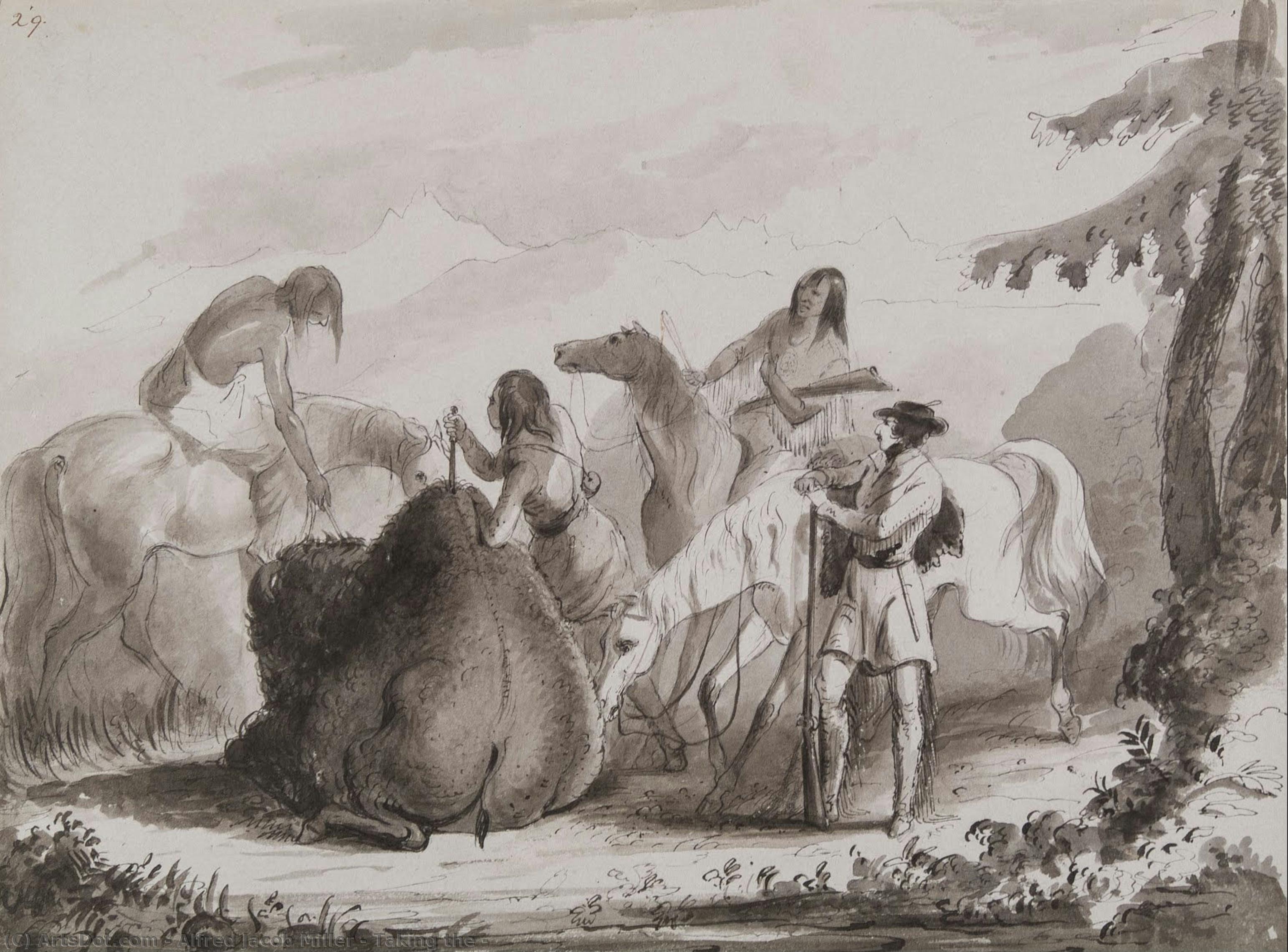
Taking the Hump Rib
Alfred Jacob Miller’s “Taking the Hump Rib” stands as an arresting testament to the Romantic spirit of American art—specifically, its fascination with the untamed frontier and the portrayal of indigenous cultures amidst the grandeur of the Rocky Mountains. Completed in 1837, this watercolor painting captures a pivotal moment during William Drummond Stewart's expedition into the West, documenting not merely scenery but also the complex interactions between European observers and Native American communities. The artwork’s composition immediately draws the eye to a central scene: a group of men—likely fur traders—engaged in assisting a horseman struggling to ascend a steep incline, aptly named “Hump Rib.” Miller skillfully employs watercolor techniques—characterized by delicate washes and subtle gradations of color—to convey both the ruggedness of the landscape and the palpable tension within the tableau. The muted palette—dominated by browns, greens, and blues—reflects the prevailing atmospheric conditions of the region during that time, lending an air of authenticity to the depiction. Beyond its technical prowess, “Taking the Hump Rib” resonates with deeper symbolic significance. It embodies the Romantic ideal of confronting nature’s challenges head-on, mirroring Stewart's ambition to explore and document the wilderness while simultaneously acknowledging the vulnerability of human endeavor against its formidable forces. The horseman represents not only physical exertion but also the pursuit of progress—a theme central to the burgeoning American Westward expansion. Simultaneously, Miller subtly portrays the collaborative spirit between Europeans and Native Americans, highlighting the necessity of mutual respect and understanding in navigating unfamiliar territories. The painting’s emotional impact is undeniable. It evokes a sense of immediacy and drama, transporting viewers back to 1837 and immersing them in the sights and sounds of the expedition. Miller's meticulous observation—evident in the detailed rendering of clothing, equipment, and facial expressions—transforms the scene into more than just a visual record; it becomes a window into the human experience within the context of an era defined by exploration, discovery, and cultural exchange.- Artist: Alfred Jacob Miller
- Year Created: 1837
- Medium: Watercolor
- Dimensions: 27 x 20 cm
- Location: Private Collection
Historical Context: The Fur Trade Era and Stewart’s Expedition
The painting emerged during the height of the fur trade era—a period marked by intense competition between European nations for control over lucrative trading routes in North America. William Drummond Stewart's expedition aimed to establish a foothold for the American Fur Company (AFC) among Native American tribes, primarily the Crow and Pawnee. Miller’s artwork serves as invaluable documentation of this undertaking, capturing not only the physical landscape but also the social dynamics inherent in intercultural encounters. The AFC sought to forge alliances with indigenous peoples while simultaneously exploiting their resources—a complex relationship that fueled both economic prosperity and cultural disruption.Technique: Watercolor Rendering and Observational Detail
Miller’s masterful watercolor technique—characterized by layering translucent washes of pigment—allowed him to achieve remarkable luminosity and tonal subtlety. He meticulously studied the effects of light on the terrain, skillfully capturing the rugged contours of the mountains and the diffuse glow of twilight. Furthermore, Miller's keen eye for detail extended beyond mere topographical representation; he painstakingly rendered clothing, equipment, and facial expressions, conveying a profound understanding of human behavior within the context of an unfamiliar environment.Symbolism: Confrontation with Nature and Collaboration Between Cultures
“Taking the Hump Rib” embodies several symbolic motifs that encapsulate the Romantic worldview prevalent during Miller’s time. The arduous climb represents humanity's struggle against nature—a recurring theme in Romantic art—while simultaneously symbolizing ambition and aspiration. Simultaneously, the collaborative effort between Stewart and his men underscores the importance of mutual respect and understanding in navigating intercultural relations—a sentiment particularly pertinent to the historical context of the fur trade era.Vergelijkbare kunstwerken


Kunstenaarsbiografie
A Pioneer of the American West
Alfred Jacob Miller, born in Baltimore in 1810, occupies a unique and vital position in the narrative of American art. He wasn’t merely a painter of landscapes or portraits; he was a visual chronicler of a vanishing world – the fur trade era of the Rocky Mountains and the lives of the Native American tribes who inhabited them. His journey to artistic recognition was unconventional, beginning not with formal academic training but with an innate talent nurtured by early exposure to artists like Thomas Sully. While attending John D. Craig’s Academy in Baltimore, Miller's education lacked a dedicated art curriculum, yet this absence perhaps fostered a distinctive style that would later set him apart. A pivotal period followed when he journeyed to Paris in 1832, immersing himself in the rigorous study of life drawing at the École des Beaux-Arts and absorbing the artistic traditions of Europe. This foundational experience honed his observational skills and provided a technical base upon which he would build his uniquely American vision.The Transformative Expedition
Miller’s career took an extraordinary turn in 1837, when fate – or perhaps artistic destiny – intervened in the form of Sir William Drummond Stewart, a Scottish aristocrat with a passion for the untamed West. Stewart commissioned Miller to accompany him on a hunting expedition into the heart of the Rocky Mountains, tasking him with documenting the landscapes and cultures encountered along the way. This wasn’t simply an assignment; it was an immersion into a world few Americans, let alone artists, had ever witnessed. For months, Miller meticulously sketched scenes of Native American life – the Sioux, Crow, Shoshone, and others – capturing their customs, clothing, rituals, and interactions with trappers and traders. He recorded the rugged beauty of the terrain, the drama of hunts, and the quiet moments of daily existence on the frontier. These weren’t romanticized depictions intended to glorify the West; they were honest observations imbued with a sensitivity that distinguished Miller's work from much of his contemporaries’. Upon returning to New Orleans, he transformed these sketches into a series of paintings that would establish his reputation as a significant figure in American art, offering an invaluable glimpse into a world on the cusp of irreversible change. The rendezvous was a grand affair devised by St. Louis businessman and politician William H. Ashley in 1822 to keep the fur trappers from leaving the mountains to deliver the season’s catch. He advertised for one hundred “Enterprising Young Men” who would agree to remain in the mountains for two or three years. (*St. Louis Enquirer*, 1822 and 1823) Each summer, Ashley sent a caravan of traders from St. Louis to meet the men at a prearranged place with supplies and trade goods to exchange for their pelts. Other companies followed his lead, and by the 1830s the rendezvous was made up of numerous camps involving hundreds of company trappers, free trappers, and sundry Indian tribes. Following several weeks of “High Jinks,” as Miller put it, and then some serious trading, the trappers and Indians would return to the mountains in time for the fall trapping season and the traders to St. Louis. (Russell, 1941, pp. 1 – 2; Clokey, 1980, p. 67; Ross, 1968, text accompanying plate 110; Wishart, 1979, pp. 121 – 124; Washburn, 1967, pp. 50 – 54) Miller’s adventure began shortly after he found quarters on the second floor of L. Chittenden’s dry-goods store at 26 Chartres Street in New Orleans, exchanging a portrait of the landlord for his first month’s rent. Miller displayed several paintings in the ground-floor window, and they apparently attracted the attention of a stylishly-dressed gentleman, whom he took to be a Kentuckian, who came in, browsed around and watched him paint for a few moments, commented favorably on his technique, then exited. A few days later, the man returned, introduced himself as Captain William Drummond Stewart, retired from the British Army, and explained that he was planning to attend the annual rendezvous of fur trappers and traders in the Rocky Mountains that summer and wanted an artist to accompany him to make a visual record of the trip. (Miller, Journal, p. 35) From British Consul John Crawford, who had previously served in Baltimore and might have known Miller there, Stewart assured the young Miller that the captain, a veteran of the peninsular campaign and Wellington’s victory over Napoleon at Waterloo, would be able to fulfill any financial commitments that he made. (Porter and Davenport, 1963, pp. 4, 16 – 19, 129; Strong, 200"
Alfred Jacob Miller
1810 - 1874 , Verenigde Staten
Belangrijkste feiten
- Artistic Movement Or Style: Realisme & Romanticisme
- Artists Who Influenced This Artist:
- Thomas Sully
- Horace Vernet
- Date Of Birth: January 2, 1810
- Date Of Death: 1874
- Full Name: Alfred Jacob Miller
- Nationality: Amerikaans
- Notable Artworks:
- De Lange Bosom Uitbreidt Zich Tot De Hemel
- Kamp Scène (Sioux)
- Grote Schaal (Een Crow Chief)
- Argali - Bergschapen
- Snelle Indianen Schieten Elk
- Shoshone Indiaan & Hond
- Place Of Birth: Baltimore, USA

