
- Home

- Op canvas afdrukken
- Albrecht Dürer
- Johannes Kleberger

 Bestel schilderij Koop afbeelding in hoge resolutie
 Verstuur
 Delen
Delen
 Details
 Toevoegen aan favorieten

 Download
 Vergelijkbare werken
 X-Ray
X-Ray
 Diavoorstelling
Johannes Kleberger
 Olieverf op paneel
- Overig
- Renaissance Humanisme
 1526
1526- Renaissance
 365.0 x 365.0 cm
 Kunsthistorisches Museum
Giclée / Kunstafdruk
Giclée- of canvasafdruk van museumkwaliteit met snelle productie en flexibele afwerkingsopties.
 Lees meer over



































Kies uit onze vooraf ingestelde maten die overeenkomen met de originele verhoudingen van het kunstwerk.

U kunt uw eigen afmetingen opgeven om in een specifieke lijst of ruimte te passen. Als de door u gekozen maat niet overeenkomt met de proporties van het originele kunstwerk, zullen wij de afbeelding bijsnijden of uitbreiden met een gespiegelde of effen rand. Een digitaal mockup wordt ter goedkeuring naar u verzonden voordat de productie begint.
Houd er rekening mee dat de preview op het scherm de werkelijke bijsneding of uitbreiding niet weergeeft. Alleen de mockup toont de uiteindelijke compositie nauwkeurig.
Hoewel aangepaste maten beschikbaar zijn, raden wij aan een afmeting uit de vooraf bepaalde lijst te kiezen om de originele proporties te behouden.
Wereldwijde levering () binnen 2 weken in plaats van de standaard 4/5 weken. (1 juli)

Gratis wereldwijde expressverzending

Hoogwaardig linnen canvas

Volledige verzendverzekering

Garantie op terugbetaling van invoerrechten

Garantie op exacte kleurweergave

60 dagen retourbeleid (alleen bij defecten)

100% Geld-terug-garantie

Korting bij meerdere afnames
 De optie voor glas is alleen beschikbaar bij een formaat kleiner dan 110 cm.

Johannes Kleberger
Giclée / Kunstafdruk
Afmetingen reproductie
-


Eindtotaal
-
Beschrijving verzamelobject
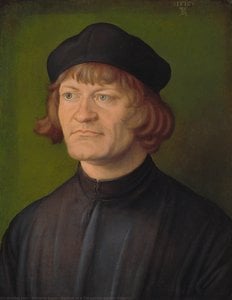
Johannes Kleberger: Een Portret van Macht en Intrige
Albrecht Dürer’s “Portret van Johannes Kleberger,” geschilderd in 1526, is meer dan alleen een nabijheid; het is een zorgvuldig geconstrueerde verklaring van welvaart, ambitie en politieke manoeuvreur binnen de complexe omgeving van de Duitse Renaissance. Deze unieke cirkelvormige portret, besteld door de internationale koopman zelf, biedt een fascinerende blik op het leven van een man die diep verbonden is aan Europese koninkelijkheid en gehuld in subtiele symboliek.
De Onderwerp: Johannes Kleberger – Financier en Hofhouding
Johannes Kleberger was een prominente figuur in de XVIe eeuw. Een internationale koopman met sterke banden tot het Franse hof, woonde hij buitenland af vanaf 1521, aanvankelijk in Bern en later in Lyon, waarbij hij één van Koningin Elisabeth I’s belangrijkste financiers werd. Zijn huwelijk met Felizitas Imhoff in 1528, dochter van de beroemde humanistische Willibald Pirckheimer (een goede vriend van Dürer), was een strategische unie die bemoeilijk werd door Pirckheimer’s initiële oppositie. Kleberger’s sluwheid en ambitie zijn tastbaar zelfs door het geschilderde beeld; hij verschijnt als een man van beslissende actie en geconcentreerde gedachte, terwijl hij rechtstreeks naar zijn rechterkant kijkt.
Artistieke Techniek en Samenstelling: Een Renaissance Innovatie
Dürer’s techniek in dit portret is opmerkelijk voor zijn innovatieve samenstelling. De bust, afgebeeld met prachtige realisme, lijkt te pulsen met leven, maar wordt abrupt afgekapt aan de onderkant en geframeerd binnen een cirkelvormige opening die doet denken aan een muur. Dit creëert een intrigerende paradox van stabiliteit en instabiliteit, gekwalificeerd door het donkere achtergrond. Dürer beheerst gebruik olieverf laagtechnieken, waardoor subtiele schittering en diepte ontstaan die de realisme van het portret versterken. Het gebruik van nauwkeurige lijnen definieert gezichtslijnen en tekstblokken, terwijl geometrische vormen – cirkels, ovale en rechthoekige blokken – dragen bij aan de formele structuur. De cirkelvorm zelf was een afwijking van het gebruikelijke portretteren, waardoor klassieke medaillen werden nagebootst en een gevoel van tijdloosheid en belangrijkheid werd gegeven aan Kleberger’s beeld.
Symboliek en Verborgen Betekenissen
Naast de prachtige afbeelding is “Portret van Johannes Kleberger” rijk aan symbolische elementen. De Latijnse tekst, herinnerend aan klassieke portrettenmedaillen, geeft informatie over Kleberger’s naam, oorsprong en leeftijd. Cruciaal is dat het ook het cabbalistische teken “sol in corde leonis” bevat (zon in het hart van een leeuw), verwijzend naar zijn astrologische constellatie bij geboorte – een symbool dat belooft bijzondere kracht en sterkte. Dürer, raadplegend Kleberger, integreerde verder referenties naar zijn karakter en positie binnen vier spandrelen: de astrologische teken voor Leo omringd door zes sterren, de kunstenaar’s handtekening, een figuurlijke wapenschild ( drie groene klauwblad boven een gele drieheuvels), en een herhaalde klauwbladmotief versierd met een helm – wat staat voor eerbiediging. Deze details verheffen het portret boven een eenvoudige nabijheid, waardoor het wordt omgevormd tot een zorgvuldig geconstrueerde representatie van deze invloedrijke figuur uit de Renaissance.
Historische Context en Emotionele Impact
Gemaakt tijdens een periode van significante politieke en sociale verandering in Europa, “Portret van Johannes Kleberger” weerspiegelt de opkomende humanistische idealen en de groeiende koopmansmacht. Het portrets emotionele impact ligt in zijn complexe afbeelding van een man die zowel bewonderd werd voor zijn financiële bekwaamheid als misschien verdacht werd vanwege zijn opportunistische aard. Dürer vangt niet alleen Kleberger’s buitenlijke verschijning maar geeft ook aanwijzingen over een innerlijke intensiteit, waardoor kijkers worden aangemoedigd om na te denken over de motivaties en complexiteiten van deze belangrijke figuur uit het Renaissance tijdperk.
Vergelijkbare kunstwerken



Biografie van de kunstenaar
A Life Forged in Nuremberg: The Early Years and Apprenticeship
Albrecht Dürer, a name synonymous with the German Renaissance, emerged from the bustling artisan city of Nuremberg in 1471. His father, Albrecht Dürer the Elder, was a successful goldsmith who had immigrated from Hungary, bringing with him a lineage steeped in craftsmanship. It was within this environment—the scent of metal and the meticulous precision of handiwork—that young Albrecht’s artistic inclinations first took root. Though his father envisioned a similar path for him, apprenticing him initially in the family trade, it soon became undeniable that Albrecht possessed an exceptional gift for drawing. At thirteen, he transitioned to the workshop of Michael Wolgemut, Nuremberg's leading artist at the time. This was no mere technical training; it was immersion into a world of illuminated manuscripts, painted panels, and—crucially—the burgeoning art of woodcut illustration. The sheer volume of work produced by Wolgemut’s workshop, including the extensive illustrations for the *Nuremberg Chronicle*, provided Dürer with an unparalleled foundation in design, composition, and the mechanics of image-making. A remarkable silverpoint self-portrait from 1484, created when he was barely a teenager, stands as astonishing evidence of his precocious talent—a testament to a burgeoning artistic identity already taking shape.
The Italian Influence and Artistic Maturation
Dürer’s ambition extended far beyond the confines of Nuremberg. Driven by an insatiable curiosity and a desire to master the art of painting, he embarked on his first journey to Italy in 1494. This was not simply a sightseeing trip; it was a pilgrimage to the heart of the Renaissance. He encountered the works of masters like Raphael, Giovanni Bellini, and Leonardo da Vinci—artists who were redefining the possibilities of form, perspective, and human expression. The impact of this exposure was profound. Dürer absorbed the classical motifs, harmonious compositions, and subtle sfumato techniques that characterized Italian art, yet he never abandoned his Northern European sensibility for meticulous detail and symbolic depth. A second sojourn to Italy between 1505 and 1507 further solidified these influences, allowing him to study ancient Roman ruins and refine his understanding of anatomy and proportion. This synthesis of Northern precision and Italian grace became the hallmark of Dürer’s unique artistic style.
Mastering the Mediums: Painting, Engraving, and Woodcut
Dürer was a master of multiple mediums, each offering him distinct avenues for creative expression. His paintings, though fewer in number than his prints, demonstrate a remarkable command of oil paint and an ability to capture both physical likeness and psychological depth. Works like the *Feast of the Rose Garlands* reveal a vibrant palette influenced by Venetian colorism. However, it was in the realm of printmaking—particularly engraving and woodcut—that Dürer truly revolutionized artistic practice. He elevated these techniques from mere reproductive methods to independent art forms, capable of conveying complex narratives and profound emotions. The *Apocalypse* series (1498), a collection of fourteen woodcuts illustrating the Book of Revelation, showcased his mastery of this medium despite its inherent limitations. Later engravings like *Melencolia I* (1514) and *Saint Jerome in His Study* (1514) are testaments to his unparalleled skill—intricate compositions filled with symbolic meaning and executed with breathtaking precision. He didn’t just depict reality; he imbued it with layers of intellectual and spiritual significance.
A Theorist and Innovator: The Legacy of Albrecht Dürer
Dürer was not merely an artist; he was a scholar, a theorist, and an innovator who sought to understand the underlying principles governing artistic creation. He believed in the mathematical foundations of art and dedicated himself to establishing a scientific approach to representation. His treatises on geometry, proportion, and human anatomy—most notably *Four Books of Human Proportion* (1528)—were groundbreaking for their time, demonstrating his commitment to rigorous observation and rational analysis. These writings were not simply academic exercises; they were intended to elevate the status of artists from mere craftsmen to intellectual practitioners. Dürer’s legacy extends far beyond his individual artworks. He bridged the gap between Northern European traditions and Italian Renaissance ideals, introducing classical motifs into Northern art while maintaining its distinctive character. His theoretical contributions helped establish a new framework for artistic practice, inspiring generations of artists with his technical skill, innovative spirit, and profound vision. He remains, to this day, one of the most important figures in the history of Western art.
Influences and Enduring Impact
- Michael Wolgemut: Dürer’s initial mentor, providing foundational skills in drawing, painting, and woodcut techniques.
- Leonardo da Vinci: Inspired Dürer’s exploration of anatomy, perspective, and sfumato—the subtle blending of tones.
- Raphael: Influenced Dürer’s compositional harmony and idealized forms.
- Giovanni Bellini: Contributed to Dürer's understanding of color and Venetian painting traditions.
Dürer’s influence reverberates through centuries of art history. His meticulous realism, his innovative use of printmaking, and his theoretical writings continue to inspire artists and scholars alike. He demonstrated that art could be both technically masterful and intellectually rigorous—a legacy that continues to shape the artistic landscape today. His work stands as a testament to the power of observation, the pursuit of knowledge, and the enduring human desire to create beauty and meaning.

Albrecht Dürer
1471 - 1528 , Duitsland
Belangrijkste feiten
- Artistic Movement Or Style: Renaissance
- Artists Or Movements Influenced By This Artist:
- Wolgemut
- Nuremberg
- Artists Who Influenced This Artist:
- Leonardo da Vinci
- Raphael
- Bellini
- Date Of Birth: 21 mei 1471
- Date Of Death: 6 april 1528
- Full Name: Albrecht Dürer
- Nationality: Duits
- Notable Artworks:
- Apocalypse
- Melencolia I
- St. Jerome
- Place Of Birth: Nuremberg, Duitsland
Gerelateerde artikelen

The Northern Awakening: Artistic Innovation & Cultural Transformation in the German Renaissance
Explore the artistic innovation of the German Renaissance! Discover Dürer, the Danube School & Reformation art. Learn about techniques, materials & lasting influence. Find museum-quality reproductions at ArtsDot.


Albrecht Dürer: A Renaissance Master's Legacy of Innovation and Self-Portraiture
Explore the life & art of Albrecht Dürer, a pivotal German Renaissance master. Discover his groundbreaking printmaking techniques, iconic self-portraits, and lasting influence on Western art history. A deep dive into innovation & symbolism.

Albrecht Altdorfer: Innovation, Spirituality & the Northern Renaissance Landscape
Explore the groundbreaking art of Albrecht Altdorfer, a pioneer of the Northern Renaissance's Danube School. Discover his innovative landscapes, spiritual symbolism & lasting influence on German painting.

The Digital Portrait Renaissance: Transforming Personal Photography into Timeless Oil Paintings Through Artistic Reproduction
Transform your cherished photos into timeless oil paintings with ArtsDot's expert artists. Museum-quality reproductions & custom portraits, crafted to last a lifetime. Discover the art of personal legacy.

Van Momentopname tot Meesterwerk: De Transformatie van Persoonlijke Fotografie door Renaissance Olieschilderkunst en Maatwerk
Transformeer uw foto's tot tijdloze Renaissance meesterwerken bij ArtsDot. Handgeschilderde reproducties met museumkwaliteit, persoonlijke service & 100% tevredenheidsgarantie. Investeer in een blijvende legacy.



