


 Voorvertoning
 Verstuur
 Delen
Delen
 Details bekijken

 Download
 Vergelijkbare items
 Röntgenonderzoek
 Diavoorstelling
Journey
 Oil
Oil- WallArt
- Bengal School of Art
 1913
1913- 19th Century
 210.0 x 150.0 cm
 National Gallery of Modern Art
 Lees meer
Handgemaakte olieverfreproductie
Met de hand geschilderd in olieverf op canvas in uw gewenste maat en lijst, op bestelling gemaakt door onze kunstenaars. ( Bestel print Koop afbeelding)




P118B $10

P118H $10

P118W $10

P438Z $10

P508JH $12

P508YH $12

P805H $10

P805Z $10

P919BZ $10

P919G $10

P919XJ $10

P959ZH $10

P968JZ $12

W106C $8

W218G $10

W218JH $8

W218Y $10

W307PJ $10

W316G $10

W316PJ $8

W316Y $10

W398PJ $8

W4111J $10

W500HY $15

W500JH $15

W692G $12

W849H $8

W940BG $15

W953PJ $8




Kies uit onze vooraf ingestelde maten die overeenkomen met de originele verhoudingen van het kunstwerk.

U kunt uw eigen afmetingen invoeren om in een specifieke lijst of ruimte te passen. Als de door u gekozen maat niet overeenkomt met de verhoudingen van het originele beeld, zullen we het kunstwerk bijsnijden of het schilderij uitbreiden met extra handgeschilderde elementen. Een digitale mockup wordt ter goedkeuring naar u verzonden voordat de productie begint.
Houd er rekening mee dat de preview op het scherm niet de werkelijke uitsnede of uitbreiding weergeeft. Alleen de mockup toont de uiteindelijke compositie nauwkeurig.
Hoewel aangepaste afmetingen mogelijk zijn, raden we aan een maat uit de vooraf gedefinieerde lijst te selecteren om de originele verhoudingen te behouden.
Na de bestelling zal het team van ArtsDot.com per e-mail contact opnemen met de klant voor instructies en een mockup-voorbeeld sturen.
Wereldwijde levering () binnen 3 tot 4 weken in plaats van de standaard 5 weken. (1 september). Zonder concessies aan de kwaliteit.

Gratis wereldwijde expressverzending

Hoogwaardig linnen canvas

Volledige verzendverzekering

Garantie op terugbetaling van invoerrechten

Garantie op exacte kleurweergave

Retourbeleid van 60 dagen (alleen bij defecten)

100% Geld-terug-garantie

Korting bij meerdere afnames
 De optie voor glas is alleen beschikbaar bij een formaat kleiner dan 110 cm.

Journey
Druktechniek
Afmetingen reproductie
-


Eindtotaal
$ 263
The Soul of the Bengal School: A Study of Abanindranath Tagore’s Journey
In the twilight of the 19th century, a profound artistic revolution began to stir within the heart of India, led by a visionary who sought to reclaim a national identity through the brush. Abanindranath Tagore, a central figure of the illustrious Tagore family, stood at the forefront of this movement, challenging the rigid dominance of British academic realism. His masterpiece, Journey (often referred to as Journey’s End), serves as a poignant testament to this era of transition. Created in 1913, the painting is not merely a depiction of a weary animal; it is a soulful rejection of Western oil traditions in favor of a new, indigenous aesthetic that blended the delicate precision of Mughal miniature traditions with the ethereal, misty qualities of the Japanese wash technique.
The composition invites the viewer into a moment of profound stillness and quietude. At its center lies a camel, collapsed under the immense weight of a heavy load, resting upon a bed of cloth. There is an undeniable intimacy in how Tagore captures this scene; the subject matter—a traditional vignette of trade and travel—is stripped of grandiosity to focus on the raw, emotive essence of endurance. The palette is masterfully subdued, dominated by warm, earthy tones that evoke a sense of dust, heat, and the passage of time. Through his precise yet delicate linework, Tagore defines the contours of the camel’s body and the irregular folds of its burden, creating a rhythmic harmony between the organic forms of the animal and the textured layers of the surrounding fabric.
Technique and the Ethereal Atmosphere
What distinguishes Journey from the heavy, physical presence of contemporary European oil paintings is its luminous, almost translucent quality. Tagore utilized a technique that favored a soft, atmospheric glow over harsh shadows. The light appears to descend from above, casting gentle shadows that lend a subtle three-dimensionality to the forms without breaking the flattened, decorative perspective characteristic of the Bengal School. This approach creates a misty, dreamlike appearance, where the boundaries between the subject and its environment seem to blur into a unified, emotive atmosphere.
For the discerning collector or interior designer, this artwork offers a sophisticated balance of texture and tone. The brushstrokes, while appearing slightly rough in certain areas to suggest the grit of travel, are applied with a finesse that allows for a sense of light to permeate the surface. This interplay of light and shadow makes the piece an exceptional focal point for spaces that require a sense of calm, depth, and historical resonance. It is a work that does not shout for attention but rather commands it through its quiet, persistent beauty.
Symbolism and Emotional Resonance
Beyond its technical brilliance, Journey is steeped in profound symbolism. The camel, burdened by its heavy load after long distances, serves as a powerful metaphor for resilience and the indomitable spirit of endurance. It reflects the very struggle of the Indian art movement itself—the weight of colonial influence being carried toward a new, self-determined destination. The load represents the labor, commerce, and the heavy history of a nation in flux, while the stillness of the scene suggests a moment of necessary reflection and rest amidst the toil.
To possess a reproduction of this masterpiece is to bring a piece of the Bengali Renaissance into one's personal sanctuary. The painting evokes a melancholic yet peaceful mood, making it an ideal selection for those seeking to infuse their interiors with intellectual depth and emotional warmth. It remains an unforgettable image, capturing a pivotal moment in art history where tradition was not merely preserved but reimagined to create something truly eternal.
Vergelijkbare kunstwerken


Biografie van de kunstenaar
Vroege Leven en Achtergrond
- Geboren: 7 mei 1861, Joransanko, Calcutta, Brits-Indië
- Overleden: 5 december 1951
- Familie: Lid van de vooraanstaande Tagore-familie; neef van Rabindranath Tagore. Zijn grootvader was Girindranath Tagore, en zijn vader was Gunendranath Tagore.
- Opleiding: Studeerde in de jaren 1880 aan het Sanskrit College in Kolkata en volgde later de Calcutta School of Art.
Artistieke Ontwikkeling en Invloeden
- Vroege Training: Leerde pasteltechnieken van O. Ghilardi en olieverfschilderen van Charles Palmer aan de Calcutta School of Art.
- Mughal- en Rajputstijlen: Streefde naar de modernisering van deze stijlen door westerse kunstmodellen te verwerpen.
- Swadeshi-waarden: Verweefde Swadeshi-waarden in zijn kunst om Indiase tradities te bevorderen.
- Whistlers Aestheticisme: Beïnvloed door de esthetische principes van Whistler.
- Japanse Invloed: Integreerde later Chinese en Japanse kalligrafische tradities in zijn stijl na ontmoetingen met de kunstenaars Tikan en Hesida.
Belangrijke Werken en Artistieke Bijdragen
- Rohini II: Een opmerkelijk werk dat zijn artistieke vaardigheid ten toon legt.
- Passing of Shajahan: Een ander significant schilderij dat zijn stijl weerspiegelt.
- Season Flower in a Vase: Demonstreert zijn meesterschap in techniek en onderwerp.
- Arabian Nights Serie (1930): Beschouwd als een van zijn grootste prestaties, waarbij hij verhalen uit de Duizend-en-één Nacht gebruikte om het koloniale Calcutta te verkennen.
- Bharat Mata: Een betekenisvol schilderij dat Moeder India symboliseert.
- Oprichter van de Bengal School of Art: Speelde een cruciale rol in de vorming van de moderne Indiase schilderkunst en het bevorderen van nationalistische kunst.
- Indian Society of Oriental Art (1907): Richtte deze vereniging op om traditionele Indiase kunstvormen te promoten.
Nalatenschap en Historisch Belang
- Pionier van de Moderne Indiase Schilderkunst: Erkend als een sleutelfiguur in de ontwikkeling van de moderne Indiase kunst.
- Invloed op Latere Kunstenaars: Mentor van vooraanstaande kunstenaars zoals Nandalal Bose, Asit Halder, Kshitindranath Majumdar en Jamini Roy.
- Revival van Traditionele Kunstvormen: Pleitte voor een terugkeer naar traditionele Indiase technieken en stijlen.
- Impact op de Bengaalse Kinderliteratuur: Schreef invloedrijke kinderboeken zoals Rajkahini, Budo Angla, Nalak en Khirer Putul.
- Nationale Kunstschatten: Zijn werken worden beschouwd als nationale kunstschatten.

Abanindranath Tagore
1871 - 1951 , India
Belangrijkste feiten
- Artistic Movement Or Style: Bengal School of Art
- Artists Or Movements Influenced By This Artist:
- Nandalal Bose
- Kshitindranath Majumdar
- Jamini Roy
- Artists Who Influenced This Artist:
- Whistler
- Mogol-kunstenaars
- Rajput-kunstenaars
- Date Of Birth: 7 mei 1871
- Date Of Death: 5 december 1951
- Full Name: Abanindranath Tagore
- Nationality: Indisch
- Notable Artworks:
- Rohini II
- Passing of Shajahan
- Season Flower in a Vase
- Place Of Birth: Jorasanko, India
Gerelateerde artikelen

Raja Ravi Varma: Bridging Tradition & Modernity in 19th-Century Indian Art
Explore the life & art of Raja Ravi Varma, a pioneer who fused European techniques with Indian iconography. Discover his iconic paintings, lasting legacy, and influence on modern Indian art at ArtsDot.

The Hague School: Realism, Atmosphere & the Dawn of Dutch Impressionism
Explore the Hague School's pivotal role in Dutch art history. Discover realism, atmospheric landscapes & its influence on Impressionism. Learn about key artists like Mauve & Maris with ArtsDot.

Top 10 Meesterwerken van de Hudson River School: Kunst voor uw interieur
Ontdek de 10 meesterwerken van de Hudson River School! Leer over Thomas Cole, Frederic Church & meer. Prachtige landschappen uit de 19e eeuw voor uw interieur. Kunst reproducties van museumkwaliteit op ArtsDot.com.

The Sublime Landscape: Exploring the Hudson River School Movement
Explore the captivating world of the Hudson River School! Discover the history, artists, and defining characteristics of this iconic American art movement. Learn about Romanticism's influence & find inspiration for your collection.
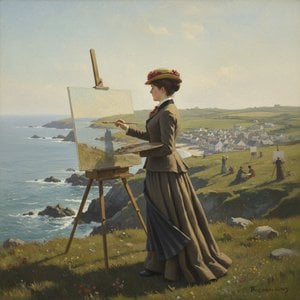
Elizabeth Adela Forbes: A Pioneering Impressionist of the Newlyn School
Explore the life & art of Elizabeth Adela Forbes, a pioneering Impressionist of the Newlyn School. Discover her captivating paintings, unique style, and lasting legacy with ArtsDot.


