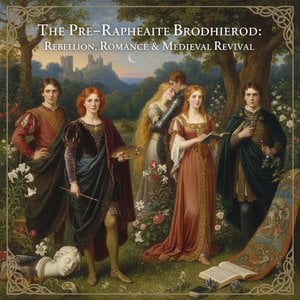
Sir Frank Dicksee: A Romantic Visionary of the Victorian Era
Sir Francis Bernard Dicksee, known affectionately to many as Frank, stands as a luminous figure in the tapestry of Victorian art history. Born in London in 1853, his life was destined for a profound engagement with the aesthetics of beauty and drama. He did not merely stumble into the world of fine art; rather, he inherited a deep artistic lineage from his father, Thomas Dicksee, whose early guidance instilled in the young artist a reverence for classical technique and narrative power. Growing up in the vibrant atmosphere of Fitzroy Square, Bloomsbury, Dicksee was immersed in a culture where the brushstroke was a tool for storytelling, laying the groundwork for a career that would eventually see him ascend to the highest echelons of the British art establishment.
His formal training began at the Royal Academy Schools in 1870, a period that provided the rigorous technical foundation necessary to execute his grander, more imaginative visions. While his roots were firmly planted in classical discipline, his spirit was deeply intertwined with the burgeoning interest in Pre-Raphaelite aesthetics. Although he was not an official member of the Pre-Rapha lite group, the influence of masters like Dante Gabriel Rossetti and William Holman Hunt is unmistakable in his work. From them, he adopted a commitment to capturing idealized beauty, often infused with mythological or literary references, and a dedication to meticulous detail that demanded the viewer's full, contemplative attention.
The Mastery of Narrative and Emotion
Dicksee’s oeuvre is celebrated for its ability to bridge the gap between historical documentation and romantic dreaming. He possessed a rare gift for transforming literary legends into breathing, emotive realities. One cannot discuss his contribution to art without reflecting on his hauntingly beautiful depiction of La belle dame sans merci. Inspired by the evocative poetry of John Keats, this masterpiece demonstrates his command over composition and expressive brushwork, transporting the viewer into a medieval world of enchantment and melancholy. Similarly, works such as The Mother showcase his ability to pivot from the epic to the intimate, capturing the tender essence of devotion and human connection with breathtaking realism.
Beyond the realm of legend, Dicksee was a master of portraiture, particularly noted for his exquisite renderings of fashionable women. These portraits were more than mere likenesses; they were studies in grace, elegance, and the subtle psychological depths of his subjects. Through the use of layering thin glazes of oil paint, he achieved a remarkable tonal subtlety and an atmospheric depth that allowed light to seem as though it were emanating from within the canvas itself. Whether portraying the contemplative gaze of a gentleman in John Belcher or the refined sophistication of Miss Edith Fitton, his technique always served the ultimate goal of emotional resonance.
Legacy and the Height of Artistic Achievement
The trajectory of Dicksee’s career was marked by consistent prestige and growing influence within the British art world. His talent was recognized early, leading to his election as a member of the Royal Academy in 1891. This ascent culminated in one of the most significant honors an artist could achieve: serving as the President of the Royal Academy in 1924. His contributions to the arts were so profound that he was knighted in 1925, a testament to his status as a pillar of his era. His work remains a vital window into the late nineteenth-century soul, reflecting a period defined by romantic idealism and an unwavering belief in the power of beauty.
Today, the legacy of Sir Frank Dicksee continues to inspire admiration among collectors and historians alike. His paintings, now housed in prestigious institutions such as the Bristol Museum and Art Gallery and the Haslemere Educational Museum, serve as enduring monuments to a vanished age of craftsmanship. He remains a definitive voice of the Victorian era, an artist who could weave together the threads of history, literature, and personal emotion into a seamless, luminous tapestry of light and color.
Klausimai ir atsakymai
Ar yra apžvalga visų temų, kurias vaizdavo Sir Francis Bernard (Frank) Dicksee?
Sir Francis Bernard (Frank) Dicksee Tematų katalogas yra puslapis, kuriame kūriniai suskirstyti pagal jų tematiką.
Ar galiu peržiūrėti Sir Francis Bernard (Frank) Dicksee kūrybą pagal nuotaiką?
Sir Francis Bernard (Frank) Dicksee Nuotaudų kambarys – tai puslapis, kuriame kūriniai sugrupuoti pagal nuotaiką.
Kur galiu pamatyti Sir Francis Bernard (Frank) Dicksee kūrybinę veiklą chronologine tvarka?
Sir Francis Bernard (Frank) Dicksee kūrybos laiko linija Kūrybos chronologija pateikia Sir Francis Bernard (Frank) Dicksee darbus chronologine tvarka, metus po metų.