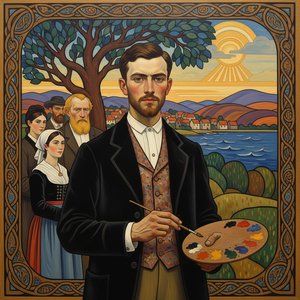
The Artistic Journey of Siegfried Berndt
Siegfried Berndt was a German painter and graphic artist. His artistic evolution moved from Impressionism, which he encountered in Paris, through Expressionism, and eventually toward Neue Sachlichkeit. He was a dedicated practitioner of woodcut techniques, a pursuit that began in 1903 and led him toward Expressionism. Throughout his career, Berndt's work was exhibited in various locations, including Berlin and Dresden. He served as an assistant in the studio of Eugen Bracht and later worked as a lecturer in the architecture class at the Dresden Academy of Fine Arts. Additionally, he held a position as an art and craft teacher at the Freie Waldorfschule Dresden.
Legacy and Recognition
Berndt's work has been featured in several collections and exhibitions. His pieces have been held in institutions such as the Lindenau-Museum in Altenburg, the Galerie Neue Meister in Dresden, and the Kupferstichkabinett. During the period of National Socialism, several of his works, including Straße, Der Teich, and Sitzender Junge, were confiscated and destroyed. Following the end of the Nazi era, Berndt continued to live and work in Dresden. His works have since seen a resurgence of interest, with a catalog focusing on his color woodcuts published in 2013.
Klausimai ir atsakymai
Kur galima rasti sugrupuotą pagal spalvų paletę Siegfried Berndt kūrybą?
Norėdami rasti Siegfried Berndt darbus konkrečia spalvų paleta, apsilankykite paveikslautojo Pagrinti pagal spalvų paletę puslapyje.
Kuriame mieste ir šalyje gimė Siegfried Berndt?
Siegfried Berndt gimė Görlitz, Germany šalyje.
Ar galiu pasimokyti apie Siegfried Berndt spalvų naudojimą visuose darbuose?
Siegfried Berndt darbų spalvų naudojimą, pateikiamus ši ši internetinė svetainė, galima išstudizuoti puslapyje Paletės genomas.
Kur galiu pamatyti Siegfried Berndt kūrybą 3D galerijoje?
Siegfried Berndt 3D galerija yra puslapis, kuriame kūriniai rodomi virtualioje trimensione galerijoje.