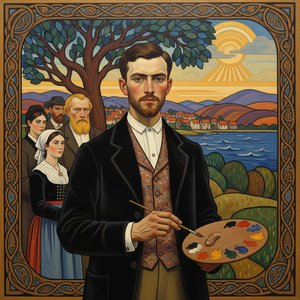
The Luminous Legacy of Paul Emil Jacobs
In the grand tapestry of nineteenth-century German Romanticism, few threads shine with as much exotic allure and technical grace as those woven by Paul Emil Jacobs. Born on August 20, 1802, in the scholarly atmosphere of Gotha, Jacobs was destined for a life where intellect and aesthetics would intertwine. As the son of the esteemed philologist Frederick Jacobs, his upbringing was steeped in the richness of classical literature and history, providing a profound intellectual foundation that would later inform his most evocative canvases. His formal artistic journey began at the prestigious Munich Academy of Fine Arts, an institution that instilled in him the rigorous academic discipline required to master the complexities of human anatomy and the subtle interplay of light.
The trajectory of Jacobs’s career was irrevocably altered by his move to Rome in 1824. This period of Mediterranean influence acted as a catalyst for his creative evolution, allowing him to absorb the classical grandeur and vibrant atmosphere of Italy. It was here that he first captured the critical imagination of the art world with "The Raising of Lazarus," a work that demonstrated not only his command over dramatic religious narrative but also an emerging ability to infuse monumental scenes with deep, palpable emotion. This early success paved the way for more ambitious undertakings, such as his 1836 commission at Hannover’s Welfenschloss, where he painted a series of historical works that showcased his versatility and his capacity to translate significant cultural events into enduring visual legacies.
Mastery of the Orientalist Vision and the Human Form
While his roots were firmly planted in German academic tradition, Jacobs’s heart often wandered toward the mysterious and opulent landscapes of the Orient. He became a celebrated figure within the Orientalist movement, a genre that sought to capture the perceived exoticism, luxury, and sensuality of Eastern cultures. His brushwork possessed a unique ability to render the textures of silk, the warmth of sun-drenched skin, and the intricate details of Middle Eastern life with breathtaking precision. In masterpieces such as "A Harem Beauty at her Toilette," Jacobs invites the viewer into a world of serene elegance and quiet luxury, where every detail—from the sheen of jewelry to the soft drape of fabric—contributes to an atmosphere of profound intimacy.
Beyond his fascination with the East, Jacobs was a virtuoso in the depiction of the human figure. His approach to nude art was characterized by a rare sensitivity; he avoided the purely clinical in favor of a poetic grace that celebrated the natural beauty of the body. This mastery is evident in works like "Zither-playing Turk," where the physical form is harmonized with tonal balance and expressive gesture, or his evocative portrayals of Scheherazade from the Arabian Nights, which utilize masterful light effects to create a sense of enchantment. Whether depicting the strength of "Greek Freedom Fighters"—reflecting his sympathy for the Greek War of Independence—or the tender vulnerability of sleeping figures, Jacobs’s work remains a testament to his ability to find the divine within the human.
A Lasting Impression on Art History
The significance of Paul Emil Jacobs extends far beyond the mere aesthetic pleasure of his paintings. He was an artist who bridged the gap between the rigid structures of classical mythology and the burgeoning romantic fascination with the "other." His ability to navigate diverse subject matters—ranging from religious altarpieces like "Calvary"* in Gotha to intimate lithographed portraits of luminaries such as Goethe—marks him as a truly multifaceted talent of his era. Through his meticulous attention to atmospheric effects and his profound empathy for his subjects, Jacobs left behind a body of work that continues to captivate the modern imagination, reminding us of a time when art sought to expand the boundaries of the known world through the lens of beauty and wonder.
Klausimai ir atsakymai
Kuriame mieste ir šalyje gimė Paul Emil Jacobs?
Paul Emil Jacobs gimė Gotha, Germany šalyje.
Kokias nuota išreiškia Paul Emil Jacobs kūryba?
Autoriaus Nuotaudų kambarys puslapio kūriniai yra sugrupuoti pagal Paul Emil Jacobs darbų atmosferą.
Kuriame istoriniame laikotarpyje kūrė Paul Emil Jacobs?
Paul Emil Jacobs kūrė 19th Century laikotarpiu. Šis laikotarpis leidžia įvertinti kūrybinę veiklą istoriniame kontekste.