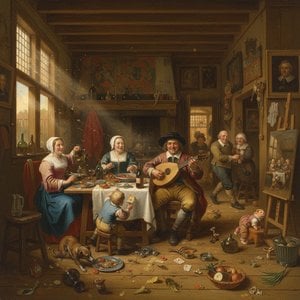
The Life and Origins of Jan Thopas
To understand the technical precision of Jan Thopas, one must look to his origins in Arnhem. Born about 1626, he entered a world that would require him to navigate life through sight and touch rather than sound. He was born deaf, a fact that shaped his lived experience and his eventual specialization in the silent, meticulous language of drawing. His early years were marked by a significant shift in family structure; following the death of his father, his mother remarried a mayor of Emmerich. This change in domestic circumstances likely influenced the movement of his family across the borders of the Netherlands and Germany during his formative years.
Jan Thopas emerged as a significant figure of the Dutch Golden Age, though his contribution was defined by a specific, narrow expertise. While many of his contemporaries sought scale and grandiosity, his focus remained on the intimate and the detailed. His ability to translate human character into leadpoint and wash suggests a mind accustomed to observing the subtle nuances of form without the distraction of auditory input. He was not a generalist of the canvas, but a specialist of the parchment, carving out a niche in a crowded artistic market through sheer technical command.
Early Life and Travels Through the Netherlands
Thopas’s early years were defined by a peripatetic existence, moving through various Dutch and German territories. Born in Arnhem, he likely spent time in Emmerich as a young child. His mobility was a necessity of his circumstances; because he was born deaf, he lived under the constant care of a guardian and resided with various family members. This reliance on a support network shaped his early movements as he navigated the social and professional landscapes of the Dutch Golden Age.
By the time he reached his teenage years, his residence shifted toward the major urban centers of the Netherlands. He lived in Utrecht until 1656, a period that established his presence in the regional art scene. From Utrecht, his path led him to Amsterdam, followed by a period in Haarlem. These shifts were not mere wanderings but part of a settled progression through the most significant commercial and artistic hubs of the era. His later life saw him in Zaandam and eventually Assendelft, where his movements finally ceased.
Specialized Techniques and Artistic Style
Thopas carved out a niche in the Dutch Golden Age by focusing on the precision of drawn portraiture and miniatures. He was a virtuoso in the use of plumbago, or leadpoint, often applying it alongside wash on vellum. This technical control allowed him to produce incredibly refined drawings that relied on subtle gradations rather than heavy brushwork. His preference for lead marker on parchment demonstrates a commitment to a medium that demands absolute accuracy from the hand.
His technical range extended beyond simple monochrome studies. He frequently worked in colour, utilizing parchment and Japanese paper to achieve specific textures and tones. This versatility allowed him to move between the rigid requirements of formal portraiture and the delicate demands of miniature work. The results are characterized by a technical refinement that prioritizes the clarity of line and the specific properties of the support material.
Notable Commissions and Key Works
Thopas demonstrated a technical versatility that extended beyond his specialized portraiture. He produced a brilliant copy of a painting by Cornelis Cornelisz van Haarlem, specifically the work depicting Venus, Mars and Cupid. This ability to translate existing compositions into his own refined style highlights his command over the medium. His output also included more somber subject matter, such as a painting portraying a dead child.
His engagement with private patrons is best seen in the Kerckrinck Series. This collection consists of nine drawings known today, which were commissioned by Theodorus Kerckrinck. These works represent a significant portion of his surviving output and demonstrate the high level of detail required for such specific commissions. His skill in capturing likenesses is further evidenced by his 1682 work, a deathbed portrait of a child, probably Catharina Margaretha van Valkenburg.
- Deathbed portrait of a child, probably Catharina Margaretha van Valkenburg (about 1680-1682)
- The Kerckrinck Series
Later Years and Death in Assendelft
The final chapter of Thopas's life was centered in Assendelft. After a career spent moving through the major Dutch art hubs, he settled in this location, where he remained until his death. His presence in Assendelft marks the conclusion of a peripatetic existence that had previously taken him through Utrecht, Amsterdam, and Haarlem.
Records regarding his passing are not perfectly synchronized. While some sources place his death between 1685 and 1695, the official record identifies 1695 as the year he died. This period of his life represents the end of a specialized career focused on the precision of drawn portraiture. He died in Assendelft, leaving behind a body of work that relied on the technical rigor of leadpoint and wash on vellum.
Where to See His Works Today
To encounter the technical precision of Thopas, one must look toward the major print cabinets of Europe. His drawings are not merely scattered; they are anchored in significant domestic and foreign collections that recognize his specific skill in leadpoint and wash. The Rembrandthuis holds a substantial portion of his output, containing nearly forty of his finest portraits. This concentration offers a rare opportunity to see the breadth of his portraiture in a single setting.
Beyond these institutional holdings, his presence is felt in various private collections where his works remain held. This distribution reflects the peripatetic nature of his life and the high demand for his specialized miniatures and drawings. For those seeking his earliest technical developments, the Fondation Custodia in Paris maintains two miniatures from about 1646. These pieces provide a direct link to his emerging talent as a young draftsman.
Klausimai ir atsakymai
Kur galiu pamatyti visus Jan Thopas kūrybos darbus?
Visi ši ši internetinė svetainė esantys Jan Thopas kūriniai galima peržiūrėti puslapyje Visi kūriniai.
Kiek Jan Thopas kūrinių galima peržiūrėti?
Visi kūriniai puslapio kataloge galite peržiūrėti 1 kūrinys kūrinius, autoriaus: Jan Thopas.
Kaip galiu stebėti Jan Thopas kūrybos eigą metmet metams?
Galite peržiūrėti Jan Thopas kūrybos laiko liniją: puslapyje Kūrybos chronologija kūriniai surikiuoti pagal jų sukūrimo datą.
Kur galiu pamatyti Jan Thopas kūrybą, sugrupuotą pagal atmosferą?
Jan Thopas kūrybą pagal nuotaikas galite peržiūrėti joje, kurioje kūriniai sugrupuoti pagal jų atspindžiamas nuotaikas: Nuotaudų kambarys