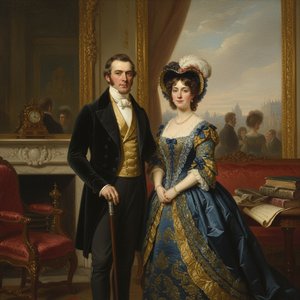
A Life in Light and Oil
Born in New York City in 1830, Israel Quick occupied a space where the precision of the lens met the texture of the brush. He was a man of two disciplines, working as both a painter and a photographer during a century that saw the rapid evolution of visual documentation. His life spanned the mid-to-late nineteenth century, a period when the art of capturing a likeness was undergoing a profound transformation. He moved through the American landscape, eventually finding a place within the artistic circles of Ohio.
His dual vocation suggests a mind preoccupied with the mechanics of seeing. While photography offered a new, mechanical way to freeze a moment, painting allowed for a more deliberate, tactile interpretation of the subject. This intersection of mediums defined his professional identity, as he navigated the technical demands of the darkroom and the expressive possibilities of the canvas.
The Art of the Likeness
Quick’s output was largely centered on the human form, specifically through the medium of oil on canvas. His work often focused on the individual, seeking to capture the specific character of his sitters through careful observation. His technical approach was grounded in the traditions of portraiture, aiming to translate the physical presence of a person into a permanent, painted record.
His portfolio includes several notable subjects and studies, such as:
- The portrait of John Humphreys Tate, painted in 1892.
- A portrait of a young boy.
These works demonstrate a commitment to the formal qualities of portraiture. In his 1892 depiction of John Humphreys Tate, Quick utilized oil to establish a sense of permanence, a task that required a deep understanding of light and shadow to define the subject's features.
A Quiet Legacy
By the time of his death in 1901, Quick had established a body of work that remains held in institutional collections. His pieces have found their way into the care of the University of Cincinnati Fine Arts Collection, ensuring that his technical contributions to American portraiture are preserved. He did not seek to overturn the established order of art, but rather to master the tools of his era, whether they were made of pigment or light.
His significance lies in this quiet mastery of the likeness. He belonged to a generation of American artists who bridged the gap between the old world of manual painting and the new world of photographic reality, leaving behind a record of the faces and figures of his time.
Klausimai ir atsakymai
Ar galiu ieškoti Israel Quick kūrinių pagal raktažodžius?
Israel Quick kūrybą galima tyrinėti pagal raktažodžius tame šio autoriaus Raktažodžiais puslapyje. Kiekvienas raktažodis sugrupuoja susijusią kūrybinę veiklą.
Iš kokios šalies yra Israel Quick?
Israel Quick gimė United States.
Kur galima rasti Israel Quick kūrybą, suskirstytą pagal meno kryptis?
Israel Quick kūrybą pagal stilių galima peržiūrėti puslapio Visi meno kryptys skiltyje.
Kur galiu pamatyti Israel Quick kūrybos spalvų profilį?
Israel Quick darbų spalvų naudojimą, pateikiamus ši ši internetinė svetainė, galima išstudizuoti puslapyje Paletės genomas.