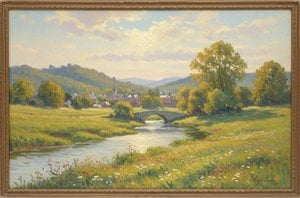
The Impressionist Precision of Harry Lips
To look at the work of Harry Lips is to see a specific, grounded response to the shifting landscapes of mid-century Europe. He was a painter who understood the weight of light and the structure of terrain, moving beyond mere observation to capture the essence of a place through an impressionist lens. His career was shaped by the physical displacement of war, a reality that forced a transition from the urban energy of Rotterdam to the more settled, topographical concerns of Maastricht. This move was not a retreat but a redirection of his gaze.
His technical approach relied on the immediate, tactile quality of oil on canvas. He did not rely on artifice; instead, he used the medium to define the ruggedness of a coastline or the quietude of a mountain range. His work possesses a directness that avoids unnecessary ornamentation, focusing instead on the interplay of light and shadow across a landscape. He was a painter of specific locales, finding his subject matter in the natural world rather than the abstract.
A Life Defined by Displacement and Place
The trajectory of Lips's life was dictated by the geopolitical realities of the 1940s. His development as an artist was rooted in formal training and the necessity of relocation. His output reflects a man who found stability in the study of the earth and the sea.
- Education at the Rotterdam Academy of Fine Arts.
- Relocation to Maastricht following the 1940 bombing of Rotterdam.
- Collaborative studio life with Henk Sitskoorn and Jan Vink.
- Exhibition history including the Bonnefanten Museum, Stedelijke Museum Amsterdam, and Panorama Mesdag Museum.
His subjects were not limited to the Dutch landscape. He expanded his scope to include the Breton coast and the Spanish mountains, proving that his impressionist method was adaptable to different climates and light conditions. Whether painting the Limburg landscape or the ruggedness of Spain, the intent remained the same: to record the physical reality of the world through a controlled, painterly hand.
The Tangible Legacy of a Maastricht Artist
Lips remains a significant figure for those studying the regional evolution of Dutch impressionism. His presence in major collections, such as the Bonnefanten Museum, confirms his standing within the canon of mid-century Dutch art. He did not seek to reinvent the wheel; he sought to master the light as it hit the canvas. His work is characterized by a certain honesty in its execution, a refusal to overstate the emotional weight of a scene in favor of a precise, visual truth.
His paintings, such as his 1971 oil works, demonstrate a mature command of composition and color. He left behind a body of work that serves as a visual record of the landscapes he encountered, from the ports of Rotterdam to the mountains of Spain. He died in Maastricht, leaving a legacy defined by the steady, disciplined application of oil paint to canvas.
Klausimai ir atsakymai
Kaip Harry Lips karjera skirstoma į laikotarpius?
Harry Lips karjera puslapyje Karieros istorija atskleidžiama etapais: tai horizontali kūrybos darbų laiko linija, suskirstyta į karjeros periodų skyrius.
Kokie kiti Harry Lips vardai yra žinomi?
Harry Lips taip pat žinomas (žinoma) kaip Hendrikus Jacobus Lips.
Ar galiu ieškoti Harry Lips kūrinių pagal raktažodžius?
Harry Lips kūrybą galima tyrinėti pagal raktažodžius tame šio autoriaus Raktažodžiais puslapyje. Kiekvienas raktažodis sugrupuoja susijusią kūrybinę veiklą.
Kur galiu rasti statistiką apie Harry Lips kūrybinę veiklą?
Statistika apie Harry Lips kūrybinį veiklą galima rasti puslapyje Statistika.