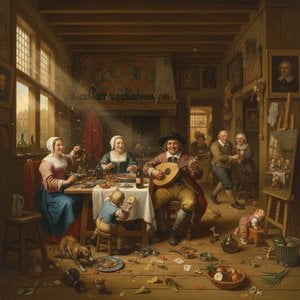
The Luminous Legacy of Hans Bollongier
In the heart of the Dutch Golden Age, a period defined by unparalleled prosperity and an explosion of creative genius, the name Hans Bollongier—often known as Jan Bollongier—resonates with the delicate fragrance of a spring morning. Born in the vibrant city of Haarlem around 1600, Bollongier emerged as a master of the floral still life, a genre that allowed him to capture the fleeting essence of nature with breathtaking precision. Though his life was tragically brief, ending at approximately forty-five years of age, he left behind a body of work that serves as a window into the soul of seventeenth-century Netherlands. His artistry was not merely about decoration; it was an exploration of texture, light, and the profound beauty found in the ephemeral.
The foundations of Bollong and his technique were laid through rigorous training under the esteemed painters Hendrick van Balen I and II. These mentors were champions of the Baroque style, a movement that thrived on dramatic contrasts and opulent detail. From them, Bollongier inherited a profound understanding of chiaroscuro—the masterful manipulation of light and shadow to create depth and atmosphere. This training allowed him to transcend simple botanical illustration, transforming a mere bouquet into a theatrical event where every petal seemed to catch a stray beam of sunlight against a moody, darkened background.
A Symphony of Petals and Symbolism
To gaze upon a Bollongier masterpiece is to enter a world of sensory richness. His compositions often feature exquisite arrangements of tulips, roses, anemones, and carnations, meticulously rendered to showcase the subtle veins of a petal or the dewy moisture on a stem. Yet, beneath this surface-level beauty lies a deeper, more contemplative layer of meaning. During his era, the Dutch tulip mania had left a lasting mark on the collective psyche; thus, his vibrant bouquets often served as vanitas symbols—reminders of the transience of earthly life and the inevitability of decay. By painting flowers that bloom at different times of the year in a single, impossible arrangement, he captured a sense of eternal perfection that exists only within the realm of art.
His technical prowess is perhaps most evident in works such as "Flower Piece" and "Still Life with Flowers." In these canvases, one can observe:
- Meticulous Realism: A commitment to portraying the natural world exactly as it appeared, avoiding idealized forms in favor of authentic textures.
- Atmospheric Depth: The use of dark, earthy tones to push the vibrant reds, whites, and yellows of the blossoms toward the viewer.
- Narrative Details: The inclusion of small, often overlooked elements like snails or insects, which add a layer of biological realism and reinforce the theme of life's cycle.
Historical Significance and Lasting Influence
Bollongier’s impact extended far beyond his own lifetime. As a prominent member of the Haarlem Guild of St. Luke, he was part of a flourishing community of artists that included luminaries like Johannes Vermeer. While his direct collaborations with such masters are subjects of scholarly fascination, the stylistic currents of Haarlem undoubtedly flowed through his brush. His ability to marry the scientific accuracy of botanical study with the emotional weight of the Baroque movement made him an essential figure in the evolution of Dutch genre painting.
His influence can be traced through the lineage of later flower painters, providing a blueprint for artists who sought to balance scientific observation with artistic drama. Today, his works reside in prestigious institutions such as the Frans Halsmuseum and the Rijksmuseum, where they continue to enchant modern audiences. Hans Bollongier remains a testament to the power of the small-scale masterpiece—a painter who, through the humble medium of a flower vase, captured the magnificent, fleeting splendor of an entire era.
Klausimai ir atsakymai
Kiek Hans Bollongier (Jan Bollongier) kūrinių galima peržiūrėti?
Visi kūriniai puslapio kataloge galite peržiūrėti 11 kūriniai kūrinius, autoriaus: Hans Bollongier (Jan Bollongier).
Kaip laikui bėgant evoliucionavo Hans Bollongier (Jan Bollongier) kūryba?
Hans Bollongier (Jan Bollongier) Karieros istorija – tai vartojimo metu judanti laiko linija, kurioje kūrybos darbai pateikiami chronologine tvarka, suskirstyti į karjeros periodų skyrius.
Kur galima rasti Hans Bollongier (Jan Bollongier) kūrybos darbų grupavimą pagal techniką?
Hans Bollongier (Jan Bollongier) darbus pagal technikas galima peržiūrėti jo/jos puslapio Visi mediai skiltyje.